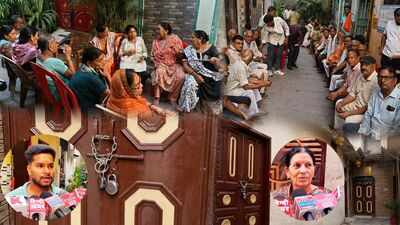
Ratnagiri, Maharashtra witnessed a prompt compliance action when unauthorised banners were removed from the premises of the District Government Hospital following a formal representation by the Hindu Rashtra Samanvay Samiti. The hospital administration’s response underscores a core civic principle: public health institutions must remain neutral, safe, and welcoming to all, regardless of belief, background, or community affiliation.
Government hospitals are shared spaces where life-saving care is delivered under pressing conditions. Neutrality in such environments is not merely symbolic; it is fundamental to patient trust, clinical focus, and the equitable delivery of services. When public property is used without sanction for banners or promotions, even with benign intent, it risks diluting the hospital’s duty to provide a calm, non-partisan, and non-sectarian setting.
The event emerged from a procedural path familiar in civic administration: a citizen grouphere, the Hindu Rashtra Samanvay Samitisubmitted a formal representation noting the presence of unauthorised banners. Such representations are a legitimate instrument of participatory governance. They prompt verification, documentation, and, if warranted by law and policy, corrective measures by the competent authority.
From a regulatory standpoint, unauthorised banners on public premises typically contravene municipal by-laws and the Bombay Prevention of Defacement of Property Act, 1995. Across Maharashtra, outdoor signagebanners, hoardings, posters, and flexrequires prior permission from the local authority and, where the property is a government facility, additional clearance from the institutional head or designated officer. Absent such permissions, removal is standard procedure, and repeat violations can trigger penalties under applicable statutes.
Beyond permission, location and content controls apply. Safety-critical zonesemergency departments, triage bays, fire exits, ambulance bays, stairwells, and evacuation routesmust remain free from visual clutter. Signage that obscures statutory information, emergency wayfinding, or infection-control advisories undermines operational readiness and can constitute a hazard during mass-casualty or disaster response.
The Bombay Prevention of Defacement of Property Act, 1995 provides the overarching prohibition against defacement of public property, which includes unauthorized pasting, hanging, or exhibiting materials on government buildings. Violations may attract fines and, in certain cases, prosecution, with the local body empowered to remove offending materials and recover costs from responsible parties.
Professional conduct frameworks add a complementary layer. The National Medical Commission’s professional codesbuilding on the earlier Medical Council of India regimediscourage promotional or misleading advertising in medical contexts. While these ethical regulations primarily address medical practitioners and institutions, their spirit supports a non-promotional, patient-first environment within government facilities.
Clinical governance also intersects with facilities management. Banners made of flex or fabric can disrupt airflow, hamper cleaning, and complicate infection-prevention protocols. In fire safety planning, combustible materials near electrical fixtures or crowded corridors increase risk. Removal of unauthorised materials is therefore not only a legal necessity but also a clinical safety imperative.
Administratively, the pathway generally involves registering the complaint, conducting an on-site inspection, photographing and inventorying the materials, checking permission records, issuing a brief notice when appropriate, and executing removal under supervisory oversight. A concise file note and post-action documentation preserve transparency, deter recurrence, and protect the decision-making trail.
Transparency benefits all stakeholders. When hospitals publish a simple “signage and display policy” on notice boards and institutional websiteswhat is permitted, where, by whom, and with what approvalscitizens gain clarity, staff gain operational confidence, and community groups can align their civic energy with the rule of law.
Citizen participationwhether by formal representations, social audits, or constructive dialogueworks best when it is principled, non-confrontational, and anchored in public interest. In this Ratnagiri instance, the complaint functioned as a catalyst for lawful course correction. The result reinforces that lawful oversight, when exercised responsibly, strengthens public institutions for everyone.
Courts and regulators across India have repeatedly urged strict action against illegal hoardings and unauthorised displays on public property. In Maharashtra specifically, periodic enforcement drivesespecially after safety incidentshave intensified scrutiny over unsanctioned outdoor advertising. The trajectory is clear: local bodies and public institutions are expected to maintain clean, compliant, and safe premises.
It is important to distinguish between permitted institutional signagepatient rights charters, treatment protocols, emergency wayfinding, and government program informationand non-institutional banners that advertise external events, make political or sectarian appeals, or promote private interests. The latter generally require explicit permissions and are commonly disallowed within functional hospital zones.
Public neutrality also advances dharmic harmony. A government hospital that keeps its spaces free of sectarian or promotional messaging provides equal dignity and comfort to Hindus, Buddhists, Jains, and Sikhs alike, reflecting India’s ethos of pluralism and mutual respect. Such neutrality turns the hospital into a sanctuary of health where shared civic values supersede identity markers.
For many families waiting outside emergency rooms, visual clutter and unsolicited messaging can heighten stress. Clear corridors, legible medical information, and unobstructed emergency signage have a calming effect, allowing caregivers and patients to focus on what matters mosttimely, compassionate care.
A practical compliance blueprint for hospitals that wish to prevent recurrence includes five pillars: a codified signage policy covering permissions, placements, and durations; a zoning plan that keeps clinical, emergency, and evacuation areas free of non-clinical displays; a single-window e-permission workflow integrated with municipal by-laws; scheduled audits tied to infection control and fire safety rounds; and a clear takedown protocol with cost recovery for violations.
Measuring impact can be straightforward. Facilities can monitor complaint volumes, time-to-remove for unauthorised materials, audit compliance scores, and qualitative patient feedback about wayfinding and perceived orderliness. Such metrics feed continuous improvement, linking everyday facilities management to tangible gains in patient experience and safety.
Digitisation strengthens governance. Publishing permissions, durations, and contact points online (consistent with proactive disclosure obligations) reduces ambiguity and curtails misuse. Open data on removalssummarised without sensitive identifiersencourages deterrence and signals that institutional standards are applied uniformly.
Community charters can complement rules. When local groups, civil society, and hospital administrators co-create a concise charteraffirming safety, neutrality, non-obstruction, and respect for all communitiesenforcement becomes easier and consensus-driven. Festival-related messaging or community announcements can be channelled to designated public community boards outside clinical zones, curated to remain informational and inclusive.
The Ratnagiri action demonstrates a valuable equilibrium: a lawful citizen complaint, a measured administrative response, and a result that advances safety, neutrality, and harmony. Replicated thoughtfully, such practices protect the integrity of public institutions while nurturing unity across dharmic traditions and beyond. In a space dedicated to healing, the clearest message should always be care, competence, and the quiet confidence of rule of law.
Inspired by this post on Hindu Jagruti Samiti.