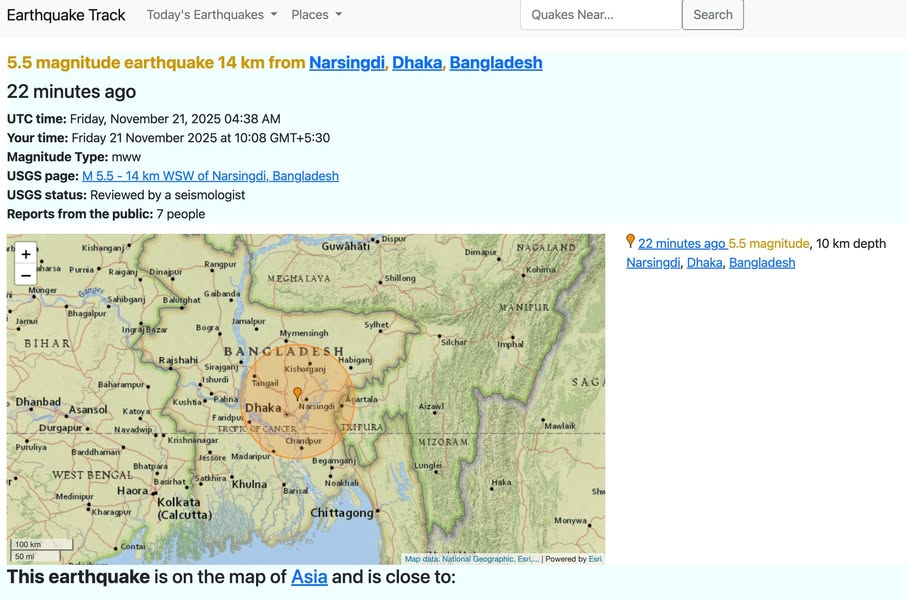
At approximately 10:08–10:10 am IST, mild tremors were felt in Mayapur and across parts of West Bengal following a magnitude 5.5 earthquake centered near Narsingdi, Bangladesh, roughly 300 kilometers from Mayapur. Shaking lasted only a few seconds but was widely noticed in Kolkata, Malda, Nadia, Cooch Behar, and several other districts.
Preliminary reports from regional sources indicate at least three fatalities and multiple injuries in Bangladesh. As of initial assessments, no significant damage has been reported in Mayapur. Residents in affected areas described gentle swaying, brief rattling of windows, and a momentary pause before routine activities resumed.
Seismologically, the Ganga-Brahmaputra basin’s soft alluvial soils enable moderate earthquakes to be felt over long distances despite limited localized impact. The epicentral area near Narsingdi lies within a complex tectonic setting, which helps explain the broad distribution of felt intensity across West Bengal.
Community networks responded with measured calmchecking on neighbors, elders, and students while sharing verified updates from the India Meteorological Department (IMD) and the Bangladesh Meteorological Department (BMD). Across the region, established bonds among temples, viharas, gurdwaras, and Jain sanghas foster a culture of mutual care that strengthens resilience during brief but unsettling seismic activity.
Standard safety guidance includes: drop, cover, and hold on; remain away from glass and unsecured shelves; avoid elevators during and immediately after shaking; once the tremor stops, check for hazards and visible structural cracks; anticipate aftershocks; and rely on official advisories from IMD, BMD, and local administration. Maintaining a small emergency kit with water, a torch, essential medicines, and key contacts further enhances preparedness.
Moments like these underscore a shared commitment to compassion and preparedness across dharmic traditionsHindu, Buddhist, Jain, and Sikh. Nurturing unity in spiritual diversity supports practical cooperation, attentive neighborliness, and community-wide readiness when tremors ripple through the region.
Details presented here reflect early information and may be refined as agencies release shakemaps and impact assessments. Subsequent updates will align with verified data from IMD, BMD, and district authorities.
Inspired by this post on Dandavats.