
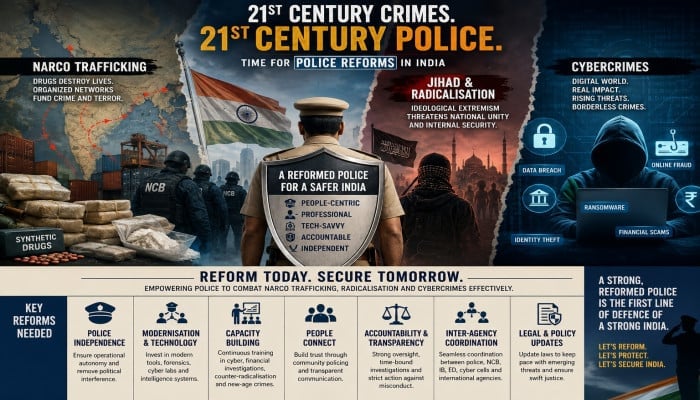
India’s internal security debate can no longer be confined to older images of policing: a station house, a district boundary, a constable with a lathi, and a criminal operating within visible geography. The contemporary battlespace has moved into encrypted chats, cryptocurrency wallets, offshore call centres, drone corridors, synthetic media, narco-finance networks, and transnational terror ecosystems. This shift does not merely demand better equipment. It demands a redesigned police institution capable of protecting a digital, mobile, and strategically targeted Bharat.
The central problem is structural. The Police Act of 1861 emerged from a colonial administrative logic designed for a largely rural and pre-industrial society. Its institutional assumptions were about crowd control, local order, property enforcement, and district-level command. That framework is now being asked to respond to cybercrime syndicates operating from Southeast Asia, narcotics pushed across borders through drones and maritime routes, terror financing routed through hawala and crypto assets, and radicalisation pathways shaped by encrypted platforms and algorithmic targeting.
This mismatch is visible in the daily experience of citizens. A family may lose its savings to a deepfake-enabled investment scam before the local police station understands which platform, wallet, bank layer, or foreign server must be traced. A young person in a border state may be pulled into addiction through narcotics supply chains that are also linked to terrorist financing. A police investigator may face a crime scene that is not a street or a house but a cloud account, a blockchain trail, a compromised SIM card, and a disappearing digital identity. These are not future scenarios. They are already part of India’s security environment.
The first major threat is the cybercrime surge. The National Cybercrime Reporting Portal has recorded an extraordinary rise in complaints, with reported cybercrime complaints increasing from tens of thousands in 2019 to more than fifteen lakh in 2023. Between January and April 2024 alone, roughly 7.41 lakh complaints were registered. Financial losses have also grown sharply, with Indians losing significant sums to online fraud, fake digital identities, fraudulent domains, OTP theft, investment scams, and so-called digital arrest operations.
The nature of cybercrime has changed from isolated phishing attempts to an organised service economy. Cybercrime-as-a-Service allows scam factories, often operating from outside India, to target Indian citizens at scale. Deepfake tools now enable impersonation of relatives, officials, and corporate leaders. Cryptocurrency laundering complicates recovery and attribution. State-linked cyber operations create additional risks for defence, financial systems, and critical infrastructure. India’s progress through institutions such as the Indian Cybercrime Coordination Centre, CERT-In, and the Defence Cyber Agency is significant, but state police capability remains uneven and often insufficient for first-response investigation.
The second threat is narco-terrorism, where narcotics are not treated merely as contraband but as strategic instruments. India’s geography places it between the Golden Crescent and the Golden Triangle, two major narcotics-producing regions. This geography creates persistent vulnerability across Punjab, Jammu and Kashmir, the Northeast, coastal routes, and urban distribution networks. Drug seizures worth thousands of crores demonstrate both stronger enforcement and the scale of the trafficking challenge.
Narco-terrorism works through three linked mechanisms. It generates finance for extremist and terrorist networks. It weakens vulnerable communities through addiction, especially in border regions. It allows weapons, communication channels, and logistics to be hidden inside trafficking ecosystems. When drones drop narcotics and weapons near sensitive borders, the police problem becomes simultaneously a border security issue, a public health issue, a financial intelligence issue, and a counterterrorism issue.
The third threat is externally supported terrorism and hybrid warfare. Contemporary extremist networks do not depend only on physical infiltration. They use encrypted messaging, digital propaganda, shell entities, hawala channels, real estate holdings, and increasingly, cryptocurrency. The challenge is not to stigmatise any religious community; it is to identify violent networks that misuse religious language for recruitment, financing, and coercion. A plural society committed to Hindu, Buddhist, Jain, Sikh, and broader dharmic civilisational harmony must distinguish clearly between ordinary faith communities and organised violence.
The experience of terrorism in India shows that first responders matter. A local police officer may be the first state representative to notice suspicious movement, unusual financial patterns, extremist content circulation, or sudden local mobilisation. Yet effective recognition requires training in intelligence indicators, digital evidence, legal procedure, community-sensitive policing, and inter-agency coordination. Without this capacity, early warning signals remain scattered across police stations, intelligence files, financial databases, and central agencies.
The fourth threat is the new economy crime frontier. Platform-enabled crime now includes dark-web narcotics markets, offshore gambling networks, synthetic identity fraud, online trafficking, AI-generated extortion, and financial crimes routed through complex corporate and digital layers. Traditional policing was built around place: the village, the town, the district, the state. Modern crime is built around networks. A criminal may recruit in one state, host data abroad, receive payment through a digital wallet, launder proceeds through crypto assets, and exploit victims across multiple jurisdictions.
Therefore, police reform must begin with specialist cadres. A generalist constabulary cannot be expected to master blockchain analytics, digital forensics, counter-radicalisation indicators, financial intelligence, controlled deliveries, drone forensics, and platform compliance procedures. India needs dedicated career tracks for cybercrime investigation, financial crime and anti-money laundering, counterterrorism intelligence, narcotics investigation, and forensic science. These tracks should include promotion pathways, continuing education, operational autonomy, and technical partnerships with universities and industry.
Forensic infrastructure is the second pillar. The Bharatiya Nagarik Suraksha Sanhita places greater emphasis on forensic examination for serious offences, but a legal mandate cannot function without laboratories, trained scientists, sample management systems, and reliable timelines. Backlogs weaken prosecution and public trust. A National Forensic Science Mission with shared infrastructure, regional laboratories, mobile forensic units, and expert deployment protocols would make criminal justice more credible and technically resilient.
Technology must be treated as core infrastructure, not an optional add-on. Systems such as the Crime and Criminal Tracking Network System and the Interoperable Criminal Justice System represent important foundations. The next stage should include AI-assisted FIR analysis, real-time pattern detection, lawful facial recognition and biometric use under judicial oversight, encrypted inter-agency communication, and secure data-sharing among state police, NIA, IB, NCB, ED, border agencies, and financial intelligence units. Oversight is essential, because technological policing without constitutional safeguards can damage liberty and legitimacy.
Human capital is equally important. India’s police-to-population ratio remains below ideal levels, and actual field strength is further reduced by vacancies, administrative duties, VIP deployments, and uneven training. Recruitment expansion is necessary, but numbers alone will not solve the crisis. Higher educational standards, specialised lateral entry, psychometric screening, constitutional values training, language skills, cyber literacy, and better compensation are central to building a professional police force. The dignity of honest police work must be matched by institutional support.
Legal reform is the fifth requirement. The Bharatiya Nyaya Sanhita has taken steps by recognising terrorism, organised crime, mob lynching, and digital evidence within the criminal justice framework. However, cybercrime and AI-enabled offences require more precise treatment. India needs stronger rules on platform cooperation, cross-border data access, synthetic media misuse, crypto-linked money laundering, and repeat offender databases that function across state boundaries while respecting due process.
International examples offer useful lessons without requiring blind imitation. The United Kingdom’s National Crime Agency separates certain specialised organised crime, cyber, and economic crime functions from ordinary territorial policing. The United States uses fusion centres for intelligence sharing among federal, state, and local agencies. Israel integrates police, border security, military intelligence, and civilian intelligence through structured coordination. India’s Multi-Agency Centre and state-level Subsidiary Multi-Agency Centres point in a similar direction, but they require stronger staffing, clearer legal authority, and operational accountability.
Police reform also has a civilisational dimension. A confident Bharat cannot protect cultural continuity, social harmony, economic growth, and national sovereignty through outdated security institutions. Communities that value dharma, justice, restraint, and social order have a direct stake in professional policing. Weak policing harms the poor first, because they have the least ability to recover from fraud, narcotics, intimidation, communal violence, or procedural delay. Reform is therefore not only a security agenda; it is a justice agenda.
The most difficult reform is political. A modern police force requires operational independence, accountable leadership, protection from arbitrary transfers, transparent performance metrics, and insulation from partisan pressure. This does not mean police should become unaccountable. It means accountability must be legal, institutional, and constitutional rather than informal, electoral, or patronage-driven. A police force dependent on political favour cannot reliably investigate organised crime, terror financing, or local networks protected by influence.
The security choice before India is stark. Reform may be administratively difficult, fiscally demanding, and politically uncomfortable. Non-reform is more costly. It leaves citizens exposed to digital fraud, border communities exposed to narcotics, cities exposed to sleeper networks, and the economy exposed to organised criminal innovation. A Viksit Bharat requires not only highways, digital payments, satellites, and manufacturing strength, but also a police institution able to defend the society that those achievements are meant to serve.
The principle of Nyaya requires more than new statutes. It requires institutions capable of delivering justice with speed, technical competence, fairness, and constitutional restraint. The old policing model was designed for another age. The new battlespace is already here. India’s task is to build a 21st-century police force before the distance between threat and response becomes a strategic vulnerability.
Inspired by this post on Hindu Post.







Leave a Reply
You must be logged in to post a comment.