
Across most industries, risk and capital move together. Entrepreneurs assume uncertainty and deploy capitalfinancial, intellectual, and humanto reduce, share, or price that risk. When incentives align, value chains become resilient and participants are rewarded in proportion to the risks they bear.
Where there is risk, there is capital. Financial capital encompasses loans and funds; intellectual capital includes designs, data, and methods (for instance, proprietary formulations or new business models); human capital reflects skills, know-how, and productivity. Balanced systems match these forms of capital to the points of greatest uncertainty, creating a fair distribution of outcomes.
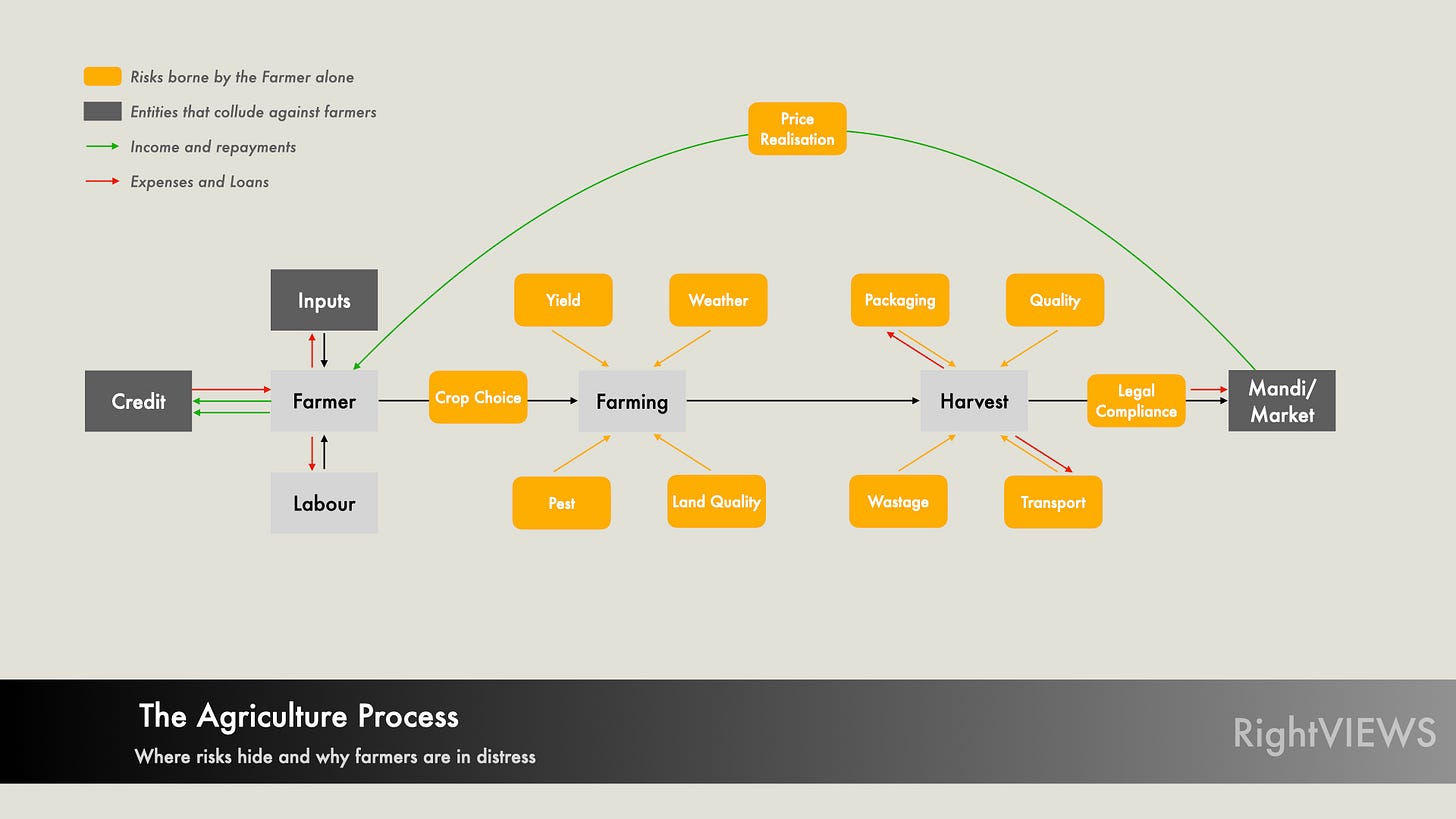
Agriculture is differentit is misaligned. The farmer absorbs the overwhelming share of production, climate, biological, price, and policy risk, while many upstream and downstream actorscreditors, input suppliers, aggregators, and buyersoften operate with safeguards that shift volatility away from themselves. This structural imbalance leaves smallholders exposed to shocks they cannot hedge, finance, or influence.
A comparative view underscores the pattern. In developed agricultural markets, explicit collusion is less prevalent, yet the underlying risk burden remains concentrated on farmers. Decades of global agricultural development have emphasized yields and on-farm productivity, but without commensurate investments in risk-sharing mechanisms, post-harvest systems, and market governance, productivity gains alone cannot stabilize farm incomes.
Field observations and stakeholder interviews consistently reveal the human cost of misalignment. A bumper harvest can coincide with a price crash, erasing margins. A timely monsoon may be offset by transport bottlenecks or storage losses. In each scenario, the farmer faces non-negotiable input bills and debt service while bearing uncertainty no single household can prudently shoulder. The lived reality is persistent anxiety over weather windows, market timing, contract reliability, and logistics.
Rebalancing requires institutional support on multiple fronts: evidence-based crop choice and rotation advisories; robust agricultural extension for climate-resilient practices; market synchronization via transparent contracts with enforceable standards; reliable transportation, warehousing, and cold-chain infrastructure; affordable and flexible credit tied to verifiable production and sales data; indexed and event-based insurance; and price-risk tools that are simple enough for smallholders to adopt. Each element spreads risk across the agricultural value chain rather than concentrating it at the farm gate.
Regulatory reform is a critical complement. Transparent price discovery, fair competition, and enforceable contract farming frameworks can reduce market concentration and align incentives among buyers, financiers, and producers. Various policy proposals in India and elsewhere have aimed to improve competition, contract enforceability, and logistics integrationdirections that, if implemented with safeguards and accountability, can strengthen farmer outcomes while preserving market efficiency.
A comprehensive approach can be operationalized through a Smart Agriculture Management System (SAMS)an integrated architecture that connects agronomic advisories, input planning, finance, insurance, logistics, quality standards, and market linkages on a single, auditable workflow. By embedding data-driven decision tools, verifiable contracts, and traceable post-harvest movement, SAMS enables risk to be priced and shared by those best positioned to bear it, rather than defaulting to the farmer.
Community cooperation further strengthens resilience. When producer collectives, cooperatives, and agri-enterprises cultivate a culture of shared stewardship and mutual supportvalues common across dharmic traditionsknowledge spreads faster, bargaining power improves, and local safety nets deepen. Such solidarity reduces fragmentation, builds trust, and unifies diverse stakeholders around the common goals of food security and rural prosperity.
Without integrated reformcombining risk-sharing finance, enforceable contracts, market transparency, and post-harvest infrastructureagriculture will remain a high-risk, low-return enterprise for farmers. Aligning risk and capital across the value chain is the essential breakthrough that can transform agriculture from a precarious livelihood into a stable, wealth-creating sector.
Inspired by this post on RightViews.











