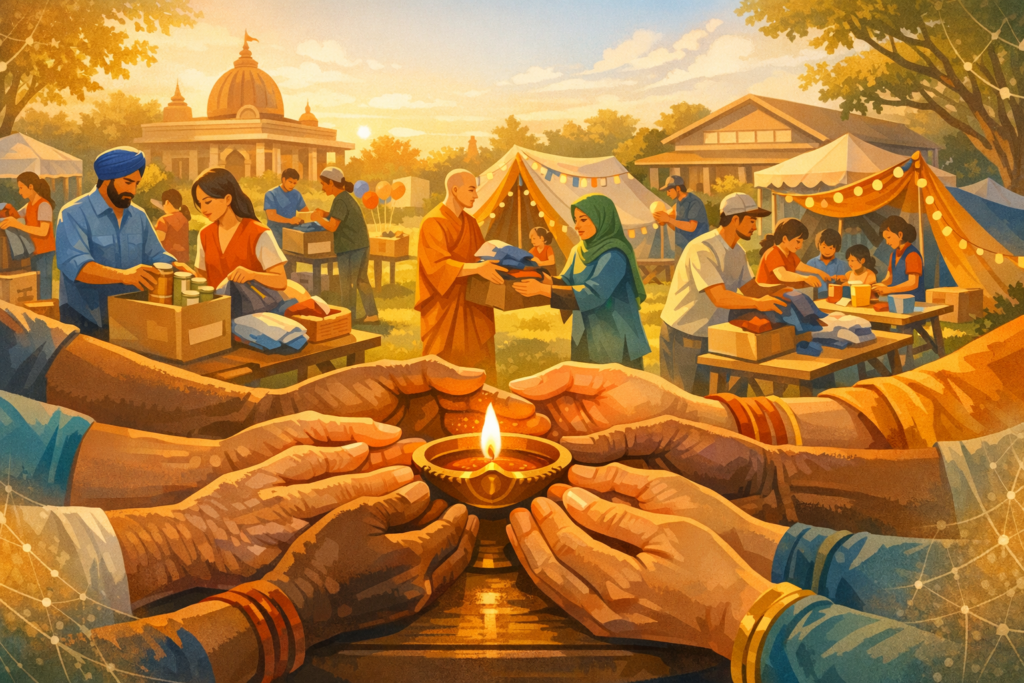
The question of whether end-of-life experiences are genuine deathbed visitations or mere hallucinations has engaged seekers and scholars across civilizations. Within Hinduism and the broader Dharmic family of Buddhism, Jainism, and Sikhism, the final moments are regarded as a sacred transition, inviting careful discernment and deep compassion. This exploration sets out clear distinctions, draws on scriptural insights, and aligns with contemporary hospice observations, all while honoring unity among dharmic traditions.
In academic terms, deathbed visitations refer to perceived encounters with ancestors (pitṛs), gurus, devas, or one’s Ishta Devata that are coherent, calming, and aligned with the person’s moral-spiritual life. Hallucinations, by contrast, are perceptions without external stimuli that frequently arise from physiological or pharmacological factors such as fever, hypoxia, or certain medications. Dharmic traditions accept that consciousness (caitanya) is profound and not reducible to neurochemistry alone, yet they also encourage viveka (discernment) when interpreting such phenomena.
Hindu texts describe the close of life as a subtle reorganization of prāṇa and the antahkaraṇa (the inner instrument comprising manas, buddhi, ahaṅkāra, and citta). The Bhagavad-Gita (8.5–6) emphasizes the significance of remembrance (smaraṇa) at the last moment, suggesting that the tendencies (saṁskāras) and cherished devotion can shape the experience of departing consciousness. The Upanishads similarly highlight the journey of the jīva and the abiding reality of ātman, grounding a framework in which meaningful visions at death are neither anomalous nor trivialized.
From this perspective, visitations often carry features of darśana: a serene presence of one’s Ishta Devata, revered guru, or pitṛs, accompanied by moral clarity, reassurance, and a peaceful affect. These experiences tend to be coherent, consistent with the person’s lifelong practice, and sometimes yield veridical details later corroborated by family. By contrast, delirium-driven hallucinations often present as agitating, fragmented, fearful, or disorganized, lacking enduring solace or alignment with the individual’s established spiritual outlook.
While uniquely Hindu in its formulations of karma and reincarnation (punarjanma) and its aim of moksha, the broader Dharmic horizon offers strong convergences. In Buddhism, mindful dying, metta (loving-kindness), and teachings on transitional states encourage compassionate clarity. Jainism emphasizes ahiṁsā, pratikraman, and samayik, cultivating equanimity and non-attachment at life’s end. Sikh thought centers on Hukam and the power of Naam Simran (e.g., the remembrance of Waheguru), affirming the Divine presence with dignity and grace. Across these paths, unity arises in honoring a peaceful, lucid transition and refusing to impose a singular route to the sacred.
Phenomenologically, several markers can help differentiate likely visitations from probable hallucinations: sustained calm rather than agitation; meaningful, value-aligned content rather than random distortions; coherence across time; an uplifting or reconciliatory tone; and, on occasion, new information later verified. These markers are not infallible, but they guide compassionate interpretation consistent with Hindu beliefs and the wider Dharmic ethos.
Contemporary hospice observations, including studies on end-of-life dreams and visions, report that many patients—lucid and oriented—describe comforting encounters with deceased relatives or spiritual figures near death. Such accounts often correlate with reduced fear and improved acceptance. Dharmic frameworks understand these as possible signs of prāṇa reorientation and the flowering of deep saṁskāras, without denying that physiology can also shape perception.
A balanced Dharmic approach embraces a both-and model: physiological processes and spiritual realities may co-occur. Caregivers can therefore uphold medical diligence—addressing pain, hypoxia, infection, or medication effects—while simultaneously honoring experiences that appear ethically elevating, peaceful, and consonant with a lifetime of practice. This integrative stance reflects the Hindu philosophy of unity in diversity and encourages humility in the face of life’s most profound threshold.
Practical guidance for families and caregivers includes listening without dismissal, asking gentle clarifying questions, and supporting the person’s chosen path of devotion. Reading from the Bhagavad-Gita, chanting the person’s preferred mantra or stotra, or offering silent presence can nurture serenity. Simple environmental supports—soft light, reduced noise, and familiar sacred images—help sustain focus and ease.
Across traditions, practices may be adapted to the person’s faith and inclination: Gita recitation or japa for Hindus; metta, breath awareness, or recollection of the Buddha’s qualities in Buddhist contexts; pratikraman or samayik for Jains; and Naam Simran and shabad kirtan for Sikhs. The unifying principle is compassionate accompaniment that respects Ishta, acknowledges the sanctity of the moment, and avoids prescriptive imposition.
Ethically, a Dharmic ethos cautions against forcing a singular interpretive lens. Dignity, consent, and reverence are paramount. Where signs suggest delirium or distress, appropriate clinical care should be sought. Where experiences are calm, morally clarifying, and coherent, families may treat them as meaningful without fear of contradiction with medical prudence.
In sum, Hinduism and its Dharmic sister traditions offer a compassionate grammar for understanding the difference between deathbed visitations and hallucinations. The final journey can be met with clarity—grounded in scriptural wisdom, enriched by lived devotion, and informed by contemporary observations—so that the departing and their loved ones find solace, purpose, and unity at life’s most sacred threshold.
Inspired by this post on Hindu Blog.