Hindu wisdom observes a paradox at the heart of modern life: in striving to explain existence, people often forget to experience it. The Hindu way of life directs attention from endless analysis toward lived presence, aligning thought, feeling, and action with dharmaethical living that honors both inner clarity and outer responsibility. This orientation does not reject knowledge; it situates knowledge within an experiential path that values direct awareness, compassionate conduct, and steady practice.
Across the dharmic traditions, a shared insight emerges: life reveals itself most clearly when attention rests in the present. Buddhism emphasizes mindfulness as a disciplined, moment-to-moment awareness; Jainism highlights anekāntavāda (the many-sidedness of truth) and aparigraha (non-grasping) to soften rigid judgments; Sikhism cultivates simran (remembrance) and seva (selfless service) to embody humility and unity. These streams converge in a single currentlive consciously, act ethically, and let experience refine understanding.
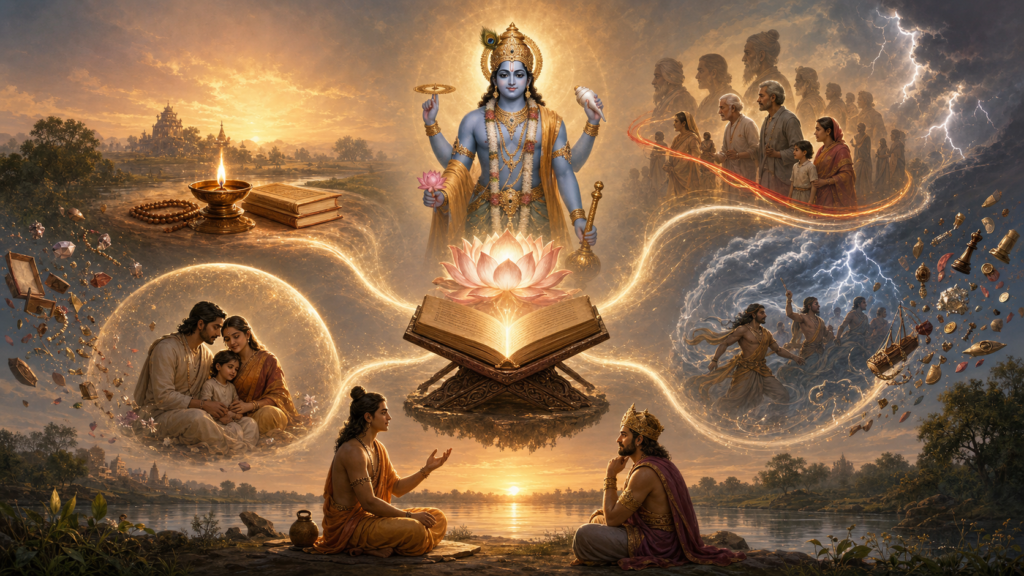
Texts such as the Bhagavad Gita develop this principle through karma yoga: acting wholeheartedly while relinquishing anxiety over outcomes. By releasing fixation on results, action becomes a field for clarity, not a battleground for control. In this mode, even ordinary duties become meaningfulwork, relationships, and service evolve into practices that cultivate presence, resilience, and inner equanimity.
Classical yoga deepens this turn from excessive interpretation to direct awareness. Practices like pratyāhāra (gathering the senses inward), dhyāna (meditation), and cultivation of sakshi-bhāva (witnessing awareness) train the mind to observe rather than overreact. Such training does not negate thought; it refines thought by anchoring it in lived experience, reducing reactivity, and promoting compassionate discernment.
In practical terms, simple daily anchors support this shift. Mindful breathwork stabilizes attention; brief pauses between tasks restore clarity; gratitude and quiet study of the Upanishads or the Gita orient the day toward purpose. When combined with aparigrahaletting go of the urge to possess every answerthese small disciplines open space for insight to arise without force.
This approach also honors emotional reality. Hindu spirituality encourages allowing joy, grief, and uncertainty to appear without immediate classification. In the presence of attentive awareness, emotions become teachers rather than obstacles. Over time, this fosters a steady, compassionate intelligencecapable of acting decisively while remaining open to nuance, a hallmark also affirmed by anekāntavāda.
Unity across dharmic traditions reinforces this ethos of living fully. Mindfulness (Buddhism), non-attachment and plural perspectives (Jainism), remembrance and service (Sikhism), and yoga and dharma (Hinduism) offer complementary methods aimed at the same end: a life of presence, responsibility, and inner freedom. Each path enriches the others, revealing a shared commitment to compassionate action and experiential wisdom.
Ultimately, the invitation is clear: understand by living. Rather than exhaust energy on exhaustive explanations, let awareness inform action and let action refine awareness. This is the strength of the Hindu pathknowledge woven into life, analysis tempered by practice, and meaning discovered in the very act of being present.
Inspired by this post on Hindu Blog.