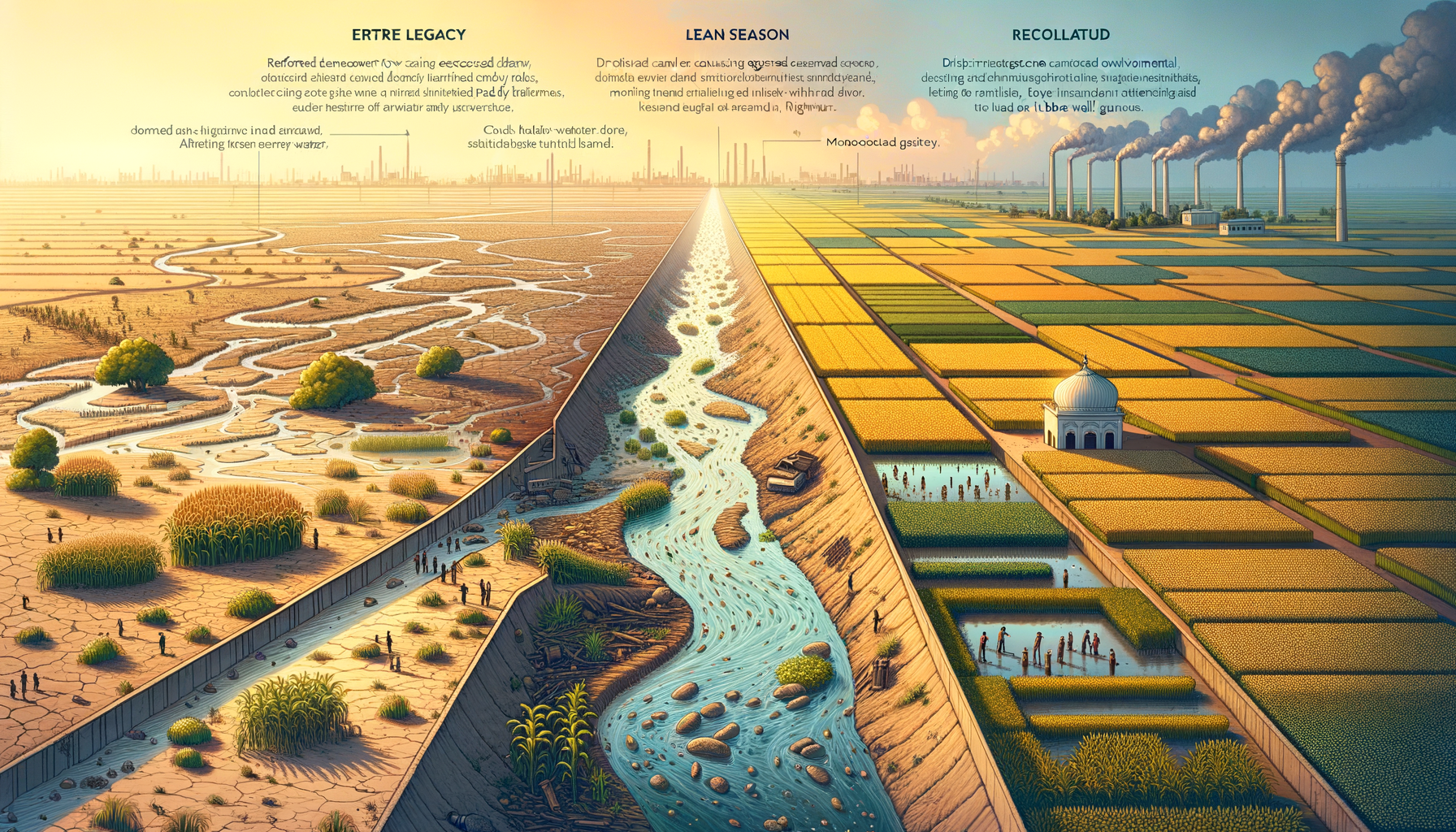
Punjab’s river water crisis is not a sudden emergency but the culmination of layered historical choices, policy misalignments, and ecological stressors that have accumulated over decades. The lived reality across villages and towns reveals a shared sense of grievance: river systems once central to Punjab’s identity now struggle to meet agricultural, ecological, and domestic needs. This analysis traces how these injustices took root and outlines a constructive, unity-affirming path forward that honors the region’s dharmic ethos of stewardship and interdependence.
Historically, British-era canal construction such as the Upper Bari Doab and Sirhind Canals reshaped surface flows, while post-Independence arrangements redistributed waters of the eastern riversRavi, Beas, and Sutlejunder national priorities. The 1960 Indus Waters Treaty allocated the eastern rivers for India’s use, after which inter-state allocations extended supply beyond Punjab to Haryana and Rajasthan. The 1966 reorganization of Punjab and subsequent agreements intensified interstate dependencies. Over time, the Sutlej-Yamuna Link (SYL) dispute came to symbolize competing riparian claims and legal-constitutional tensions, even as the underlying hydrology changed due to overuse and climate variability.
The Green Revolution, while boosting national food security, incentivized paddy-wheat monocultures and heavy groundwater extraction. Tube wells proliferated, and in many blocks groundwater tables declined alarmingly. Communities at the tail end of canal commands frequently reported inequitable deliveries, forcing greater reliance on aquifers. Reports of water quality concernsincluding salinity, agrochemical residues, and pockets with elevated heavy metals and uranium in parts of the Malwa belthave compounded public health anxieties. Urban and industrial effluents, particularly through streams like the Buddha Nullah, further stressed river ecology and wetlands such as Harike, undermining biodiversity and downstream livelihoods.
Ecologically, the Sutlej, Beas, and Ravi systems face reduced lean-season flows, fragmented habitats, and insufficient environmental flow norms. Hydrological variability driven by erratic monsoons and a warming climate heightens flood-drought oscillations, while snow and glacier dynamics in the upper catchments add uncertainty. On the ground, farmers describe wells that once brimmed now requiring deeper drilling, mothers recount the daily calculus of safe drinking water, and elders recall rivers that were cultural arteries as much as they were physical ones. Across faiths and communities, a unifying sentiment recurs: jal is sacred, and caring for it is a shared duty.
Perceived injustices arise from three reinforcing gaps. First, policy design emphasized output targets over resource integrity, effectively exporting virtual water through paddy without commensurate investment in aquifer recharge or crop diversification. Second, regulatory enforcement lagged on pollution control and groundwater governance, leaving vulnerable communities to shoulder health and economic risks. Third, interstate coordination often prioritized allocations over basin-wide resilience, producing recurring conflict rather than cooperative solutions grounded in riparian science and equity.
Interstate dynamicsPunjab, Haryana, and Rajasthan foremostrequire cooperative federalism anchored in transparent data, riparian principles, and adaptive management. Judicial directives and administrative processes have a role, but durable solutions depend on shared basins thinking: river ecology first, community water security next, and agricultural productivity aligned with hydrological limits. Seen this way, the SYL controversy is less a zero-sum contest and more a prompt to reframe the question: how can the eastern rivers be managed so that each state’s legitimate needs are met without exhausting the aquifers or eroding ecological flows?
A pragmatic pathway blends near-term relief with structural reform. Key measures include: (1) accelerated crop diversification with assured procurement and price support for maize, pulses, and oilseeds; (2) micro-irrigation at scale, combined with canal lining and on-farm water budgeting; (3) strict industrial effluent compliance and tertiary treatment upgrades for urban wastewater before discharge; (4) community-led groundwater governance and recharge through check dams, ponds, and managed aquifer recharge; (5) scientifically defined environmental flow norms for the Sutlej-Beas-Ravi system, safeguarding wetlands and biodiversity; and (6) a transparent interstate basin council to harmonize allocations with seasonal availability, climate projections, and ecological thresholds.
Evidence from villages shows that when policy support meets community initiative, results follow. Gurdwaras organizing jal sewa, Hindu, Buddhist, Jain, and Sikh institutions hosting water-health clinics, and farmer cooperatives piloting low-water crops create a foundation for trust. These dharmic traditions converge on a common ethic: protect life by protecting water. Programs that link faith-based stewardship with scientific monitoringrain gauges, water quality testing, and open data dashboardscan turn moral commitment into measurable gains.
Ultimately, Punjab’s river water crisis is both a cautionary tale and an opportunity. It cautions against policies that discount hydrological realities, and it invites a renewal grounded in unity, ecological integrity, and dignified livelihoods. By aligning agricultural policies with basin health, strengthening interstate cooperation, and mobilizing dharmic values for practical stewardship, the region can transform a long tale of injustices into a forward-looking model of resilience for India and beyond.
Inspired by this post on SikhNet – News.