“Most of us spend too much time on the last twenty-four hours and too little on the last six thousand years,” observed Will Durant, capturing the necessity of renewing historical memory. Revisiting a six-millennia arc of Indian history illuminates a maritime civilisation whose cultural footprints extended far beyond the subcontinent, shaping commerce, art, ritual, and sacred geography across regions.
Research by David Frawley in Gods, Sages and Kings and Michel Danino in The Lost River: On the Trail of the Sarasvatī, together with the scholarship of S. Srikanta Sastri, positions the Vedic world within a lived maritime environment. These insights align with a corpus of modern historical studies demonstrating how ancient India sustained seaborne trade and cultural exchange at scale.
From the late nineteenth century through the mid-twentieth century, detailed works consolidated this understanding: Radhakumud Mookerji’s Indian Shipping, R. C. Majumdar’s Classical Accounts of India and Ancient Indian Colonies in the Far East, and Moti Chandra’s Trade and Trade Routes in Ancient India. Complementary anthologies by V. Raghavan and V. S. Agarwala trace the diffusion of Indian artistic, musical, and theatrical traditions abroad.
Three illustrative moments evoke the scale and reach of this world. Pliny the Elder lamented how Rome’s precious metals flowed to India in exchange for Malabar pepper, calling India the “sink of precious metals.”
In the second century CE, a Greek artist engraved an image identified with Bharata Mata on a silver dish at Lampsacos (present-day Lapseki, Turkey). In Bali, Wayang Beberperformed by the Dalangunfurls painted narrative sheets of Ramayana and Mahabharata episodes, preserving Indian epics as living theater.
Nowhere outside India is the cultural imprint denser than in Southeast AsiaBṛhad-Bhārata in historical parlance. As R. C. Majumdar noted, “The Indian colonies in the Far East must ever remain as the high-water mark of maritime and colonial enterprise of the ancient Indians… a new India was established in that far-off region… we find new towns and countries called Ayodhya, Kaushambi, Srikshetra, Dvaravati, Mathura…”
Moti Chandra’s synthesis emphasizes that commerce moved alongside culture. V. S. Agarwala’s foreword evokes that world of movement: “In the travellers besides the merchant community were included monks, pilgrims, pedlars, horse traders, acrobats and actors, students and tourists… Indian travellers by land and sea routes, were also the carriers of Indian story literature.”
In the classical and post-classical eras alike, major Hindu politiesMaurya, Gupta, Rashtrakuta, Chola, and Vijayanagarasustained naval power and maritime presence, entwining state capacity with commercial and cultural horizons.
Subsequent centuries witnessed political transitions and conflict across the Indian Ocean and Central Asia that disrupted earlier patterns. Yet mercantile initiative and dharmic community life adapted and endured. In the sixteenth century, Sindhi Bhatiyas and later Kutchi Banias established themselves in Muscat, Oman, accruing commercial influence, building temples, observing festivals, and maintaining networks that connected port cities to sacred geographies. The Motisvar Temple in Muscatassociated with a nineteenth-century Sindhi Bhatia patron and visited in 2018 by India’s Prime Ministerstands as an emblem of this continuity.
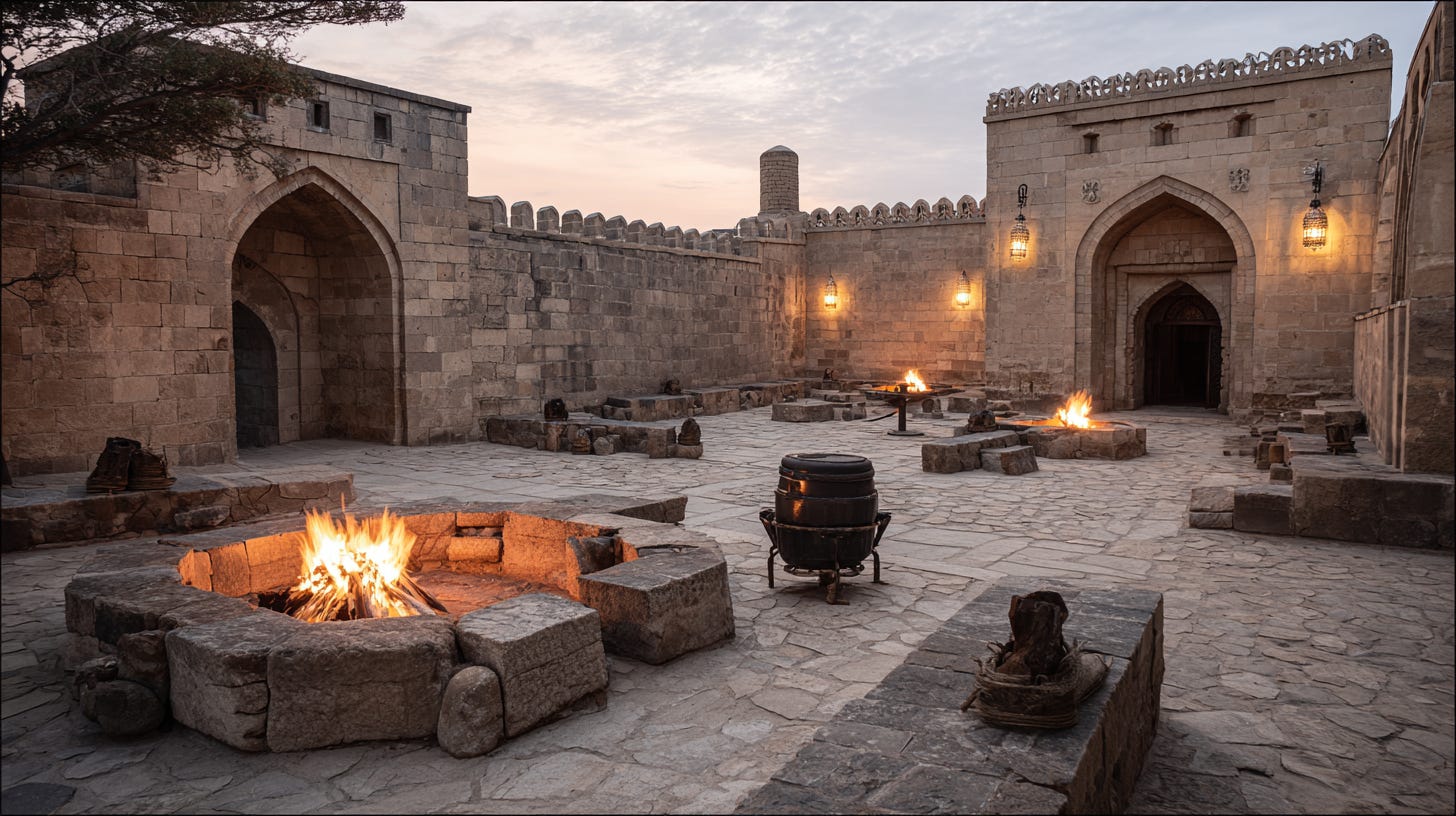
Further northwest, in Baku, Azerbaijan, a resonant testament to this extended sacred geography rose in 1745: the Jvalaji temple, today known as the Ateshgah of Baku. For at least three centuries prior to the Russo-Persian War of 1722, brisk trade connected India to the region. Hindu and Sikh merchants, traders, and bankers lived and worked in Bokhara, Samarkand, and Azerbaijan, and commerce continued despite geopolitical upheavals.
Jvalaji rapidly became a pilgrimage destination. European travelers recorded the devotion of pilgrims who marked their foreheads with saffron and undertook arduous journeys across hostile terrains. One witness described meeting “two Hindu Fakirs” traveling with remarkable resolve, emblematic of a pan-dharmic pilgrimage ethos shared across Hinduism, Buddhism, Jainism, and Sikhisman ethos that prizes perseverance, sacred duty, and compassionate service.
As its name indicates, Jvalaji is a shrine dedicated to Agni. Seven “Sacred Fires” once burned within the temple’s enclosed precinctsthe original Garbha-Grihaechoing the Vedic conception of Agni’s seven “tongues” or flames (Sapta-Jihva). The temple complex preserves 17 inscriptions: 14 in Sanskrit (Nāgari and Dēvanāgari), two in Gurumukhi, and one in Farsi. The earliest inscription invokes Gaṇeśa with the words “śrī gaṇeśāya namaḥ.”, while another composes an elaborate Stuti to Shiva.
P. V. Kane, in his History of Dharmasastra, cites a śloka from the site and discusses the rites performed there. The gistrecited as a moral compass for ritual and givingreads: “In Yajnas, vows, pilgrimages, the feeding of Brahmanas at sacred places, giving sacred offerings to ancestors, in the hands of a mendicant, wealth finds its righteousness.” The presence of such verses in Baku underscores a wider pattern: diaspora communities faithfully carried liturgy, inscriptional practice, and ritual codes wherever they settled.
Devotees connected the Baku Jvalaji to the Jwalamukhi temple in Kangra, a Shakti-Peetha in Himachal Pradesh, regarding Kangra as the Chhota (smaller) Jvala ji and Baku as the Bada (greater) Jvala ji. James Morier, Secretary to the British Embassy in Persia, recorded in 1818 meeting a solitary sadhu in Karadagh returning from Baku to Benaresa poignant portrait of unassisted, resolute pilgrimage that resonates across dharmic traditions.
By the late nineteenth century, colonial rivalries had turned parts of Arabia and Central Asia into theaters of war, prompting many Hindu residents of Baku to leave. The shrine became increasingly associated with Zoroastrian reverence for sacred fire and came to be known as Ateshgah. The name is a Persian compound (“Atesh” for fire and “gah” for place), which some have related etymologically to Sanskrit Atharvan and Gruha, reflecting how ritual vocabularies often converge around shared elemental symbolism.
In 1925, the distinguished Zoroastrian priest Jivanji Jamshedji Modi visited the complex and wrote in My Travels Outside Bombay: Iran, Azerbaijan, Baku that, after examining its inscriptions and architecture, it was “not a Parsee Atash Kadeh but… a Hindu Temple whose Brahmins… used to worship fire (Sanskrit: Agni).” By the time of his visit, it no longer functioned as a living temple or Zoroastrian shrine. In 2007, the Government of Azerbaijan designated it the Ateshgah Temple State Historical Architectural Reserve, preserving its layered history.
The sacred fire that links Kangra to Baku illuminates an expansive historical reality: Indian maritime and overland networks carried goods, stories, liturgies, and ethics across Central Asia and beyond. The Jvalaji–Ateshgah continuum testifies to how Hindu and Sikh communities, in dialogue with neighboring traditions such as Zoroastrianism, cultivated resilient spaces of worship and service. Read in this light, the site is not only a monument of Indian maritime history and temple culture abroad but also a living reminder of dharmic unityhonoring diversity across Hinduism, Buddhism, Jainism, and Sikhism while celebrating a shared commitment to truth, compassion, and spiritual pluralism.
Inspired by this post on Dharma Dispatch.