
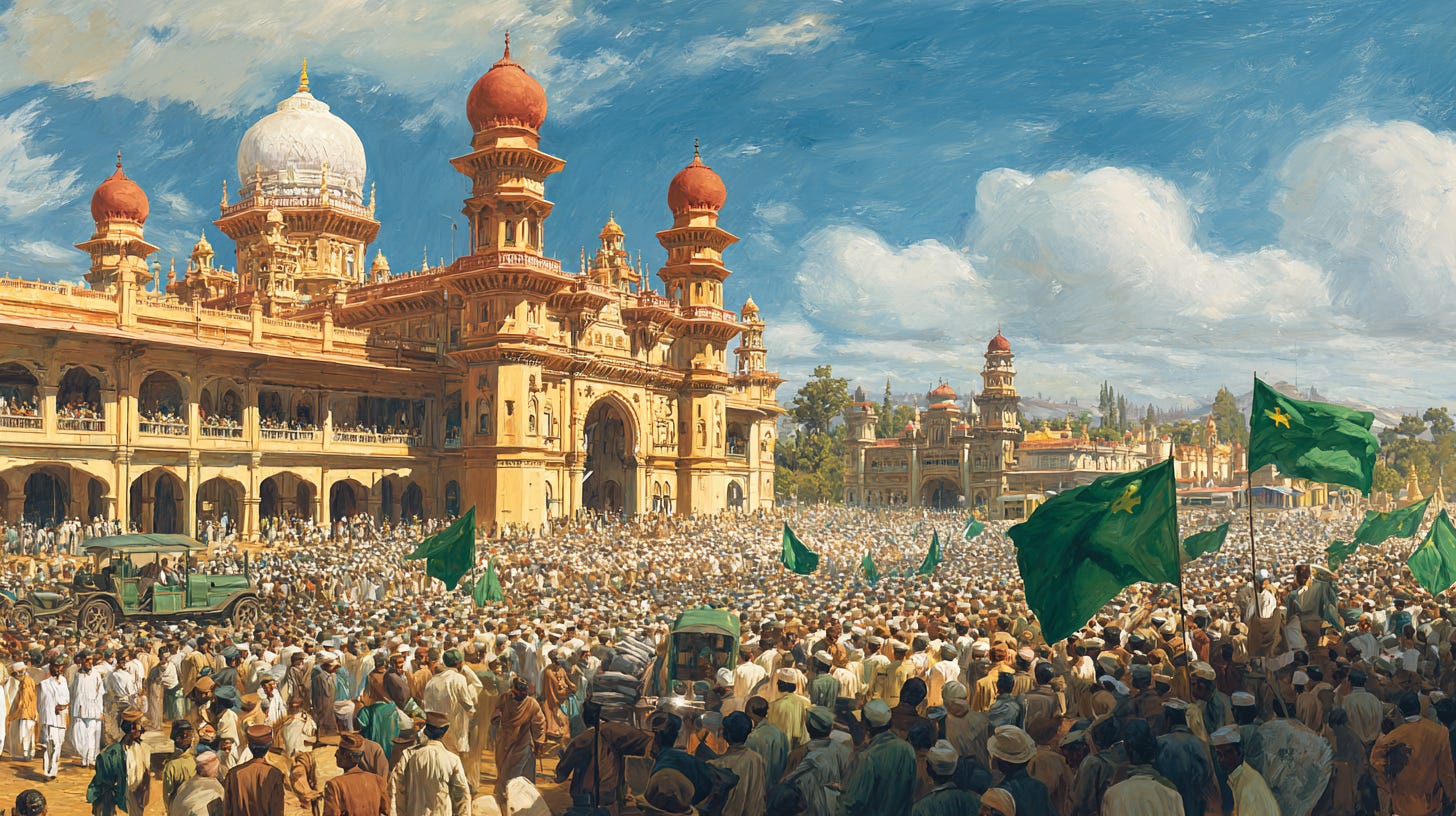
Circa 1946, the undivided Bharatavarsha stood at a historical inflection point. Political negotiations and mass mobilizations linked to the Pakistan movement had intensified, and major urban centersLahore, Lucknow, Karachi, and Calcuttawere gripped by communal tension and sporadic outbreaks of violence. In this fraught environment, symbolic assertions acquired unusual potency and often became flashpoints.
Within this wider context, accounts recall an episode in Mysore in which a group reportedly demanded that the Pakistan flag be hoisted on the Mysore Palace. The incident is cited as emblematic of how political symbolism intersected with princely state authority, public order concerns, and the broader two-nation debate in late-colonial India. While specific details vary across retellings, the core point remains clear: competing national imaginaries increasingly tested civic restraint and administrative composure in the final years before Independence.
Understanding such an episode requires situating it in the escalating spiral of 1946: intense political rallies, counter-mobilizations, and anxious rumor mills that traveled faster than official clarifications. Cities from Lahore to Calcutta were not merely locations on a map but living theaters where uncertainty, fear, and aspiration converged. The Mysore Palace, as a symbol of cultural heritage and state legitimacy, naturally became a stage upon which national questions were dramatized through flags, processions, and competing claims to representation.
Analytically, the demand to hoist a political flag on a heritage monument underscores three themes central to Partition-era history. First, political symbolism can amplify risk when social trust is brittle; a banner is not just fabric but a condensed signal of identity and power. Second, princely states were navigating a delicate pathmaintaining order, safeguarding cultural patrimony, and negotiating constitutional futures amid fast-moving events. Third, communal generalizations were (and remain) counterproductive; they obscured the diversity of experiences within communities and impeded the sober conflict-resolution needed to prevent escalation.
Oral histories from the era often carry a quiet poignancy: many families remember curfews, shuttered markets, and anxious evenings punctuated by distant shouts or sirens. Such memories foster an empathetic understanding of how ordinary peopleHindus, Buddhists, Jains, Sikhs, and otherssought safety, dignity, and continuity in daily life while leaders debated the subcontinent’s future. The episode associated with the Mysore Palace invites reflection on this shared social fabric and on the duty to protect spaces that symbolize collective heritage.
There are enduring lessons that emerge from this lens. Responsible leadership avoids incendiary language and foregrounds due process. Heritage sites require depoliticized protection during times of unrest. Community mediationrooted in the dharmic values of ahimsa, dialogue, and restraintoffers practical guardrails against rumor, retaliation, and cycles of provocation. When applied consistently, these principles transform flashpoints into opportunities for civic learning and de-escalation.
For contemporary readers, the value of revisiting 1946 lies not in rehearsing grievance but in mastering balance: honoring historical truth while strengthening inter-community trust. Unity among dharmic traditionsHinduism, Buddhism, Jainism, and Sikhismhas historically nurtured plural civic norms that prioritize compassion, forbearance, and mutual respect. Re-centering those norms provides a proven pathway to navigate polarizing symbols, protect cultural landmarks like the Mysore Palace, and uphold a shared commitment to India’s civilizational plurality.
Viewed this way, the reported Mysore flag demand is less a standalone episode and more a window into the pressures of the Partition era. It highlights how symbols, when untethered from constitutional process and social responsibility, can inflame pre-existing fractures. It also demonstrates that calm institutional responses, community solidarity, and ethical restraint are not only historically effective but remain essential for preserving harmony and cultural heritage in the present.
Inspired by this post on Dharma Dispatch.
