
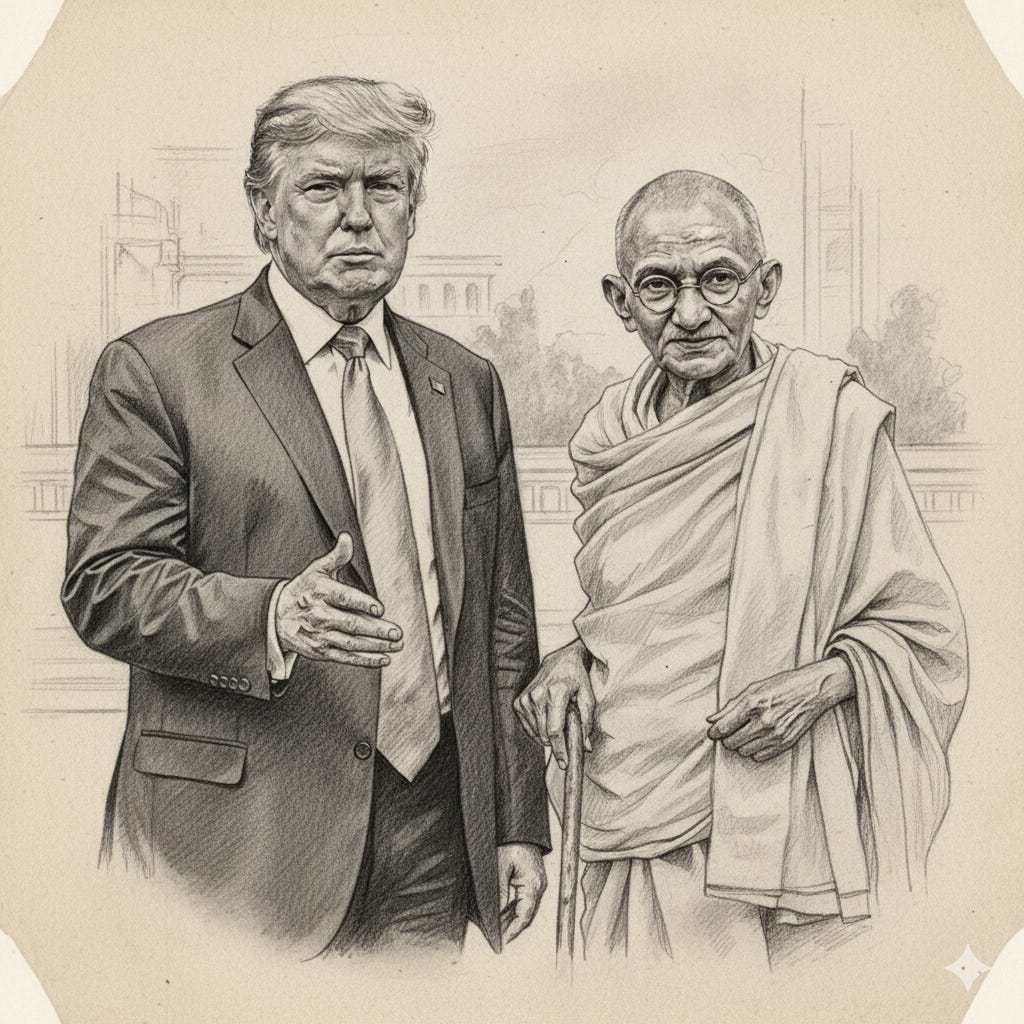
A recent intergenerational conversation raised an unexpected proposition: that Donald Trump and Mahatma Gandhi share notable similarities. The comparison initially surprised, especially when the assumption was that the reference was to Rahul Gandhi. Yet the insistence on Mahatma Gandhi prompted a closer, sober examination of the traits, strategies, and contexts that shape both figures.
On personal discipline, Mahatma Gandhi practiced abstinence from alcohol and smoking and emphasized self-restraint as a pillar of ethical life. Public reporting consistently notes that Donald Trump abstains from alcohol and smoking and has voiced strong opposition to recreational drugs. While their cultural milieus differ, both articulated a preference for restraint that resonates with dharmic values of self-control and accountability.
Economically, Gandhi’s advocacy of Swadeshiprioritizing indigenous production and boycotting foreign importssought national self-reliance and dignity amid colonial domination. Trump’s “America First” framing and MAGA-era policies emphasized reshoring, tariff leverage, and strategic supply-chain decisions. Though arising from vastly different political economies and historical moments, both approaches signal economic nationalism as a tool of statecraft and societal confidence.
In political technique, Gandhi’s Non-cooperation and Satyagraha mobilized mass civil disobedience through non-violence and moral suasion. He at times used ascetic pressure within his own party, including fasts intended to redirect policy. Trump, by contrast, has relied on institutional leverage, market measures (such as tariffs), and intraparty branding to discipline opponentse.g., popularizing the “RINO” label. The methods differ profoundlynon-violent civic action versus combative political negotiationyet both illustrate strategic non-cooperation as an instrument for change.
Leadership judgments invite nuanced debate. Indian historiography frequently revisits Gandhi’s pivotal support for Jawaharlal Nehru over Sardar Patelseen by some as inspired idealism and by others as a costly miscalculation. Observers of Trump similarly note a leadership style highly attuned to personal loyalty and public acclaim. In both cases, assessments vary, revealing how charismatic leadership can magnify both vision and vulnerability.
Regarding war and peace, Gandhi’s commitment to Ahimsa coexisted with complex stances on Indian participation in British wars, reflecting moral calculus under colonial constraint. Trump has argued against “endless wars,” favored burden-sharing, and authorized targeted military actions while expanding deterrent capabilities. The comparison underscores a shared rhetorical distance from protracted conflict, tempered by pragmatic engagement with state power.
Questions of private ethics and public responsibility also surface. Gandhi’s “experiments with truth,” including austere tests of brahmacharya described in his autobiography, have long been scrutinized. Trump’s public personashaped by celebrity, allegations, and admissions about past relationshipshas provoked its own moral debates. Across traditions, such tensions invite reflection on Satya (truth), self-discipline, and the gap that can exist between personal conduct and civic leadership.
The tragedy of Partition and the violence that accompanied it remain among the most painful chapters in South Asian history. Scholarly assessments diverge on agency, inevitability, and responsibility. What is clear is Gandhi’s tireless advocacy for interfaith harmony amid spiraling communal tensions and the incalculable human cost of the subcontinent’s division. Contemporary political movements everywhere should heed this history: polarizing strategies can deepen fault lines, whereas a dharmic ethic of Ahimsa, Karuna (compassion), and Seva (service) can foster reconciliation and shared civic purpose.
Placed side by side, Gandhi and Trump are not equivalents; they are case studies in how leaders channel self-restraint messaging, economic nationalism, and strategic non-cooperation within radically different contexts. The meaningful insight lies not in forced symmetry but in understanding how methods, myths, and moral claims shape public lifeand how societies can cultivate virtue while managing competition and dissent.
For communities rooted in Hinduism, Buddhism, Jainism, and Sikhism, the constructive takeaway is unity through ethical engagement. Ahimsa guides non-violent civic action; Satya demands intellectual honesty; and Sarvodaya (welfare of all) calls for inclusive, plural civic discourse. Comparative political analysis, when anchored in these dharmic values, can transform polarization into principled dialogue and help build a cohesive, compassionate public sphere.
Inspired by this post on RightViews.
