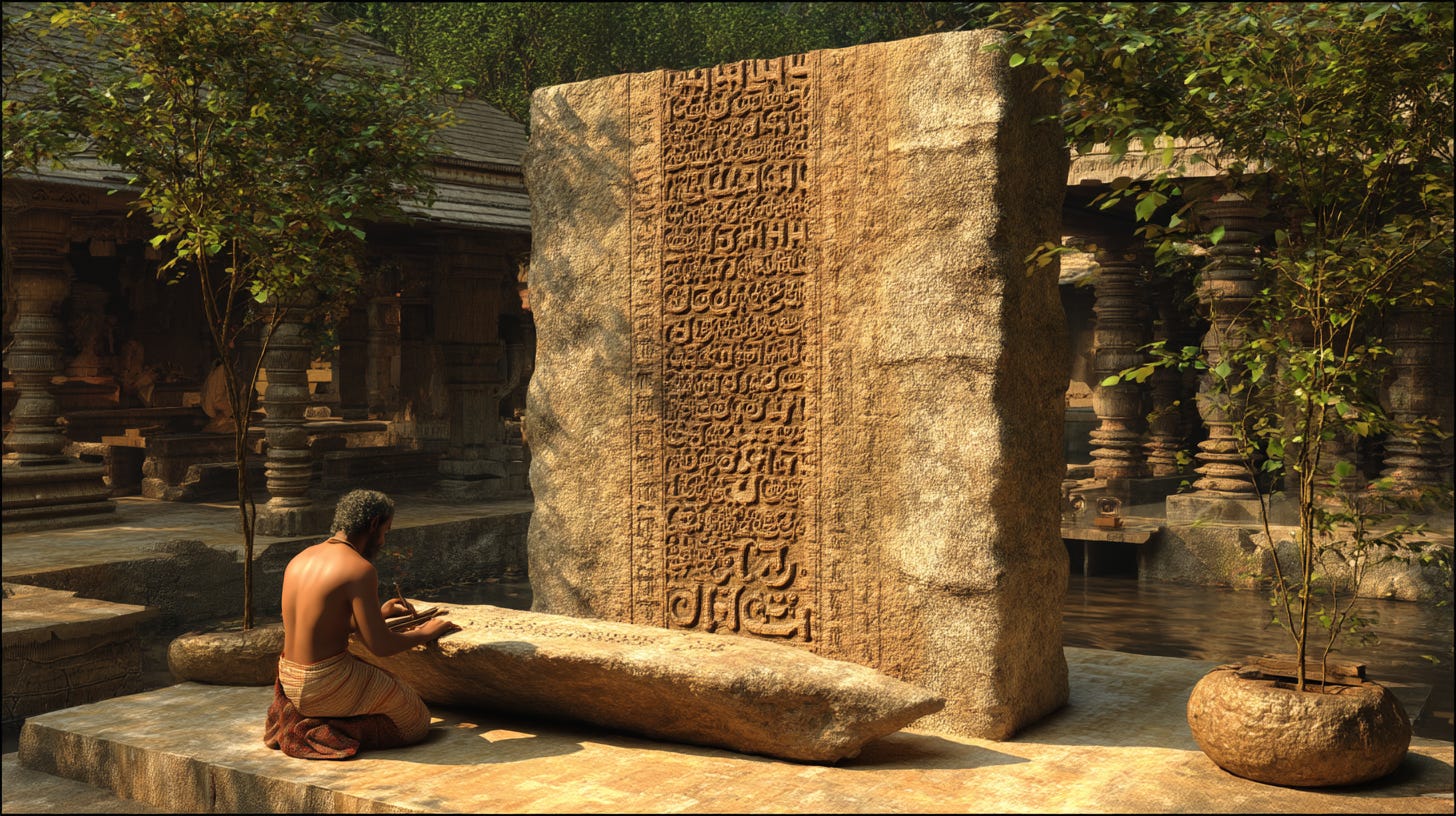
I have long been obsessed with inscriptionsthose quiet, enduring lines on stone and copper that outlast empires. To me, they are not just texts; they are the physical artifacts of our historical memory. Preserving them is essential if we, as Hindus and as inheritors of a vast civilisation, care about our cultural future.
Over the years, I have learned that inscriptions are the raw material of our history. After careful sifting and analysis, they shape our textbooks and popular narratives. When someone speaks confidently about the remarkable system of local self-governance in the medieval Tamil Desham, that confidence often rests on the authority of the famed Uttaramerur inscription from the 10th century CE.
Yet in our discussions about epigraphy, one crucial aspect is often overlooked: the inscription-makers themselves. I feel a special reverence for these unknown, unsung heroesthe scribes, historians, chroniclers, and engraverswho combined linguistic prowess with artistic finesse to compose and etch our past on stone, metal, bark, and leaf.
I love how the last line of many inscriptions names the engraverand sometimes his lineagealongside the ruler, the composer of the text, its purpose, and the exact city or village. Each record becomes a self-contained micro-archive: who ordered it, who wrote it, who engraved it, and why it mattered.
Since the time of Kautilya, our statecraft took inscriptions seriously. The Arthasastra offers guidelines for composing Śāsanas, emphasizing linguistic eloquence, exactitude, clarity, etiquette, and elegant handwriting. I find it inspiring that Śāsana-writing evolved into both a science and an artand even into a lucrative profession. A remarkable 14th-century Sanskrit inscription near Anantapur reads like a tutorial on crafting the perfect Śāsana-padya, reminding us that a Śāsana typically blends prose and poetry.
Within this administrative world, the chief of the Śāsana departmentcalled the Śāsanācārya or Rāya sūtradhāriheld real influence. The engraver under him was known as the Shilpi. He directed and supervised the writing of Śāsanas and sometimes authored them personally. For this reflection, I’ve focused on Southern India, where this tradition flourished in dazzling ways.
Across history, I’ve encountered many celebrated Śāsana-writers whose verses qualify as brilliant literature. The iconic R. Narasimhacharya curated a bouquet of such gems in his classic Śāsanapadyamañjari. Each time I browse its pages, I feel a deep gratitude for the literary beauty embedded in our epigraphic record.
Consider Ravikeerti, the renowned Śāsana-writer of Pulikeshi II, who gifts us vivid details of the Chalukya era. Or the great Kannada poet Rannaonce a bangle-sellerwho began his career as a Śāsana-writer under Chavundaraya of the Western Ganga dynasty. Their journeys remind me that literary brilliance often begins in the most unexpected places.
When I think of the 12th century, I picture the Jain Śāsana-writer Boppana Pandita in the Shravanabelagola region, honoured as Kannada-gavi-Bappa“the polish to the Kannada poets.” At his Guru Balachandra Munindra’s command, he composed a Śāsana in praise of Gommateshwara. One moving excerpt has stayed with me: “At the directions of that Muni, Boppana Pandita, approving of the proposal to compose the Sasana praising the qualities of Gommata Jinendra, lord of earth, and having finished it, by Kavadamayya Deva’s order, Bagadage Rudra with affection caused it to be engraved and erected.”
That single record introduces four contributorsthe official (Kavadamayya Deva) who commissioned it, the Muni (Balachandra) who supplied the subject, the poet (Boppana) who shaped it, and the unnamed engraver who brought it to life. I often pause here, humbled by how many hands, minds, and hearts converge to preserve a truth in stone.
Another favorite of mine is a long and illuminating Śāsana from the reign of the Hoysala monarch Vira Narasimha II, found in Haruvanahalli (under Arasikere). It records renovations to the Lakshmi Narasimha Temple and reads: “The necklace of poets, Somanatha Pandita dictated the text of this Śāsana. The accomplished ambidextrous writer and the Emperor of Avadhana, Srikarananda Vishwanatha wrote it down. The Rāya sūtradhāri Suroja the brother of Gopoja got it engraved.”
Beyond naming its makers, this inscription hints at a vibrant literary cultureclearly, the art of Avadhana thrived during the Hoysala period. Discoveries like this transform my understanding of how literature, administration, and temple life intertwined in South Indian history.
In the Chola country, I’m always struck by the primacy placed on record-keeping. Their scrupulous land surveys and rigorous revenue management generated inscriptions with remarkable administrative clarity. As Sri B.A. Saletore notes: “During the days of Vira Rajendra I, for example, revenue officers entered matter which was related to land in revenue registers in accordance with the command of the king; and then they had it engraved on copper-plates and stone.”
Under Kulothunga Chola I, an extensive land survey in 1086 culminated in a sweeping remission of customs duties. The people, overjoyed, hailed him as Sunkadavirta Cholathe Chola who exempted Sunkas (tax). I read this as more than fiscal policy; it reflects a king’s desire to be known as Praja-Vatsala, affectionate to his citizensa timeless ideal in Indian history.
For me, tracing these inscriptions is both an intellectual pursuit and an emotional journey. Each Śāsana I encounter feels like a conversation with our ancestorsmeasured, meticulous, and full of meaning. And each time I meet the nameless Shilpi in the final line, I whisper a quiet thank you.
To be continued.
Inspired by this post on The Dharma Dispatch