
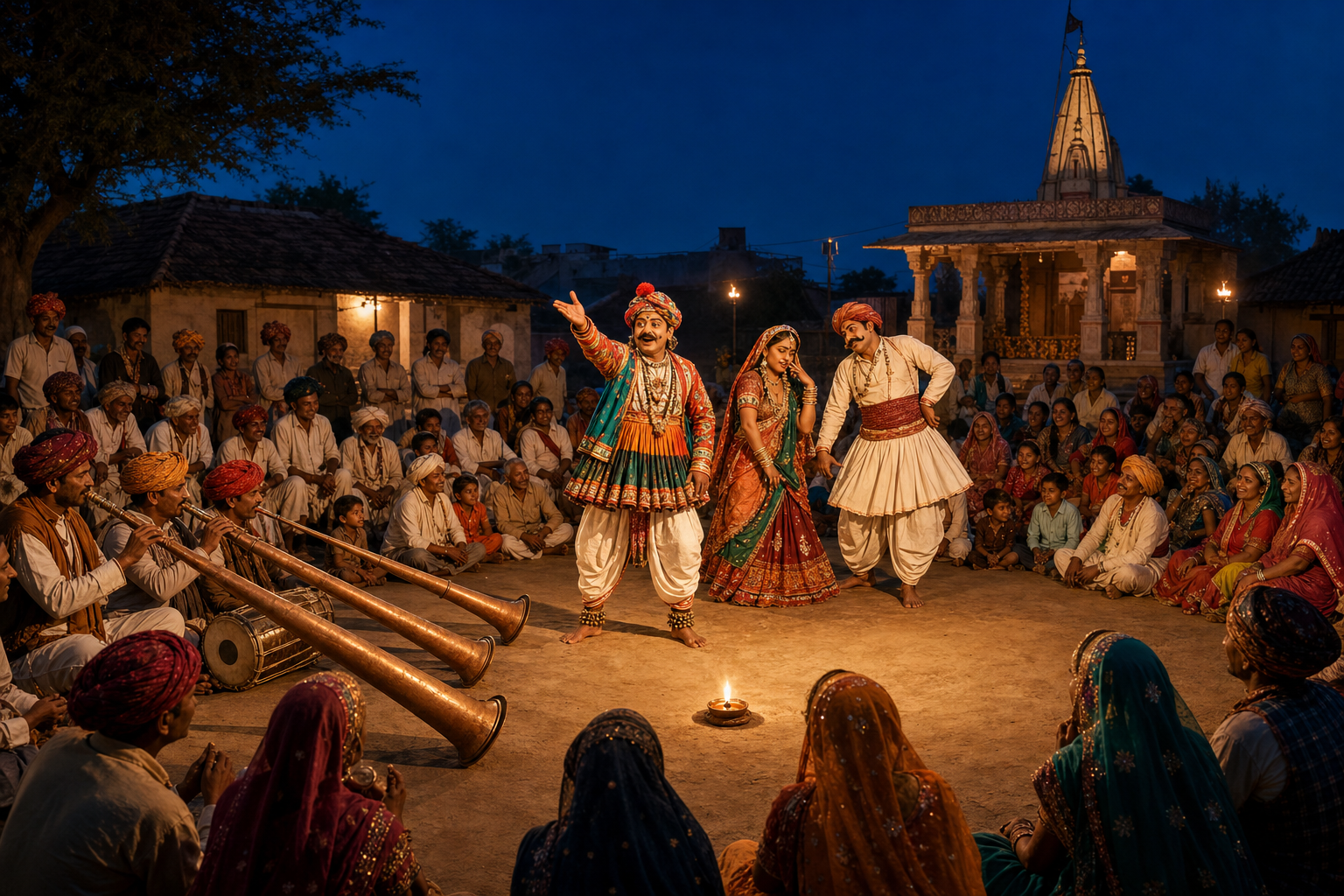
A village square transformed into a theatre
Bhavai is one of Gujarat’s most enduring folk theatre traditions, with a history conventionally traced to the fourteenth century. It is not merely a collection of old plays. It is an integrated performance system in which acting, music, dance, recitation, improvisation, ritual and social commentary meet in an open public space. A village square, temple courtyard or central clearing becomes the stage; the spectators form its living boundary; and the performers turn familiar language, recognizable characters and local tensions into a shared dramatic experience.
For a first-time spectator, Bhavai can feel unusually immediate. There is generally no proscenium arch separating actor from audience, little dependence on elaborate scenery and no expectation that spectators will remain emotionally detached. A performer may address the gathering directly, a comic figure may comment on the action, and a familiar social type may suddenly become the subject of satire. The emotional force of Bhavai arises from this proximity: the community does not simply observe the drama but becomes part of the environment in which its meanings are negotiated.
What exactly is Bhavai?
Bhavai is best understood as Gujarati folk theatre rather than as a single play or dance. A complete presentation traditionally contains several short dramatic units called vesha, each with its own characters, situation, mood and narrative purpose. One vesha may draw upon mythology, another upon regional history, and another upon a recognizable social conflict. Music and dance connect these units, while humour gives the performance continuity even when the stories themselves are independent.
The Gujarati theatrical form should not be confused with the Rajasthani dance also called Bhavai, which is especially associated with balancing pots and performing feats of physical control. Gujarati Bhavai can certainly include energetic dancing, balancing, acrobatics and displays of skill, but its central organizing principle is the dramatic vesha. Narrative, characterization, dialogue and commentary remain fundamental to its identity.
The meaning of the name
The etymology of “Bhavai” is interpreted in several ways, and no single explanation should be presented as conclusively established. A widely repeated interpretation connects bhav, meaning emotion or expressive state, with vahini, a carrier or vehicle, making Bhavai a carrier of emotion. Other interpretations associate bhava with existence, performance or the world and aai with mother, thereby linking the name to the Mother Goddess. These explanations differ linguistically, but each recognizes Bhavai as a medium that carries feeling, collective memory and moral reflection from performer to audience.
The sacred association is more securely visible in performance practice than in etymological speculation. Traditional presentations invoke forms of the Goddess, especially Amba and Bahuchara, although local observances vary. The performance may begin with a lamp, torch, image or invocation that marks the acting space as ritually significant. Bhavai therefore moves between two complementary functions: it is an offering framed by devotion and a form of popular entertainment capable of vigorous social criticism.
Asait Thakar and the origin tradition
The origin of Bhavai is traditionally credited to Asait Thakar, whose name is also rendered Asaita Thakar. Community memory places him in fourteenth-century north Gujarat. According to a widely circulated legend, Ganga, the daughter of the village headman Hema or Hemala Patel, was held by a regional official. Asait claimed that she was his daughter and shared a meal with her to substantiate the relationship. By crossing a rigid caste boundary, he secured her release but was subsequently ostracized by members of his own community.
This account belongs to transmitted legend rather than securely documented biography, and versions differ in names and political details. Its enduring ethical centre is nevertheless clear: Asait places another person’s safety above inherited restrictions. Read in that way, the story is not a warrant for communal accusation but a narrative about courage, solidarity and resistance to social exclusion. The distinction between tradition and verifiable history is also maintained in the detailed Sahapedia account of Bhavai.
Tradition further holds that Asait transformed his experience into a body of dramatic compositions exposing social hypocrisy and harmful customs. He is credited with approximately 360 veshas. That number should be treated as an attribution within the tradition rather than as a count of surviving autograph manuscripts. Bhavai was transmitted substantially through performance, memory and apprenticeship, so texts could change as one generation taught another. Modern surveys frequently state that only a fraction of the attributed repertoire survives, with some placing the available number at roughly sixty.
The loss cannot be measured by titles alone. When a vesha disappears, the tradition may also lose its melodies, entrances, gestures, comic timing, regional vocabulary and conventions of audience interaction. Conversely, a surviving title does not guarantee a single fixed text. Different troupes may preserve different versions, shorten or extend a scene, substitute a song or adjust its topical references. Bhavai’s repertoire is therefore better understood as a living performance archive than as a closed literary canon.
The Bhavaiyya, Targala, Nayak, Vyas and Bhojak communities
The hereditary performers are commonly described as Bhavaiyyas or Targalas, but regional names vary. Accounts identify Nayak or Naik in parts of north Gujarat, Vyas in Saurashtra and Bhojak in Kutch, although terminology is not entirely uniform. The original description’s reference to the Nayak community is therefore substantially correct but requires this regional context. Performers from other backgrounds now learn and present Bhavai as well, while hereditary families retain an especially important body of embodied knowledge.
The word nayak has a second theatrical meaning. It can refer to the leader of a Bhavai troupe, who functions as organizer, director, narrator and sutradhar. This dual use—community name in one context and performance office in another—can cause confusion. The troupe’s nayak helps choose the veshas, coordinates the musicians, prepares the acting area, guides transitions and intervenes when improvisation requires the story to be redirected.
The performing community is not a peripheral detail in Bhavai’s history. Touring routes, devotional obligations, systems of patronage, family instruction and the practical division of labour all shaped the art. A mandali required actors, singers, instrumentalists, costume knowledge, comic skill and the ability to respond instantly to an audience. Much of this expertise was transmitted by observation and repeated participation rather than through a written acting manual.
The chachar: an open and responsive stage
The traditional performance area is often called the chachar or, in some descriptions, phoda. It is an open, delimited space with spectators gathered around it. A lamp or torch associated with the Goddess may remain alight, while the musicians sit near the edge of the acting area. The absence of built scenery is not a sign of technical poverty. It is a deliberate spatial system in which movement, music, costume and spoken description establish place and atmosphere.
This arrangement produces a distinctive actor–audience relationship. Entrances can begin beyond the ring, allowing music and movement to announce a character before the dialogue starts. Spectators can see one another as well as the actors, making communal reaction part of the event. Laughter travels across the circle, moments of devotion reorganize its mood, and a local allusion can generate a response that changes the timing of the scene. The chachar is consequently both a stage and a temporary public forum.
How a traditional Bhavai performance unfolds
A presentation traditionally takes place at night, and several veshas may be performed in succession. The sound of the bhungal, Bhavai’s characteristic long copper wind instrument, helps announce the event and gather spectators. The nayak prepares or marks the acting space, after which invocatory songs establish the devotional frame. Documented performance sequences frequently include an appearance of Ganesha, sometimes represented by an actor holding a metal plate before the face. Some traditions also include appearances associated with Kali or a Brahmin figure before the principal dramatic action begins.
These preliminaries should not be treated as a mechanically identical script followed by every troupe. Bhavai is regionally varied, and the number, order and elaboration of invocations can change. What remains consistent is their function: they consecrate the occasion, acknowledge divine protection, settle the gathering and prepare the transition from ordinary village space to dramatic space.
A character’s arrival may be introduced by an entrance song often called an avanu. Music identifies the change in action, while costume, gait and vocal register quickly establish social type and dramatic intention. Once a vesha is underway, prose dialogue can alternate with verse, singing, dance, mime and direct address. The story may be simple, but its performance requires exact coordination among the actor, musicians, nayak and audience.
The ranglo is especially important. Usually described as a male jester, comic commentator or narrator, he can speak with characters, address spectators and expose contradictions that the main plot leaves unstated. He is not merely an interruption inserted for laughter. He connects separate dramatic registers and often expresses the critical intelligence of the performance. Contemporary Bhavai may also feature a rangli, a female counterpart whose presence reflects the form’s adaptation to modern theatrical practice.
The vesha as a flexible dramatic unit
A vesha is a self-contained playlet, but it also belongs to a larger night of performance. This modular construction gives Bhavai unusual flexibility. A troupe can select pieces according to the occasion, available performers, local interests and expected audience. It can expand a popular comic exchange, shorten a familiar narrative or introduce a topical reference without rebuilding the entire production. Such flexibility helped Bhavai remain relevant across changing social environments.
The dramaturgy depends heavily on oral and embodied techniques. Repetition allows the audience to recognize a pattern; exaggeration makes a gesture legible across an open space; musical refrains stabilize the pace; and improvisation keeps familiar material responsive. A literary reading of the dialogue alone therefore captures only part of the work. The meaning also resides in timing, accent, bodily stance, interruption, melody and the audience’s reply.
Improvisation does not mean the absence of structure. Experienced performers work within inherited character types, narrative sequences, rhythms and entrance conventions. Their freedom resembles disciplined variation: the frame is known, but the precise realization changes. This balance between continuity and responsiveness is one reason Bhavai can preserve medieval cultural memory while commenting on circumstances encountered by a later audience.
Mythology, history and social satire
Scholarly and encyclopedic surveys commonly organize Bhavai veshas into mythological, historical or legendary, and social groups, although troupe repertoires do not always follow a rigid taxonomy. The Impart Encyclopedia of Art identifies Ramdev as an early vesha attributed to Asait and lists works such as Jasma Odan, Jhuthan and Zanda Zulan among historical or legendary narratives. It places Purabiyo, Saraniyo and Vanzara among social satires, while figures such as Ganesha and Ardhanarishvara appear in mythological material.
Religious subjects are not isolated from ordinary life. Divine and epic figures can be presented through speech, humour and movement accessible to a rural gathering. Historical memories can likewise become vehicles for examining loyalty, dignity, power or injustice. Social veshas portray traders, officials, artisans, mendicants, householders and mobile communities, creating a broad theatrical map of Gujarati life.
Satire is one of Bhavai’s defining methods. Authority figures may be mocked, pretension punctured and social rules tested by comic reversal. Caste arrogance, exploitation, hypocrisy, unequal gender relations and the misuse of status have all entered its critical field. Humour enables difficult criticism to be voiced in a form that attracts rather than lectures an audience. The laughter can be generous, abrasive or uncomfortable, but it encourages recognition of the contradiction being staged.
Some inherited portrayals also rely on stereotypes, double meanings or bawdy humour. Academic appreciation should neither erase these features nor reproduce them without context. They reveal the social vocabulary of the periods in which particular versions evolved, including both resistance to hierarchy and prejudice toward certain groups. Responsible contemporary staging can retain satire’s energy while revising demeaning caricature and directing criticism toward conduct, power and injustice rather than inherited identity.
Music as Bhavai’s dramatic architecture
Music does far more than accompany Bhavai. It gathers the audience, signals an entrance, regulates dance, marks transitions and alters the emotional temperature of the chachar. The bhungal is its most recognizable instrument. This long metal wind instrument is often sounded in a pair and produces a forceful tone suited to open-air performance. Its call can announce an important character, reinforce a dance pattern or create continuity between spoken passages.
Other instruments documented in Bhavai ensembles include the pakhawaj or tabla, jhaanjh and kansijoda cymbals, sarangi and harmonium. The precise ensemble varies by troupe, period and availability. Melodic practice combines regional idioms with material associated with Hindustani and semi-classical music, while the rhythmic design changes with dramatic mood. One modern encyclopedia describes six basic rhythmic types, but living performance cannot be reduced to a single standardized score.
The musician must understand the drama rather than simply maintain a beat. A delayed cue can weaken an entrance, while a well-placed bhungal phrase can enlarge a character before a word is spoken. Refrains help spectators follow a long night of episodic action, and shifts in tempo distinguish devotion, comedy, conflict and celebration. In this sense, Bhavai’s musicians participate in narration.
Dance, gesture and physical skill
Dance is woven into character entry, transition and dramatic display. Studies note relationships with regional raas traditions and with aspects of Kathak movement, although Bhavai retains its own performance logic. Circular pathways suit the chachar, rhythmic footwork answers the percussion, and stylized turns allow a character to address spectators positioned on different sides. Gesture must remain large enough to be legible without becoming detached from narrative purpose.
Some veshas include balancing, acrobatics, mock combat or other demonstrations of bodily control. These feats contribute wonder and excitement, but they are not present in equal measure in every repertoire. Their effectiveness depends on rhythm and characterization: a display can signify courage, boastfulness, divine power or comic failure. Bhavai thus converts physical technique into dramatic language rather than presenting movement as an unrelated spectacle.
Costume, makeup and instantly readable characters
Traditional Bhavai uses costume economically. Recognizable garments, ornaments and props establish identity quickly because several veshas may be presented during one night. Descriptions of rural practice refer to dhotis and regional jamas for male characters and to saris or ghaghra choli for female characters. Makeup has included locally available materials such as multani mitti for a lighter base and soot for emphasizing the eyes. Practices naturally differ among hereditary, urban and institutionally trained troupes.
For much of Bhavai’s documented history, male members of hereditary communities performed both male and female roles. This convention demanded close observation of voice, movement, clothing and social gesture. It should be understood historically rather than treated as an unchangeable rule. Women and artists from outside hereditary lineages now participate in modern adaptations, demonstrating that cultural continuity can include expanded access without denying the contribution of traditional families.
A multilingual theatre of everyday Gujarat
Gujarati is central to Bhavai, but surviving and documented veshas can incorporate Hindi-Urdu and Marwari vocabulary or speech patterns. This linguistic range reflects the connected social world of western India, shaped by pilgrimage, trade, migration, political change and contact among communities. It also gives performers a practical method for distinguishing characters and making a production intelligible beyond one locality.
Language in Bhavai is performative rather than merely descriptive. A shift in register can indicate authority, intimacy, pretension or regional identity. A proverb can condense a moral argument, while a rhyme or repeated phrase can invite audience recognition. The vernacular quality is therefore not evidence of artistic simplicity. It is a sophisticated communication strategy developed for spectators with different levels of literacy and theatrical experience.
Entertainment, instruction and a village public sphere
Bhavai historically performed several functions at once. It entertained, honoured sacred powers, transmitted stories, created livelihood and opened a space for public criticism. A field-research-based study in the journal Traditional Culture describes its ceremonial, didactic, socially integrative and critical roles. These functions explain why Bhavai cannot be adequately classified as either ritual or secular theatre: its strength lies in moving between them.
Before electronic mass entertainment, an itinerant mandali could bring news-like topicality, ethical debate and collective amusement into the same gathering. Performers often learned about local circumstances before choosing or adapting their material. The stage could therefore reflect the audience’s immediate social world. A comic exchange about debt, status or domestic conflict was not abstract when spectators recognized comparable situations around them.
That responsiveness also explains the emotional range of Bhavai. Humour may dominate, yet devotion, affection, pathos, courage, anger and wonder can emerge within the same night. The transition between these states does not necessarily follow the psychological continuity expected of modern realist drama. Music, entrance, gesture and story type can reorganize the collective mood almost immediately.
The touring mandali and its cultural economy
Traditional troupes travelled between villages and depended upon negotiated patronage, hospitality, food, gifts and performance income. Published descriptions record mandalis of roughly a dozen or more members, though size has always varied. Touring required logistical as well as artistic knowledge: instruments and costumes had to be transported, relationships with patrons maintained, roles allocated and performances adjusted when an actor or musician was unavailable.
This economy helps explain both Bhavai’s mobility and its vulnerability. When village patronage declines, the loss affects more than the number of shows. Performers have fewer opportunities to practise extended veshas, apprentices receive less sustained training, and instrument makers lose demand. Preservation must therefore address livelihoods and working conditions rather than treating performers as decorative representatives invited only for short festival demonstrations.
Bhavai’s influence on modern Gujarati theatre
Bhavai’s relationship with urban and literary theatre has been complex. From the nineteenth century onward, some elite commentators criticized its bawdy humour and exaggerated performance. Reformers attempted to make it acceptable to urban audiences, sometimes reducing precisely the irreverence that gave the form its social power. The history of revival is therefore also a history of selection: certain musical, visual and comic features were celebrated while others were sanitized or excluded.
Gujarati dramatists nevertheless drew creatively upon Bhavai’s narrator, ranglo, songs, vernacular speech, direct audience address and episodic structure. Works associated with Dalpatram, Narmad, C.C. Mehta, Rasiklal Parikh and later experimental playwrights demonstrate this continuing influence. Mena Gurjari, whose modern stage history is connected with Rasiklal Parikh and Dina Pathak, is frequently cited as an important bridge between folk dramaturgy and post-Independence Gujarati theatre.
Modern adaptation is most effective when it studies Bhavai’s internal logic rather than borrowing only its colourful surface. A ranglo placed in an otherwise conventional play does not automatically create Bhavai. The deeper inheritance lies in the relationship among actor, music, open space, audience and social commentary. When these relationships are understood, Bhavai can inform contemporary theatre without being reduced to a visual motif.
A tradition under pressure, not a relic
Cinema, television, mobile media, migration and changing leisure patterns have reduced the regular audience for long rural performances. Hereditary artists also confront unstable income, limited prestige and the understandable desire to secure different opportunities for their children. These pressures have narrowed the traditional performance circuit, but describing Bhavai as already extinct would be inaccurate. Rural troupes, trained theatre artists, cultural institutions and contemporary playwrights continue to perform or adapt it in different forms.
The central preservation question is not whether Bhavai should remain frozen in a reconstructed medieval form. Living traditions have always changed. The more useful question is whether change occurs with the knowledge, consent and material participation of the communities that sustained the form. Innovation can renew subjects, include women, use new venues and address contemporary problems while still respecting the vesha structure, musical vocabulary and performer lineages.
What meaningful preservation requires
Documentation should record complete performances rather than isolated highlights. A useful archive would connect each vesha’s text with video, melody, rhythm, entrances, gestures, costume practice, performer biography, regional vocabulary and known variants. Transcription in Gujarati, transliteration and careful translation could make the material accessible without replacing the original language. Digital files should include reliable metadata and clear agreements concerning performer credit, consent and future use.
Transmission requires paid apprenticeships and repeated performance opportunities. A workshop lasting several days can introduce Bhavai, but it cannot reproduce knowledge developed through touring, musical coordination and live audience response. Senior artists should be compensated as teachers and repertory authorities. Training partnerships among hereditary mandalis, universities, theatre schools and cultural institutions can help, provided that institutional prestige does not displace community expertise.
Preservation also requires the bhungal and other instruments to remain audible as practices rather than museum objects. Instrument makers, players and younger learners need commissions and stages. Similarly, costumes and props should be documented as systems of character communication, not merely collected. The complete ecology of Bhavai includes the people who prepare, transport, repair, teach and interpret its material culture.
New veshas can address present-day concerns such as environmental stress, public health, digital misinformation, debt, migration or unequal access to education. This would continue Bhavai’s established function as entertaining social pedagogy. Contemporary writing should preserve the form’s willingness to question authority while avoiding the uncritical recycling of stereotypes. Satire remains strongest when it challenges harmful conduct and entrenched power.
Bhavai and the wider dharmic cultural landscape
Bhavai retains specific Gujarati and Shakta devotional roots and should not be detached from them. At the same time, its combination of ethical narrative, music, embodied teaching and community participation places it within India’s wider ecology of sacred and vernacular storytelling. Hindu, Buddhist, Jain and Sikh traditions each preserve distinctive forms of narrative performance and public instruction. Studying them in dialogue can strengthen mutual appreciation without pretending that their histories or theologies are identical.
Bhavai’s multilingual speech, varied character world and critique of hierarchy offer an especially valuable lesson for cultural unity. Its origin legend is most constructive when understood as a defence of human dignity across a social boundary. Its satire is most constructive when it encourages communities to examine themselves rather than vilify one another. Such an interpretation remains faithful to the form’s critical energy while supporting respect among India’s dharmic and other cultural communities.
How to watch Bhavai with greater understanding
A spectator can begin by listening for the bhungal and observing how its sound reorganizes the space. Attention can then turn to the sacred opening, the location of the musicians, the nayak’s coordinating role and the way an entrance song defines a character. During the vesha, the most revealing question is often not simply what happens but how the ranglo, music and audience reshape the meaning of what happens.
Changes in language, rhythm and bodily stance deserve equal attention. A comic exaggeration may communicate status before dialogue explains it. A repeated verse may allow the audience to anticipate and participate. A topical remark may briefly bring the village’s present into an inherited story. Once these techniques become visible, Bhavai no longer appears to be a sequence of simple skits; it emerges as a highly adaptive method of collective storytelling.
Why Bhavai still matters
Bhavai matters because it preserves more than entertainment. It records how communities have prayed, laughed, criticized power, represented difference and converted public space into a forum for reflection. Its minimal stagecraft reveals the technical sophistication of voice, rhythm and movement. Its modular veshas demonstrate how an inherited form can remain responsive, while its performing families embody centuries of knowledge that no script can fully contain.
The tradition’s future depends upon a balanced approach: rigorous documentation, fair payment, intergenerational teaching, responsible adaptation and opportunities for full live performance. When these elements are supported together, Bhavai can remain what it has long been—a sacred offering, a social mirror and a compelling expression of Gujarat’s living cultural heritage.
Research basis: Historical and performance details in this account were checked against Sahapedia’s Bhavai documentation module, the Impart Encyclopedia of Art and the peer-reviewed field-research summary published by Traditional Culture.
Inspired by this post on Hindu Blog.
