
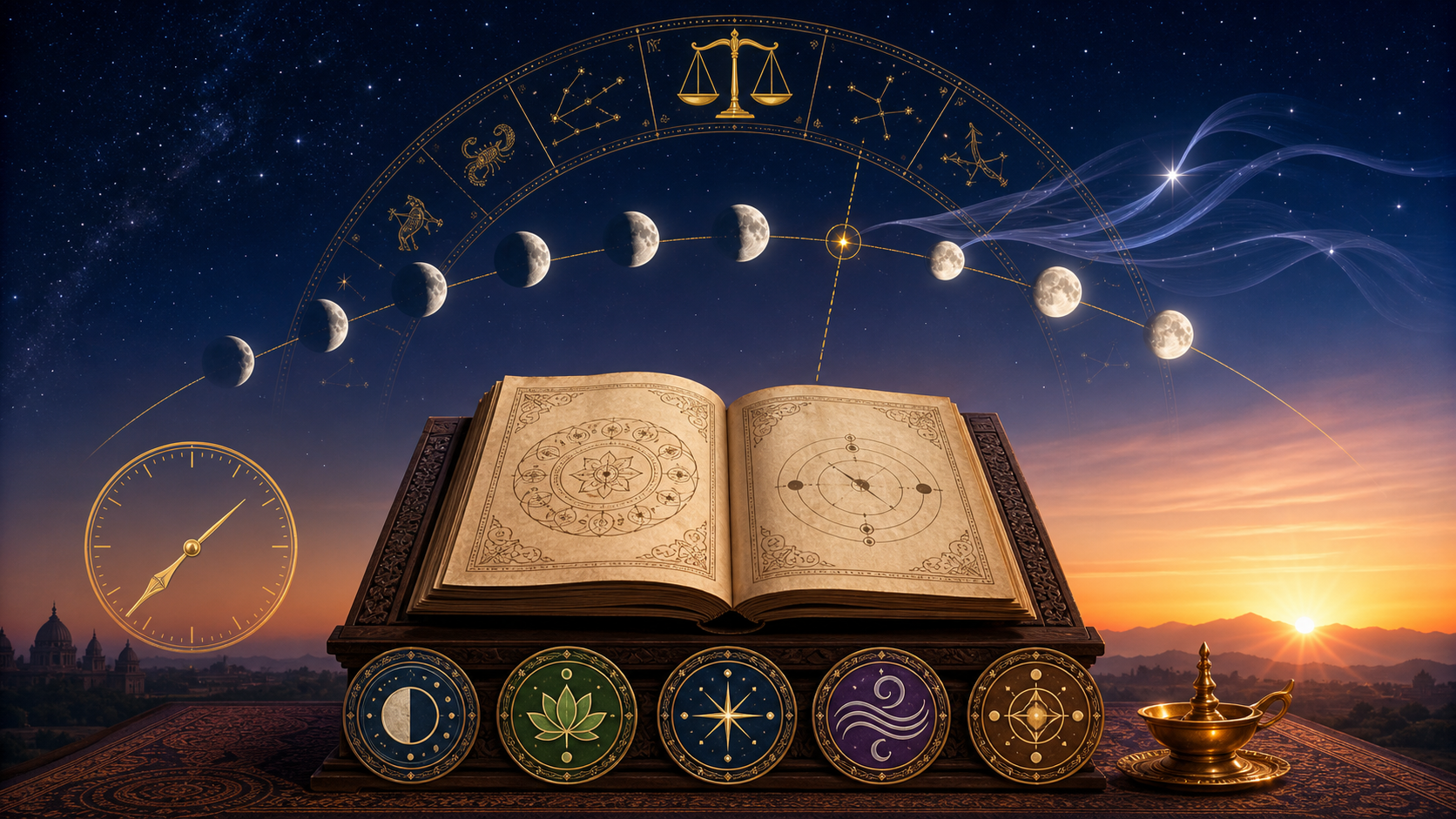
Wednesday, July 22, 2026 presents a significant transition in the Hindu calendar. The reference Panchang places Shukla Paksha Ashtami until 7:37 AM India Standard Time, followed by Shukla Paksha Navami. This early-morning change is the key to understanding the date: a Gregorian day begins at midnight, whereas a tithi is determined by the changing angular relationship between the Moon and the Sun and can begin or end at any hour.
The Moon remains in Tula Rashi throughout the civil day and occupies Swati Nakshatra for nearly all of July 22 in the regional calendar used across much of northern, eastern and southern India. Together, the tithi, nakshatra, rashi, weekday and locally calculated time periods provide a structured guide for worship, fasting and practical planning. They should not, however, be treated as a substitute for a location-specific muhurta when arranging a wedding, Griha Pravesh, initiation or another major samskara.
July 22, 2026 Panchang at a glance
Gregorian date and weekday: Wednesday, July 22, 2026. In traditional weekday terminology, it is Budhavara, the day associated with Budha or Mercury.
Paksha: Shukla Paksha, the waxing or bright fortnight between Amavasya and Purnima.
Tithi: Shukla Paksha Ashtami continues until 7:37 AM IST. Shukla Paksha Navami begins at 7:37 AM and continues thereafter.
Nakshatra: In the north, east and much of southern India, Chitra or Chithirai or Chithira ends at 12:13 AM, after which Swati or Swathi or Chothi prevails for the rest of July 22 and continues until 1:50 AM on July 23. Western Indian almanacs using a different computational convention place Swati until approximately 11:03 PM on July 22, followed by Vishakha or Visakam.
Rashi or Moon sign: Tula Rashi, corresponding to sidereal Libra, remains operative throughout July 22.
General auspicious-time assessment: The source tradition does not treat July 22 as a universally auspicious date for major new beginnings. This is a composite muhurta judgment, not a declaration that ordinary work, prayer, study, service or family duties should stop.
Understanding the Ashtami-to-Navami transition
A tithi is one of the thirty lunar dates in a synodic month. It is calculated from the difference between the geocentric ecliptic longitudes of the Moon and the Sun. Each successive increase of 12 degrees produces a new tithi. In simplified mathematical form, the tithi number is obtained by taking the Moon–Sun longitude difference modulo 360 degrees, dividing it by 12 degrees and identifying the resulting interval.
Shukla Paksha Ashtami occupies the interval in which the Moon has moved between 84 and 96 degrees ahead of the Sun. Navami begins when that elongation reaches 96 degrees. The reported transition at 7:37 AM therefore represents an astronomical boundary rather than an arbitrary clock-based division.
Because the Moon does not move at a constant apparent speed, a tithi is not exactly twenty-four hours long. It may be shorter or longer than a civil day, begin before sunrise, extend across two dates or occasionally be absent at successive sunrises. This is why a calendar entry can correctly describe July 22 as Ashtami in the early morning and Navami for the remainder of the day.
Traditional Hindu observance commonly gives special importance to the tithi present at local sunrise. Since the reference calculation keeps Ashtami in force until 7:37 AM, places where sunrise occurs before that boundary experience Ashtami at sunrise. Festival authorities may nevertheless apply additional rules involving sunrise, midday, moonrise, sunset or a prescribed period of tithi-vyapti. The date of a vrata should consequently be confirmed through the relevant sampradaya rather than inferred from the tithi name alone.
Ashtami and Navami carry distinct ritual associations in different Hindu traditions. Shakta communities frequently connect these tithis with forms of Devi, while Vaishnava, Shaiva, Smarta and regional traditions may observe separate rites or regard the day primarily as part of the ordinary lunar sequence. These classifications describe inherited religious practice; they should not be represented as experimentally established predictions about personal success or failure.
Shukla Paksha and the lunar-month context
Shukla Paksha is the bright half of the lunar month, during which the illuminated portion of the Moon generally increases from the new moon toward the full moon. July 22 falls within Ashadha in the calendar systems underlying this Panchang. The broader year references are Vikram Samvat 2083 and Shalivahana Shaka 1948, with Parabhava Nama Samvatsara used in the sixty-year Jovian cycle. The source convention also identifies Kali Yuga year 5128.
Regional solar calendars retain their own month names and day counts. Following the sequence used in the reference calendar, July 22 corresponds to the sixth day of Aadi Masam in Tamil Nadu, the sixth day of Karkidakam Masam in Kerala and the fifth day of Srabon in calendars followed in Bengal and Assam. Gujarati year numbering also differs because the Gujarati Vikram year begins near Diwali rather than at the same seasonal point used by several northern calendars.
These differences do not indicate competing or incompatible religious systems. They arise from amanta and purnimanta lunar-month conventions, solar-month calendars, regional epochs, local festival rules and distinct astronomical tables. The plurality is characteristic of Hindu timekeeping and allows communities to preserve regional continuity while participating in a shared sacred rhythm.
Nakshatra on July 22, 2026
In the regional table used for northern, eastern and much of southern India, Chitra continues only until 12:13 AM on July 22. Swati begins immediately afterward and lasts until 1:50 AM on July 23. Swati therefore governs almost the entire civil day. The published regional Swati Nakshatra table for 2026 records these boundaries and separately lists the western Indian calculation.
For Maharashtra, Gujarat, Goa, northern Karnataka and parts of southern Rajasthan, the referenced western table places Swati from 8:49 PM on July 21 until 11:03 PM on July 22. Vishakha begins after 11:03 PM. The different clock boundaries reflect differences in almanac conventions, ephemerides and ayanamsha choices; the Moon itself does not physically change nakshatra several hours earlier merely because it is viewed from another Indian state.
A nakshatra is one of twenty-seven equal divisions of the sidereal ecliptic, each spanning 13 degrees and 20 minutes. Chitra extends from 23 degrees and 20 minutes of Kanya to 6 degrees and 40 minutes of Tula. Swati extends from 6 degrees and 40 minutes to 20 degrees of Tula, while Vishakha begins at 20 degrees of Tula and continues into Vrischika.
Swati is the fifteenth nakshatra. Traditional Jyotisha associates it with Vayu and assigns Rahu as its planetary ruler. Many muhurta traditions classify it as a movable or Chara nakshatra and consider it supportive of activities involving movement, trade, learning, negotiation, adaptability or independent effort. Such applications remain tradition-dependent; tithi, weekday, yoga, karana and the purpose of the proposed activity must also be examined.
Tula Rashi throughout July 22
The Moon remains in Tula Rashi throughout July 22. This agrees with the nakshatra sequence: the concluding portion of Chitra lies in Tula, all of Swati lies in Tula and the opening three quarters of Vishakha also lie in Tula. A late-evening change from Swati to Vishakha in a western Indian Panchang therefore does not automatically produce a change of rashi.
Rashi and nakshatra describe two different resolutions of the Moon’s sidereal position. The zodiac contains twelve rashis of 30 degrees each, whereas the nakshatra system contains twenty-seven sectors of 13 degrees and 20 minutes. A single rashi can consequently contain portions of several nakshatras. On this date, the finer nakshatra designation changes while the broader Tula Rashi designation remains stable.
The sidereal Sun is in Karka Rashi during this period, following Karka Sankranti in mid-July. This solar placement is separate from the Moon sign and should not be confused with a person’s natal rashi, lagna or Western tropical Sun sign.
The five limbs of the Panchang
The Sanskrit term Panchang refers to five limbs: tithi, vara, nakshatra, yoga and karana. July 22 is Budhavara; the tithi changes from Ashtami to Navami; and Swati is the principal nakshatra. Yoga is calculated from the sum of the solar and lunar longitudes, divided into twenty-seven sectors, while karana represents half a tithi, or approximately six degrees of Moon–Sun separation.
Budhavara is traditionally associated with communication, study, writing, accounting, analysis and commerce. This symbolic association may make the weekday culturally suitable for intellectual or administrative work, but it does not override an unsuitable tithi, nakshatra or prohibited interval when a formal muhurta is required.
Yoga and karana must be taken from the same location-specific Panchang and computational system used for sunrise and the tithi boundary. Combining a tithi from one regional table with yoga, karana or muhurta values from another can create internally inconsistent results. This is especially important on July 22 because published almanacs disagree about whether Ashtami ends before or after sunrise.
Good time and periods traditionally avoided
The broader source calendar places July 22 among dates that are not generally recommended for major new beginnings. The corresponding July 2026 auspicious-date index treats the date conservatively. This does not make the day spiritually negative. Worship, japa, meditation, charity, study, routine employment, medical care and previously commenced work do not ordinarily require suspension merely because a date lacks a broad auspicious classification.
Rahu Kalam, Yamagandam and Gulika Kalam are derived from local daylight. The period from sunrise to sunset is divided into eight equal sections, and particular sections are assigned to each weekday. On a Wednesday, Rahu Kalam occupies the fifth daylight segment, Yamagandam the second and Gulika the fourth. Exact clock times therefore change with latitude, longitude, date and local sunrise.
As an illustration of this location dependence, a Hyderabad Panchang for July 22, 2026 gives sunrise at 5:56 AM and sunset at 6:48 PM. It places Yamagandam from 7:32 AM to 9:09 AM, Gulika from 10:45 AM to 12:22 PM and Rahu Kalam from 12:22 PM to 1:59 PM. The same table lists Amrita Kalam from 1:25 PM to 3:10 PM and does not assign an Abhijit Muhurta.
The Hyderabad example uses its own drik calculation and should not be mechanically combined with the reference entry’s 7:37 AM tithi boundary. It is included to demonstrate why a city must be specified before publishing an exact “good time.” A person following both the Amrita and Rahu restrictions in that local table would remove the overlap from 1:25 PM to 1:59 PM; even the remaining interval would still require checks of tithi, nakshatra, yoga, karana, tara bala and chandra bala before being declared a formal muhurta.
Traditional restrictions on Rahu Kalam and related periods generally concern the initiation of important undertakings. They do not require an ongoing journey to stop, a workplace to close or urgent treatment to be delayed. This distinction prevents a practical calendar from becoming a source of unnecessary fear.
Durga Ashtami, Gupt Navratri and Bhadali Navami
Under the reference calculation, Ashtami is present at sunrise and lasts until 7:37 AM. July 22 can therefore carry the monthly Durga Ashtami observance in traditions that use this regional tithi table. It also falls within Ashadha Gupt Navratri, which begins on July 15 and concludes around July 23 in the cited calendar sequence. Shakta practitioners may treat the Ashtami phase as especially relevant for Devi worship, subject to lineage-specific instructions.
Some western and central Indian drik Panchangs calculate the tithi boundary earlier and find Navami at sunrise. Those calendars may identify July 22 with Bhadali or Bhadli Navami; a location-based drik Panchang for the date provides one such example. The differing observance labels follow different computed boundaries and sunrise rules rather than a disagreement about the order of Ashtami and Navami.
Anyone observing a vrata should follow the calendar accepted by the household, temple, guru-parampara or local community. If fasting is undertaken, it should remain proportionate to age, health, medication and daily responsibilities. Religious discipline does not require unsafe dehydration or the neglect of necessary medical advice.
Why Panchang timings differ between sources
Differences of a few minutes usually arise from rounding, coordinates, atmospheric assumptions or the adopted definition of sunrise. Larger differences in nakshatra or tithi boundaries can result from distinct ephemerides, ayanamsha values, traditional vakya calculations, drik or observationally based methods and editorial choices in regional almanacs.
Time-zone conversion is another frequent source of error. The 7:37 AM transition in the reference entry is stated in India Standard Time. It should not be copied unchanged for Toronto, London, Singapore or New York. The astronomical event must first be converted to the local time zone, and the local sunrise must then be used to determine the civil date on which an observance falls.
A responsible Panchang reading therefore begins by choosing one internally consistent source for one city. Apparent disagreements should be examined through method, location and observance rules before either source is dismissed as incorrect.
A practical method for using the July 22 Panchang
1. Establish the location. The city and time zone are essential for sunrise, sunset, Rahu Kalam, Yamagandam, Gulika and day-based festival decisions.
2. Identify the relevant tithi. The reference entry gives Ashtami until 7:37 AM IST and Navami afterward. The tithi required for a particular vrata must be tested against the prescribed sunrise, midday, sunset or moonrise rule.
3. Check the nakshatra and rashi. Swati is the principal nakshatra, and Tula is the Moon sign throughout the day. A formal muhurta may also require the relationship of the day’s nakshatra and Moon sign to the participant’s birth star and natal Moon.
4. Remove prohibited intervals. Rahu Kalam, Yamagandam, Gulika, Durmuhurta and Varjyam should be obtained from the same local Panchang. Overlapping good and restricted intervals should be resolved conservatively rather than selectively.
5. Match the time to the activity. A window suitable for study, trade or routine worship is not automatically suitable for marriage, property registration, a medical procedure or travel. Major samskaras require a fuller muhurta analysis.
6. Preserve continuity of practice. When two reliable regional calendars differ, a household normally follows the system used by its temple, family tradition or community. Consistency is usually more meaningful than switching between sources to obtain a preferred result.
The lived value of a daily Hindu calendar
For a household accustomed to consulting the Panchang before beginning a vrata, lighting a lamp or scheduling a ceremony, these calculations are not abstract numbers. They connect astronomical cycles with memory, family discipline and sacred routine. The early transition from Ashtami to Navami on July 22 illustrates how carefully traditional timekeeping observes change rather than forcing the Moon into the fixed boundaries of a civil calendar.
The coexistence of multiple regional readings also offers a constructive lesson in Dharmic plurality. Hindu, Jain, Buddhist and Sikh communities each preserve distinctive calendar traditions, observances and interpretive authorities. Respect for those differences supports unity without erasing historical or theological particularity, and no regional reckoning needs to be presented as inherently superior to another.
The astronomical calculations underlying a Panchang can be studied and tested as positional astronomy. Interpretations concerning auspiciousness, deity associations and the expected quality of an activity belong to inherited religious and astrological traditions. Keeping those two levels distinct allows the calendar to be discussed with both intellectual accuracy and cultural respect.
Frequently asked questions
What is the tithi on July 22, 2026? According to the reference calendar, Shukla Paksha Ashtami lasts until 7:37 AM IST, and Shukla Paksha Navami begins afterward.
Why do some Panchangs call the date Navami? Some drik and western Indian almanacs calculate the Ashtami boundary before local sunrise. Because the sunrise tithi often supplies the day’s label, those calendars identify July 22 as Navami.
Which nakshatra is active? Chitra ends at 12:13 AM in the north–east–south regional table, after which Swati continues throughout the rest of July 22. A western Indian table changes from Swati to Vishakha at approximately 11:03 PM.
What is the Moon sign? The Moon remains in Tula Rashi throughout July 22, including during the late portions of Chitra, all of Swati and the opening portion of Vishakha.
Is July 22 a good day for an important beginning? The source tradition does not assign the date blanket auspicious status. A major beginning should be placed only after checking a local Panchang, the nature of the activity and any personal muhurta requirements.
Can the listed IST timings be used outside India? No. They must be converted to the destination time zone, and observance decisions must be reconsidered against local sunrise and sunset.
Does a restricted muhurta mean that normal life must stop? No. Such restrictions traditionally concern the start of selected important activities. Routine duties, compassionate service, urgent care and ongoing work continue according to practical necessity.
July 22, 2026 is therefore best understood as a transitional Panchang day: Ashtami yields to Navami at 7:37 AM IST, Swati shapes almost the entire day and the Moon remains in Tula Rashi. Its practical value lies not in treating time fatalistically, but in reading lunar rhythm carefully, following a coherent regional tradition and matching religious observance to the correct local calculation.
Inspired by this post on Hindu Blog.
