
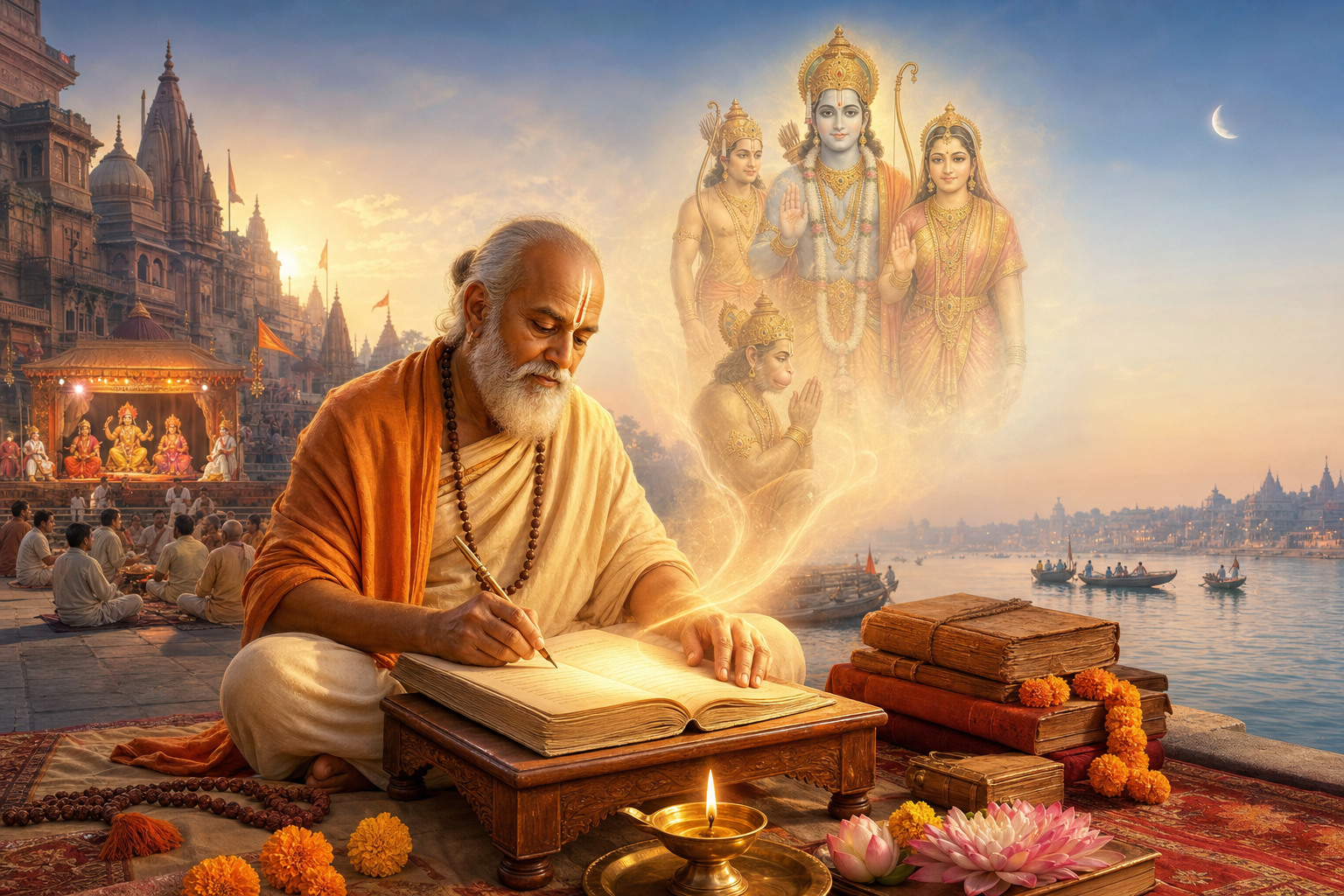
Tulsidas Jayanti 2026 will be observed on Wednesday, August 19, commemorating Goswami Tulsidas, the poet-saint whose Rama-centered devotional literature transformed the religious and literary culture of northern India. The observance falls on Shukla Paksha Saptami in the lunar month of Shravan. Although commonly described as a birth anniversary, it is more fully understood as a celebration of Tulsidas’s poetry, devotion to Lord Rama, ethical vision and continuing influence on literature, music, theatre, pilgrimage and domestic worship.
Tulsidas Jayanti 2026 at a glance: The date is Wednesday, August 19, 2026. The calendrical designation is Shravan Shukla Paksha Saptami, meaning the seventh lunar day of the waxing fortnight of Shravan. The occasion is also called Tulsi Jayanti and Goswami Tulsidas Jayanti. Its central figure is the early modern Hindi poet Tulsidas, best known for the Ramcharitmanas and traditionally associated with the Hanuman Chalisa.
How the 2026 date is calculated
The date changes on the Gregorian calendar because Tulsidas Jayanti is determined by a tithi rather than a fixed solar date. In the technical framework of the Hindu lunisolar calendar, a tithi represents each 12-degree increase in the angular separation between the Moon and the Sun. Thirty tithis constitute a synodic lunar month. Shukla Paksha is the waxing half of that cycle, and Saptami is its seventh tithi. A tithi does not necessarily begin at midnight or last exactly 24 hours, so it can start or end during a civil day.
For New Delhi, the August 19, 2026 panchang calculation identifies the day as Shravan Shukla Saptami and lists Tulsidas Jayanti among its observances. In that location-specific calculation, Saptami remains until approximately 7:19 p.m. local time. Panchang timings depend on longitude, latitude, sunrise and the astronomical model being used. Devotees outside India should therefore consult a reliable local temple calendar or city-specific panchang rather than applying Indian clock times unchanged.
Many festival rules give importance to the tithi prevailing at local sunrise, although detailed conventions can vary among regions and sampradayas. This explains why a religious date may occasionally differ between countries even when the underlying astronomical event is the same. For most Indian calendars consulted for 2026, the civil date is consistently August 19.
Why Tulsidas Jayanti matters
Tulsidas Jayanti honors more than the remembered birth of one individual. It recognizes a historic convergence of poetry, theology, oral performance and vernacular communication. Tulsidas gave the Rama tradition a literary form that could be sung, recited, dramatized and remembered across generations. His work entered temples and scholarly commentaries, but it also entered courtyards, village stages, pilgrimage routes and family gatherings. That ability to move between learned and popular settings remains one of the clearest reasons for his enduring significance.
The emotional power of the observance often lies in cultural memory. For many families, a familiar chaupai recalls the voice of a grandparent, an evening recitation or a community Ramlila. For literary readers, the anniversary invites renewed attention to a major figure in early modern Hindi. For devotees, it offers a day to contemplate bhakti, humility, disciplined speech, seva and the ethical responsibilities represented in the story of Lord Rama.
Biography, tradition and historical uncertainty
A careful account must distinguish documented history from devotional biography. The earliest references to Tulsidas are brief, while fuller life stories developed through later hagiographies and commentarial traditions. Hagiography is not simply failed history; it records how a religious community remembers moral character, sanctity and divine grace. It nevertheless operates by different standards from modern archival biography. Miracles, visions and dramatic turning points should therefore be identified as traditions rather than presented as independently verified events.
The source tradition followed by many festival calendars states that Tulsidas was born in 1497 CE, corresponding to Vikram Samvat 1554, at Rajapur in the Chitrakoot region of present-day Uttar Pradesh. It names Atmaram Dubey as his father and Hulsi as his mother. Rajapur stands near the Yamuna and remains an important center of Tulsidas remembrance. These details are preserved in popular devotional accounts, including the source article on Tulsidas Jayanti.
Modern scholarship does not agree on a single birth year or even an uncontested birthplace. Dates including 1497, 1532 and 1543 appear in respected religious and academic publications. A University of California, Berkeley study of Tulsidas and the Rama tradition notes that scholars have often treated 1532 as the most likely year while emphasizing the scarcity of secure evidence. The Murty Classical Library, by contrast, uses 1543–1623. These differences make it prudent to describe August 19 as the annual commemoration of Tulsidas’s birth without presenting an anniversary number as historically certain.
Some 2026 calendars call the occasion the 529th birth anniversary because they calculate from 1497. That numbering is internally consistent with one traditional chronology, but it should not be mistaken for scholarly consensus. The lunar observance itself does not depend on resolving the disputed civil year: it follows the inherited association of Tulsidas’s birth with Shravan Shukla Saptami.
Traditional narratives describe a difficult childhood and an early attachment to the name of Rama. Later accounts often call him Rambola and identify a teacher named Narharidas, who is said to have introduced him to the Rama story. Tulsidas honors a merciful guru in his poetry, but the historical identification of that guru remains uncertain. The traditions are best read as expressions of a central conviction: sacred teaching, compassionate mentorship and the remembrance of Rama transformed a vulnerable life into one of extraordinary literary productivity.
Another celebrated story concerns his marriage to Ratnavali. In later devotional biography, Tulsidas’s intense attachment to his wife prompted her to urge him toward an equally intense love of Rama. The encounter is remembered as the decisive movement from household attachment to renunciation and total devotion. Its dramatic details expanded in retelling and cannot be independently established, but the story has remained powerful because it translates an abstract spiritual principle into a recognizable human experience: an existing capacity for love is redirected toward a larger and more enduring ideal.
Tulsidas spent a substantial part of his mature life in Varanasi and died in 1623, a date accepted much more widely than his birth year. The honorific Goswami reflects his reception as a religious master and disciplined devotee; it should not be treated merely as a modern surname. Later communities also connected him closely with the Ramanandi tradition, although the precise nature of his institutional or initiatory affiliation remains a subject of historical debate.
Tulsidas in the world of early modern bhakti
Tulsidas wrote during a period of intense literary creativity in northern India. Sanskrit remained a major language of sacred learning, while Awadhi, Braj Bhasha and other regional literary idioms supported expanding traditions of devotional verse, romance, narrative and song. Poet-saints such as Kabir, Surdas, Mirabai and Tulsidas developed distinct voices rather than a single uniform program. Their works nevertheless demonstrate how bhakti could make the relationship between human beings and the divine immediate, emotionally compelling and publicly shareable.
The term bhakti is usually translated as devotion, but its Sanskrit root also carries senses of participation, sharing and belonging. In Tulsidas’s poetry, devotion is not restricted to private emotion. It includes hearing sacred narrative, remembering the divine name, joining the company of devotees, serving others, cultivating humility and orienting conduct toward dharma. This social and participatory dimension helps explain why his compositions traveled so effectively through recitation and collective performance.
Why the language of the Ramcharitmanas was transformative
Tulsidas composed the Ramcharitmanas primarily in Awadhi, while also drawing on Sanskrit learning and the broader multilingual environment of his time. Awadhi was capable of elaborate narrative, sophisticated meter and subtle theological argument. Calling the work merely a simplified version of a Sanskrit epic therefore understates its artistry. Tulsidas did not mechanically translate the Valmiki Ramayana; he created a distinctive Rama narrative with its own framing dialogues, devotional emphasis, poetic architecture and interpretation of divine embodiment.
The choice of a widely intelligible literary vernacular expanded participation in the Rama tradition. The Murty Classical Library’s scholarly edition and translation describes the work as a literary masterpiece, a devotional text and a major compendium of philosophy and sacred lore. Its accessibility did not require intellectual thinness. On the contrary, the poem could be heard as narrative by one audience, contemplated as theology by another and examined as complex poetics by specialists.
Its vernacular form also belonged to a shared North Indian literary world. Research on its metrical organization notes affinities with Awadhi narrative conventions developed in earlier romances, including Sufi premakhyan literature. Recognizing this literary inheritance does not diminish the work’s Hindu devotional identity. It reveals how artistic forms can circulate across communities and be adapted to new theological purposes, producing a cultural heritage richer than rigid civilizational boundaries suggest.
What Ramcharitmanas means
The title Ramcharitmanas, conventionally rendered as the sacred lake of Rama’s deeds, supplies the poem with its governing metaphor. The narrative is imagined as a pure and inviting body of water into which listeners and readers may enter. Its seven books become flights of steps leading toward the lake, its chaupais resemble lotuses and its theological depths cannot be measured by a single approach. This metaphor makes reading participatory: the text is not only information about Rama but a literary environment in which memory, emotion and reflection meet.
The poem itself states that its composition began in Vikram Samvat 1631, corresponding to 1574 CE, on Ram Navami in Ayodhya. Later tradition supplies a precise completion period, but academic research is more cautious and generally holds that the work was completed after Tulsidas moved to Varanasi. The difference illustrates a useful principle: an internally stated starting date can carry stronger historical weight than later biographical details whose textual foundations are less secure.
The seven kandas
The Ramcharitmanas is arranged in seven major sections: Bala Kanda, Ayodhya Kanda, Aranya Kanda, Kishkindha Kanda, Sundara Kanda, Lanka Kanda and Uttara Kanda. Together they move from the theological preparation for Rama’s appearance and his early life through exile, Sita’s abduction, the alliance with Hanuman and Sugriva, the search for Sita, the conflict in Lanka, the return to Ayodhya and extended reflection on devotion, kingship, knowledge and liberation.
The narrative is more intricate than a linear sequence of events. Four prominent dialogical frames involve Shiva and Parvati, Yajnavalkya and Bharadvaja, Garuda and Kakabhushundi, and Tulsidas with his audience. These voices allow the same sacred story to be approached from different levels of knowledge and devotion. The structure also dramatizes a fundamental feature of oral religious culture: meaning emerges through telling, listening, questioning and retelling rather than through an isolated text alone.
The technical craft of Tulsidas’s poetry
The poem’s musicality depends on quantitative meters organized by units called matras. Its narrative frequently proceeds through groups of chaupais followed by a doha or soratha. In standard descriptions, a chaupai has four segments of sixteen matras; a doha normally arranges each line in a 13–11 pattern, while the soratha reverses that cadence to 11–13. These schemes create variation between narrative movement, summary, aphorism and emotional emphasis. Their mnemonic rhythm has helped sustain recitation across centuries.
Tulsidas also worked skillfully across literary registers. Sanskrit invocations establish continuity with learned textual traditions, while Awadhi carries the principal narrative. Braj Bhasha becomes prominent in several other compositions. Simile, alliteration, repetition, dialogue, proverbial compression and shifts in narrative pace enable the poetry to function both as public performance and as close reading. The result is devotional literature whose accessibility is achieved through craftsmanship rather than simplicity alone.
A theological work that resists a single label
The Ramcharitmanas is frequently classified as a classic of saguna bhakti, devotion directed toward a personal divine form with attributes. That description is useful but incomplete. Tulsidas also explores the relation between saguna and nirguna understandings of ultimate reality. The personal Rama who walks through the narrative is simultaneously related to transcendent Brahman. Devotion, knowledge and grace are therefore not presented as mutually exclusive categories.
Rama’s name occupies a particularly important mediating role. The divine name can be spoken, heard and remembered even when philosophical understanding remains incomplete. It gives theological depth to ordinary acts of recitation and makes spiritual practice available in conditions where elaborate ritual or prolonged study may not be possible. This emphasis helps explain why communal chanting and repeated reading became central to the reception of Tulsidas’s works.
Tulsidas’s theology also works toward reconciliation between Shaiva and Vaishnava devotion. Shiva and Parvati are not treated as hostile competitors to Rama; they are honored as authoritative participants in the transmission of Rama’s story. The poem’s narrative framing and invocations create a devotional world in which reverence for Shiva and devotion to Rama illuminate one another. This feature offers a historically grounded basis for celebrating unity without erasing the distinctive practices of different Hindu sampradayas.
Rama is presented as both divine and ethically exemplary, but the poem’s moral world is distributed across many characters. Sita embodies dignity, courage and spiritual strength amid suffering. Hanuman joins extraordinary capability with humility and service. Bharata renounces personal advantage in favor of loyalty and rightful responsibility. Lakshmana demonstrates vigilance and sacrifice. Their relationships allow the narrative to examine duty under pressure rather than presenting dharma as an effortless set of rules.
Like other early modern texts, the Ramcharitmanas also contains passages shaped by the social assumptions and hierarchies of its historical setting. Responsible engagement neither conceals difficult lines nor detaches them from literary and historical context. A sound method compares manuscripts and translations, examines who is speaking, studies the surrounding narrative and considers the history of interpretation. Isolated verses should not be used to humiliate communities or to convert a sacred literary inheritance into an instrument of hostility.
Works beyond the Ramcharitmanas
Tulsidas’s literary achievement extends beyond his best-known epic. Works commonly attributed to him include Vinaya Patrika, Gitavali, Kavitavali, Dohavali, Janaki Mangal, Parvati Mangal, Baravai Ramayana, Ramalala Nahachhu, Ramajna Prashna, Krishna Gitavali, Vairagya Sandipini and Hanuman Bahuk. The IIT Kanpur Ramcharitmanas project provides a concise overview of this corpus and its literary and philosophical importance.
These compositions reveal considerable formal range. Some narrate sacred events; others collect independent lyrics, supplications, moral reflections or intense expressions of physical and spiritual distress. Vinaya Patrika adopts the language of petition and surrender. Kavitavali uses sophisticated quatrain forms and sometimes offers a more personal, late-life voice. Hanuman Bahuk connects bodily suffering with prayer to Hanuman. Taken together, the works show Tulsidas as a versatile poet rather than the author of only one monumental book.
The textual history of Kavitavali also demonstrates why critical scholarship matters. The Oxford critical-edition project has examined dozens of manuscripts and identified shorter and longer recensions containing substantially different numbers of poems. Its research shows how copying, revision, scribal error and deliberate alteration can produce multiple textual forms over time. A printed devotional edition may be spiritually authoritative for its community while still representing one stage in a complex history of transmission.
Tulsidas and the Hanuman Chalisa
The Hanuman Chalisa is traditionally and widely attributed to Tulsidas. Its name refers to its forty principal verses, framed by introductory and concluding dohas. The hymn praises Hanuman’s strength, wisdom, courage, service to Rama and capacity to dispel fear and adversity. Its compact structure, rhythmic language and suitability for individual or collective recitation have made it one of the most recognizable devotional compositions associated with Tulsidas.
On Tulsidas Jayanti, recitation of the Hanuman Chalisa often accompanies readings from the Ramcharitmanas. The pairing is thematically appropriate because Hanuman represents the active form of devotion: knowledge becomes service, power becomes protection and achievement is offered without self-display. This model remains emotionally relatable in workplaces, families and public life, where competence gains moral value when joined to humility and responsibility.
From manuscript to performance and living memory
The influence of Tulsidas cannot be measured by books alone. The Ramcharitmanas circulated through handwritten manuscripts, memorized passages, public exposition, household recitation, music and theatre. Print later multiplied standardized editions, while recordings, broadcasts and digital texts expanded its reach further. Each medium changes the conditions of reception: a manuscript encourages slow study, collective recitation foregrounds sound, performance gives bodies to the narrative and digital search makes thematic comparison easier.
Ramlila is the most visible example of this movement from text to community performance. The UNESCO account of Ramlila explains that many productions draw primarily from Tulsidas’s Ramcharitmanas and combine narration, song, dialogue and dramatic scenes. UNESCO inscribed the tradition on the Representative List of the Intangible Cultural Heritage of Humanity in 2008. Performances may last from approximately ten days to a full month, depending on local practice.
Ramlila also demonstrates the social function of sacred performance. Actors, musicians, craftspeople, organizers and audiences jointly create the event. Masks, costumes, lights and effigies involve forms of inherited practical knowledge. UNESCO’s description emphasizes participation across distinctions of caste, religion and age. This communal dimension is especially relevant to Tulsidas Jayanti because it shows how a devotional text can create shared cultural space rather than remaining the possession of a narrow literary elite.
Sacred geography associated with Tulsidas
Rajapur, Chitrakoot, Ayodhya and Varanasi form the principal geography of Tulsidas remembrance. Rajapur is honored in a major birthplace tradition. Chitrakoot is inseparable from the Rama narrative and its devotional landscape. Ayodhya is associated with the declared beginning of the Ramcharitmanas. Varanasi became the poet’s mature literary and spiritual setting and the place of his death.
Tulsi Ghat in Varanasi bears his name, and religious tradition associates him with the Sankat Mochan Hanuman Temple. Such claims combine history, place-making and devotional memory and should be described with that distinction intact. Their importance does not rest only on proving a single founding event. Sacred sites preserve patterns of pilgrimage, performance, recitation and community identity that have accumulated over centuries.
How Tulsidas Jayanti is observed
There is no single, universally binding liturgy for Tulsidas Jayanti. Practices differ among temples, regions, families and devotional organizations. Common observances include puja to Lord Rama, Sita, Lakshmana and Hanuman; readings from the Ramcharitmanas; recitation of the Hanuman Chalisa; bhajans; katha or scholarly discourse; processions; floral offerings; and community meals. Programs may also explore Tulsidas’s life, the history of Awadhi literature and the ethical themes of his poetry.
At a temple or community center, a thoughtful program can combine devotion with education. A short explanation of Shravan Shukla Saptami may precede the recitation. Selected passages can then be sung in the original language and explained in the language most accessible to the audience. A lecture may distinguish traditional biography from historical evidence, while a children’s activity can explore meter, storytelling or Hanuman’s ideal of service. Concluding with shared food or a service project gives social form to the values being discussed.
A simple home observance may begin with cleaning the prayer space and placing an image or murti of Rama, Sita, Lakshmana and Hanuman, or a respectfully kept copy of the Ramcharitmanas. A lamp, water, flowers and fruit may be offered according to family custom. The household may recite the Hanuman Chalisa, read a chosen passage, sit briefly in silent remembrance and conclude by sharing prasada. The spiritual quality of the observance depends more on attention, reverence and ethical intention than on elaborate display.
Readers with limited time can choose a focused practice. Fifteen minutes may include an opening prayer, the Hanuman Chalisa and one ethical reflection. An hour may add a passage from Bala Kanda, Ayodhya Kanda or Sundara Kanda with commentary. A longer gathering may include sequential readings, music and discussion. Anyone planning an extended or continuous recitation should distribute responsibilities carefully so that pronunciation, rest, hospitality and respect for the text are maintained.
Sundara Kanda is frequently selected because it centers on Hanuman’s journey, discernment, courage and service to Sita and Rama. Bala Kanda offers the poem’s theological and literary foundations. Ayodhya Kanda provides profound material on duty, grief, renunciation and political responsibility. No single selection exhausts the work; the best passage is one that can be read attentively and interpreted responsibly within the time available.
Fasting is not a universal requirement of Tulsidas Jayanti. Some devotees may observe a fast or eat simple sattvic food according to family or sampradaya custom, while others emphasize recitation and seva. Health, age, pregnancy, medication and medical advice should take priority over voluntary austerity. Devotion is not measured by unsafe deprivation, and no one should be pressured into a practice that conflicts with health needs.
Making the observance meaningful for families and younger readers
Tulsidas Jayanti can become a bridge between generations when young participants are invited to ask questions rather than only repeat information. A family might compare the same Rama episode in the Valmiki Ramayana, the Ramcharitmanas and a regional performance tradition. Older relatives can explain where they first heard a particular verse. Children can identify how rhythm assists memory or discuss why Hanuman’s humility matters despite his exceptional power.
Translation should be treated as an aid rather than a sign of inadequate devotion. Tulsidas’s own literary achievement demonstrates the importance of communicating sacred narrative through a language people can understand. Reading an Awadhi passage alongside a reliable Hindi, English or regional-language translation allows pronunciation, meaning and literary texture to reinforce one another. Audio resources can help, but they should supplement rather than replace attentive engagement with the text.
A service activity can prevent commemoration from becoming purely ceremonial. Families or institutions may support literacy, distribute books, provide a meal, assist elders, care for animals or contribute time to a local community need. Such actions should be conducted without publicity-driven humiliation of recipients. Seva most closely reflects Tulsidas’s devotional ethic when competence is joined to humility and the dignity of every person is protected.
Tulsidas Jayanti and unity among Dharmic traditions
Tulsidas belongs specifically to the Hindu tradition of Rama bhakti, and an accurate celebration should preserve that identity. Unity does not require collapsing Hinduism, Buddhism, Jainism and Sikhism into one doctrine. It can instead emerge through respectful study of converging ethical practices: Hindu bhakti and dharma, Buddhist compassion and mindful conduct, Jain ahimsa and aparigraha, and Sikh remembrance of the divine name and seva. These traditions retain distinct scriptures, histories and philosophies while offering resources for disciplined, compassionate life.
The strongest internal precedent for harmony in Tulsidas’s work is his reconciliation of Shaiva and Vaishnava devotion. That model discourages sectarian contempt while permitting real theological difference. Applied carefully in a wider Dharmic setting, it encourages communities to honor one another’s sacred vocabulary, reject mockery, cooperate in service and discuss disagreement without dehumanization. It does not authorize attributing modern interfaith claims to Tulsidas that he did not historically make.
The Rama story itself has a plural literary history. Hindu, Buddhist and Jain traditions developed distinct Rama narratives, each interpreting characters and events through its own ethical and philosophical framework. Acknowledging this plurality does not weaken any one version. It demonstrates the remarkable capacity of a shared narrative world to generate sustained reflection across South Asian traditions. Tulsidas’s Ramcharitmanas is one of the most influential expressions within that larger history.
Why Tulsidas remains relevant in the digital age
Tulsidas offers a powerful lesson in communication: enduring ideas become socially influential when intellectual depth is joined to linguistic accessibility, memorable form and emotional truth. Contemporary educators, spiritual institutions and public communicators face a similar challenge. Specialized knowledge must be translated without being distorted, and broad access must not be confused with superficiality. The Ramcharitmanas demonstrates that vernacular expression can carry demanding philosophy.
Digital access creates new opportunities and responsibilities. Searchable editions, recordings and translations can introduce the text to global audiences, but decontextualized quotations can also circulate rapidly. Readers should verify the kanda and passage, compare editions, inspect surrounding verses and consult informed commentary before drawing sweeping conclusions. Philology, theology, performance studies and lived devotional practice each reveal a different dimension of the work.
His poetry also remains relevant because it does not deny vulnerability. Devotion appears amid separation, moral uncertainty, illness, exile, grief and the limits of human knowledge. The emotional movement is not from effortless certainty to triumph, but from instability toward trust, responsible action and surrender. That pattern continues to speak to readers confronting family strain, public duty, fear or personal loss.
Frequently asked questions
When is Tulsidas Jayanti in 2026? Tulsidas Jayanti will be observed on Wednesday, August 19, 2026. The corresponding lunar date is Shravan Shukla Paksha Saptami. Local tithi timings should be checked through a city-specific panchang.
Is it the 529th birth anniversary of Tulsidas? Calendars using the traditional 1497 CE birth year describe it that way. Scholars disagree about his birth year, with 1532 and 1543 also appearing in major studies and editions. The anniversary number should therefore be identified as tradition-dependent rather than universally settled.
Where was Tulsidas born? Rajapur in the Chitrakoot region of Uttar Pradesh is the best-known birthplace tradition and remains central to annual celebrations. Historical scholarship notes that the surviving evidence does not establish the birthplace with complete certainty, and other locations have also appeared in biographical traditions.
What is Tulsidas best known for? He is best known for the Ramcharitmanas, an Awadhi masterpiece that reimagines the Rama story through a rich devotional and theological framework. The Hanuman Chalisa is also traditionally attributed to him, and his broader corpus includes important works in Awadhi and Braj Bhasha.
Which text should be read on Tulsidas Jayanti? The Ramcharitmanas is central, while Sundara Kanda and the Hanuman Chalisa are especially common choices. Vinaya Patrika, Kavitavali and Dohavali can broaden the observance by revealing Tulsidas’s range as a devotional lyricist, moral thinker and literary craftsman.
Is fasting compulsory? No universal rule makes fasting compulsory for every observer. Recitation, reflection, puja, bhajan and seva are widely meaningful forms of observance. Anyone following a family or temple fasting custom should adapt it responsibly to health needs.
A lasting legacy of devotion, language and service
Tulsidas Jayanti 2026 offers an opportunity to honor a poet whose influence exceeds the boundaries of a single book. His legacy lives in the sound of recited chaupais, the public energy of Ramlila, the intimacy of household prayer, the discipline of textual scholarship and the continuing effort to express profound ideas in an accessible language. The most meaningful tribute is not uncritical praise but attentive reading, historically responsible interpretation, humble devotion and compassionate action.
Observed on August 19, the day can unite literary study with spiritual practice and cultural memory with present responsibility. Tulsidas’s reconciliation of devotional paths, his poetic command of vernacular language and his portrayal of strength governed by service remain especially valuable in a fragmented age. When the commemoration encourages learning, ethical conduct and respect across Dharmic communities, it carries his legacy forward as a living source of wisdom rather than a monument confined to the past.
Research sources: The date and tithi were checked against Drik Panchang. Biographical and theological questions were compared with Vasudha Paramasivan’s University of California, Berkeley dissertation, the IIT Kanpur Ramcharitmanas project, the Murty Classical Library of India and the Oxford Kavitavali critical-edition project. The discussion of Ramlila draws on UNESCO’s Intangible Cultural Heritage record.
Inspired by this post on Hindu Pad.







Leave a Reply
You must be logged in to post a comment.