
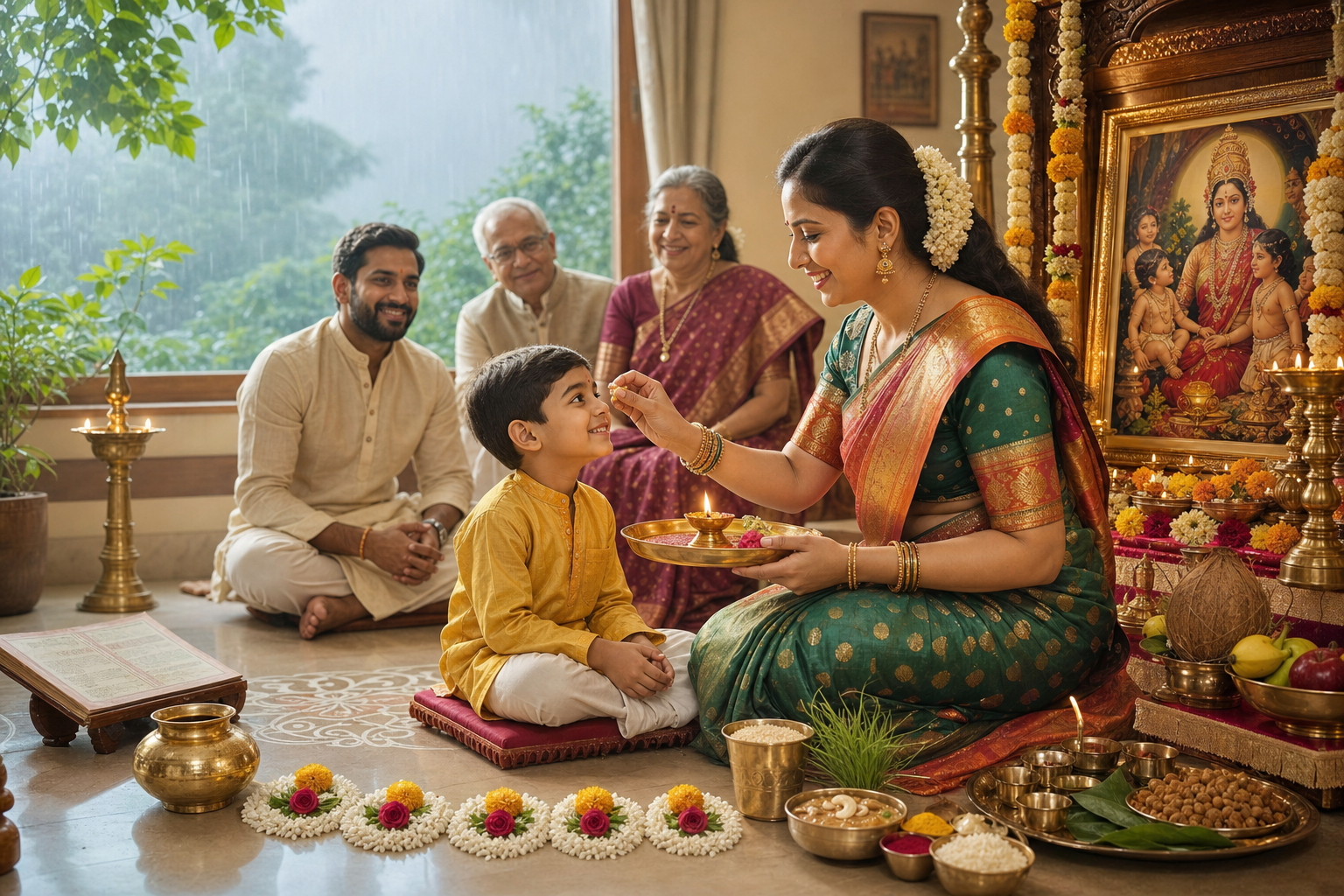
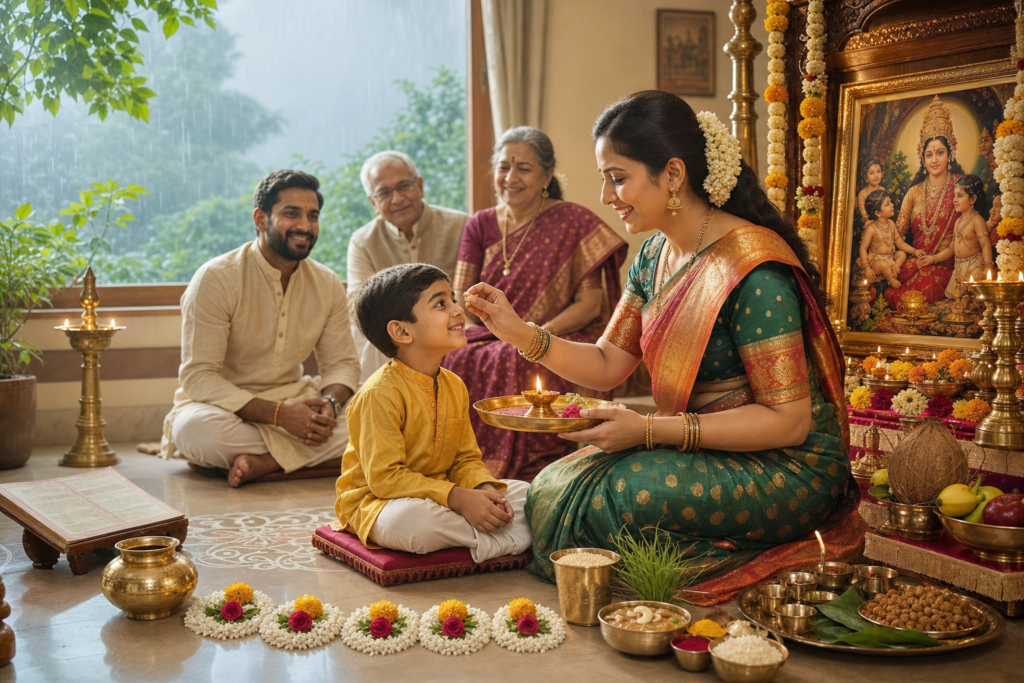
Jivati Puja is one of western India’s most intimate Shravan observances: a household vrata through which maternal care, family responsibility, and devotion are directed toward the well-being of children. Known variously as Jivati Puja, Jiviti Pooja, Jivti Pujan, Jivantika Puja, Jara Jivantika Puja, and Jara Jeevantika Vrata, it is associated especially with Maharashtra and Gujarat. Its most memorable ritual moment is often simple—a lamp is circled before a child, sacred rice is offered as a blessing, and a family pauses to express hopes that are otherwise difficult to put into words.
Jivati Puja 2026 at a glance
In Maharashtra and Gujarat, the five Shravan Fridays in 2026 fall on 14 August, 21 August, 28 August, 4 September, and 11 September. These are the dates generally listed for Jara Jivantika Puja in the western Indian Amanta calendar tradition. Some households worship Jivati Devi on every Friday of Shravan, while others perform the principal vrata on one selected Friday. Both patterns are documented, and inherited family practice normally determines which is followed.
Why the 2026 dates extend into September
The observance is tied to a lunar month rather than to a fixed Gregorian date. Maharashtra and Gujarat generally follow Amanta lunar reckoning, in which a month concludes with Amavasya and the next month begins after it. In 2026, Shravan in this regional system extends approximately from 13 August through 11 September, creating five Fridays within the month. A 2026 Jara Jivantika calendar listing records the same sequence of dates.
This calendar distinction matters because northern Indian Purnimanta calendars place Shravan in a different Gregorian window. Families outside Maharashtra and Gujarat, particularly those living overseas, should therefore use a panchang calculated for their location and their own sampradaya. Sunrise conventions, longitude, and the exact lunar-month boundary can affect observances near the beginning or end of the month.
What Jivati Puja means
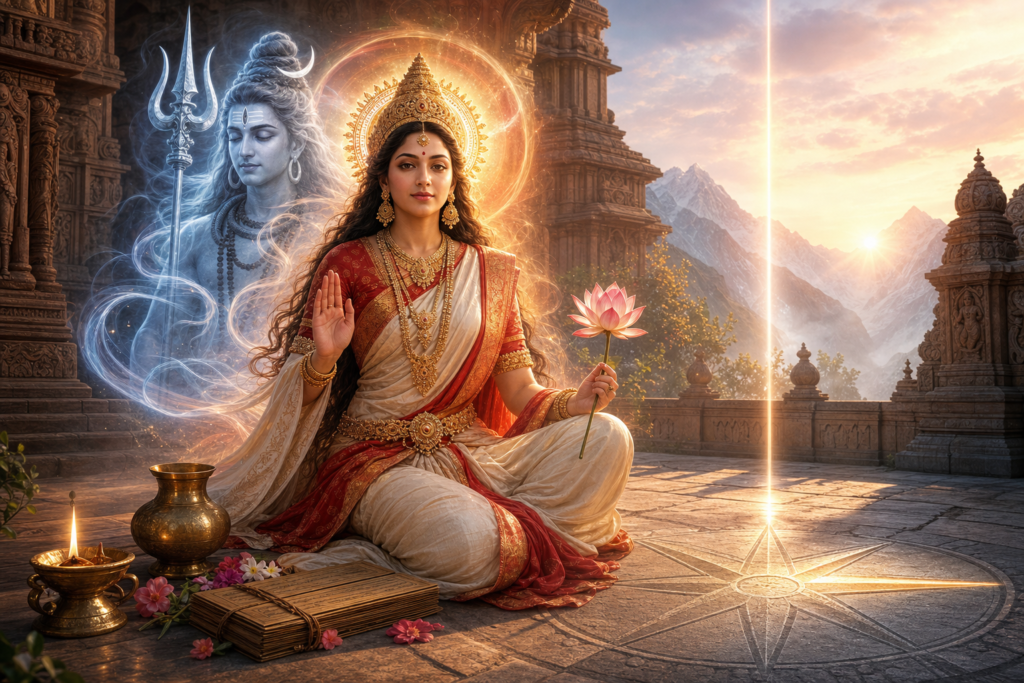
The name Jivantika is connected in devotional usage with life, vitality, and continued well-being. Jivati is consequently revered as a protective mother deity who watches over children. Many popular explanations identify her as a manifestation of Goddess Parvati, while other regional traditions approach her as a distinct guardian goddess within the wider Shakta world. These interpretations need not be forced into a single definition; Hindu regional worship frequently allows a deity to be understood through both local identity and a larger theological relationship.
A vrata is more than a fast. Technically, it is a chosen religious discipline involving intention, regulated conduct, worship, remembrance, food practices, charity, or some combination of these elements. Puja is the act of ceremonial worship within that discipline. Shravan Shukravar Vrat therefore describes the Friday observance as a whole, whereas Jivati Puja refers more specifically to worship of the goddess.
Traditional descriptions place married women, especially mothers, at the centre of the vrata. Some families also observe it while praying for the blessing of children. This is a statement about historical ritual practice, not a claim that caregiving belongs only to women. Fathers, grandparents, siblings, and children can participate in the household prayer, preparation, hospitality, and acts of service while respecting the form transmitted through the family.
For a parent, the observance can carry a powerful emotional weight. The ritual does not pretend that family life is free from uncertainty; it gives uncertainty a disciplined form. Concern becomes prayer, food becomes hospitality, and protective instinct becomes a public commitment to nurture a child with attention and compassion.
A historical and seasonal perspective
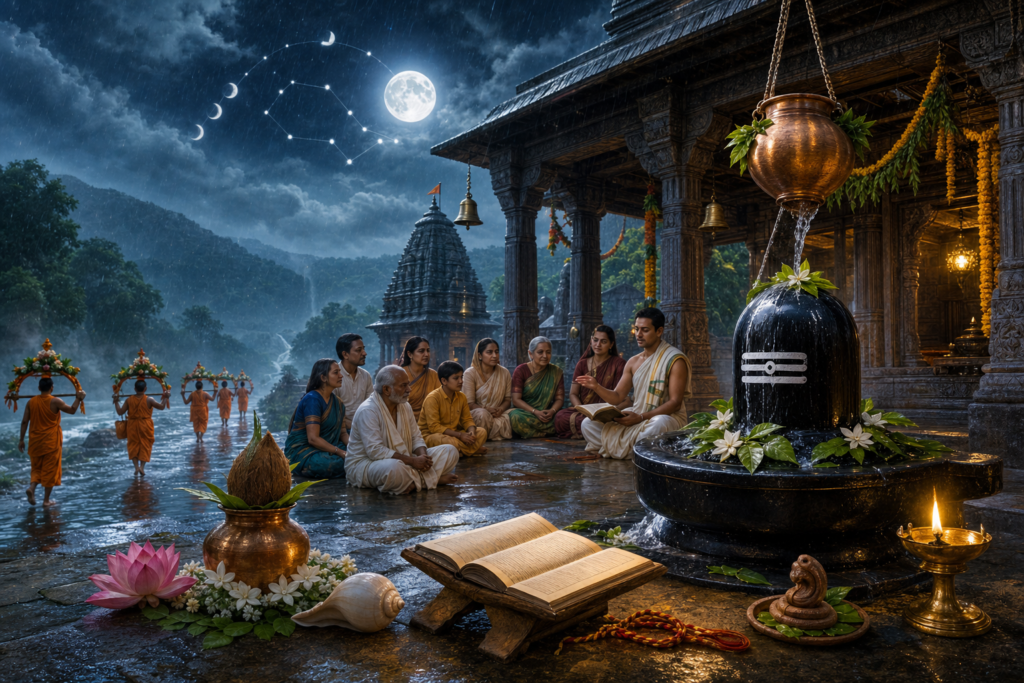
Shravan overlaps with the monsoon in much of western India. Historically, rain, contaminated water, infectious disease, difficult travel, and limited medical access could make childhood especially precarious. It is understandable that a guardian-deity tradition focused on children acquired particular force during this season. This seasonal context offers a persuasive cultural interpretation, although it should not be presented as a conclusively proven single origin for the vrata.
Ethnographic scholarship on rural Maharashtra places Jivantika within a broader field of protective mother deities, fertility customs, birth rituals, and family narratives. Such research shows that apparently domestic ceremonies can preserve memories of vulnerability, social organization, gendered labour, and the emotional experience of caregiving. It also shows why local practice may differ by region, community, and household even when the deity’s protective purpose remains recognizable.
Religious belief and medical care serve different functions. Jivati Puja may provide spiritual reassurance and reinforce careful parenting, but it is not a substitute for vaccination, nutritious food, safe drinking water, supervision, prenatal care, or timely treatment by qualified health professionals. A responsible observance treats these practical duties as part of protecting life rather than as competitors to faith.
Understanding the traditional Jivati image
Many Maharashtrian homes worship a printed Jivati image rather than a three-dimensional murti. The widely circulated sheet is visually dense: it commonly brings together Narasimha, Krishna subduing Kaliya, Jara-Jivantika with children, and Budha and Brihaspati. A contemporary Marathi account of the image interprets this sequence as a complete vision of protection, longevity, education, and mature character.
Narasimha and protection in moments of crisis. Narasimha appears because the Vishnu avatara protects the child devotee Prahlada from Hiranyakashipu. In popular interpretation, this panel represents rescue from dangers that can arise suddenly within the apparently secure sphere of home and family. The emphasis is not fear for its own sake, but confidence that vulnerability is worthy of immediate protection.
Krishna and Kaliya as protection beyond the home. The Kaliya episode places the youthful Krishna amid water, play, companions, and a dangerous serpent. Popular Jivati exegesis reads it as protection from hazards encountered while children explore the world. The image also contains an ethical nuance: Krishna restrains Kaliya and orders him to depart rather than treating destruction as the only possible response. Protection and measured compassion therefore appear together.
Jara and Jivantika as sustaining maternal powers. The central figures are commonly shown caring for or playing with children. The Mahabharata account of the yakshini Jara, who joins the two halves of the infant later named Jarasandha, is sometimes used to explain her association with restored life. Jivantika is understood as the power that sustains life and guards childhood. This connection belongs to popular interpretation; it should not be treated as proof that every element of the poster originated in a single scriptural passage.
Budha and Brihaspati as intellectual and ethical guidance. The planetary deities at the bottom of the image broaden the prayer beyond physical survival. Budha is associated with intelligence, expression, and discernment, while Brihaspati represents knowledge, education, counsel, and spiritual maturity. Their presence suggests that a child’s flourishing includes the formation of judgement and character, not merely the avoidance of danger.
Read as a whole, the image follows a meaningful progression: immediate protection, preservation of life, intellectual development, and wise adulthood. That sequence helps explain why a small household print can function as a compact theology of caregiving. It asks not only that a child live, but that the child grow into a thoughtful and responsible person.
Scriptural attribution and the limits of certainty
Several devotional guides attribute Jara Jivantika Vrata to the Skanda Purana. Precise recension, khanda, and chapter references are often absent from modern summaries, however, and the Skanda Purana exists in a complex textual history with substantial regional variation. An academic description should therefore call this a traditional attribution rather than presenting an unverified chapter reference as settled fact.
The worship is also part of living folk religion, which means oral narratives, family instructions, illustrated prints, and regional ritual manuals are important sources alongside Sanskrit texts. A practice does not become culturally insignificant merely because every detail cannot be traced to one canonical verse. Its continuity may instead rest on repeated household transmission and the meanings families have cultivated around it.
The Jivantika vrata katha
An older documented version of the Friday vrata story concerns a child separated from his birth mother and raised in a royal household. His mother continues the Shravan Friday discipline and casts a blessing of rice for him even though she does not know where he is. Jivantika’s protection follows the child during his travels, and the rice blessing eventually helps reveal his true parentage. Recognition leads to reunion, restored dignity, and care for the family from whom he had been separated.
The narrative’s central message is that responsible love is not cancelled by physical distance. Maternal intention reaches beyond the visible household, while truth eventually repairs a broken relationship. B. A. Gupte recorded a version in Hindu Holidays and Ceremonials, published in its revised second edition in 1919. As with any early ethnographic collection, its historical vocabulary and social assumptions should be read critically rather than treated as timeless ritual law.
The Jivantika Friday story should not be confused with Jivitputrika or Jitiya Vrat, an Ashwin observance prominent in Bihar, Jharkhand, eastern Uttar Pradesh, and Nepal. Both express concern for children, but their calendar dates, narratives, regional settings, and ritual disciplines are distinct.
Regional diversity in Maharashtra and Gujarat
In many Maharashtrian homes, the Jivati print is installed near the household shrine at the beginning of Shravan. Friday worship may include a flower-and-durva garland, haldi-kumkum, akshata, a cotton ornament, arati, naivedya, aukshan of children, and hospitality for married women. Puran Poli or a more elaborate festive meal may be prepared where family custom requires it.
Vidarbha and the Zadipatti cultural region preserve additional artistic forms associated with the name Jivati. The Marathi Vishwakosh account of जिवती describes wall drawings connected with Shravan Bal, parents, serpents, fields, trees, the sun, and the moon. This regional observance occurs around the transition into Shravan and should be recognized as a related but distinctive local expression rather than automatically merged with every Friday-puja procedure.
In Gujarat, Jivantika Mata is likewise approached as a guardian of children, and Shravan Friday worship is found in both household and temple settings. Gujarati practice may differ in food, language, image style, vows, and community participation. Shared dates and a shared protective theme do not imply that every Maharashtrian instruction must be copied into a Gujarati home.
This diversity is characteristic of Hindu tradition. Kuladharma, kulachar, regional panchang, the guidance of elders, and the resources available to a household can all shape the ritual. No single internet checklist should erase a carefully transmitted family practice.
Jivati Puja preparation and materials
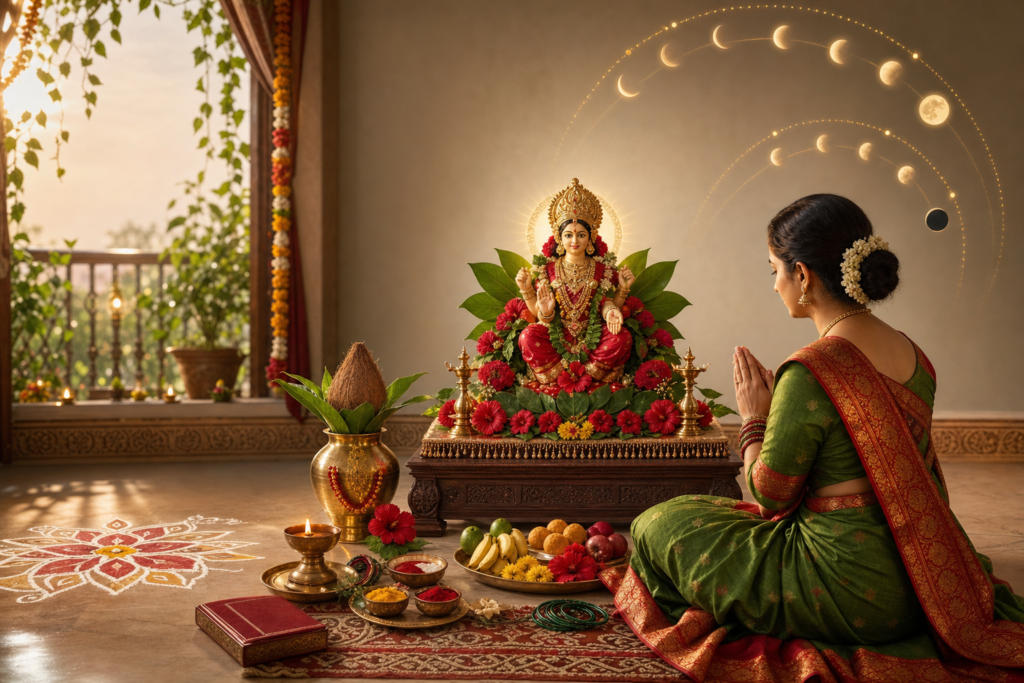
A practical home observance may use a clean Jivati image, a stable lamp, cotton wicks, oil or ghee, water, sandalwood paste or another customary gandha, haldi, kumkum, akshata, locally appropriate flowers, durva, incense if normally used, fruit, betel leaves and nut where customary, and a simple naivedya. Milk with sugar, roasted gram, jaggery with coconut, or a family sweet are common options. Elaborate purchasing is not a requirement for sincere worship.
Some Maharashtrian procedures add aghada leaves, a combined flower-and-durva garland, or a cotton ornament formed with twenty-one marked sections. These are meaningful regional details, not universal tests of validity. When a prescribed plant is unavailable, a household should follow informed family or priestly guidance rather than using an unidentified or unsafe substitute.
1. Establish the household procedure. Before the first Friday, the family determines whether its custom requires all Shravan Fridays, the first Friday, or one chosen Friday. It also establishes whether a formal fast, invited meal, katha, or concluding image retirement belongs to the vrata. This preliminary clarity prevents a mixture of unrelated instructions gathered from different regions.
2. Prepare the worship space. The shrine area is cleaned, and the image is placed securely at a respectful height. Some families attach the print near the devghar at the beginning of Shravan; others bring it out only for the puja. A small rangoli may be drawn if customary, while the lamp is positioned so that children, fabric, paper, and loose hair remain safely away from the flame.
3. Bathe and make the sankalpa. After ordinary personal purification, the principal devotee states the intention of the vrata: worship of Jivantika during Shravan for the welfare, sound judgement, safety, and ethical growth of the children and family. The sankalpa may include the names of children who live elsewhere. An inherited Sanskrit or vernacular formula may be used when available, but a sincere and precise prayer in the household’s language is also meaningful in informal worship.
4. Light the lamp and begin with customary invocations. Many households first remember Ganesha, the family deity, the guru tradition, and protective deities before approaching Jivati. The sequence varies. The lamp signifies attentive presence and continuity of life; it should be treated both as a sacred symbol and as an actual flame requiring supervision.
5. Offer the basic upacharas. Gandha, haldi-kumkum, akshata, flowers, durva, incense, lamp, and naivedya are offered according to household practice. A simple panchopachara form is sufficient where no elaborate vidhi has been inherited. The original source itself notes that no single universally binding procedure governs Jiviti Puja.
6. Recite the prayer or mantra. A commonly cited short invocation is Om Shri Jivantikayai Namah. Some Marathi ritual guides also prescribe the following verse: जरे जीवन्तिके देवी बालयुक्ते प्रमोदिनी | रक्षाव्रते महाशक्ती पूर्णकामे नमोस्तुते | Its sense is a salutation to the mighty and joyful Jivantika associated with children, protection, and the fulfilment of worthy intentions. Recitation 108 times is a published practice, but the number should not be presented as universal where family custom differs.
7. Read or narrate the vrata katha. The Friday story can be read in Marathi, Gujarati, Sanskrit, Hindi, English, or the language best understood by the family. Comprehension matters because the katha communicates the ethics of steadfast care, truthful identity, generosity, and responsibility. Mechanical recitation without explanation is less educational for younger participants.
8. Perform arati and aukshan. After worship, children may be seated safely and honoured through aukshan. Kumkum and akshata are applied where culturally and personally appropriate, and blessed rice may be placed gently on or above the head. The gesture expresses prayer and affection; it should never frighten a child or involve smoke, flame, or substances that trigger an allergy.
9. Offer and distribute naivedya. Milk and sugar, roasted gram, fruit, jaggery-coconut, or a family preparation may be presented and then shared as prasad. Hygiene remains essential, especially where milk is used during warm and humid weather. Food that has spoiled should not be consumed merely because it was ceremonially offered.
10. Extend hospitality where customary. Some procedures invite five married women who have children, apply haldi-kumkum, and offer milk, sugar, roasted gram, food, or a respectful gift. Other families honour one suvasini or host relatives. This category belongs to a particular historical ritual grammar and should never be used to diminish unmarried, widowed, divorced, childless, or otherwise differently situated women.
11. Conclude with gratitude. The prayer closes with remembrance of the family deity, ancestors, teachers, caregivers, and all who protect children in practical life. Where the same image remains installed throughout Shravan, it is worshipped again on the following Friday. Some Maharashtrian families turn or remove the paper at Shravan Amavasya and retire it respectfully the next day.
Fasting rules and responsible observance
Accounts of Jara Jivantika Vrat describe several food disciplines. Some devotees avoid cooked food and take fruit and water; some observe a lighter fast until the evening puja; some prepare a full ritual meal; and some emphasize worship without a restrictive fast. The coexistence of these practices confirms that there is no single rule suitable for every lineage or body.
Pregnant or breastfeeding women, children, older adults, people with diabetes, those taking medication, and anyone with an eating disorder or other relevant medical condition should not undertake a restrictive fast without appropriate medical guidance. The purpose of a life-affirming vrata is not served by preventable harm. A modified discipline—such as simple food, reduced indulgence, prayer, charity, or dedicated caregiving—can preserve the ethical intention when fasting is unsafe.
Some online descriptions mention red clothing, avoidance of social functions, or night-long wakefulness. These are local or source-specific observances rather than universally documented requirements. Families should not treat them as compulsory unless they belong to their established vrata tradition.
Traditional foods and their social meaning
Common offerings include milk with sugar, roasted chana or फुटाणे, jaggery and coconut, fruit, and sweets. Some Maharashtrian households prepare Puran Poli or a festive meal containing varan-bhat with ghee, vegetables, puran, kheer, chutney, and other family dishes. A preparation called आरत्या is also described in some Marathi instructions as small crisp fried breads made from wheat dough enriched with jaggery and ghee.
Food serves three connected purposes: it is offered as naivedya, shared as prasad, and used to welcome others. The movement from shrine to family to guest turns private concern into social nourishment. The deepest value lies in sharing safely and without waste, not in displaying expense.
One Friday or every Friday?
Published descriptions differ because they record different household traditions. One pattern installs or draws Jivati on the first Friday and worships her on every Friday of Shravan. Another performs a principal puja on any one Shravan Friday. A third maintains simple weekly worship but hosts the special meal or haldi-kumkum gathering only once. None of these variations should be declared false without examining the family’s kulachar.
For a family beginning without an inherited procedure, the most defensible approach is a simple Friday puja with a clear sankalpa, basic offerings, prayer, child-centred blessing, and prasad. Guidance from a trusted elder or knowledgeable local priest can then determine whether a more formal vrata should be adopted in future years.
When children live far away
Marathi custom records a symbolic practice in which akshata is offered toward the directions when children are away from home. A modern household may also name each absent child in the sankalpa and contact the child after worship. The enduring principle is remembrance across distance, not a claim that ritual action eliminates ordinary responsibility for communication, care, and emergency planning.
Can the entire family participate?
Traditional leadership by married women can be honoured without making everyone else passive. Other family members may clean the shrine, prepare food, supervise lamps, read the katha, arrange charitable service, or help younger children understand the symbols. Such participation makes visible the truth that child welfare is a shared obligation even when the vrata preserves a specifically maternal form.
Environmentally responsible completion
If a paper image is retired after Shravan, local temple and municipal guidance should be followed. Plastic lamination, synthetic cloth, foil, and chemically printed paper should not be placed in rivers, lakes, or soil. Natural flowers can be composted where feasible, clean uncoated paper can be handled respectfully according to local practice, and reusable worship materials can be retained. Reverence for a protective goddess is consistent with protecting the water and land on which children depend.
Jivati Puja and unity across Dharmic traditions
Jivati Puja is a specifically Hindu and regionally rooted observance; unity does not require erasing that identity. Its governing values—care for vulnerable life, disciplined intention, generosity, truthfulness, non-harm, and intergenerational responsibility—are nevertheless intelligible across the wider Dharmic landscape of Hinduism, Buddhism, Jainism, and Sikhism. The vrata is best presented through respectful self-understanding, without denigrating another deity, sect, community, or spiritual path.
Frequently asked questions
Is Jivati Puja performed only by mothers? Traditional accounts focus on married women and mothers, while some also mention women praying for children. Informal family prayer can include all relatives. Rules for formally adopting the vrata should follow the relevant family or sampradaya rather than assumptions made from a generalized online article.
Is there an exact Jivati Puja muhurta? The defining calendar condition is Friday during Shravan in the applicable regional calendar. Some families worship after the morning bath, while others perform arati near the evening lamp-lighting time. A local panchang and inherited custom take priority where a precise time is required.
Must a new image be purchased every year? Practices differ. Some families install a fresh paper image and retire it after Shravan; others preserve a framed image and use it annually. A family’s established method is more authoritative for that household than a commercial expectation to buy new materials.
Can the puja be performed without elaborate offerings? Yes, according to descriptions that emphasize the absence of one fixed vidhi. A clean space, lamp, water, flowers or another respectful offering, simple naivedya, prayer, and compassionate intention can form a coherent home puja. Financial strain is neither a devotional requirement nor a measure of sincerity.
Does the vrata guarantee a child’s health or conception? Devotional traditions speak of Jivantika’s blessings for children and, in some accounts, for couples seeking children. These are matters of faith rather than medically testable guarantees. Fertility concerns, pregnancy, and childhood illness require appropriate professional care alongside any spiritual observance.
Can Jivati Puja be observed outside India? Yes, but the household should verify the lunar month using a location-specific panchang. Safe substitutes may be used for unavailable flowers or foods under informed guidance, and environmental regulations should be respected. The essential elements of remembrance, protection, gratitude, and responsible care do not depend on geographical proximity to Maharashtra or Gujarat.
The enduring significance of Shravan Shukravar Vrat
Jivati Puja endures because it joins theology to ordinary family life. Its lamp evokes continuity, its image gathers several forms of protection, its katha honours devotion across distance, and its food transforms prayer into hospitality. At its most thoughtful, the vrata asks adults to do more than desire a child’s welfare: it asks them to build the conditions in which children can be safe, educated, compassionate, and resilient.
For 2026, the relevant Fridays in Maharashtra and Gujarat are 14 August, 21 August, 28 August, 4 September, and 11 September. Whether a household observes one Friday or all five, simplicity, factual understanding, health-conscious practice, and fidelity to family tradition provide a sound foundation for worship.
Reference note. The core description and date claim were compared with the full source article on Jiviti Puja, regional Marathi accounts, calendar listings, B. A. Gupte’s historical folklore collection, and scholarship on protective mother-deity traditions in Maharashtra. These sources document a living and variable practice; they do not establish one compulsory ritual for every Hindu household.
Inspired by this post on Hindu Pad.




Leave a Reply
You must be logged in to post a comment.