
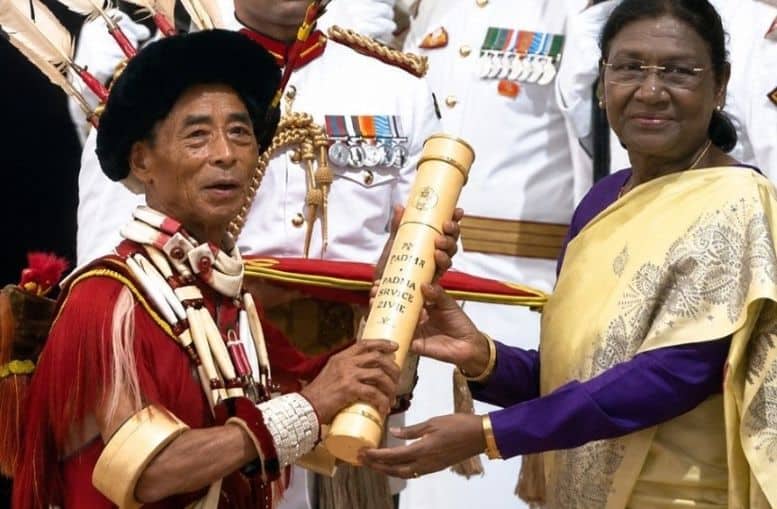
On 23 June 2026, President Droupadi Murmu conferred the Padma Shri on Guru Sangyusang S. Pongener during the second Civil Investiture Ceremony at Rashtrapati Bhavan. The honour, presented in the field of Art, recognized more than six decades of work devoted to Ao Naga songs, dances, theatre, oral traditions, and community-based cultural education. The official Padma Awards announcement identified him as an awardee from Nagaland, while the investiture gave national visibility to a cultural mission that had developed quietly over generations.
The ceremony was a landmark, but it was not the beginning of Pongener’s significance. Long before the Padma Shri brought renewed attention to his name, he had become a performer, composer, theatre practitioner, teacher, organizer, and custodian of Ao Naga folk heritage. His achievement lies not simply in retaining a collection of old songs. It lies in sustaining the human relationships through which cultural knowledge is remembered, interpreted, practised, corrected, and entrusted to another generation.
The emotional force of this work is readily understood. When an elder who carries an unwritten song, ceremonial sequence, movement vocabulary, or oral history dies without transmitting that knowledge, a community may lose something that cannot be reconstructed from a textbook. Pongener recognized this danger early. Rather than treating modernization as an excuse for cultural amnesia, he responded by creating opportunities for young people to encounter their inheritance as a living practice.
A Life Formed in Ungma
Sangyusang S. Pongener was born on 23 March 1945 in Ungma village in Nagaland’s Mokokchung district. Ungma is widely regarded as one of the oldest Ao Naga settlements, and its community life gave him sustained exposure to folk songs, collective dances, festivals, storytelling, customary practices, and the social meanings attached to performance. Public biographical accounts record that he attended Government Middle School in Ungma, continued his secondary education at Mayangnokcha Government Higher Secondary School in Mokokchung, and later pursued studies associated with Gauhati University.
His most consequential education, however, occurred within the community. Pongener learned by listening to elders, observing performers, repeating songs and movements, and understanding when and why particular forms were used. This was not informal learning in the sense of being unstructured or insignificant. It was a disciplined oral pedagogy in which accuracy depended on attention, memory, repetition, participation, and correction by knowledgeable cultural bearers.
Such an education transmits more than lyrics or choreography. A learner must absorb pronunciation, vocal inflection, rhythm, posture, formation, gesture, etiquette, costume, occasion, and collective responsibility. Meaning often resides in the relationship between these elements. A song detached from its social setting may retain its melody while losing much of its historical or ethical content. Pongener’s training among elders therefore gave him access not only to artistic forms but also to the cultural grammar that made those forms intelligible.
As social conditions changed, the environments that had supported this transmission also began to change. Formal education, migration, new occupations, urbanization, recorded entertainment, and altered patterns of community gathering created opportunities for younger generations, but they also reduced the time available for sustained learning from elders. Pongener did not frame tradition and modern life as irreconcilable opposites. His response was practical: traditional knowledge had to be taught deliberately if it was no longer being absorbed automatically through everyday community life.
From Cultural Concern to a Lifelong Vocation
Accounts of Pongener’s journey describe a consequential personal choice. He left the security of stable employment and committed himself to cultural work despite limited financial support and questions about the practicality of that decision. The sacrifice matters because heritage conservation is often celebrated only after decades of poorly funded labour have already been performed. Before awards, institutional recognition, or national ceremonies, there are usually years of travel, rehearsal, note-taking, teaching, persuasion, and community organizing.
For more than sixty years, Pongener worked across several connected fields. He performed Ao Naga folk arts, learned and recalled oral material, composed new culturally grounded songs, participated in theatre, directed productions, mentored performers, and helped organize public cultural programmes. The breadth of these activities is important. A tradition survives more securely when it has several channels of transmission rather than depending on a single performer or an occasional commemorative event.
Approximately sixty original cultural songs are attributed to him in published biographical accounts. Their value is not confined to the number of compositions. They demonstrate that safeguarding heritage need not mean mechanically reproducing a fixed past. A living tradition can support creativity when new work remains informed by inherited language, aesthetics, social memory, and community standards. Composition, in this sense, becomes both artistic expression and cultural continuity.
Pongener’s contributions to folk theatre and dance extended the same principle into embodied performance. As an actor and director, he used the stage to communicate narratives, customs, moral reflection, and collective memory. Theatre can make cultural knowledge visible in ways that a written description cannot: relationships appear through dialogue, values emerge through conflict, and social history is communicated through voice, movement, clothing, music, and interaction.
This multidimensional approach is particularly relevant to Ao Naga folk heritage because oral traditions, performing arts, social practices, and community events cannot always be separated into self-contained categories. A song may also preserve a narrative; a dance may encode collective organization; clothing may indicate identity or occasion; and a performance may draw meaning from the place and community in which it occurs. Pongener’s work has treated these elements as parts of an interconnected cultural system rather than isolated entertainment products.
The Naga Wadir Welfare Cultural Club
A decisive institutional step came in 1982, when Pongener co-founded the Naga Wadir Welfare Cultural Club. He has served as its General Secretary since its inception, using the organization to promote folk dance, music, community events, training, and cultural preservation. The club gave an enduring organizational form to work that might otherwise have depended entirely on individual availability and memory.
The official 2026 Padma awardee profile credits his leadership with training more than 2,000 young artists and mentoring over 100 apprentices. It also records that his original compositions have been presented on local, national, and international platforms. These figures reveal the scale of the transmission network built around his work: the achievement is measured not only by performances completed but also by people equipped to perform, teach, and interpret the tradition themselves.
Institution-building is technically important in heritage safeguarding. A capable organization can maintain rehearsal schedules, identify knowledgeable elders, connect teachers with learners, provide performance opportunities, preserve records, coordinate travel, and create continuity when individual circumstances change. It can also distribute responsibility across a community. This reduces the danger that an entire body of knowledge will disappear when a single custodian is no longer able to teach.
The club’s role also complicates the popular image of one heroic individual rescuing a tradition alone. Pongener’s leadership has been central, but cultural transmission is necessarily collective. Elders taught him; colleagues helped build the institution; performers rehearsed and presented the material; families supported learners; audiences gave performances social relevance; and successive students carried knowledge forward. The Padma Shri therefore honours an individual while also illuminating the community relationships that made his work possible.
How Living Heritage Is Actually Transmitted
Since 2024, Pongener has also mentored young people through the Government of India’s Kala-Deeksha programme under the Ministry of Culture. This role connects community-rooted knowledge with a more formal cultural initiative. It also recognizes an essential principle: expertise in an oral and performative tradition cannot be transferred adequately through lectures alone. Learners require sustained proximity to an experienced practitioner, repeated practice, correction, and opportunities to perform within meaningful contexts.
Much of this expertise is tacit. A written score may preserve a sequence of notes, but it may not capture vocal texture, breath, emphasis, timing, or the interaction between a lead singer and a group. Video may record movement, but it cannot by itself explain why a gesture is appropriate, how a formation changes, or what responsibilities accompany a performance. The mentor must interpret the form, explain its context, identify errors, and help the learner develop judgment rather than mere imitation.
Pongener’s practice closely illustrates the broader concept of intangible cultural heritage. Under UNESCO’s 2003 Convention, living heritage includes practices, expressions, knowledge, skills, associated objects, and cultural spaces that communities recognize as part of their inheritance. Its principal domains include oral traditions, performing arts, social practices, festive events, knowledge concerning nature, and traditional craftsmanship. Ao Naga cultural practices should not be assumed to hold any particular UNESCO listing; the framework is useful because it explains why transmission, community participation, and continuing practice matter.
In professional heritage practice, safeguarding is often a more precise term than preservation. Preservation can suggest keeping an object unchanged, whereas living heritage is repeatedly recreated by the people who practise it. Safeguarding therefore aims to maintain the conditions under which a community can continue to learn, perform, interpret, and renew a tradition. Pongener’s combination of mentorship, composition, performance, theatre, and organizational leadership reflects this dynamic model.
An archive remains valuable, but an archive alone is insufficient. A recording can preserve the sound of one performance while leaving unanswered questions about language, context, variation, audience, ownership, and occasion. The more durable method combines documentation with active teaching. Recordings support memory; written notes clarify context; public performances sustain relevance; and apprenticeship develops new practitioners capable of carrying the tradition beyond the lifespan of any document.
Institutions seeking to extend Pongener’s legacy can draw a practical documentation model from this insight. Each audio or video record should ideally include the name of the form, performer and teacher; the language and textual meaning; the date, place, and social occasion; musical or movement structure; costume and instrument details; known variants; restrictions on access; and community-approved conditions for reuse. Consent and cultural ownership must be treated as foundational requirements rather than administrative afterthoughts.
A strong training curriculum would likewise move through several stages: attentive observation, guided repetition, contextual explanation, ensemble practice, public presentation, reflective feedback, and eventual responsibility for teaching others. This is an analytical model rather than a claim about the precise syllabus Pongener follows. It helps explain why his mentorship has had lasting influence: a successful learner does not merely reproduce one performance but acquires enough understanding to become another link in the chain of transmission.
Digital media can strengthen that chain when used responsibly. High-quality recordings can preserve vocal and movement detail; searchable catalogues can connect dispersed community members with cultural material; and online lessons can support learners who live away from their villages. Yet technology also creates risks of decontextualization, unauthorized circulation, commercial exploitation, and the elevation of one recorded version into an artificial standard. Community governance must therefore guide what is recorded, who may access it, and how it may be presented.
A Record of Recognition
National recognition of Pongener’s work began decades before the Padma Shri. In 2002, he received the Sangeet Natak Akademi Award for his contribution in the traditional performing-arts field. The honour is especially significant because the Sangeet Natak Akademi recognizes sustained excellence in music, dance, theatre, and traditional performing arts, including the contribution made through teaching and scholarship.
The official Padma profile records that the North East Zone Cultural Centre, in collaboration with Indira Gandhi National Open University, conferred the title of Guru on him in 2012. In 2017, the Government of Nagaland honoured him with the Governor’s Award in Art and Music. Together, these distinctions show a widening circle of recognition: first through the performing-arts establishment, then through regional cultural and educational institutions, the state government, and finally the national civilian honours system.
The Padma Awards 2026 were announced on 25 January 2026. The official list comprised 131 awards, including 113 Padma Shri honours, and named Sangyusang S. Pongener in the field of Art, representing Nagaland. President Droupadi Murmu formally presented his award on 23 June at the Ganatantra Mandap of Rashtrapati Bhavan. Akashvani News reported that he received a warm welcome in Dimapur after returning from New Delhi.
The Padma Shri is India’s fourth-highest civilian honour, but its deeper value in this case lies in what it makes visible. Folk practitioners often work far from major institutions, commercial markets, and metropolitan cultural circuits. National recognition can direct public attention toward their communities, strengthen the legitimacy of traditional pedagogy, encourage young learners, and remind policymakers that cultural infrastructure includes living teachers as well as buildings and archives.
An award, however, cannot substitute for transmission. Ceremonies create attention; sustained teaching creates continuity. The real measure of Pongener’s legacy will be whether learners continue to sing, dance, perform, research, document, and teach with cultural understanding. His decades of work have already created a substantial foundation, but living heritage must be renewed whenever another generation chooses to accept responsibility for it.
Why His Work Matters to Bharat
Pongener’s story broadens the understanding of Bharat’s cultural heritage. National culture is not a uniform collection assembled from interchangeable parts. It is a living network of regional, linguistic, tribal, indigenous, artistic, philosophical, and religious traditions. Hindu, Buddhist, Jain, Sikh, tribal, and other community inheritances contribute to this civilizational plurality without needing to surrender their distinct identities. Genuine cultural unity grows through knowledge, respect, and reciprocal recognition rather than the flattening of difference.
Ao Naga folk heritage must therefore be encountered on its own terms, with the community remaining central to interpretation. National appreciation becomes meaningful when it supports local agency instead of appropriating cultural forms as decorative symbols. Pongener’s work offers a constructive model: it begins with elders and community memory, builds capable local institutions, trains young people, and then carries the tradition to broader platforms without severing it from its roots.
His recognition also challenges the tendency to treat Northeast India as peripheral to the national cultural narrative. Nagaland’s traditions are not supplementary material added to a supposedly complete account of Indian culture; they are part of the substance of that account. The Padma Shri directs attention toward the intellectual, artistic, and pedagogical contributions of communities whose knowledge has often circulated more strongly through oral and performative channels than through widely distributed written texts.
Language is central to this process. Oral traditions live through sound, metaphor, rhythm, memory, and culturally specific meanings that may resist simple translation. Safeguarding a song consequently requires more than preserving its tune. It requires attention to the words, pronunciation, narrative setting, social function, and knowledge needed to interpret it. Pongener’s emphasis on learning from elders and teaching young practitioners helps protect this relationship between language and performance.
His career also suggests several priorities for cultural policy: long-term support for senior practitioners; fellowships that allow apprentices to train intensively; community-controlled audiovisual archives; partnerships between villages, schools, universities, and cultural institutions; regular performance opportunities; accurate contextual documentation; and ethical rules governing access and reuse. Short festivals can raise awareness, but durable transmission requires programmes that continue between festivals and allow learners to progress from introductory exposure to mastery.
At a homecoming reception in Ungma after the investiture, Pongener reportedly shared his aspiration to establish an academy where young people could study traditional songs, dances, folklore, cultural practices, and the meanings associated with customary garments. Such an academy would be a logical extension of his life’s work. If grounded in community authority and linked with active practitioners, it could unite oral pedagogy, performance, research, and responsible digital documentation within one enduring institution.
An Enduring Cultural Legacy
Guru Sangyusang S. Pongener’s life demonstrates that cultural conservation is not passive nostalgia. It is an exacting form of public service involving memory, artistic discipline, teaching, organization, and faith in the ability of younger generations to care for what they inherit. His work has carried Ao Naga songs, dances, stories, and performance knowledge across a period of profound social change while allowing them to remain connected to community life.
The Padma Shri recognizes a distinguished individual, but the larger lesson is collective. Traditions endure when elders are respected as knowledge-bearers, young people receive time and space to learn, institutions support repeated practice, and communities retain authority over the meaning of their heritage. Pongener has spent more than six decades strengthening every part of that chain. His legacy is therefore not only the cultural material he has remembered or composed, but also the human capacity he has built around it.
For Nagaland, his honour affirms the national importance of Ao Naga folk arts. For Bharat, it offers a compelling example of unity through cultural dignity. For future practitioners, it provides a demanding yet hopeful principle: heritage survives not because it is admired from a distance, but because someone learns it carefully, practises it sincerely, and passes it forward with understanding.
Inspired by this post on Hindu Post.





Leave a Reply
You must be logged in to post a comment.