
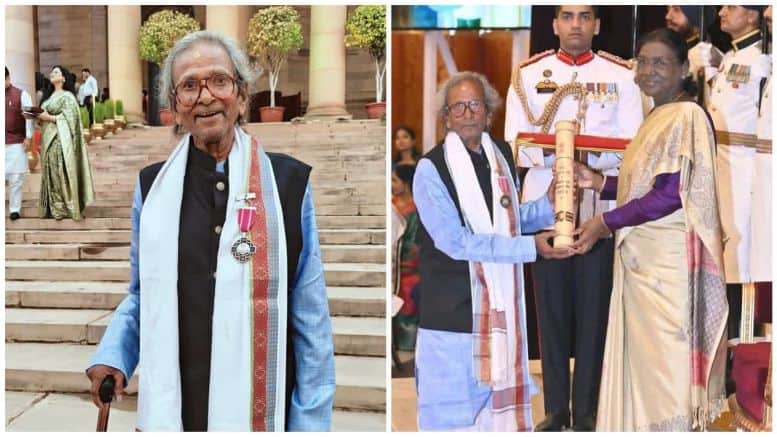
Simanchal Patro and a lifetime devoted to cultural preservation
When Shri Simanchal Patro was conferred the Padma Shri in 2026, the honour recognized far more than the distinguished career of an individual performer. It acknowledged nearly eight decades of disciplined service to Prahallada Nataka, the devotional musical theatre of southern Odisha that unites drama, Odissi music, stylized movement, oral knowledge, elaborate costume, and Vaishnava bhakti. The official Padma Awards notification identifies him in the field of Art and associates him with Odisha, placing a regional theatrical lineage within the national record of cultural achievement.
The recognition is especially significant because traditional theatre rarely survives through texts alone. It lives through trained voices, remembered melodies, embodied gestures, shared discipline, and the patient correction of one generation by another. Patro safeguarded each of these elements. His legacy therefore cannot be measured only by the number of performances he gave or the honours he received; it must also be understood through the students he trained, the akhadas he supported, and the artistic confidence he restored to a tradition facing diminishing patronage.
Roots in Bamakei and the making of a traditional artist
Patro was born in 1927 in Bamakei, also written as Bomakei, in the Ganjam district of Odisha. Published biographical accounts are not entirely consistent about his precise date of birth: several secondary accounts record 2 February 1927, while the Government of India profile issued in connection with the 2026 Padma honours records 7 July 1927. Official and journalistic sources also alternate between the spellings Patro and Patra. The year, place, artistic lineage, and substance of his contribution, however, are consistently documented.
His childhood unfolded within a rural cultural environment in which performance was connected to collective memory, religious observance, and community life. His father, Sura Patro, was a practitioner and guru of Prahallada Nataka. Consequently, artistic instruction did not arrive as an isolated extracurricular activity. Melody, dialogue, narrative, worship, and rehearsal belonged to the rhythm of the household and village. Such an upbringing allowed the young Simanchal to absorb the art as a living language before approaching it as a formal discipline.
The official biographical profile records that he began learning Sakhi Nata at approximately seven years of age under Guru Narasingha Pradhan of Palur. This form, in which boys perform female companion roles, gave him early exposure to music, acting, bodily control, and the conventions of gendered characterization in traditional theatre. Recognizing his aptitude, his father subsequently introduced him to the role of Prahallada and to the songs associated with the sutradhar, the singer-director who helps organize both the action and the audience’s understanding of it.
That early training developed into a long and demanding apprenticeship. In addition to instruction from his father, biographical accounts associate Patro’s education with masters such as Kora Patra, Laxman or Lakshan Satapathy, and Trinath Pradhan. Sources vary in spelling and in the precise sequence of instruction, but they agree that the training extended over many years. He studied dialogue delivery, raga, tala, song, dance posture, stylized poses, dramatic timing, character construction, and the distinctive performance grammar of Hiranyakashipu.
This method of education illustrates the depth of the guru-shishya tradition. A role was not mastered by memorizing lines and entering the stage. The student had to understand where a melodic phrase should breathe, how a rhythmic cycle shaped movement, how a gesture altered the emotional meaning of a verse, and how the energy of a performance could be sustained across many hours. Patro’s achievement rested on this integrated education in music, theatre, movement, literature, and devotional discipline.
Understanding Prahallada Nataka as ritual, music, and theatre
Prahallada Nataka, also written as Prahlad Natak or Prahallāda Nātaka, dramatizes the Puranic account of Prahallada, the devoted son of the Asura king Hiranyakashipu. The king attempts to suppress his son’s unwavering devotion to Sri Hari Vishnu. At the narrative climax, Bhagwan Narasimha manifests in a form that is neither fully human nor fully animal and defeats Hiranyakashipu under conditions that overcome the protections he had obtained. The episode is at once theatrical and philosophical: worldly power reaches its limit, devotion survives coercion, and dharma is restored through a form that transcends ordinary categories.
The description of Hiranyakashipu merely as a villain does not capture the artistic complexity of the role. He is an imperious ruler, a father confronted by a son he cannot command, and a figure whose apparent invulnerability intensifies his inability to accept a reality beyond his control. Prahallada, by contrast, embodies calm conviction rather than physical force. The tension between these two modes of power gives the theatre its emotional and ethical force. Narasimha’s appearance resolves the conflict, but the drama derives much of its power from the sustained encounter between authority and conscience.
The form emerged in the cultural geography of Ganjam and the adjoining region historically associated with Jalantara. Scholarship summarized by the Impart Encyclopedia of Art connects the first written text to the late nineteenth century and identifies Gourahari Parichha as its composer, with the patronage of Ramakrishna Chhotaraya of Jalantara. Other cultural histories credit Chhotaraya more directly with creating or conceiving the form. These differing formulations reflect the distinction between composing a text, patronizing it, and shaping its first performance tradition.
Prahallada Nataka is often performed in an open area marked out for performers and spectators. A raised wooden structure and a chair representing Hiranyakashipu’s throne establish the visual centre of royal authority. Musicians remain essential to the theatrical space rather than functioning as an invisible accompaniment. Instruments associated with the form include the mardal, harmonium, mukhaveena, trumpets, conch shells, and gini or cymbals. Costume, vocal projection, processional movement, and the spatial relationship between ruler, devotee, musicians, and audience transform a relatively simple arena into a sacred dramatic world.
Music supplies the architecture of the performance. A commonly documented structure includes 126 songs drawing on approximately thirty-five ragas and six talas, together with Sanskrit and Odia verses. Accounts of extended repertoires and complete performance cycles sometimes provide larger totals, which suggests variation between textual enumeration, local versions, and the material sung during expansive presentations. Whatever total is applied, mastery requires much more than a competent singing voice. The performer must retain a large oral repertoire while coordinating melody, rhythm, gesture, characterization, and narrative sequence.
The gahaka or sutradhar occupies a particularly important position. He may serve as lead singer, guide the chorus, direct musicians, praise or introduce characters, and comment on unfolding action. In this respect, Prahallada Nataka does not separate narration, musical direction, and dramatic interpretation as sharply as many modern productions do. Its theatrical intelligence lies in the coordination of these functions, enabling audiences to follow a long and musically complex narrative without losing its emotional thread.
Traditional presentations can continue for much of the night and, in extended form, for approximately twelve hours. This duration changes the relationship between performer and spectator. The event becomes a shared vigil rather than a brief entertainment product. Fatigue, anticipation, music, devotion, and collective attention accumulate across the night. For rural audiences, the theatre historically offered not only spectacle but also a communal means of encountering sacred narrative, ethical conflict, regional language, inherited music, and the memory of earlier performers.
The Hiranyakashipu who defined an era
Patro’s most celebrated achievement was his portrayal of Hiranyakashipu, locally central enough for the performer to be known as the Raja. He began assuming major dramatic responsibilities while still young and eventually became so closely identified with the role that regional audiences regarded him as a definitive Hiranyakashipu. His high-pitched, resonant voice, command of dialogue, musical intelligence, stylized movement, and imposing physical presence allowed him to sustain the king’s authority across an unusually long performance.
The role demands a difficult balance. If Hiranyakashipu is portrayed only through volume and anger, the performance becomes monotonous. The artist must instead reveal pride, affection, irritation, wounded authority, calculation, fear, and rage without weakening the character’s regal stature. Music must intensify these shifts without interrupting the action. Patro’s reputation indicates an ability to integrate the ruler’s outward grandeur with the inner instability produced by Prahallada’s refusal to abandon devotion.
Such control also required exceptional stamina. Singing forcefully for hours can compromise pitch, diction, and dramatic concentration, while elaborate costume and forceful movement add physical strain. Patro maintained these standards across decades, performing in Ganjam and beyond the region. His longevity was therefore not simply biographical. It represented the continuous renewal of a demanding technical practice whose survival depended upon artists capable of presenting it convincingly before changing audiences.
The emotional effect of his performance can be understood even by those unfamiliar with the form. Every community possesses stories in which conscience confronts power, a child tests an elder’s assumptions, or conviction survives intimidation. Prahallada Nataka gives these experiences a sacred and highly disciplined theatrical form. Patro’s Hiranyakashipu made the conflict vivid enough for spectators to feel its danger, while the surrounding music and ritual framework situated that danger within a larger moral order.
From acclaimed performer to institution-builder
Patro recognized that excellence on stage would not by itself guarantee continuity. During the twentieth century, Prahallada Nataka lost much of the royal and landed patronage that had once supported traditional performance. Rural audiences continued to sustain it, but cinema, television, migration, changing work patterns, and the economics of lengthy productions reduced opportunities. A form requiring numerous performers, musicians, costumes, rehearsals, and many hours of presentation could not compete on convenience alone.
His response was pedagogical and institutional. In Bamakei, he established the Lakshmi Nrusimha Natya Kala Sansad, creating a structured space in which younger artists could study the repertoire and performance techniques. The institution gave aspirants access to knowledge that might otherwise have remained dispersed among ageing specialists. It also affirmed that village-based artistic instruction possessed intellectual and cultural value worthy of organized preservation.
Patro’s work extended beyond his native village. Accounts of his career credit him with establishing, supporting, or teaching through akhadas in several parts of Ganjam, including places identified in biographical records as Nalabanta, Humma, Khajipalli, Sundhipalli, Padmapur, and Badagada. He spent sustained periods training young people rather than limiting instruction to occasional demonstrations. This geographical network broadened the tradition’s base and reduced the danger that it would disappear with one troupe or one family.
His pedagogy necessarily involved both preservation and judgment. Oral traditions remain alive because teachers transmit a recognizable grammar while allowing skilled performers to respond to audience, place, and circumstance. Excessive rigidity can turn a living form into a museum object, but uncontrolled alteration can dissolve its musical and ritual identity. Patro’s long apprenticeship and performance experience gave him the authority to distinguish between creative interpretation and the loss of essential structure.
The results became visible when his students matured into performers and gurus in their own right. This is perhaps the most consequential dimension of his legacy. A celebrated portrayal ends when the curtain falls, but a trained disciple carries the repertoire into another village, another troupe, and another generation. Patro therefore functioned as a living bridge between the masters who trained him and the artists who will encounter Prahallada Nataka after his lifetime.
Awards that brought a regional tradition into national view
In 1990, Patro received the Sangeet Natak Akademi Award for his contribution to Prahallada Nataka. The honour placed his achievement within Bharat’s national performing-arts framework and confirmed that the technical sophistication of a village-rooted theatre deserved recognition alongside more widely institutionalized classical forms. The award was important for Patro personally, but it also gave the endangered tradition greater cultural visibility.
Further recognition followed. The Government of India profile records an Odisha Sangeet Natak Akademi honour in 1997 and the Sri Guru Gangadhar Memorial Award presented in 2024 during the Dhauli Kalinga Mahotsav. These distinctions trace a long arc of acknowledgement, from specialist recognition of his artistry to broader appreciation of his role as a senior guardian of Odia cultural heritage.
The Padma Shri 2026 represents the most prominent national recognition in that sequence. The official citation describes Patro as a legendary figure in folk theatre and records his enduring commitment to teaching younger generations. He has also been honoured with the epithet “Vishma Pitamaha” of Prahallada Nataka, conveying the reverence accorded to an elder whose knowledge, endurance, and authority helped hold an artistic community together.
The Padma Shri does not transform Prahallada Nataka into an important tradition; its historical, musical, and spiritual value existed long before the award. National recognition nevertheless has practical consequences. It can draw researchers, cultural institutions, audiences, and policymakers toward a form that might otherwise remain outside mainstream attention. It can also remind younger practitioners that mastery of inherited art is a form of public service rather than an obsolete pursuit.
A legacy with significance across Dharmic traditions
Prahallada Nataka is firmly rooted in Vaishnava devotion and Narasimha worship, and that specificity deserves preservation rather than dilution. At the same time, its emphasis on disciplined practice, fidelity to truth, humility before a reality larger than worldly authority, and the transmission of wisdom through a teacher-student lineage carries wider Dharmic resonance. Hindu, Buddhist, Jain, and Sikh traditions remain distinct in doctrine and practice, yet each recognizes, in its own way, the ethical importance of disciplined learning, compassion, courage, memory, and service.
Patro’s career thus offers a constructive model of cultural unity. Unity need not require the erasure of regional language, sectarian identity, or artistic difference. It can arise through mutual respect for communities that preserve their traditions with integrity and share their wisdom without hostility toward other paths. Prahallada Nataka enriches the larger Dharmic cultural landscape precisely because it remains recognizably Odia, musical, theatrical, and Vaishnava.
What meaningful preservation now requires
Celebrating Patro’s Padma Shri is only the beginning of responsible cultural preservation. Prahallada Nataka requires sustained training grants, fair remuneration for artists, support for costumes and instruments, accessible rehearsal spaces, and performance opportunities that do not force troupes to compress the form beyond recognition. Senior gurus must be supported as educators, not invited merely as ceremonial figures after their ability to teach has been diminished by age or financial hardship.
Documentation is equally important. Complete performances should be recorded with high-quality sound, multiple camera perspectives, accurate metadata, and subtitles that preserve the relationship between Odia and Sanskrit material. Musical notation, raga and tala analysis, costume documentation, oral histories, regional variants, stage diagrams, and performer genealogies can help future artists and scholars understand the tradition as a complex system. Digital archives should supplement living instruction, however, because a recording cannot correct posture, train breath, explain timing, or transmit the ethical responsibilities of performance.
Educational outreach can also expand the audience without trivializing the work. Universities, schools, museums, and performing-arts institutions can organize lecture-demonstrations that explain the narrative, instruments, character types, music, and staging before presenting substantial excerpts. Such preparation enables new spectators to appreciate the form on its own terms instead of judging it by the speed and visual conventions of commercial entertainment.
The economic welfare of practitioners must remain central. Heritage cannot be preserved by expecting artists to survive indefinitely on sacrifice and reverence. Travel costs, medical needs, apprenticeships, instrument maintenance, and months of rehearsal have material consequences. A sustainable model would combine public funding, responsible cultural tourism, institutional commissions, community patronage, and transparent archival partnerships while keeping artistic decisions in the hands of knowledgeable practitioners.
Patro’s life demonstrates why traditional artists are often described as living archives. His memory contains melodies, gestures, interpretive decisions, corrections from earlier gurus, and knowledge shaped by thousands of hours before audiences. Yet the phrase should never obscure his agency. He was not a passive storehouse of inherited material. He selected, interpreted, performed, organized, taught, and persuaded young people that the tradition deserved a future.
The enduring guardian of Prahallada Nataka
Shri Simanchal Patro’s journey from a village childhood to the Padma Shri is ultimately a history of cultural stewardship. He received an artistic inheritance from his father and gurus, refined it through rigorous training, gave it dramatic authority through his Hiranyakashipu, and returned it to society through institutions and disciples. Each stage of that journey strengthened Prahallada Nataka as both a performance tradition and a carrier of spiritual memory.
His story also corrects a common misunderstanding about heritage. Traditions do not endure simply because they are ancient, beautiful, or sacred. They endure because particular people rehearse when audiences are small, teach when resources are scarce, repair costumes and instruments, remember difficult compositions, and persuade another generation to care. Patro performed this patient labour for most of his life.
The Padma Shri 2026 honours that extraordinary perseverance. More importantly, it directs national attention toward the living community of singers, musicians, actors, teachers, craftspeople, and spectators who continue to sustain Prahallada Nataka. Patro’s greatest memorial will not be recognition alone, but the sound of its ragas in future akhadas, the confidence of newly trained performers, and the continued appearance of Narasimha’s story on the stages of Ganjam and beyond.
Featured image source: ETV Bharat
Inspired by this post on Hindu Post.


Leave a Reply
You must be logged in to post a comment.