
When the Dice Fall
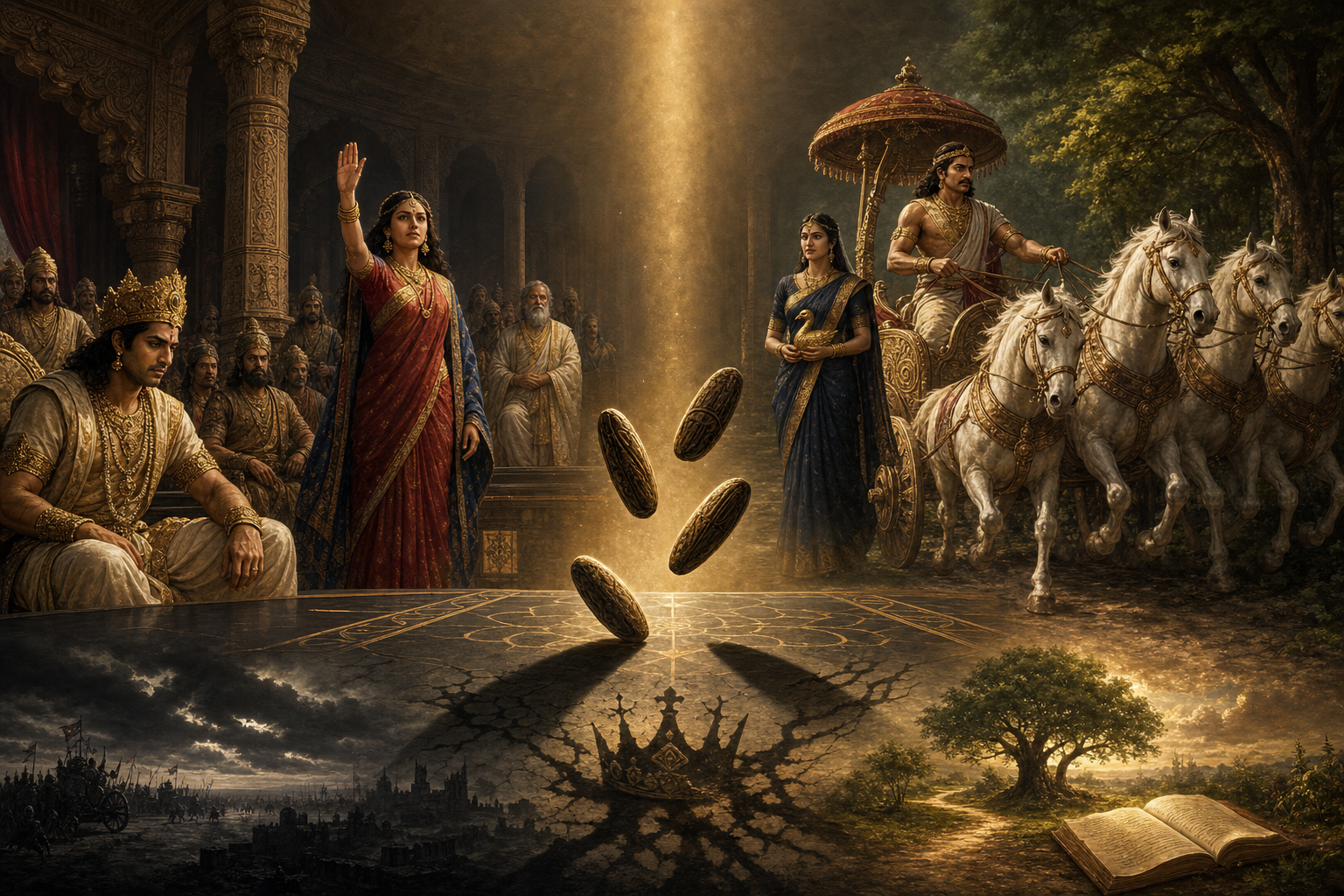
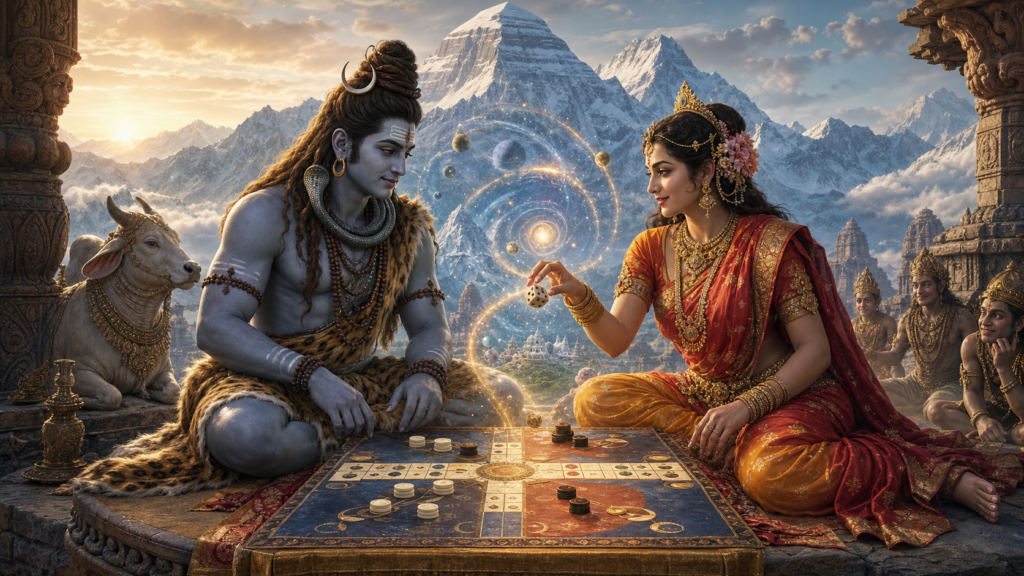
The Mahabharata is far more than an account of the Kurukshetra War. It is an extended inquiry into dharma, political responsibility, human weakness, moral uncertainty, and the consequences of choice. Few episodes concentrate these concerns as powerfully as the dice game in the royal assembly. A small group of marked playing pieces becomes the instrument through which wealth changes hands, sovereignty collapses, a queen is humiliated, and an entire civilization moves toward war. The scene remains disturbing because the catastrophe does not arrive as an invasion from outside. It grows within a royal household, under the eyes of elders who understand that something is wrong but fail to stop it.
Two kings stand in the shadow of dice in the epic: Yudhishthira, ruler of Indraprastha, and Nala, ruler of Nishadha. Both are celebrated for virtue. Both lose their kingdoms through gambling. Both enter exile, suffer separation, and eventually recover what was lost. Yet the resemblance is not simple repetition. The story of Nala is narrated to Yudhishthira during the Pandavas’ forest exile, allowing one ruined king to encounter the experience of another. It functions as consolation, warning, instruction, and psychological mirror. Read together, the two narratives reveal how temptation works, how institutions enable wrongdoing, and how suffering may become a difficult school of self-knowledge.
Dice Before the Mahabharata
The epic’s treatment of gambling belongs to a much older Indian conversation. The famous “Gambler’s Lament” of the Rigveda portrays dice as captivating objects that overpower judgment, destroy domestic peace, consume wealth, and send the gambler back to play despite repeated regret. The poem is strikingly observant: attraction survives loss, humiliation does not cure compulsion, and hope fastens itself to the next throw. Later legal and political texts generally treat gambling as a dangerous activity requiring restraint or regulation. The subject was therefore not marginal. Ancient Indian traditions recognized gambling as a personal vice, a social hazard, an economic activity, and, in some settings, a practice carrying ritual or political associations.
The objects called aksha in early literature were not necessarily identical to modern six-sided dice. Nuts or elongated pieces could be used, and their unequal shapes made the mechanics of play different from those of contemporary casino games. The exact rules of the games described in the Mahabharata are not fully reconstructed from the narrative. This uncertainty matters. The epic is interested less in providing a gaming manual than in examining unequal skill, manipulation, escalating stakes, compromised consent, and the moral responsibilities of everyone present. The dice are physical objects, but they also become a language through which desire, resentment, fate, and political power act upon human beings.
Why Yudhishthira Accepts the Invitation
The first great dice match occurs in the Sabha Parva, after the Pandavas have established Indraprastha and Yudhishthira has performed the Rajasuya. Their prosperity intensifies Duryodhana’s jealousy. Instead of confronting the Pandavas through open warfare, Duryodhana and Shakuni devise a contest capable of dismantling their power while preserving the appearance of courtly procedure. Dhritarashtra authorizes the invitation despite warnings, especially from Vidura. Shakuni, renowned for his command of dice, plays on Duryodhana’s behalf. Yudhishthira therefore enters a contest whose political purpose has already been determined and whose practical conditions heavily favor his opponents.
Yudhishthira’s decision is not explained by a single motive. He knows that gambling is dangerous, yet he also considers a formal summons difficult for a kshatriya king to refuse. Royal etiquette, family hierarchy, personal pride, attachment to play, and a conception of destiny converge. His language sometimes suggests that events unfold under the power of fate, but that recognition does not eliminate agency. The ethical force of the episode depends precisely on this tension. Yudhishthira is neither a helpless puppet nor an uncomplicated villain. He is a morally serious person whose judgment becomes trapped within competing obligations and an acknowledged vulnerability.
The invitation also exposes the danger of reducing dharma to a rigid social formula. A rule such as “a warrior must not refuse a challenge” cannot be applied mechanically when the challenger acts fraudulently, the contest threatens dependants, and the supposed game conceals a project of dispossession. Dharma in the Mahabharata requires discernment, attention to circumstances, and concern for consequences. Yudhishthira’s error is not that he values duty; it is that one perceived duty overwhelms other obligations, including the protection of his family, subjects, and kingdom. A partial truth becomes destructive when treated as the whole of moral reality.
The Architecture of Escalation
The wagering proceeds through escalation. Yudhishthira loses treasures, servants, armies, territories, and royal authority. Instead of treating each loss as a reason to stop, the match converts defeat into pressure for another stake. This pattern resembles what modern behavioral research calls “chasing losses”: the belief that one further attempt may reverse an accumulating disaster. The comparison should not be used to impose a modern clinical diagnosis on an epic character, but it helps identify the narrative’s psychological precision. Each wager narrows the gambler’s world until recovery through the next throw appears more imaginable than withdrawal.
The most terrible stage begins when Yudhishthira stakes his brothers, then himself, and finally Draupadi. At this point the game ceases to be merely an imprudent contest over property. It becomes an assault on personhood and moral order. Human beings are spoken of as transferable stakes, while the assembled court allows the language of gambling to disguise coercion. The sequence reveals the dehumanizing logic of uncontrolled possession: wealth, political office, kinship, and even another person’s freedom are drawn into a single economy of risk.
Shakuni’s role is crucial, but blaming him alone would simplify the episode. His superior skill and hostile intention make the contest predatory. Duryodhana supplies the envy and political objective. Dhritarashtra grants institutional permission. Dushasana enforces the resulting violence. Karna intensifies Draupadi’s humiliation through cruel speech. Elders who possess status and knowledge hesitate, debate, or remain silent. The disaster is therefore distributed across a network of choices. The Mahabharata shows that grave injustice often requires more than one aggressor: it also requires authorization, rationalization, enforcement, and passive spectatorship.
Draupadi’s Question and the Crisis of Law
Draupadi does not accept the wager’s validity. Summoned to the assembly, she asks a question that destabilizes the legal performance surrounding the game: did Yudhishthira lose himself before he staked her, or did he stake her while he still possessed legal standing? If he had already lost himself, what authority remained to wager another person? If a husband’s claimed authority over his wife is invoked, can that authority survive his own enslavement? Her inquiry transforms the assembly from a gaming hall into a court confronted with the limits of its own categories.
The elders struggle to answer because the question exposes a deeper contradiction. A procedurally completed wager cannot automatically become righteous when its subject is a human being and its conditions are corrupt. Bhishma acknowledges the subtlety of dharma, yet his uncertainty does not protect Draupadi. Vikarna, one of Dhritarashtra’s sons, protests the injustice, demonstrating that moral clarity is possible even within the Kaurava household. Vidura repeatedly condemns the proceedings. Their responses differ, but the larger institutional failure remains: recognition without effective intervention allows violence to advance.
Draupadi’s resistance is intellectual, legal, ethical, and spiritual. She refuses the role of silent victim and demands that powerful men account for their conduct. Traditions differ in the details with which her protection in the assembly is narrated and interpreted, but the theological meaning is consistent: the attempt to dishonor her does not achieve its intended finality. Her dignity cannot be reduced to the judgment of the gamblers. She becomes the moral center of the scene because she names the disorder that the court’s language is designed to conceal.
Dhritarashtra eventually intervenes and offers Draupadi boons. Through careful choices, she secures the freedom of Yudhishthira and the other Pandavas. The immediate disaster appears to be reversed, but the reversal is incomplete. A second match is arranged, and the Pandavas lose again. The new condition requires twelve years in the forest followed by a thirteenth year lived incognito; discovery during that final year would renew the exile. The repeated game demonstrates that a crisis cannot be repaired merely by restoring property while leaving the enabling structure intact. Envy, weak governance, and the refusal to impose accountability continue to operate.
Nala Enters Yudhishthira’s Exile
During the forest exile, Yudhishthira is burdened by grief and responsibility. The sage Brihadashva responds by recounting the story of Nala and Damayanti in the Vana Parva. The placement is deliberate. Yudhishthira believes that no king has suffered as he has, but the sage introduces a predecessor whose losses closely resemble his own. The comparison does not trivialize Yudhishthira’s pain. It breaks the isolation created by shame. Suffering often persuades a person that his failure is uniquely irredeemable; narrative answers by placing private anguish within a larger human pattern.
Nala is the virtuous king of Nishadha, famed for justice, skill with horses, generosity, and noble bearing. Damayanti, princess of Vidarbha, hears of his qualities, while he hears of hers. Their mutual attraction is carried through the celebrated episode of the golden swan. At Damayanti’s svayamvara, several deities desire her and require Nala to serve as their messenger. Despite the emotional cost, he fulfills the task. Damayanti nevertheless recognizes and chooses Nala. Their union is therefore founded not only on beauty and affection but also on discernment, declared preference, and fidelity under divine pressure.
Kali, angered that Damayanti has chosen Nala, waits for an opportunity to enter and corrupt him. The narrative describes a lapse in ritual purity as the opening through which Kali gains influence. It would be reductive to treat this element as a simple claim that one minor omission mechanically causes ruin. Within the story’s moral universe, the lapse signals a moment when vigilance fails and a hostile tendency enters. Kali’s influence externalizes the experience of being overtaken by a destructive impulse while preserving the difficult question of responsibility. Nala is afflicted, but his actions still produce real suffering.
Nala, Pushkara, and the Loss of Nishadha
Under Kali’s influence, Nala accepts a dice challenge from his brother Pushkara. The dice themselves are associated with Dvapara, while Kali works through Nala’s disturbed judgment. Nala continues to wager despite warnings and loses his wealth and kingdom. As in Yudhishthira’s match, the destructive power of gambling lies in repetition, narrowing attention, and the conversion of hope into an instrument of further loss. Yet the political setting differs. Shakuni’s contest is a calculated assault embedded in a royal conspiracy; Nala’s fall is represented more explicitly through possession, cosmic hostility, and an inward corruption that Pushkara exploits.
Nala and Damayanti leave the kingdom with little protection. Their exile is physically and psychologically severe. Hunger, exhaustion, shame, and fear strain the relationship. Nala eventually abandons Damayanti while she sleeps, after cutting part of their shared garment. The decision is often explained through a mixture of distorted judgment, self-loathing, concern that she might fare better without him, and Kali’s continuing influence. Whatever the motive, the result is abandonment. The epic does not permit inner torment to erase the harm experienced by the person left behind.
Damayanti’s conduct after the separation is remarkable. She survives danger, resists harassment, reaches safety, and persistently seeks reliable information about Nala. Her fidelity is not passive waiting. It is strategic action supported by memory, intelligence, and carefully designed tests. She later uses an announcement of a second svayamvara as a device to draw out the unknown charioteer she suspects may be Nala. Like Draupadi, Damayanti combines emotional endurance with analytical judgment. Both women act within restrictive circumstances without surrendering their capacity to question, decide, and intervene.
Karkotaka and the Meaning of Disguise
Nala encounters the serpent Karkotaka and rescues him from a forest fire. Karkotaka then bites Nala, altering his appearance and enabling him to live unrecognized under the name Bahuka. The transformation is painful but protective. It also forces a separation between royal identity and visible status. Nala, once admired for beauty and sovereignty, must exist as a person whose capacities are concealed beneath an unfamiliar exterior. The episode turns disguise into moral discipline: he can no longer rely on recognition, rank, or appearance to confirm who he is.
As Bahuka, Nala enters the service of King Rituparna of Ayodhya and becomes valued for his extraordinary knowledge of horses and chariot driving. Rituparna possesses mastery of numerical calculation and dice. Their relationship produces an exchange of specialized knowledge, commonly described through the arts associated with horses and with aksha. This is one of the most important differences between Nala’s first and second encounters with gambling. He does not recover merely because fortune changes. He acquires understanding of the system that once overpowered him.
Rituparna’s rapid counting of leaves and fruits on a tree demonstrates a disciplined ability to infer the whole from a limited observation. Nala’s control of horses similarly joins attention, embodied knowledge, timing, and command. The exchange suggests that practical mastery requires more than courage or good intention. It requires trained perception. The king who once entered a contest without adequate control becomes a student. Humility before knowledge prepares the restoration that royal pride could not achieve.
Recovery Without Erasing Responsibility
As the narrative advances, Kali leaves Nala, and Nala’s true identity is gradually recognized. Damayanti does not accept appearances without examination. She observes Bahuka’s unusual abilities, seeks testimony, and arranges tests connected with Nala’s known qualities. Their reunion therefore depends on evidence as well as longing. The process respects the depth of the injury between them. Recognition must be established, explanations must be heard, and trust must be rebuilt.
Nala later challenges Pushkara again. Now equipped with knowledge and restored self-command, he wins back the kingdom. Significantly, victory does not end in annihilation. Nala forgives Pushkara and permits reconciliation. The ending does not make the earlier suffering unreal, nor does it suggest that every dispossessed ruler will receive a miraculous reversal. Its ethical point is that recovery becomes meaningful when it includes transformed judgment. Nala returns to kingship with a deeper understanding of vulnerability, skill, restraint, and mercy.
Brihadashva also imparts knowledge of dice to Yudhishthira. The instruction is not an invitation to gamble recklessly. It removes the helpless mystique surrounding the activity. Knowledge can expose the mechanism by which an apparently supernatural force gains power over the mind. The epic repeatedly values disciplined learning as a means of restoring agency. What is obscure can terrify; what is understood can be assessed, limited, or refused.
Two Kings, Two Forms of Responsibility
Yudhishthira and Nala are both righteous kings, but neither is protected from error by a reputation for virtue. This is a central lesson of the Mahabharata. Ethical character is not a permanent possession that makes vigilance unnecessary. A person may be truthful, generous, and learned while remaining vulnerable to pride, compulsion, social pressure, or a poorly interpreted duty. Great qualities can even become points of danger when they are isolated from practical wisdom.
Nala’s story places more emphasis on possession by Kali, concealment, the acquisition of technical knowledge, and eventual reconciliation with his rival. Yudhishthira’s story places more emphasis on a corrupt political institution, a public assault on Draupadi, the silence of elders, and consequences that engulf many kingdoms. Nala’s disaster is intensely domestic and dynastic; Yudhishthira’s becomes civilizational. The first concludes with a relatively contained restoration. The second contributes to a war whose victory leaves the survivors surrounded by grief.
The contrast also clarifies the scale of royal responsibility. A private individual may lose personal wealth, but a ruler who gambles with the resources of a kingdom exposes subjects who never consented to the risk. Rajadharma therefore demands a standard higher than personal sincerity. A king’s body, decisions, and possessions are connected to a political community. Yudhishthira’s wagers reveal the danger of treating public authority as private property. The moral injury expands because the stakes belong, in a meaningful sense, to many lives.
Fate, Karma, and Human Effort
The dice narratives resist a simple opposition between fate and free will. Terms such as destiny, time, divine ordering, past action, and human effort overlap without becoming identical. Fate explains why events may exceed anyone’s intention, but it does not transform injustice into virtue. Human effort does not guarantee success, but its uncertainty does not make effort meaningless. The epic’s moral world is tragic precisely because people act within conditions they did not create while remaining answerable for the choices available to them.
Yudhishthira sometimes interprets the match as something ordained, and Nala is explicitly afflicted by Kali. Nevertheless, both must learn, endure, and act. Neither recovers by announcing that destiny alone caused the loss. This balance avoids two extremes. Absolute self-blame ignores manipulation, inherited conditions, and forces beyond individual control. Absolute fatalism dissolves accountability and discourages reform. The narratives instead encourage responsibility without denying vulnerability.
Karma should likewise not be reduced to immediate reward and punishment. The Mahabharata repeatedly shows good people suffering and wrongdoers enjoying temporary success. Karma operates within a larger moral field that may not be visible from a single event. The dice fall quickly, but their consequences unfold over years. Ethical causation is therefore presented as layered, relational, and often delayed. This complexity invites patience in judgment while preserving the need to oppose adharma when it appears.
The Women Who Refuse Moral Erasure
A comparison focused only on the two kings would remain incomplete. Draupadi and Damayanti bear consequences created by male contests, yet neither is narratively reduced to those consequences. Draupadi interrogates the legality and morality of the wager in public. Damayanti survives abandonment and constructs a careful path toward recognition and reunion. Each preserves memory when others prefer convenient forgetting. Each demonstrates that fidelity to dharma may require resistance rather than submission.
Their experiences also expose the inadequacy of interpreting family duty as one-sided obedience. A household cannot be dharmic if one member’s prestige or vow is protected at the cost of another’s dignity. Draupadi’s question reaches beyond ancient royal law: no social role can legitimately erase personhood. Damayanti’s loyalty similarly does not prevent her from testing Nala and demanding credible recognition. Love and ethical scrutiny are not opposites. Trust worthy of restoration must be able to withstand truth.
Readers may feel anger when the assemblies, courts, and families around these women fail them. That emotional response is not foreign to serious interpretation. Moral emotion can alert the intellect to a violation that formal reasoning has obscured. The challenge is to turn that response into disciplined understanding: who possessed authority, who spoke, who remained silent, and which beliefs allowed abuse to be presented as procedure? These questions make the epic relevant without flattening its historical and theological setting.
Gambling as a Study of the Divided Mind
The epic displays several mechanisms familiar in the study of risky behavior. Initial participation becomes commitment; commitment creates a need for consistency; loss produces shame; shame encourages secrecy or a desperate attempt at reversal; and each new wager increases the cost of stopping. The gambler may feel active while becoming progressively less capable of meaningful choice. The movement is not from freedom to physical imprisonment in one step. It is a narrowing of attention until only the game appears real.
Uncertainty itself can intensify attachment. A predictable loss is easier to abandon than an irregular pattern in which victory always seems possible. The next throw promises not merely money but the cancellation of humiliation. This is why moral condemnation by itself may be ineffective. A person caught in compulsive behavior often already knows that damage is occurring. Effective intervention requires boundaries, truthful companionship, reduced access to further harm, and the willingness of institutions to interrupt escalation.
The royal courts fail this standard. Vidura warns Dhritarashtra, and others perceive danger, but authority does not act early enough. The lesson is relevant to families, organizations, financial systems, and digital platforms. A system that profits from repeated risk cannot place the entire burden of restraint on the vulnerable participant. Personal responsibility remains essential, but ethical design and institutional accountability matter as well. The Mahabharata refuses to isolate the gambler from the social world that invites, applauds, manipulates, or normalizes the game.
Dharma Is More Than Rule Compliance
Yudhishthira’s crisis demonstrates why dharma cannot be identified with literal compliance alone. The invitation is formally delivered, the wagers are verbally declared, and the match occurs before witnesses. None of these features makes the outcome just. Procedure can be used to manufacture legitimacy for exploitation. Dharma requires attention to intention, capacity, consent, proportionality, and the welfare of those affected. When these are ignored, a rule-governed event may still be profoundly adharmic.
Nala’s recovery adds another dimension: dharma requires competence. Good motives without self-knowledge can leave a ruler exposed. His education under Rituparna represents the integration of virtue with technique. He learns to govern the activity that once governed him. In contemporary terms, ethical decision-making benefits from literacy about probability, persuasion, financial risk, and cognitive bias. Moral seriousness becomes more effective when supported by practical understanding.
Both narratives also distinguish forgiveness from denial. Nala’s mercy toward Pushkara comes after the kingdom is recovered and the imbalance of power has been corrected. Draupadi’s rescue does not make the assembly’s wrongdoing disappear. Reconciliation worthy of the name cannot require victims to pretend that no violation occurred. It must be preceded by truth, protection, responsibility, and a credible change in conduct.
A Shared Dharmic Reflection
The ethical themes of the dice narratives can enter a constructive conversation with other dharmic traditions without erasing their differences. Buddhist teachings on heedfulness examine how craving and delusion narrow awareness. Jain disciplines of self-restraint and aparigraha challenge the possessiveness that converts wealth and persons into objects of acquisition. Sikh teachings emphasize truthful living, responsibility, remembrance, and mastery over impulses that disturb moral clarity. Hindu traditions offer multiple accounts of dharma, karma, disciplined action, and liberation from attachment. Together, these perspectives affirm that freedom requires more than the opportunity to choose; it requires the cultivation of a mind capable of choosing well.
Such comparison should promote mutual understanding rather than claim that all traditions teach an identical doctrine. Their vocabularies, metaphysical commitments, practices, and histories remain distinct. Unity among dharmic communities is strengthened when difference is approached with accuracy and respect. The shared concern is practical and ethical: greed, heedlessness, domination, and loss of self-command injure both the individual and the community, while truthfulness, restraint, compassion, and wisdom make restoration possible.
What the Dice Teach Modern Readers
Modern gambling may involve casinos, sports betting, online games, speculative markets, or digital systems designed to sustain attention. These environments differ greatly from an ancient royal dice hall, and they should not be treated as exact equivalents. The epic nevertheless offers a durable framework for examining them. Who designs the contest? Who understands the odds? Who benefits from repetition? Can participation be meaningfully refused? Are dependants exposed to losses they did not choose? What mechanisms exist to stop escalation before irreversible harm occurs?
The same framework applies beyond gambling. Careers, political rivalries, online arguments, and damaged relationships can become games in which withdrawal feels like humiliation. People may continue investing time, money, or dignity because admitting loss seems harder than increasing it. Yudhishthira’s sequence of wagers warns that courage is not always the willingness to continue. Sometimes courage is the ability to stop, reject a corrupt invitation, or accept a limited loss before it consumes everything else.
Nala’s life after defeat offers a complementary lesson. Recovery may require anonymity, apprenticeship, and the rebuilding of capacities that pride once took for granted. A person does not cease to possess worth when status disappears. Yet inner worth must not become an excuse to avoid repair. Nala works, learns, confronts the force that distorted him, proves his identity, and returns differently. Restoration is portrayed as a disciplined process rather than a sudden return to comfort.
The stories also speak to those standing around a person in crisis. Vidura’s warnings show the value of early truth, but the assembly reveals that speech without effective protection may be insufficient. Families and institutions need clear limits on financial harm, coercion, harassment, and impaired decision-making. Compassion does not mean financing another wager or preserving appearances. It may require refusing participation, securing dependants, seeking knowledgeable assistance, and naming manipulation before it becomes normalized.
Why Yudhishthira Needs Nala
Brihadashva does not answer Yudhishthira’s grief with abstract reassurance alone. He gives him a story structured like his own but not identical to it. The differences create space for reflection. If Nala could lose a kingdom and still learn, reunite, govern, and forgive, then Yudhishthira’s present condition need not be the final definition of his life. Hope here is not the denial of responsibility. It is the conviction that responsibility can lead somewhere other than permanent shame.
Nala also gives Yudhishthira a model of knowledge acquired through defeat. The Pandava king must eventually become more than the man who lost the game. Exile exposes him to sages, narratives, ethical dilemmas, and forms of wisdom unavailable within the confidence of the royal court. The forest is not romanticized; it is filled with danger and grief. Yet it becomes a place where sovereignty is separated from possession and where the future ruler is forced to reconsider what rule demands.
Yudhishthira’s later life does not reproduce Nala’s uncomplicated restoration. The Kurukshetra War brings victory at an unbearable human cost, and Yudhishthira remains troubled by the burden of kingship. This difference prevents the Nala narrative from functioning as a promise of easy compensation. Its purpose is more disciplined: catastrophe need not end moral growth, but growth does not erase catastrophe. Wisdom after loss includes the capacity to remember what victory cannot restore.
The Final Throw
The dice games of Yudhishthira and Nala endure because they unite political analysis with intimate psychological truth. They show honorable people acting disastrously, malicious people exploiting convention, institutions failing those they should protect, and wounded people finding different paths toward recovery. The narratives neither excuse wrongdoing through fate nor pretend that willpower controls every outcome. They ask for a mature ethics capable of holding vulnerability and responsibility together.
The deepest warning is not simply “do not gamble,” although the danger of gambling is unmistakable. The deeper warning concerns every situation in which desire adopts the language of duty, procedure conceals injustice, and the next attempt promises to recover what continued participation is destroying. Dice decide destiny only when people, passions, and institutions grant them that power. The possibility of dharma begins when the spell is broken—through truthful questioning, disciplined knowledge, courageous restraint, protection of human dignity, and the humility to learn after failure.
Inspired by this post on Hindu Blog.





Leave a Reply
You must be logged in to post a comment.