
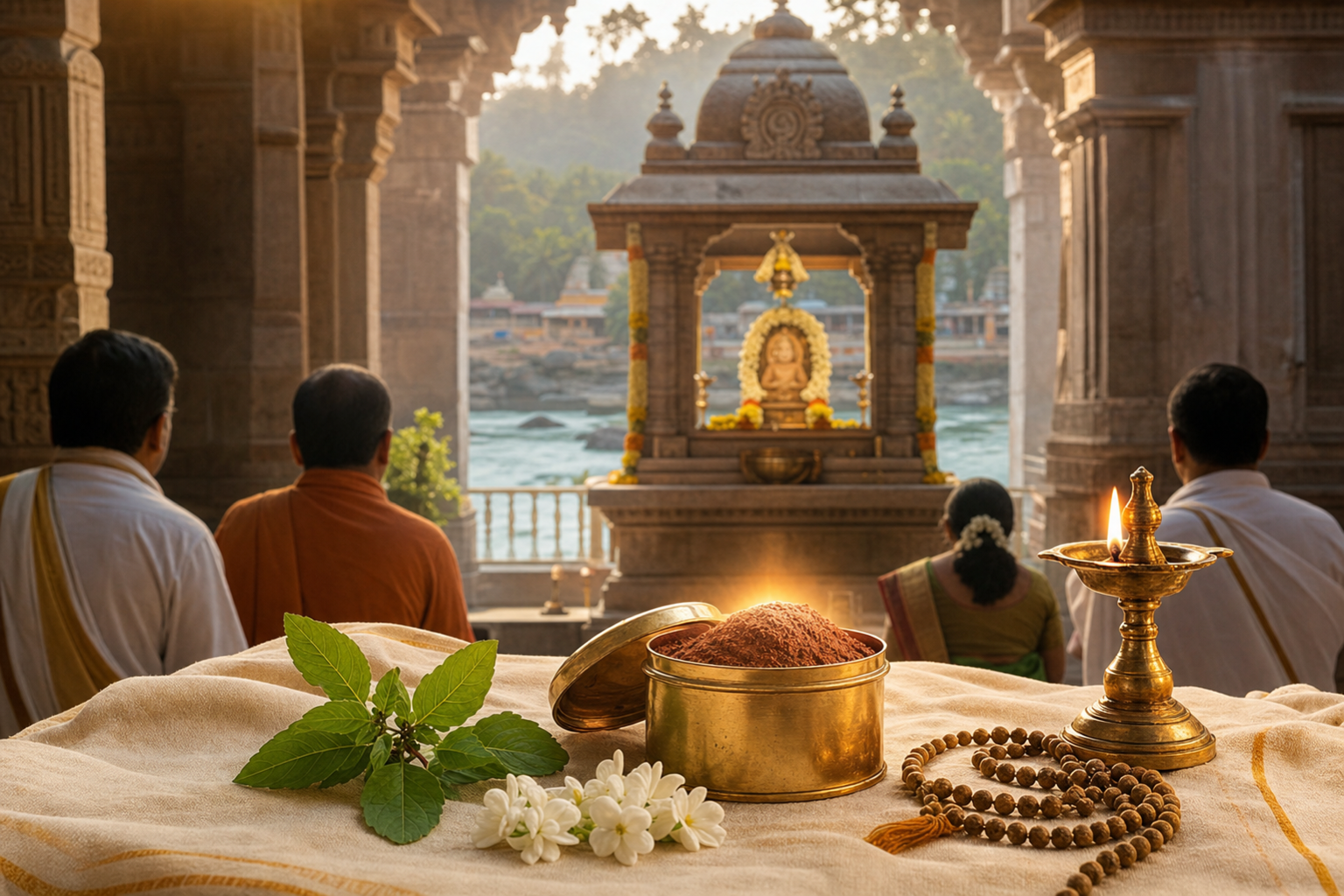
A sacred substance rooted in place and memory. Raghavendra Mrittika is the consecrated earth associated with Sri Raghavendra Tirtha and his Brindavana at Mantralayam, the celebrated pilgrimage centre on the banks of the Tungabhadra River. To devotees, this small quantity of earth is not valued for its appearance or material composition. Its importance arises from sambandha—sacred association—with the guru, the Brindavana, the Matha’s lineage and generations of devotional practice. A substance that might otherwise appear ordinary consequently becomes a compact expression of remembrance, reverence and spiritual belonging.
What the name means. The Sanskrit word mṛttikā denotes earth, soil or clay. The spelling “Mrittika” is common in English-language devotional writing, while regional usage may produce forms such as “Mritigai.” Mantralayam is likewise a widely used form of Mantralaya. These linguistic variations refer to the same devotional context: sacred earth connected with the Brindavana of Sri Raghavendra Swamy, affectionately addressed by many followers as Rayaru.
Sri Raghavendra Swamy and the Dvaita tradition. Sri Raghavendra Tirtha was a major seventeenth-century scholar, teacher and monastic leader in the lineage of Sri Madhvacharya. The institutional tradition represented by the official Sri Raghavendra Swamy Matha identifies Mantralaya as a centre of Dvaita Vedanta, Vedic learning, bhakti and Guru Seva. Dvaita maintains a real distinction between the Supreme Being, individual souls and the world, while affirming the soul’s dependence upon Vishnu. Within this framework, the guru is revered as an authoritative teacher who directs the disciple toward correct knowledge, disciplined devotion and divine grace.
Jeeva Samadhi and the Brindavana. Devotional tradition holds that Sri Raghavendra entered the Brindavana at Mantralayam in 1671 while absorbed in spiritual contemplation. This event is commonly described as Jeeva Samadhi. A Brindavana in this context is not approached merely as a memorial to a departed historical personality. Devotees understand it as the sanctified seat of a realized guru whose spiritual presence and capacity to bless sincere seekers continue beyond ordinary bodily life. Academic description must identify this as a theological and devotional claim rather than an experimentally demonstrable proposition, yet that distinction does not diminish its profound importance within the living tradition.
A living centre of pilgrimage. The Brindavana draws pilgrims because it connects doctrine with a physical place. The journey to Mantralayam, the sight of the shrine, participation in worship, listening to sacred recitation and receiving prasada allow an abstract idea of grace to become embodied experience. The official Matha describes the site as a centre visited by large numbers of devotees and situated within an active culture of Vedantic study, ritual observance, service and education. Raghavendra Mrittika carries a concentrated memory of that sacred geography into the devotee’s home.
Why ordinary earth becomes sacred. Hindu ritual culture does not generally treat sacredness as a property that can be determined solely by laboratory analysis. Sacred status may arise through origin, consecration, contact, mantra, authorized transmission and sustained communal recognition. Water received as tīrtha, food offered as prasada, ash worn as vibhuti and earth associated with a holy site all illustrate this relational understanding. Their physical constituents remain material, but their devotional identity comes from the network of narratives, rites and ethical obligations in which they participate.
The comparison with vibhuti. Devotional accounts sometimes compare Raghavendra Mrittika with the sacred ash associated with Lord Shiva. The comparison concerns function rather than material identity. Both can serve as visible signs of blessing, impermanence, protection and spiritual remembrance, but they arise from distinct ritual histories and should not be treated as interchangeable substances. Such comparisons are most constructive when they illuminate shared patterns of reverence while preserving the integrity of Shaiva, Vaishnava and Madhva practices.
The traditional account of the disciple. A widely circulated narrative relates that one of Sri Raghavendra Swamy’s disciples sought the guru’s blessing before looking for a bride. Rayaru blessed him and entrusted him with sacred Mrittika. During the disciple’s journey, he stopped for the night outside a house in a village. There, according to the story, a threatening supernatural being appeared and demanded that the container of sacred earth be moved away from the house.
The being intended to harm a newborn child within the household but claimed that the Mrittika’s radiance and heat prevented it from approaching. It attempted to bribe the disciple with a pot of gold. Although initially frightened, the disciple refused to cooperate with the destructive intention. He mixed some of the sacred earth with water and sprinkled it upon the being. The narrative states that the being was released from its afflicted condition and from the cycle of repeated birth.
The householder subsequently learned what had occurred, welcomed the disciple and, in the story’s resolution, arranged his marriage to the householder’s daughter. The disciple’s original request for guidance was therefore fulfilled through a sequence that also protected vulnerable life and liberated an antagonistic figure. The story presents grace not simply as personal good fortune but as a force that transforms fear, refuses corruption, safeguards another family and redirects even a hostile being toward release.
Hagiography and historical method. This episode belongs to the hagiographical world surrounding the saint. Hagiography records how a religious community remembers holiness through morally charged accounts of blessings, visions, trials and extraordinary interventions. Such narratives should not automatically be presented as documentary history or scientific evidence. Neither should they be dismissed as meaningless. Their primary function is theological and pedagogical: they communicate what devotees believe the guru’s grace can accomplish and what kind of conduct a disciple should embody.
The symbolism of the night and the threshold. The story places the disciple outside a family home at night, a setting associated with uncertainty and vulnerability. He stands at a threshold between danger and safety, unfamiliarity and kinship, fear and moral action. The newborn represents defenseless life and unrealized possibility. The supernatural adversary represents destructive intention, but its eventual release prevents the narrative from ending in simple retaliation. Protection and compassion operate together.
Gold as a test of discipleship. The offered treasure introduces an ethical trial. The disciple could obtain immediate wealth by moving the sacred object and ignoring the danger faced by strangers. His refusal demonstrates that a guru’s blessing is inseparable from dharma. Sacred Mrittika cannot meaningfully be carried while compassion, courage and responsibility are abandoned. The pot of gold therefore symbolizes the temptation to convert spiritual trust into private advantage.
Heat, light and transformation. The Mrittika is described in the narrative as shining like gold and producing unbearable heat for the hostile being. These images belong to an established religious vocabulary in which light signifies knowledge and heat signifies tapas, purification or concentrated spiritual power. The false gold of the bribe is contrasted with the golden radiance of grace. One promises possession; the other produces moral transformation. This contrast supplies the story with much of its literary and theological force.
Grace and reasonable human needs. Devotees frequently approach Sri Raghavendra Swamy with concerns about health, livelihood, marriage, education, family welfare and emotional distress. Tradition holds that Rayaru responds to sincere and reasonable prayers. The word “reasonable” is important because devotion is not presented as a mechanism for gratifying every desire. Prayer is ideally joined to ethical effort, patience, wise decision-making and acceptance that the desired result may not arrive in the expected form.
What the Mrittika does in devotional life. Its most defensible description is that of a sacred aid to remembrance. Kept respectfully in a home shrine, it may recall the guru’s teachings whenever anxiety, confusion or discouragement arises. The object can interrupt habitual distraction and return attention to mantra, prayer and ethical responsibility. For a devotee living far from Mantralayam, that modest container may also preserve an emotionally powerful connection to pilgrimage, family tradition and the wider community of worshippers.
A material anchor for disciplined attention. Ritual objects often work as sensory cues. Their presence can prompt a person to pause, regulate attention, remember a commitment and repeat a familiar prayer. Psychology can describe these effects through memory, habit, emotion and social belonging without deciding theological questions about miraculous power. Devotional interpretation adds another level: the same moment is experienced as the guru’s continuing guidance. The psychological and theological descriptions address different dimensions and need not be forced into unnecessary conflict.
Mantra and contemplative orientation. The invocation traditionally associated with this devotion is:
“OM SRI GURU RAGHAVENDRAYA NAMAHA”
The mantra offers reverence to Sri Guru Raghavendra. Its value is not measured by hurried numerical repetition alone. Pronunciation, attention, humility and ethical consistency shape the quality of practice. A calm repetition may help gather a scattered mind, but the deeper aim is remembrance of the guru’s learning, devotion and service. The mantra and Mrittika thus function together as verbal and material supports for spiritual attention.
Respectful handling. Devotees seeking Raghavendra Mrittika should obtain it only through the Matha or another trusted and authorized religious source. Soil should never be scraped from the Brindavana precincts or removed from pilgrimage sites without permission. Unauthorized collection damages sacred places and mistakes possession for reverence. Responsible pilgrimage protects the site so that future generations may encounter it with the same dignity.
Once received, the Mrittika may be kept in a clean, dry and clearly identified container in the shrine area. It should be handled according to instructions supplied by the Matha, a qualified acharya or the devotee’s established family sampradaya. Customs can differ across regions and households, so a generalized internet instruction should not displace living guidance. If the container is damaged or the Mrittika must be relocated or respectfully returned, advice from the issuing institution is preferable to improvised disposal.
An essential health distinction. Claims that sacred earth can cure every physical illness should not be stated as medical fact. Sacred status does not establish sterility, purity from contaminants or pharmacological efficacy. Public-health authorities note that soil can contain microbes, parasites, heavy metals or other contaminants; the MedlinePlus guidance on swallowing soil accordingly identifies potential health risks. Mrittika should not be swallowed, inhaled, placed in the eyes or applied to open wounds unless a regulated product has been independently verified as safe for that exact use by appropriate medical and public-health standards.
Prayer and medical treatment serve different purposes. A devotee may find courage, emotional steadiness and spiritual meaning through Rayaru’s remembrance while also consulting a licensed healthcare professional for illness. Prescribed treatment should not be stopped or delayed because of a devotional claim. This distinction protects both bodily welfare and the integrity of faith by preventing sacred practice from being converted into unsafe medical advice.
Faith without commercial exploitation. A sacred object derives dignity from responsible transmission, not scarcity marketing or extravagant promises. Devotees should be cautious when sellers advertise guaranteed miracles, instant cures, removal of every obstacle or privileged access to grace. Such claims risk exploiting grief and desperation. The tradition’s ethical centre lies in bhakti, study, seva, honesty and trust—not in turning consecrated earth into a speculative commodity.
Personal struggle and emotional connection. The appeal of Raghavendra Mrittika becomes especially understandable during periods when life feels unstable. A family confronting illness, a student awaiting an examination result or a person navigating unemployment may experience the sacred earth as a quiet assurance that suffering need not be faced in isolation. Academic care requires avoiding unverifiable promises, but it also requires recognizing that hope, memory and ritual support can be deeply consequential in human life.
The most mature devotional response does not ask whether a handful of earth can replace effort. It asks whether remembrance of the guru can improve the quality of effort. Does it encourage patience rather than panic, integrity rather than expediency, compassion rather than self-absorption and disciplined action rather than passivity? Understood in this way, the significance of the Mrittika extends from the shrine into daily conduct.
Sacred geography across Dharmic traditions. Hindu, Buddhist, Jain and Sikh traditions possess distinct doctrines, institutions and ritual vocabularies, yet all demonstrate in different ways that spiritual memory can become attached to places, journeys, communities and material signs. Pilgrimage sites, stupas, tirthas, shrines, footprints, relic traditions and spaces of sangat cannot be collapsed into a single practice. They nevertheless reveal a shared Dharmic sensitivity to the ways disciplined remembrance may be embodied in geography and communal life.
This comparative perspective encourages unity without erasing difference. Raghavendra Mrittika remains specifically rooted in the Madhva and Raghavendra traditions. Respect for it need not require another community to adopt its theology, just as appreciation for Buddhist, Jain or Sikh sacred practices does not require their absorption into Hindu categories. Mutual understanding becomes stronger when traditions are encountered accurately, sympathetically and without competitive claims of superiority.
Tradition, evidence and respectful language. Three levels of statement should remain clear. Historically grounded statements concern Sri Raghavendra Tirtha, the Matha, Mantralayam and the development of a continuing pilgrimage tradition. Devotional statements express what followers believe about Rayaru’s presence and grace. Hagiographical statements recount sacred narratives such as the disciple’s encounter with the threatening being. Keeping these levels distinct allows the account to remain both faithful and intellectually responsible.
The enduring lesson. The deepest significance of Raghavendra Mrittika does not depend upon treating earth as a magical instrument. It rests in the relationship the earth signifies: guru and disciple, sacred centre and distant household, inherited tradition and present responsibility. The disciple narrative reinforces this understanding. The blessing becomes effective in the story when its bearer rejects greed, protects vulnerable life and acts with courage.
For devotees, the Mrittika remains a tangible reminder that Mantralayam is more than a destination on a map. It is a living centre of Dvaita learning, bhakti and Guru Seva, sanctified in their understanding by Rayaru’s continuing presence. For researchers and readers outside the tradition, it offers a valuable case study in sacred materiality, pilgrimage, hagiography and the transmission of religious memory. Both perspectives can meet in a disciplined appreciation of what this unassuming earth has come to represent.
A balanced approach to devotion. Raghavendra Mrittika is best received with humility, safeguarded with care and interpreted without exaggeration. It may support prayer, memory and moral resolve, but it should never become a substitute for medicine, critical judgment or responsible action. When devotion is joined with knowledge, compassion and service, the sacred sand of Mantralayam points beyond itself toward the qualities for which Sri Raghavendra Swamy is revered: scholarship, steadfast faith, benevolence and guidance offered for the welfare of others.
Inspired by this post on Hindu Pad.





Leave a Reply
You must be logged in to post a comment.