
A child-safety case that demands careful scrutiny
The reported arrest of 56-year-old Mohammad Yusuf on July 4, 2026, in Tambaram, Chennai, has again focused attention on the safety of women and children in ordinary commercial settings. According to the cited report, Yusuf was accused of sexually assaulting a 12-year-old girl, the daughter of one of his warehouse employees, over approximately four months. The case was reportedly investigated by the Chitlapakkam All-Women Police Station under the Protection of Children from Sexual Offences Act, 2012, commonly known as the POCSO Act. As with every pending criminal matter, the allegations must be tested through investigation and trial, and guilt can be determined only by a competent court. That principle of due process does not diminish the gravity of the allegations or the need to examine how a child could allegedly remain vulnerable for such an extended period.
The emotional weight of such a case lies partly in the ordinariness of its setting. A warehouse attached to a neighborhood food business does not usually appear threatening. Parents, workers, students, and customers enter commercial spaces every day with an implicit expectation of safety. When that expectation is violated, the resulting harm extends beyond the immediate offence: employees become anxious about their workplaces, parents reconsider whether children can safely visit familiar shops, and women may begin to experience routine market activity as a source of risk. This erosion of trust deserves a serious institutional response grounded in evidence, victim protection, and equal application of the law.
What the 15-case compilation reports
A cited compilation of 15 reported incidents from October 2024 to July 2026 brings together allegations arising in garment shops, food outlets, medical stores, salons, barbershops, footwear businesses, watch-repair premises, and puncture shops. The incidents were reported across Tamil Nadu, Bihar, Uttar Pradesh, Karnataka, Uttarakhand, Rajasthan, Gujarat, Madhya Pradesh, and Chhattisgarh. The compilation describes allegations involving sexual assault, workplace coercion, abduction, confinement, hidden-camera recording, blackmail, deceptive relationships, threats to circulate intimate material, and pressure to change religion. It reports that FIRs were registered in all 15 cases and that arrests occurred in 11, while several accused persons were remanded to judicial custody. These figures describe police action reported at the time of publication; they do not establish conviction or final judicial findings.
Several recurring risk factors appear within the selected cases. The alleged offenders often possessed some form of situational power: control over a workplace, access to a secluded room, authority over wages, familiarity with a child, or possession of compromising photographs or videos. Some complainants were minors, while others were economically dependent employees. Alleged inducements included food, employment, marriage promises, or personal attention. Alleged methods of control included physical restraint, intoxication, salary withholding, threats, confinement, and digital blackmail. These mechanisms are significant because they describe how grooming and coercion may operate in practice, regardless of the religious identity of an offender or victim.
Evidence must be separated from inference
The compilation is useful as a case-based warning, but it cannot by itself demonstrate the national prevalence of such crimes or prove a coordinated cross-state conspiracy. Its cases were selected because the reported accused were Muslim and the reported victims were Hindu. That selection criterion makes the dataset unsuitable for calculating comparative offending rates between religious communities. A valid prevalence study would require a defined sampling frame, reliable denominators, comparison groups, consistent offence classifications, verified case outcomes, and controls for population size, occupation, age, geography, and reporting behavior. Fifteen media reports can generate hypotheses and identify safeguards worth examining, but they cannot establish causation, ideological direction, or organizational coordination without additional evidence.
This distinction matters both academically and morally. Criminal responsibility belongs to the individuals who commit, assist, conceal, or facilitate an offence. It should not be transferred to an entire religious population. At the same time, religious identity should not prevent investigators from examining credible evidence of coercive conversion, trafficking, organized blackmail, or collaboration among multiple offenders. The sound standard is neither denial nor collective accusation. It is evidence-based investigation: establish what happened, identify every participant, trace money and communications where legally justified, preserve digital evidence, protect witnesses, and allow courts to assess the proof.
Descriptions such as coordinated strategy, demographic warfare, or psychological terrorism therefore require evidence beyond similarity among selected news reports. Shared tactics do not automatically prove a shared command structure. Grooming, deceptive promises, wage-based coercion, intimate-image abuse, and threats are unfortunately used by offenders in many social contexts. A claim of organization becomes substantially stronger only when investigators identify communications, common handlers, financial links, repeated facilitators, trafficking routes, shared digital-distribution channels, or deliberate instructions connecting separate incidents. Without such evidence, the responsible formulation is that the cases present recurring alleged methods and serious institutional vulnerabilities, not a proven nationwide network.
Why children face exceptional danger
Several allegations in the compilation concern school-age girls, including students in Classes 6, 7, 10, and 11. Children are especially vulnerable because adults may exploit differences in age, authority, money, mobility, and knowledge. A child may not immediately recognize grooming, may fear punishment at home, or may believe an offender’s threat that disclosure will bring shame or danger. When a perpetrator records an assault or obtains an intimate image, the fear of circulation can create continuing control long after the original incident. Delayed disclosure is therefore not unusual and should not be interpreted as consent or fabrication.
The POCSO framework defines a child as a person below 18 and addresses sexual assault, sexual harassment, and the use of children in pornography. It is gender-neutral and places the child’s welfare at the center of reporting, investigation, evidence recording, and trial. Consent is not a defense to a sexual offence against a child under this framework. Reporting must also protect the child’s identity and privacy. Responsible journalism should consequently avoid identifying details, sensational reconstructions, images that permit indirect identification, or language suggesting that a child participated in an adult-style romantic relationship.
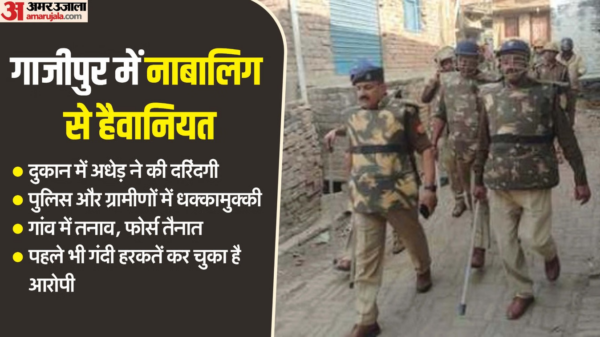
The alleged assault of a Class 6 student in a Ghazipur readymade shop, the reported attack on a Class 7 student in Bulandshahr, the alleged gang rape of a 15-year-old by a puncture-shop owner and accomplices in Agra, and the reported drugging and assault of a minor in a Chamoli barbershop illustrate different forms of situational vulnerability. The common policy question is not merely who owned a shop, but why a child could be isolated there, what warning signs were missed, whether nearby adults had a reporting pathway, and how quickly police and child-protection services responded.
Workplace power, wages, and sexual coercion
Commercial establishments can create pronounced power imbalances when a proprietor controls wages, schedules, references, housing, or continued employment. The reported Tanakpur case, in which a footwear-shop owner was accused of sexually exploiting two women employees and linking salary payment to sexual compliance, demonstrates why workplace abuse cannot be treated as a purely private dispute. Withholding earned wages to obtain sexual access is coercive conduct. It combines economic exploitation with sexual violence and may leave a worker believing that refusal will cost her income, reputation, or employability.
India’s Sexual Harassment of Women at Workplace (Prevention, Prohibition and Redressal) Act, 2013 provides an institutional route in addition to ordinary criminal law. Establishments meeting the statutory threshold must constitute an Internal Committee. Where an establishment has fewer than ten workers, or where the complaint is against the employer, the district-level Local Committee can receive the complaint. This feature is especially relevant to small shops and the unorganised sector, where employees may wrongly assume that workplace protections exist only in large companies. Market associations and municipal licensing offices should visibly display district contact details so that a worker does not have to discover the system while under threat.
Employers also require clear duties of prevention and response. These should include a written anti-harassment policy in the local language, confidential reporting channels, prohibition of retaliation, timely wage payment through traceable methods, documented shift rosters, safe closing procedures, and immediate cooperation with lawful investigations. Criminal liability must remain tied to statutory requirements and evidence; shop owners should not be automatically punished for an employee’s concealed offence merely because it occurred on the premises. Strong consequences are justified, however, where an owner participates, knowingly enables abuse, destroys evidence, threatens a complainant, ignores repeated warnings, or deliberately fails to perform a legal duty.
Deception, confinement, and allegations of coerced conversion
The compilation also includes incidents in which relationship or marriage promises were allegedly combined with abduction, confinement, or pressure to change religion. In Barabanki, a vegetable vendor was reportedly accused of attempting to take a Hindu woman for conversion and court marriage before lawyers became suspicious. In Kodagu, a woman employed at a cloth shop and her nine-year-old son were reported missing and later located at a Kerala madrasa; the cited account alleged conversion and stated that shop owners Salim and Jalil were arrested. These remain case-specific allegations requiring judicial determination.
In Dindori, a puncture-shop worker was accused of pressuring an 11th-grade student to convert, with the complainant’s account linking the harassment to two suicide attempts. In Nainital, a barber was reportedly accused of taking a woman away on a marriage promise, holding her in Bijnor for eight months, and repeatedly assaulting her. The operative legal questions in such cases concern age, consent, deception, coercion, confinement, assault, threats, and applicable state legislation. A voluntary interfaith relationship between competent adults must be distinguished from conduct involving force, fraud, intimidation, trafficking, or abuse of a minor.
The term Love Jihad is frequently used by political organizations and sections of the media to describe allegations that romantic deception is employed for religious conversion. It is not a substitute for a statutory offence or for proof in an individual case. Investigators should translate broad labels into legally testable questions: Was a false identity deliberately used? Was the complainant a minor? Was consent obtained through a material deception recognized by law? Was there a threat, assault, abduction, unlawful confinement, financial coercion, or organized facilitation? Did any person compel a religious act? Precise questions strengthen prosecution where evidence exists and protect voluntary adult choice where it does not.
Hidden cameras and technology-facilitated abuse

The reported use of recording devices introduces a distinct privacy and cybersecurity problem. In Jhunjhunu, Rajasthan, a clothing-shop owner was accused of concealing a mobile phone in a trial-room ceiling to record customers changing. In Dantewada, Chhattisgarh, a watch-repair-shop owner was accused of exposing himself to a 15-year-old girl. The compilation also refers to alleged recordings connected with the Agra and Chamoli cases and to social-media uploads in Gaya. Digital circulation can multiply the harm by making a victim fear permanent exposure, repeated viewing, and renewed blackmail.
The Bharatiya Nyaya Sanhita, which came into force on July 1, 2024, includes offences concerning sexual harassment, voyeurism, stalking, kidnapping, abduction, wrongful confinement, and trafficking. The applicable charge depends on the facts, the date of conduct, the victim’s age, and the evidence obtained. Where a child is depicted, POCSO provisions and rules protecting the child’s identity may also apply. Investigators should promptly secure original devices, request lawful preservation of platform records, document file metadata, calculate hashes, maintain chain of custody, and investigate every person who created, stored, transmitted, sold, or used an image for blackmail.
CCTV can improve security in entrances, sales floors, corridors, cash counters, warehouses, and other common areas, but an indiscriminate mandate would create new privacy risks. Cameras must never be placed in trial rooms, toilets, breastfeeding areas, or staff-changing spaces. Businesses should use visible notices, narrow fields of view, role-based access, encrypted storage, tamper alerts, audit logs, and a defined retention period. Footage should be released only through authorized procedures. A proprietor who can casually copy customer footage to a personal phone has not created a safety system; the proprietor has created another potential instrument of abuse.
A dharmic framework centered on dignity and responsibility
Within Hindu ethical vocabulary, protection of kanyas and respect for stris express a responsibility to uphold dignity, bodily autonomy, and freedom from exploitation. The concepts of maryada, lajja, vyavahara, and dharma can help articulate why commercial trust carries moral obligations. Yet these ideas should never be used to blame a victim, police women’s clothing or mobility, restrict education and employment, or treat a woman’s religious identity as family property. The burden of an offence belongs to the offender, and the responsibility of institutions is to make freedom safer rather than to reduce it.
A genuinely dharmic response is also compatible with solidarity across Hinduism, Buddhism, Jainism, and Sikhism. These traditions differ in doctrine and practice, but each contains strong resources for compassion, self-restraint, non-exploitation, service, and protection of the vulnerable. Temples, mathas, gurukulas, sampradayas, gurdwaras, Jain institutions, and Buddhist organizations can cooperate on child-safety education, trauma support, legal-literacy camps, safe transport, and emergency referral networks. Such cooperation should remain open to any victim in need. Protection becomes more credible when it is principled, lawful, and free from communal vigilantism.
A practical prevention architecture for marketplaces
At the shop level, prevention begins with environmental design. Secluded rooms should remain locked when not operationally required, access to warehouses should be logged, trial rooms should have privacy-respecting anti-voyeurism inspections, and one adult should not be permitted to isolate a visiting child without a legitimate reason. Closing shifts should use a two-person rule where feasible. Employees should know whom to call if a proprietor is the alleged offender. Emergency numbers, Local Committee contacts, and child-protection reporting information should be displayed in regional languages and in locations accessible to staff rather than only to customers.
At the market-association level, shared safeguards can make compliance feasible for small businesses. Associations can maintain trained safeguarding officers, conduct periodic workshops, provide model employment contracts, establish confidential grievance channels, and arrange independent inspections focused on physical safety and privacy. Background verification may be appropriate for sensitive roles, but it must be lawful, job-related, consistently applied, and based on verified conduct rather than religion, caste, ethnicity, or rumor. Communal profiling is both unjust and operationally ineffective because it diverts attention from observable risk factors such as prior complaints, unexplained access to children, retaliation, hidden devices, or repeated boundary violations.
At the district level, police, child-welfare authorities, labor officials, municipal bodies, and Local Committees need a common referral protocol. A complainant should not be sent repeatedly from one office to another. Reports involving a minor require child-sensitive handling and prompt application of POCSO procedures. Adult workplace complainants should be informed of both criminal-law remedies and the POSH mechanism. Where digital evidence exists, cybercrime personnel should become involved before devices are wiped or accounts disappear. Where trafficking or cross-state confinement is alleged, jurisdictions should share case information through documented channels instead of relying on informal coordination.
Courts and investigators must also distinguish speed from haste. Fast-tracking can reduce prolonged uncertainty, but it should not weaken forensic standards, defense rights, or victim support. Case management should prioritize timely medical and psychological care, preservation of evidence, avoidance of repetitive interviewing, protection from retaliation, and regular communication with the complainant or guardian. Data systems should track the progress from complaint to FIR, arrest, charge sheet, trial, acquittal or conviction, appeal, and victim compensation. Arrest counts alone do not measure justice; final outcomes, procedural quality, and long-term survivor welfare do.
Community vigilance without vigilantism
Community vigilance can help when it means noticing danger, supporting disclosure, accompanying a complainant to authorities, or ensuring that children have trusted adults. It becomes harmful when it turns into rumor, public identification of victims, forced social control, collective punishment, or violence against a religious group. Mohalla committees and faith-based organizations should therefore adopt written safeguards: no publication of a child’s identity, no confrontation that endangers evidence, no mediation of serious sexual offences, no pressure to withdraw a complaint, and immediate referral to competent authorities.
Self-defense education can improve confidence and situational awareness, including programs inspired by Kalaripayattu or Malla-yuddha. It should be treated as one optional layer rather than the principal answer. A child who freezes, complies under threat, or cannot escape has not failed. An employee dependent on wages should not be expected to overcome an employer physically. Effective prevention places responsibility on offenders, businesses, regulators, police, and courts while giving potential victims multiple safe ways to seek help.
What further research should establish
The 15-case compilation should be followed by broader, methodologically transparent research. A stronger study would specify inclusion criteria, remove duplicate reports, verify FIR and court status, distinguish allegations from findings, record victim and accused demographics without exposing identities, classify the relationship between the parties, and compare commercial-premises cases with other settings. It would also examine how frequently victims were employees, customers, minors, or acquaintances; how often digital blackmail occurred; which safeguards failed; and whether alleged accomplices were linked across cases. Only verified relational data could support a conclusion about networks or coordination.
Research should additionally ask whether small establishments understand their POSH obligations, whether district Local Committees are accessible, how quickly police preserve digital evidence, and whether survivors receive counseling and compensation. The geographic distribution of news reports should not be mistaken for incidence rates because media attention, police registration practices, internet access, language, and local political mobilization all affect visibility. Underreporting is plausible in sexual-violence cases, but the size of a hidden problem cannot be calculated from assertion alone. Better administrative data and anonymized case audits are essential.
Restoring trust through equal justice
The cases in this compilation are disturbing because they describe alleged abuses of trust in spaces woven into daily life. Their most defensible collective lesson is that marketplaces require stronger child-safety practices, enforceable workplace protections, privacy-conscious surveillance, reliable complaint channels, and competent investigation of physical and digital evidence. Allegations of forced conversion, trafficking, or organized facilitation should be examined rigorously wherever credible evidence exists. They should neither be dismissed for political convenience nor presumed merely from the religious identities involved.
Bharat’s marketplaces can remain spaces of vyavahara, dignity, and plural coexistence only when safety is treated as a shared civic duty. Hindu women and girls deserve protection as rights-bearing individuals, not as symbols used for political mobilization. Muslim citizens should not bear collective suspicion for crimes attributed to particular accused persons. A response that combines compassion for survivors, precision in law, scientific investigation, institutional accountability, and intercommunity restraint offers the strongest path toward justice. It protects the vulnerable while preserving the social trust that predatory conduct seeks to destroy.
Source and case reference: 15 Incidents: Exploitation Of Hindu Women By Muslim Shopkeepers (October 2024 – July 2026). The linked compilation and individual news reports should be read as accounts of allegations and procedural developments unless a final judgment is specifically cited.
Inspired by this post on Hindu Post.









Leave a Reply
You must be logged in to post a comment.