

As of July 10, 2026, the controversy surrounding donations to the Ram Temple in Ayodhya has developed into three overlapping matters: a criminal investigation into alleged theft by personnel involved in counting offerings, a governance debate about the safeguards used by the temple trust, and a political confrontation over responsibility. Shiv Sena leader Uddhav Thackeray has placed the Bharatiya Janata Party at the centre of that confrontation, but his claims about the political use of stolen money remain allegations rather than findings of the investigation.
The distinction is essential. Available reporting indicates that investigators have found prima facie evidence of repeated pilferage and serious control failures inside the donation-counting system. It does not establish that the BJP received stolen funds, directed the alleged theft, or used temple money to engineer defections. A factual analysis must therefore examine the documented investigation and Thackeray’s political argument separately before considering the broader implications for Hindutva, temple governance and public trust.
What triggered the controversy
Public scrutiny intensified in June 2026 after political leaders alleged that substantial donations made by devotees could not be accounted for. Early claims included an allegation by former Samajwadi Party legislator Pawan Pandey that approximately ₹7 crore to ₹7.5 crore had been stolen or embezzled. The Shri Ram Janmabhoomi Teerth Kshetra Trust initially rejected broad accusations of wrongdoing and said its transactions were recorded and periodically audited. Those initial monetary claims were not, by themselves, proof of a loss.
The Uttar Pradesh government constituted a Special Investigation Team on June 13 following a request from the trust. The team examined witnesses, financial documents, personnel records and available surveillance footage before submitting a preliminary report to the state government on June 23. According to a detailed account of the preliminary SIT findings, investigators identified about 70 suspicious incidents in footage available from April 27 to June 5. Counting personnel were allegedly seen concealing currency in clothing, pockets or footwear.
The preliminary report reportedly found that frisking requirements, supervision rules and other security protocols were not consistently enforced. It identified six counting personnel through CCTV evidence while also raising questions about wider administrative and supervisory failures. These findings materially changed the character of the controversy: it was no longer based only on political accusations, although the full scale of any loss and the responsibility of every person involved still required investigation.
On June 25, Ayodhya Police registered a First Information Report against eight people and unidentified others following a complaint from a trust member. The allegations included theft, misappropriation of cash, embezzlement of funds and the handling of valuables donated at the temple. All eight named accused were subsequently arrested. Reported provisions of the Bharatiya Nyaya Sanhita concerned theft by employees, criminal breach of trust, possession or disposal of stolen property, conspiracy and acts performed with common intention.
An FIR records accusations that warrant investigation; it is not a judgment of guilt. Arrests, recoveries and statements made during questioning must be tested through admissible evidence and judicial proceedings. Every accused person retains the presumption of innocence, while investigators remain responsible for tracing the complete movement of money and determining whether the visible incidents formed part of a larger conspiracy.
Later reporting suggested that the accused may collectively have taken approximately ₹2 crore to ₹3 crore, but that estimate emerged from the continuing investigation and reported statements rather than a final judicial determination. It should not be confused with the larger figures cited in political speeches or with the total value of donations received by the trust. A conclusive loss figure would require a transaction-level reconciliation of hundi collections, counted amounts, deposit records, valuables registers, donor acknowledgements and bank confirmations.
Uddhav Thackeray’s intervention
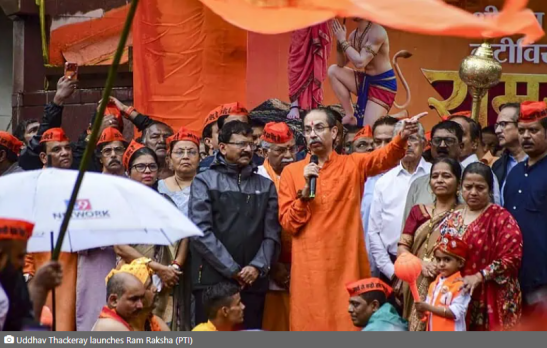
Against this background, Uddhav Thackeray accused the BJP and its ideological ecosystem of exploiting the Ram Temple movement while failing to protect devotees’ offerings. At a July 3 press conference, he alleged that money taken from the temple might have been used to destabilise opposition parties and engineer defections. He described the issue as a betrayal of Hindutva and announced a statewide campaign under the name “Ram Raksha Andolan.”
On July 5, Shiv Sena (UBT) leaders and supporters assembled at a Hanuman temple in Dadar, Mumbai. The programme included a maha aarti and recitations of the Ram Raksha Stotra and Hanuman Chalisa. Thackeray argued that ordinary Hindus would not forgive anyone who exploited their faith to steal from a temple. His statement that “Hindus are innocent, but they are not fools” condensed the political message of the agitation: devotion, in his formulation, should not be mistaken for an unwillingness to demand accounts.
The symbolism was deliberate. Rather than presenting the controversy only as an administrative dispute, the agitation used devotional practices to claim a moral right to defend the offerings of Ram bhaktas. Thackeray also invoked the participation of Shiv Sainiks in shila pujan, rath yatras, kar seva and the wider Ram Janmabhoomi movement. He argued that the sacrifices associated with that history created a continuing obligation to protect the temple from financial abuse.
Thackeray’s campaign unfolded immediately after serious political setbacks for his party. Six Shiv Sena (UBT) Lok Sabha members had joined the Eknath Shinde-led Shiv Sena, while Maharashtra Legislative Council member Sachin Ahir also left the UBT faction. This context explains why Thackeray connected the temple controversy with the market for political defections. It also makes evidentiary caution especially important: the proximity of two events can support a political narrative without proving a financial connection between them.
No publicly reported material from the SIT has established that stolen temple donations financed the defections of legislators or members of Parliament. Thackeray’s suggestion that temple money was used to break parties should consequently be described as an unproven political allegation. If evidence of such a trail exists, it would require bank records, cash-recovery links, communications, witness testimony or other corroboration capable of connecting the alleged theft to identifiable political transactions.
Shiv Sena (UBT) parliamentarian Sanjay Raut added a narrower, potentially verifiable claim. He said the undivided Shiv Sena had donated a four-kilogram silver brick and that Uddhav Thackeray had contributed ₹1 crore toward the temple’s construction, but alleged that the party had not received satisfactory acknowledgement or information about those contributions. The appropriate resolution is not rhetorical inference but donor-level verification: the original transfer record, receipt, valuables register, custody history and final use of the silver should be matched and disclosed to the donor.
Responses from the BJP, the government and the trust
Maharashtra Chief Minister Devendra Fadnavis responded by saying he was pleased that Thackeray had remembered Lord Ram and suggested that daily recitation of the Ram Raksha Stotra would benefit him. The response challenged Thackeray’s political credibility but did not resolve the accounting questions. Uttar Pradesh Chief Minister Yogi Adityanath adopted a different emphasis, saying that no guilty person would be spared while warning that allegations should not be treated as established facts before the investigation was completed.
The Vishva Hindu Parishad and the Rashtriya Swayamsevak Sangh also called for a thorough investigation and punishment for anyone found guilty. These responses demonstrate that demands for accountability cannot be reduced to a dispute between supporters and opponents of Hindutva. Organisations associated with the Ram Temple movement have an institutional interest in ensuring that wrongdoing is prosecuted and that the devotional community is not collectively blamed for the conduct of particular individuals.
The temple trust subsequently accepted the resignations of general secretary Champat Rai and trustee Anil Mishra. Krishna Mohan was appointed interim general secretary, and a three-member committee was formed to recommend candidates for a newly created chief executive officer position. The trust scheduled a further meeting for July 22 to consider appointments and review the developing situation. Resignation from office may support institutional reform, but it does not by itself prove criminal responsibility or amount to an admission of wrongdoing.
Trust treasurer Govind Dev Giri described the episode as a source of deep pain and embarrassment. The trust said that offerings received up to March 31, 2026, totalled ₹582 crore, of which ₹391 crore had been spent on operations and related expenses while the balance remained in bank accounts. It also stated that 2,926 recorded offerings from devotees were entered in its registers. Those assertions should be capable of verification through audited ledgers, bank confirmations, invoices, inventory records and donor acknowledgements.
What the headline figures do—and do not—show
Several monetary figures have circulated, but they measure different things. The ₹7 crore to ₹7.5 crore figure began as a political allegation. The reported ₹2 crore to ₹3 crore estimate concerned alleged theft identified during the investigation. The trust’s ₹582 crore statement described offerings over a stated accounting period, while an Indian Express investigation cited an estimated ₹3,500 crore in cash donations received since the trust’s formation, including the much larger collection associated with temple construction.
These figures cannot responsibly be subtracted from one another without common definitions. Construction contributions, routine hundi offerings, bank transfers, earmarked donations, jewellery and in-kind gifts may be recorded in separate systems and cover different periods. A transparent reconciliation should publish opening balances, receipts by category, expenditure, assets created, restricted funds, bank balances and closing inventories. Until that bridge is available, a large gross-receipts figure should not be represented as the amount stolen.
The governance structure behind the dispute
The Shri Ram Janmabhoomi Teerth Kshetra Trust was established on February 5, 2020, through a government-approved scheme following the Supreme Court’s 2019 Ayodhya judgment. Unlike institutions such as Tirumala Tirupati Devasthanams, the Shri Jagannath Temple administration, the Shri Mata Vaishno Devi Shrine Board and the Kashi Vishwanath Temple trust, the Ayodhya trust is not governed by a dedicated state statute setting out an equivalent administrative architecture. That difference does not necessarily imply weaker governance, but it places greater importance on the trust’s own bylaws, policies, board oversight and voluntary transparency.
India’s constitutional framework permits a distinction between religious autonomy and regulation of secular financial activity. Article 25(2)(a) of the Constitution allows the state to regulate economic, financial, political or other secular activity associated with religious practice. Article 26 protects the right of religious denominations to manage religious affairs and to own property, while requiring that such property be administered in accordance with law. Financial accountability can therefore protect religious freedom rather than negate it.
The reported donation process at Ayodhya resembled the broad workflow used at many major shrines. Offerings from about 35 hundis were opened by authorised personnel, including trust representatives and a State Bank of India representative, and moved to a counting hall inside the Pilgrim Facilitation Centre. The vulnerability was not necessarily the design of any single step. It arose from whether controls were consistently enforced across the full chain—from opening a box to counting, recording, transporting and depositing its contents.
A private risk-management review conducted in 2020 had reportedly warned that the trust lacked systematic donation records, clearly defined management layers and a comprehensive standard operating procedure. The review recommended formal processes for transactions, data management, staffing and accountability. The significance of that warning lies in a basic governance principle: a control that exists only as an informal expectation is difficult to test, enforce or assign to a responsible officer.
How a defensible donation-control system should work
A secure system begins with segregation of duties. No individual should be able to open a hundi, handle its contents, record the count, approve the result and confirm the bank deposit. Each stage should require at least two independently accountable participants, and the membership of counting teams should rotate. Trust personnel, bank representatives, security staff and accounting officers should have clearly separated responsibilities, with exceptions automatically escalated to an audit committee.
Chain-of-custody documentation should begin when a donation box is sealed and continue until the reconciled amount reaches the bank. Every box requires a unique identifier, tamper-evident seals, time-stamped handovers and signatures from both the transferring and receiving custodians. Its contents should be associated with a batch number so that the physical count, system entry, counting-machine total and bank deposit can be traced without ambiguity.
Surveillance should provide overlapping coverage of every point at which money or valuables are exposed. Cameras need independent health monitoring, adequate retention periods, restricted administrator access and logs showing who viewed, exported or deleted footage. Camera placement and blind spots should be tested through periodic red-team exercises. Security-sensitive details need not be released publicly, but an external auditor should certify that coverage, retention and access controls meet the approved standard.
Personnel controls are equally important. Background verification, conflict-of-interest declarations, restrictions on employing close relatives in the same custody chain, mandatory leave, job rotation and access reviews can reduce collusion risk. Frisking rules must be dignified, consistently applied and documented. If senior officials can waive them informally, the system effectively transfers control from a written policy to personal discretion.
Accounting controls should require daily reconciliation among the physical count, the electronic counting record, the donation-management ledger and the amount acknowledged by the bank. Unresolved differences should remain visible rather than being carried forward silently. Useful risk indicators include delayed deposits, unusual denomination patterns, repeated count corrections, CCTV downtime, unplanned personnel substitutions, dormant access credentials and an abnormal number of manual journal entries.

Gold, silver, jewellery and other high-value objects require a separate inventory system. Each item should be photographed, weighed, purity-tested where appropriate, assigned a permanent identification number and linked to a donor acknowledgement. Any melting, conversion, sale or use in construction should require board-approved documentation that preserves the link from the original gift to its final disposition. This is particularly relevant to disputes over silver bricks and ceremonial objects.
Digital payments can reduce physical cash exposure, but they are not a complete solution. A temple must continue to accommodate pilgrims who prefer cash or lack digital access. Electronic channels also introduce risks involving fraudulent payment links, impersonation, cybersecurity, failed settlements and donor-data privacy. The appropriate model is a controlled mix of payment options supported by verified official accounts, automated receipts and daily bank reconciliation.
A confidential whistleblower channel should permit employees, pilgrims, vendors and bank personnel to report suspected misconduct without passing through the managers they are accusing. Reports should receive reference numbers, preservation orders and defined investigation deadlines. Retaliation protections are essential because a nominal complaint mechanism offers little value if insiders reasonably fear dismissal, social pressure or reputational harm.
Audit, investigation and criminal proof are different
A financial-statement audit evaluates whether accounts are materially reliable; it is not designed to guarantee the detection of every theft, especially where employees collude or override controls. An internal audit tests whether procedures are operating effectively. A forensic audit reconstructs specific transactions and searches for concealed relationships or assets. A police investigation gathers evidence for prosecution, while a court determines guilt under the applicable criminal standard. Treating these functions as interchangeable creates false confidence.
The Ayodhya response should therefore combine, rather than substitute, these forms of assurance. The criminal case can identify individual liability. A forensic review can quantify the loss and trace assets. An independent control audit can determine how the system failed. A public governance review can assign institutional responsibility and monitor reforms. None of these tasks should be abandoned merely because arrests have occurred.
Appointment of a professional chief executive officer could strengthen day-to-day administration if the office has a written mandate, operational independence and measurable responsibilities. The CEO should report to the board, while a separate audit and risk committee oversees internal control, conflicts of interest, related-party transactions and whistleblower cases. Religious authorities would retain responsibility for ritual and spiritual matters, leaving professional administrators to manage secular operations under their guidance.
Public reporting should be informative without compromising temple security. Annual audited financial statements, aggregate donation categories, expenditure by purpose, reserve balances, material contracts, related-party disclosures and progress on audit findings can be published safely. Operational metrics could include the percentage of daily reconciliations completed on time, unresolved exceptions, confirmed security incidents and the average time taken to acknowledge high-value donations.
Hindutva, political ownership and accountability
Thackeray’s accusation that Hindutva was insulted transforms an accounting failure into a contest over political legitimacy. The BJP has long placed the Ram Temple at the centre of its civilisational and electoral narrative. The Shiv Sena also claims a formative role in the Ram Janmabhoomi mobilisation. The donation controversy consequently allows rival parties to argue not only about administrative competence but also about who can credibly speak for Hindu interests.
Faith, however, is not the property of a political party. Accountability for temple funds should neither depend on hostility to the BJP nor be dismissed as hostility to Hinduism. The relevant question is whether the institution entrusted with devotees’ offerings maintained controls proportionate to the scale, sensitivity and sacred purpose of those assets. That standard applies regardless of which party claims the political legacy of the temple movement.
For a family that set aside part of its income for the Ram Temple, a missing receipt or unexplained donation is not an abstract bookkeeping defect. It can feel like a breach of a personal vow. Public institutions that receive sacred offerings therefore carry a form of fiduciary responsibility deeper than ordinary commercial custody: they must protect both the economic value of the gift and the devotee’s confidence that it reached its intended purpose.
This principle also serves unity across Dharmic traditions. Hindu, Buddhist, Jain and Sikh communities articulate generosity, dāna and seva through distinct teachings and institutions, yet each depends on honest stewardship. Misconduct by individuals should never be used to stigmatise an entire religion, caste, sect or devotional community. Responsibility must follow evidence, while reform should strengthen the shared ethical expectation that sacred resources are held in trust rather than treated as political or private property.
How the competing claims should be judged
Thackeray’s demand for transparency is legitimate insofar as it seeks verified accounts, an independent investigation and protection of devotees’ money. His allegation that stolen donations funded political defections requires a much higher evidentiary threshold than has publicly been met. BJP leaders are entitled to dispute his motives, but a political counterattack cannot replace a documented explanation of the control failures identified by investigators.
The trust’s reforms should be assessed through observable results rather than assurances. A credible outcome would include publication of the final investigative findings to the extent legally permissible, prosecution based on evidence, recovery of stolen assets, reconciliation of disputed donations, independent testing of the redesigned controls and periodic reports showing that corrective actions remain in force.
The central lesson extends beyond one party or temple. Religious institutions become more resilient when spiritual authority is supported by professional administration, documented custody and independent oversight. Transparency does not diminish sanctity; it protects sanctity from exploitation. In that sense, the strongest response to the Ram Temple donation controversy is neither partisan triumph nor collective suspicion, but a verifiable system in which every offering can be traced, every custodian can be held accountable and every devotee can give with confidence.
Inspired by this post on Struggle for Hindu Existence.





Leave a Reply
You must be logged in to post a comment.