
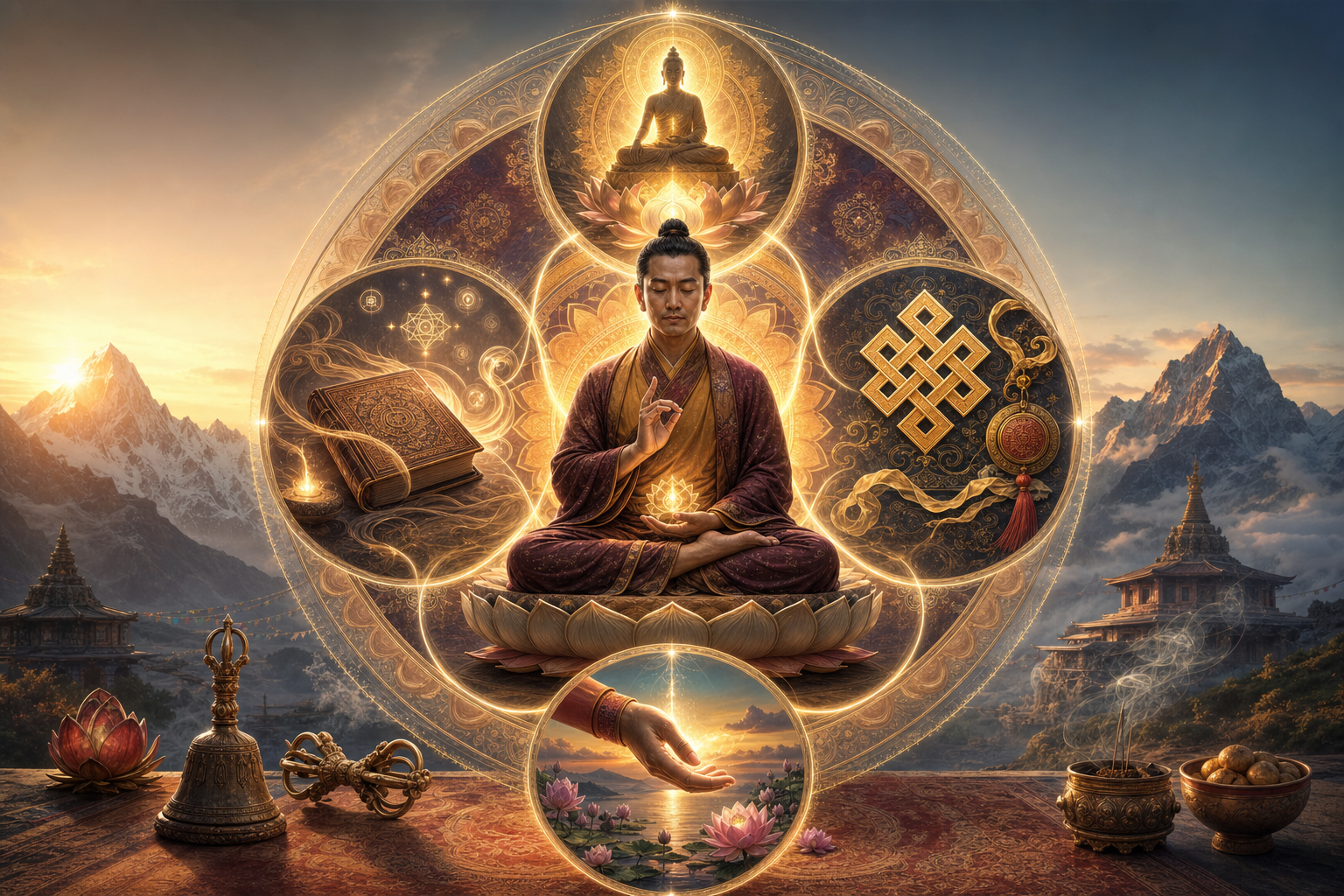
Understanding the four mudras in their proper tantric context
Tantric worship is often introduced through its most visible elements: mantra, mandala, sacred images, ritual offerings, meditation, and carefully formed gestures called mudras. Yet a mudra is much more than an arrangement of the fingers. In tantric traditions, it can function as a seal that joins bodily action, sacred speech, contemplative awareness, ethical commitment, and ritual purpose. Karmamudra, Dharmamudra, Mahamudra, and Samyamudra therefore deserve to be studied not as four isolated hand positions, but as parts of a sophisticated spiritual vocabulary.
An important historical clarification is necessary at the outset. Mudras are widely used in Hindu worship, yoga, Buddhist ritual, and Jain iconography, but this precise fourfold classification is most clearly documented in Buddhist Yoga Tantra and later Vajrayana systems. Hindu tantric traditions contain closely related ideas, shared ritual technologies, and terms such as Mahamudra, but they do not all recognize this quartet as a universal scheme. The academically responsible approach is therefore comparative: it acknowledges a broad Indic tantric environment while preserving the distinct teachings of individual lineages.
The Sanskrit word mudra can mean a seal, mark, sign, token, or gesture. A physical seal authenticates a document by showing that its contents belong to a particular authority. A ritual mudra works through a comparable symbolism: it marks an action, visualization, mantra, or state of awareness as inseparable from a sacred pattern. The practitioner is not merely representing a deity from the outside. Within the logic of tantric practice, body, speech, and mind are being reorganized around an awakened form.
This broader meaning explains why translating mudra simply as hand gesture can be misleading. Some mudras are unquestionably manual gestures. Others refer to a deity’s complete form, a mantra, a commitment, a ritual partner, a mode of insight, or the realization that seals all experience. The word changes meaning according to textual period, ritual context, initiation system, and lineage. A definition that is correct in one manual may be incomplete or incorrect in another.
Scholarly accounts of Indian Yoga Tantra describe a fourfold scheme consisting of Karmamudra, Dharmamudra, Mahamudra, and Samayamudra, with each seal connected to gestures, mantras, deity visualization, mandala symbolism, purification, and awakened knowledge. This early ritual framework is discussed in [Mahāmudrā in India](https://wisdomexperience.org/ebook/mind-seeing-mind/), while related textual patterns can also be examined in the scholarly edition of the [Sarva Tathagata Tattva Samgraha](https://eprints.soas.ac.uk/28567/1/10672726.pdf). These sources show why the four mudras should not be reduced to a modern list of wellness exercises.
A common ritual mapping associates Mahamudra with awakened body, Dharmamudra with awakened speech, Samayamudra with awakened mind or sacred commitment, and Karmamudra with awakened activity. This mapping is useful, but it is not the only interpretation. Later contemplative traditions recast the four seals in terms of the ground, path, method, and fruition of practice. Some sources also change their order or emphasize different relationships among them. The variation is evidence of a living intellectual history rather than a defect in the tradition.
1. Karmamudra: the seal of awakened activity
Karmamudra literally indicates an action seal. Karma in this compound primarily carries the sense of action or activity, not merely the popular idea of moral consequences accumulated across lives. In Yoga Tantra ritual, Karmamudra can identify the gesture or operative seal through which a sacred activity is enacted. It gives practical expression to the intention established by mantra, visualization, and contemplative awareness.
Tantric ritual does not treat action as spiritually neutral. The way a practitioner sits, moves, speaks, visualizes, offers, and concludes a rite is understood to shape consciousness. Karmamudra represents the point at which insight becomes activity. In a common fourfold correspondence, it is related to enlightened action: activity no longer governed solely by habit, attachment, hostility, or self-interest, but directed toward liberation and the welfare of beings.
In this early ritual sense, Karmamudra may involve prescribed bodily signs performed together with mantra and visualization. The gesture is not believed to operate as an arbitrary code. Its meaning arises from the entire ritual system: the deity being invoked or visualized, the relevant Buddha family or mandala, the practitioner’s initiation, and the purpose of the rite. Removing the gesture from that network is comparable to taking a single word from a technical manual and expecting it to reproduce the whole procedure.
The term acquires a more specialized meaning in later Buddhist Yogini Tantra and completion-stage literature. In those contexts, Karmamudra may refer to an embodied consort and to advanced practices in which bliss is integrated with insight into emptiness. Some traditions distinguish a physical Karmamudra from an internally visualized wisdom seal. This usage should not be projected backward onto every occurrence of the term, and it should not be treated as the defining feature of all tantric worship.
Advanced consort practice is neither a recreational technique nor a license for exploitation. Traditional sources place it inside systems of initiation, vows, ethical discipline, meditative stability, and close supervision by a qualified teacher. Consent, maturity, freedom from coercion, and the absence of abuse are indispensable ethical standards. Claims of spiritual authority never excuse manipulation. For most readers, the appropriate educational conclusion is simply that Karmamudra has multiple historical meanings and that its restricted forms cannot be learned responsibly from a general article.
At an accessible philosophical level, Karmamudra raises a relatable question: does spiritual understanding change conduct? A moment of calm during meditation has limited value if it does not affect speech, choices, relationships, or service. The action seal symbolizes the movement from inward realization to compassionate activity. It is the point at which ritual discipline is tested in ordinary life.
2. Dharmamudra: the seal of sacred speech, teaching, and reality
Dharmamudra may be translated as the Dharma seal or seal of reality. Dharma is a richly layered term. Depending on context, it can signify teaching, truth, phenomenon, principle, or the nature of things. Consequently, Dharmamudra cannot be confined to one simple definition. In ritual classifications, it is often associated with mantra and awakened speech; in contemplative explanations, it may indicate insight into the actual nature of experience.
The association with speech is technically significant. A mantra is not merely an inspirational sentence. It is a patterned form of sacred sound whose syllables, rhythm, deity association, visualization, and authorized transmission belong together. Dharmamudra seals ritual speech so that sound is aligned with meaning and awareness. Vocal recitation, silent recitation, seed syllables, and visualization may perform different functions, but none is adequately understood as mechanical repetition.
Dharmamudra also points beyond spoken language. In later interpretive systems, it can refer to the recognition that phenomena are empty of independent existence while still appearing through causes and conditions. Emptiness here does not mean that nothing exists or that moral choices are irrelevant. It means that persons and things do not possess the isolated, permanent essence ordinarily projected onto them. This insight is intended to weaken grasping without denying conventional reality.
The expression Dharma seal also appears in wider Buddhist doctrine, where it can identify characteristics that distinguish an authentic teaching. That doctrinal use should not automatically be equated with the specific Dharmamudra of a tantric fourfold ritual scheme. The terms overlap because both concern authentication by Dharma, but their functions and textual settings differ. Precise reading depends on genre, lineage, and context.
Within practice, Dharmamudra joins comprehension with recitation. Sacred speech without understanding can become empty habit, while intellectual understanding without disciplined embodiment can remain remote from experience. The seal brings them into relation. A mantra is heard, formed, visualized, and contemplated until the distinction between the person speaking and the sacred meaning being invoked is transformed.
There is also an ethical implication. Speech can heal, instruct, deceive, humiliate, or divide. A seal of awakened speech asks whether language reflects truth, restraint, compassion, and responsibility. This makes Dharmamudra relevant beyond formal worship. The care taken with mantra becomes a model for the care required in conversation, scholarship, public discourse, and interreligious dialogue.
3. Mahamudra: the great seal of awakened embodiment and realization
Mahamudra means the great seal. The term is widely known today as the name of a major contemplative tradition associated especially with the Kagyu schools of Tibetan Buddhism, although it is important in other Tibetan lineages as well. Its history is broader than that later meditation system. In Indian Buddhist tantric sources, Mahamudra can describe the great seal of the deity’s awakened form, complete identification with that form, or the culminating realization that seals all phenomena.
In an early Yoga Tantra framework, Mahamudra is frequently related to awakened body. This does not refer only to physical anatomy. The deity’s body is a symbolic and contemplative body produced through visualization, mantra, gesture, and the ritual imagination. Its colors, implements, posture, faces, arms, ornaments, and position within a mandala communicate specific qualities of awakened knowledge. To assume that these details are decorative is to miss their technical purpose.
Deity yoga uses this form to challenge an ordinary identity built from fear, craving, memory, and social conditioning. The practitioner first visualizes the sacred form according to lineage instructions and later dissolves it, preventing the visualization from becoming another permanent self-image. Mahamudra seals the process by expressing inseparability between vivid appearance and emptiness. Form appears clearly, yet it is not grasped as independently existing.
Later Mahamudra teachings place greater emphasis on direct knowledge of mind’s nature. They investigate thoughts, perceptions, and awareness without attempting to manufacture a permanent metaphysical object behind them. The approach is represented through different systems—sutra, mantra, and essence presentations, as well as explanations of ground, path, and fruition. An academic overview of these developments is available through [Oxford Bibliographies: Mahāmudrā in India](https://academic.oup.com/reference/62340/reference-article-abstract/554145209?login=false).
Mahamudra should not be misunderstood as a blank trance or the suppression of thought. Thoughts may continue to arise. The central issue is whether they are recognized without compulsive identification and grasping. Likewise, nonduality does not mean that ethical distinctions disappear. Mature presentations connect insight with compassion, disciplined conduct, and freedom from self-centered fixation.
The name Mahamudra also appears in Hindu Hatha Yoga, where it denotes a bodily practice involving posture, breath, and energetic control. That practice has its own textual history and should not be confused with the entire Buddhist Mahamudra meditation tradition. The shared name reveals centuries of interaction within the Indic religious world, but identical vocabulary does not guarantee identical doctrine or technique.
As the great seal, Mahamudra expresses culmination. It suggests that awakened understanding is not restricted to one sacred object while ordinary experience remains untouched. Every perception can be examined through the same insight into appearance, dependence, impermanence, and non-grasping. This is why Mahamudra may be described both as a ritual identity and as an ultimate realization: it seals the whole field of experience.
4. Samyamudra or Samayamudra: the seal of sacred commitment
The form Samyamudra in the source material most likely corresponds to Samayamudra, the spelling widely attested in the fourfold tantric classification. Samaya means a pledge, commitment, convention, sacred bond, or required observance. It should not automatically be confused with samyama, the combined discipline of concentration, meditation, and absorption discussed in the Yoga Sutras. The similarity of the English spellings can conceal a substantial difference in meaning.
Samayamudra is commonly translated as the pledge seal or commitment seal. In ritual, it can refer to the symbolic form through which the practitioner’s mind is bound to the awakened form of a deity. It may also encompass the commitments established through initiation and the discipline required to preserve the relationship among teacher, teaching, mandala, and community. The seal is therefore both symbolic and ethical.
A common mapping associates Samayamudra with awakened mind. The connection becomes clearer when samaya is understood as continuity of intention. A ritual visualization is not meant to be a temporary costume adopted during a ceremony and discarded when convenient. The pledge seal asks the practitioner to maintain the ethical and contemplative orientation established by the rite. Mind, symbol, and commitment must remain coherent.
Tantric sources use samaya in more than one way. It can indicate vows, a symbolic deity form, ritual substances, conventional appearance, or the bond that makes transmission effective. Later teachers may explain Samayamudra as the method that prevents practice from straying from its authentic purpose. A traditional example of a lineage-specific reinterpretation can be read in [The Meaning of the Four Mudrās](https://www.lotsawahouse.org/tibetan-masters/dola-jigme-kalzang/elucidating-hidden-meaning-four-mudras), which illustrates how the four terms can be assigned to the basis, object, method, and result of practice.
The emotional force of Samayamudra lies in the seriousness of a promise. Most people recognize the difference between a casually expressed intention and a commitment that reorganizes conduct. A sacred pledge can provide steadiness, but it can also be misused if obedience is demanded without accountability. Healthy spiritual commitment requires informed consent, ethical boundaries, transparency, and the freedom to question harmful behavior.
How the four mudras operate together
The four mudras are best understood as an integrated system. Mahamudra supplies the awakened form or comprehensive realization. Dharmamudra supplies sacred speech and insight into reality. Samayamudra maintains the contemplative and ethical bond. Karmamudra converts the whole process into purposeful activity. In the common correspondence, body, speech, mind, and action are not separate compartments; each influences and seals the others.
They should not always be arranged as a simple ladder in which one is abandoned after the next is reached. A ritual gesture may require mantra, visualization, commitment, and intended action simultaneously. Likewise, realization without ethical continuity is unstable, while commitment without understanding can become rigid. The fourfold model describes coordinated dimensions of practice more effectively than four independent stages.
A generalized tantric sequence helps clarify their relationship without disclosing restricted instructions. A properly initiated practitioner first establishes motivation, refuge, ethical orientation, and a clear ritual space. A sacred form or mandala is then generated through visualization. Mantra and mudra coordinate speech and body with that form. The relevant commitment is recollected, ritual activity is performed, and the visualization is eventually dissolved. Merit or benefit is dedicated to others rather than treated as private spiritual possession.
Within this pattern, the seal is effective because several channels of attention converge. The hands form a meaningful sign; the voice or mind carries mantra; the imagination holds a structured image; emotion is directed through devotion or compassion; and philosophical understanding prevents the image from being mistaken for an independently existing entity. Tantric ritual is therefore a disciplined coordination of cognition, embodiment, symbolism, and intention.
Traditional explanations often describe this coordination as the movement or transformation of spiritual energy. Hindu and Buddhist yogic systems may speak of prana, subtle channels, chakras, drops, winds, or inner heat, but their maps are not identical. Such language should first be understood within the contemplative systems that produced it. Claims about subtle energy represent traditional and experiential models; they should not automatically be presented as established findings of anatomy, neuroscience, or clinical medicine.
Modern research on ritual and embodied cognition can nevertheless help explain why coordinated gesture, repetition, breath, imagery, and attention may feel powerful. Posture can influence attention, repeated actions can stabilize intention, and shared ritual can strengthen memory and belonging. These observations do not prove every metaphysical claim made by a tantric text. They provide a complementary account of how disciplined symbolic action may affect human experience.
Why a mudra is not merely a hand exercise
A photograph of a hand position rarely communicates enough information to reproduce a tantric mudra. Orientation, sequence, accompanying mantra, visualization, breathing pattern, deity association, ritual purpose, and authorization may all matter. Two gestures that look similar can perform different functions, while one term can refer to several outward forms. This is why traditional manuals are often concise: they assume oral explanation and prior initiation.
The distinction between representation and participation is equally important. In art history, a mudra can be studied as an iconographic sign. In ritual, the same gesture may be performed as an active component of worship. In meditation, it may become an internal symbol. In philosophy, it may name realization itself. Academic study can compare these levels, but responsible practice does not pretend that reading about a symbol is identical to receiving its transmission.
Tantric initiations traditionally authorize particular practices and establish obligations. This does not mean that historical study is forbidden. Anyone may learn about the development, symbolism, and comparative meaning of the four mudras. It means that restricted mantras, internal yogas, and completion-stage practices should not be improvised without appropriate preparation. Intellectual curiosity and respect for lineage can coexist.
A qualified spiritual guide should demonstrate knowledge, ethical consistency, accountability, and respect for personal boundaries. Charisma alone is not qualification. Secrecy intended to protect a complex practice must never become a shield for financial, emotional, or sexual abuse. This principle is especially important when discussing Karmamudra, samaya, or claims that obedience overrides ordinary ethics.
Common misconceptions about the four types of mudras
The first misconception is that every mudra channels a measurable energy in the same manner. Tantric traditions offer multiple subtle-body models, and even related lineages may interpret them differently. It is more accurate to state that practitioners use mudra to organize attention, ritual identity, sacred intention, and, within traditional frameworks, subtle energy. Universal physiological claims require evidence beyond scriptural authority or personal testimony.
The second misconception is that Karmamudra always means sexual yoga. Its earlier and broader meaning as an action seal is essential to the fourfold Yoga Tantra system. The specialized consort meaning belongs to particular later contexts. Treating that restricted usage as the essence of Tantra sensationalizes the tradition and obscures its extensive literature on ethics, visualization, mantra, compassion, philosophy, and liberation.
The third misconception is that Mahamudra always refers to one technique. It can signify a ritual seal, the complete deity form, a culminating realization, or a developed system of meditation on mind’s nature. Hindu Hatha Yoga also uses the term for a distinct bodily practice. Context must decide which meaning is intended.
The fourth misconception is that Samyamudra necessarily means concentration. In this fourfold classification, Samayamudra and its connection with samaya provide the stronger historical reading. Concentration is certainly necessary for complex visualization, but it does not exhaust the meaning of the pledge seal. Commitment, sacred identity, and continuity of conduct are central.
The fifth misconception is that the four mudras constitute a universal Hindu doctrine. Hindu Tantrism is internally diverse, encompassing Shaiva, Shakta, Vaishnava, Smarta, regional, temple, household, and yogic traditions with their own ritual manuals. The fourfold scheme under discussion is especially prominent in Buddhist tantric materials. Recognizing that origin does not diminish the shared Indic environment in which Buddhist and Hindu tantric communities exchanged terminology, imagery, philosophical questions, and ritual methods.
Mudras across Dharmic traditions
Hindu worship employs many mudras during puja, mantra practice, meditation, temple ritual, dance, and yoga. They may accompany invocation, offering, protection, visualization, consecration, or the placement of mantra within the body through related practices such as nyasa. Their number and meaning vary by scripture and sampradaya. These Hindu systems should be studied on their own terms rather than reorganized automatically under a Buddhist fourfold model.
Buddhist traditions use mudras in images, meditation, monastic ritual, mantra systems, and Vajrayana deity yoga. Familiar iconographic gestures may express teaching, meditation, fearlessness, generosity, or the calling of the earth as witness. The four seals examined here belong to a more technical tantric register in which ritual embodiment, sacred speech, commitment, activity, and insight are closely coordinated.
Jain art and worship also preserve a disciplined language of posture and gesture. Images of the Tirthankaras emphasize meditation, equanimity, fearlessness, renunciation, and liberation. These visual forms may resemble gestures found in Hindu and Buddhist settings, but Jain interpretations are grounded in distinct teachings about the jiva, karma, nonviolence, restraint, and the path to freedom.
Sikh practice does not organize worship around the four tantric mudras. Its central disciplines include engagement with Gurbani, naam, sangat, seva, honest living, remembrance of the Divine, and resistance to empty ritualism. Gestures of reverence still appear in lived practice, as they do in most human communities, but they must be understood within Sikh teachings rather than absorbed into a generalized tantric system.
Unity among Dharmic traditions is strengthened by accurate comparison, not by erasing difference. Hinduism, Buddhism, Jainism, and Sikhism share histories, languages, ethical concerns, and cultural spaces, yet each maintains distinctive accounts of selfhood, liberation, authority, worship, and disciplined action. A respectful study of mudras can reveal genuine connections while leaving room for principled disagreement and independent identity.
A practical framework for studying tantric mudras responsibly
A reliable study begins by identifying the tradition, text, historical period, and ritual class in which a term appears. The next step is to determine whether mudra means a hand gesture, deity form, mantra-related seal, vow, partner, contemplative insight, or result. Commentarial explanations should then be compared without assuming that later meanings were always present in earlier sources. Finally, the difference between public information and initiation-dependent instruction should be respected.
Translations also require caution. Karma may mean activity rather than accumulated destiny; Dharma may mean teaching, phenomenon, or reality; maha means great but does not by itself define a method; and samaya indicates a bond or pledge within this classification. English equivalents are helpful entry points, not complete definitions. Technical Sanskrit terms retain networks of meaning that become visible only through sustained textual and ritual study.
For readers drawn to the experiential dimension, accessible foundations are more valuable than attempts to imitate restricted practices. Ethical conduct, compassion, careful attention, truthful speech, study, simple breath awareness, and respect for one’s chosen tradition provide a stable basis. Even the familiar act of bringing the palms together can become meaningful when gesture, intention, humility, and awareness agree. Its value lies less in novelty than in coherence.
The four seals also offer a useful model for evaluating spiritual life. Mahamudra asks what view of reality and identity informs the practice. Dharmamudra asks whether speech and understanding express truth. Samayamudra asks whether commitments are ethical and sustained. Karmamudra asks whether insight produces beneficial action. Together, these questions prevent spirituality from being reduced to either abstract philosophy or outward performance.
Frequently asked questions
Are Karmamudra, Dharmamudra, Mahamudra, and Samyamudra four hand positions? Not necessarily. Some early ritual applications include manual gestures, but the names can also designate sacred activity, mantra and Dharma, deity embodiment, commitment, contemplative insight, or fruition. Their meaning must be established from the relevant text and lineage.
Is Karmamudra always a consort practice? No. In the fourfold Yoga Tantra classification, it has the broader meaning of an action seal. The consort interpretation belongs to specific later Buddhist tantric and completion-stage contexts. Those advanced forms are traditionally restricted and ethically sensitive.
Is Mahamudra Hindu or Buddhist? The term appears in both Hindu and Buddhist traditions, but it does not always describe the same practice. Buddhist Mahamudra developed as both a tantric seal and a major contemplative approach to mind’s nature. Hindu Hatha Yoga uses Mahamudra for a distinct bodily and energetic discipline.
Can the four mudras be practised without initiation? Their history and symbolism can be studied publicly. Lineage-specific gestures, mantras, deity practices, internal yogas, and restricted completion-stage methods may require empowerment and direct instruction. General education should not be mistaken for ritual authorization.
Which of the four mudras is highest? Mahamudra is often presented as the culminating or great seal, particularly when it denotes ultimate realization. Nevertheless, the four are interdependent within many ritual explanations. Awakened embodiment, speech, commitment, and activity must support one another if realization is to become stable and beneficial.
The enduring significance of the four tantric seals
Karmamudra, Dharmamudra, Mahamudra, and Samyamudra preserve a demanding vision of spiritual practice. The body must embody the sacred rather than merely admire it. Speech must carry truth rather than repeat formulas without understanding. The mind must honor its commitments rather than divide devotion from conduct. Action must translate realization into compassionate responsibility.
The power of these mudras therefore lies not in exotic appearance but in integration. They bind gesture to meaning, ritual to philosophy, insight to ethics, and personal transformation to the welfare of others. Studied with historical care and respect for lineage, the four seals reveal Tantra as a disciplined effort to bring every dimension of human experience onto a path of awakening.
Inspired by this post on Hindu Blog.



Leave a Reply
You must be logged in to post a comment.