
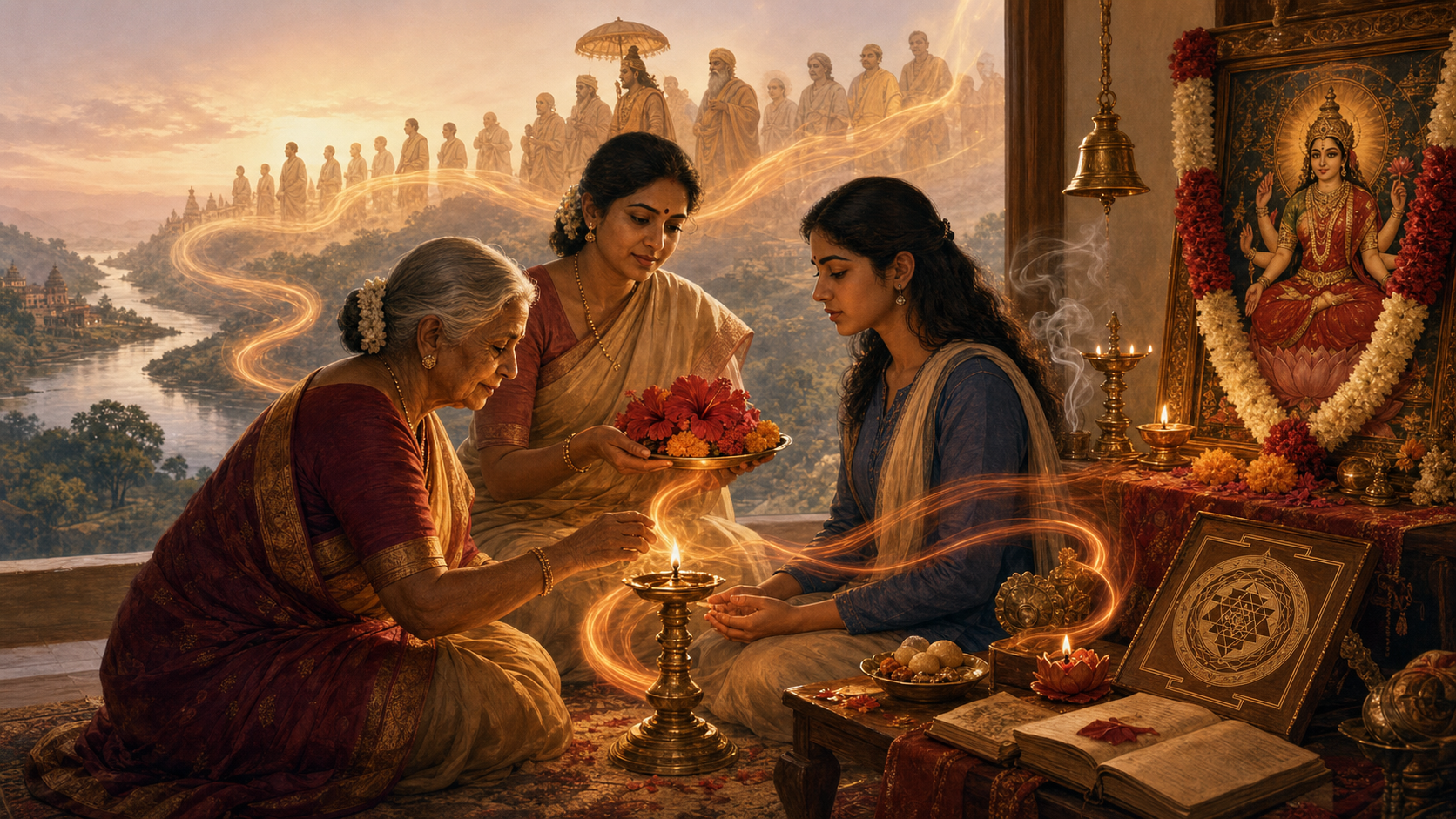
In the Shakta traditions of Hinduism, Shakti is more than an abstract theological principle or a power sought through individual meditation. She is understood as the dynamic presence of the Divine: the power by which consciousness manifests as life, perception, thought, action, nature, and spiritual awakening. Within this worldview, spiritual practice does not unfold in isolation. It enters homes, shapes relationships, becomes embedded in ritual memory, and may continue through both family inheritance and the initiatory succession known as guru-parampara.
The image of a sacred current offers a useful way to understand this continuity. A river remains recognizable even though its water is always changing; in a similar manner, a spiritual lineage preserves a pattern while every generation receives, interprets, and embodies it differently. A grandparent may sustain daily Devi worship, a parent may preserve festival observances, and a younger practitioner may rediscover the same tradition through meditation or formal initiation. The forms change, but a recognizable orientation toward the Sacred Feminine can remain alive.
This transmission should not be confused with a scientifically measurable energy passing through DNA. In academic discussion, spiritual energy is best understood as a theological and experiential category internal to the tradition. Shakta practitioners may experience Shakti as an objective divine reality, while historians, anthropologists, and psychologists may examine the rituals, memories, relationships, and embodied disciplines through which that reality becomes meaningful. These perspectives answer different questions and need not be forced into artificial conflict.
Shakti as Divine Power and Supreme Reality
The Sanskrit term Shakti broadly denotes power, capacity, potency, or energy. All Hindu traditions recognize divine powers in some form, but Shakta theology gives the Goddess a distinctive position. In many Shakta schools, Devi is not merely the consort or secondary power of a male deity. She is the supreme reality from whom the cosmos arises, by whom it is sustained, and into whom it is ultimately reabsorbed. Consciousness and its power are therefore inseparable, just as fire cannot be separated from its capacity to burn.
Texts such as the Devi Mahatmya, the Devi Bhagavata Purana, Shakta Upanishads, devotional hymns, and numerous Tantras express this vision in different ways. The Devi Mahatmya presents the Goddess as the integrated power of the gods and praises her presence within living beings as consciousness, memory, sleep, hunger, compassion, and other fundamental capacities. Tantric traditions develop more technical accounts of mantra, initiation, the subtle body, ritual visualization, sacred diagrams, and the identity between the human microcosm and the greater cosmos.
Shaktism is not a single, uniform institution. It includes temple-centered devotion, household worship, regional Goddess traditions, philosophical systems, yogic disciplines, and initiatory Tantric paths. Durga, Kali, Lalita Tripurasundari, Kamakhya, Bhadrakali, Parvati, Lakshmi, Saraswati, and innumerable local forms may each occupy the center of a community’s religious life. Consequently, no single explanation of spiritual transmission applies identically to every Shakta lineage.
What It Means for Shakti to Flow Through Generations
Intergenerational transmission operates on several connected levels. The theological level concerns divine grace and the continuing protection of the Goddess. The ritual level includes mantras, puja procedures, vows, festivals, and initiations. The ethical level consists of dispositions such as courage, restraint, compassion, reverence, and service. The social and psychological level includes learned habits, emotional associations, family narratives, and relationships with teachers. What appears to be one sacred current is therefore a layered process.
A child who watches an elder light a lamp before Devi receives more than verbal information. The child learns how the body becomes still, how the shrine is approached, how flowers are offered, and how ordinary time changes when worship begins. The fragrance of incense, the sound of a bell, the cadence of a hymn, and the sight of the flame create a multisensory memory. Decades later, even when the precise words have faded, those impressions may restore a feeling of sacred presence with remarkable force.
This is one reason a grandparent’s sadhana can exert an influence long after that person has died. The influence may be described devotionally as blessing, sociologically as religious formation, psychologically as embodied memory, or ritually as the continuity of a family observance. These descriptions illuminate different dimensions of the same inheritance. None requires the descendant to imitate the elder mechanically.
Hindu traditions frequently use the concept of samskara to describe formative impressions and cultivated dispositions. The term has several technical meanings, including life-cycle rites and subtle impressions produced by previous experience. In an intergenerational context, it helps explain why repeated acts of worship can establish a durable orientation. A household shaped by prayer, disciplined speech, hospitality, and reverence for the Goddess gives younger members a set of spiritual possibilities that may remain available even after a period of indifference.
Such inheritance is influential but not deterministic. A child born into a devout family does not automatically possess realization, ritual authority, or moral excellence. Shakta teachings retain a strong role for personal karma, intention, discipline, grace, and qualified guidance. Ancestry can provide a doorway, but each person must still decide whether and how to enter it.
Kula, Family Tradition, and the Household Shrine
The word kula can mean family, clan, community, or lineage, although Tantric traditions also give it specialized philosophical meanings. In ordinary religious life, a family may maintain a relationship with a Kula Devata or ancestral deity whose worship is associated with kinship, place, and inherited obligation. The deity connects family memory to sacred geography and may be honored during marriages, births, festivals, journeys, or moments of crisis.
When the family deity is a form of Devi, the household becomes an important site of Shakta continuity. Its shrine may contain an image, a yantra, a lamp, inherited ritual objects, or photographs of respected elders and teachers. These objects do not transmit spirituality by their mere possession. Their significance emerges through worship, interpretation, care, and the stories that explain why they matter.
Household transmission is often quiet rather than spectacular. It occurs when an elder teaches the correct way to prepare an offering, explains why Navaratri is observed, recites a familiar hymn, or insists that food be shared before anyone eats. It also occurs when family members learn that worship is inseparable from conduct. If devotion to the Goddess does not deepen respect, honesty, hospitality, and concern for vulnerable people, ritual continuity has preserved a shell while weakening its ethical center.
Women have frequently played decisive roles in this domestic transmission. Mothers, grandmothers, aunts, ritual specialists, renunciants, and female gurus have preserved songs, vows, local narratives, food traditions, healing rites, and forms of Devi worship that formal histories sometimes overlook. A serious account of Shakta lineage must therefore examine both publicly recognized authorities and the less visible labor through which sacred traditions survive in homes.
The theological elevation of the Goddess, however, should not be treated as automatic proof of social equality. Communities that worship Devi can still reproduce restrictions or injustices affecting women. Historical practice has varied by region, class, caste, period, and lineage. The most responsible interpretation allows the Sacred Feminine to challenge demeaning conduct without romanticizing every institution associated with Goddess worship.
Family inheritance may also carry tension. One generation may regard a ritual as indispensable, while another experiences it as unfamiliar or burdensome. A mature tradition makes room for questions and distinguishes reverence from coercion. Forced participation can preserve external conformity for a time, but it rarely produces the inward consent required for meaningful sadhana.
Guru-Parampara and Initiatory Transmission
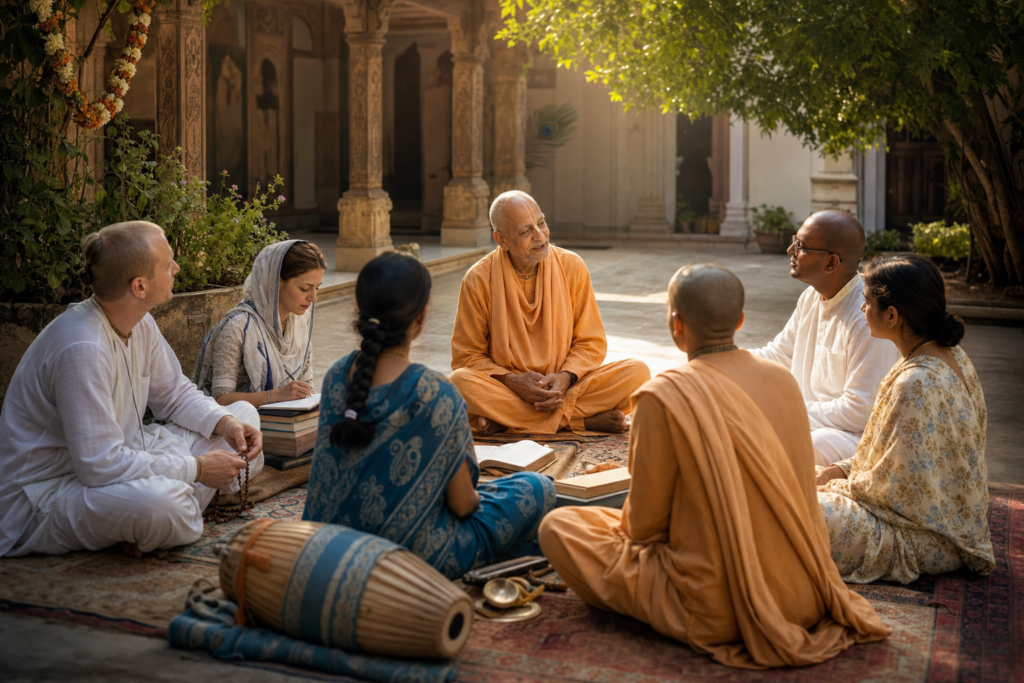
Family lineage and initiatory lineage are related but not identical. A person may inherit household devotion without possessing authorization to perform an esoteric ritual. Conversely, a practitioner may enter a Shakta lineage through a guru even when no family member follows that path. Guru-parampara refers to a succession through which teachings, disciplines, interpretations, and ritual authority are transmitted from teacher to disciple.
Diksha, commonly translated as initiation, marks a decisive transition in many Tantric traditions. Its form varies considerably. It may include purification, vows, the bestowal of a mantra, ritual identification with a deity, instruction in visualization, or entry into a graded discipline. Initiation is not simply access to secret information. It establishes responsibility, relationship, and a framework within which practice can mature.
Mantra is central because Shakta traditions often treat sacred sound as a form of divine presence rather than a symbolic label. A mantra received in a lineage carries a history of interpretation and practice. The teacher communicates pronunciation, rhythm, visualization, ritual conditions, and ethical expectations. The disciple supplies attention, repetition, discipline, and receptivity. Transmission becomes effective through this relationship between received form and sustained practice.
This explains why an initiatory mantra is not equivalent to a phrase copied from a book or video. Publicly available information may be accurate at the level of spelling yet omit the practice’s ritual setting, safeguards, contemplative meaning, or prerequisites. Traditional restrictions are not all identical, and secrecy can sometimes be misused, but the principle of appropriate preparation remains important. Technical power without ethical and interpretive formation can encourage confusion or spiritual vanity.
Some Shakta and Shaiva traditions use the term shaktipata for the descent or awakening of spiritual power through grace. Accounts may associate it with a teacher’s presence, a glance, a mantra, a ritual, an intense devotional event, or an apparently spontaneous transformation. Interpretations vary even within Tantric sources. Shaktipata should therefore not be reduced to a single dramatic sensation, nor should every unusual physical or emotional event be classified as evidence of advanced realization.
The credibility of a lineage depends on more than an impressive genealogy. A list of teachers can establish historical continuity, but spiritual integrity is tested through conduct, competence, transparency, and the fruits of instruction. A responsible guru does not demand the surrender of moral judgment, isolate disciples from legitimate support, or use sacred authority to excuse exploitation. Parampara is sustained when inherited authority remains accountable to dharma.
The disciple also carries obligations. Traditional texts praise humility, perseverance, discernment, service, and honesty. Humility does not mean passive submission, and discernment does not mean habitual suspicion. Together they protect the relationship from two opposite errors: treating the teacher as an ordinary information provider or treating the teacher’s personality as exempt from ethical evaluation.
Different Shakta Lineages, Different Forms of Continuity
Śrīvidyā traditions illustrate the precision of initiatory transmission. Their worship commonly centers on Lalita Tripurasundari and the Śrīcakra, with carefully structured relations among mantra, geometry, deity, body, and cosmos. Different Śrīvidyā lineages may follow distinct ritual sequences and theological interpretations. Some practices are widely shared, while others require initiation. The same diagram can therefore function as a devotional image, a philosophical map, or the center of a highly technical liturgy.
Kali-centered traditions provide another model. In Bengal and elsewhere, devotion to Kali may be transmitted through temple worship, family puja, songs, poetry, pilgrimage, Tantric initiation, or the influence of revered saints. The intimate language with which devotees address Kali as Mother can make theological ideas emotionally immediate. Fear, mortality, protection, freedom, and unconditional belonging meet in a single divine form.
Durga worship often creates continuity through the ritual calendar. Navaratri and Durga Puja organize collective memory through recitation, fasting, music, dramatic art, food, dance, and public celebration. Younger participants may first encounter Devi through aesthetics and community rather than formal philosophy. That entry is not necessarily superficial. Beauty, rhythm, and shared labor can become gateways to deeper inquiry.
Regional Goddess traditions add further complexity. A village deity may be inseparable from land, water, disease prevention, fertility, protection, or local history. A pan-Indian theological identification with Shakti can coexist with intensely local ritual forms. Unity in Shaktism does not require uniformity; it arises from recognizing divine power across a plurality of names, images, narratives, and practices.
This diversity also cautions against presenting every Shakta tradition as Kundalini Yoga or every form of Tantrism as an esoteric ritual system. Many devotees center their lives on straightforward bhakti, temple worship, ethical vows, and festival observance. Others pursue complex mantra and visualization disciplines. Academic accuracy requires attention to the lineage actually being discussed rather than imposing a generalized model on all practitioners.
Subtle Energy, Prana, Chakras, and Kundalini
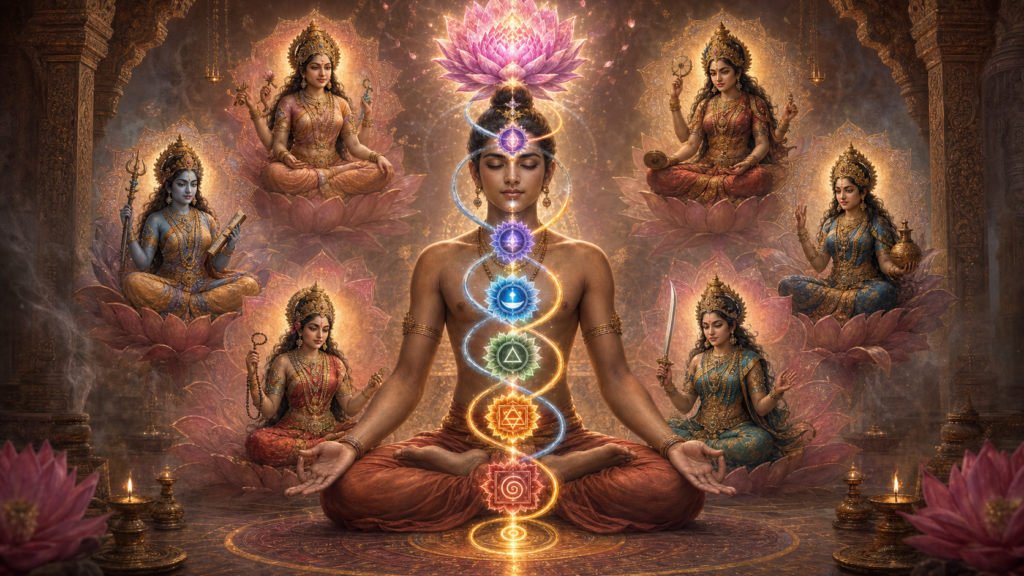
Discussions of Shakti often turn to yogic anatomy. Tantric and yogic texts describe the body through concepts such as prana, nadi, chakra, bindu, and Kundalini. These systems are not identical across all texts. The number, location, symbolism, and ritual function of chakras can vary, and the familiar modern arrangement of seven chakras should not be projected unchanged onto every historical source.
Kundalini is commonly represented as a latent power associated with the base of the subtle body. Through disciplined practice and grace, this power is said to awaken and ascend, transforming consciousness. In some systems, the process culminates in the recognition or union of Shakti and Shiva; in others, the imagery supports a different philosophical interpretation. It is a sophisticated contemplative model, not a claim that spiritual realization is biologically inherited from a relative.
A family may transmit the language, values, and preliminary disciplines that prepare a descendant for yoga, but advanced practice remains personal and contextual. Breath control, mantra, concentration, visualization, and ritual may affect practitioners differently. Intense methods are best learned from qualified teachers, particularly when they involve prolonged breath retention, extreme austerity, sleep disruption, or forceful attempts to produce altered states.
Traditional subtle-body language and biomedical language should not be treated as interchangeable. Prana is not simply oxygen, a chakra is not merely a nerve plexus, and Kundalini cannot be conclusively identified with a single physiological mechanism. Comparisons may be suggestive, but exact equivalence requires evidence that is presently lacking. Maintaining this distinction protects both the integrity of the tradition and the standards of scientific inquiry.
Psychological interpretation can still contribute useful insight. Repeated ritual regulates attention, gives form to emotion, strengthens memory, and situates personal experience within a meaningful narrative. A devotee who visualizes Devi as protective may develop courage in the face of uncertainty. Such psychological effects do not settle metaphysical questions, but they help explain how spiritual practice becomes embodied across time.
How the Sacred Current Is Cultivated in Daily Life
The transmission of Shakti is most durable when it is supported by ordinary discipline. Daily japa, brief meditation, the lighting of a lamp, scriptural recitation, and respectful care for a shrine establish continuity through repetition. The scale of the ritual is less important than its steadiness. A simple practice maintained with attention can shape a household more deeply than an elaborate ceremony performed only for display.
Sacred sound is especially effective as an intergenerational carrier because it can survive changes in location and material circumstance. A family displaced from its ancestral region may lose access to a temple or inherited home yet retain a hymn, a divine name, or the melody of an evening prayer. Voice becomes a portable sanctuary, preserving memory when architecture cannot.
Festivals provide another rhythm of continuity. Cleaning the shrine, obtaining flowers, preparing food, inviting relatives, listening to sacred narratives, and distributing prasadam turn doctrine into shared action. Children often remember participation before they understand theology. Later reflection can reveal that the festival taught cooperation, gratitude, aesthetic attention, and the transformation of domestic space into sacred space.
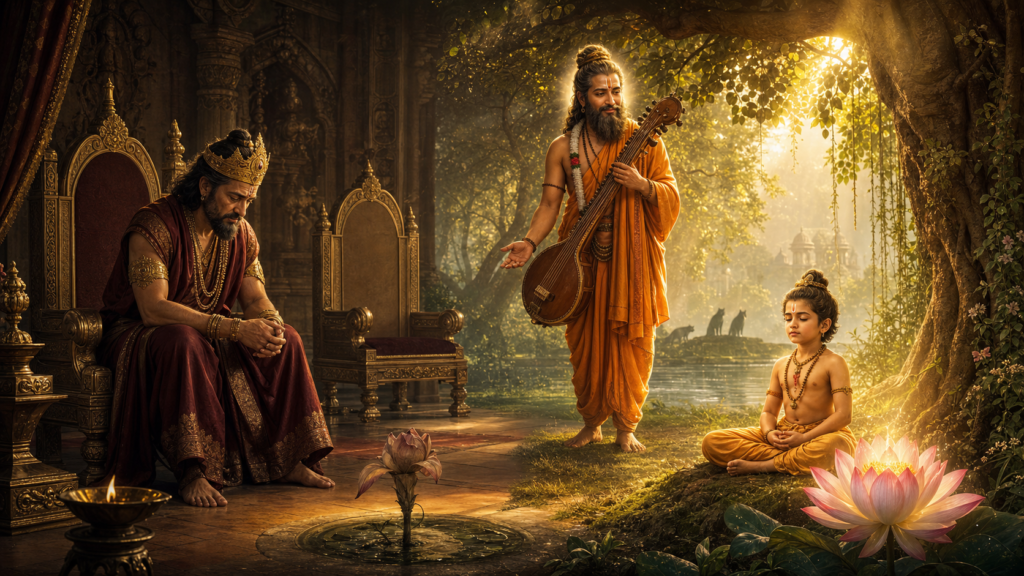
Storytelling gives ritual an interpretive frame. Narratives of Durga confronting Mahishasura, Kali dissolving fear, or Devi guiding a devotee through crisis communicate moral and philosophical possibilities. These stories should not be reduced to simplistic allegories, yet their symbolic dimensions remain powerful. They allow communities to consider how courage confronts disorder, how power is disciplined by wisdom, and how the Divine may be encountered in forms that exceed social expectations.
Food also carries spiritual memory. Recipes prepared for a vrata or festival encode local ecology, family history, rules of purity, and acts of care. When an elder teaches the preparation of an offering, technical instruction and emotional intimacy often become inseparable. The resulting dish is not sacred merely because it is old; it becomes meaningful because it participates in gratitude, offering, and shared remembrance.
Seva gives the sacred current an outward direction. Feeding guests, supporting a temple, assisting a neighbor, teaching children, caring for the environment, or serving those in distress prevents spirituality from becoming self-enclosed. Shakti understood only as private intensity can encourage fascination with unusual experiences. Shakti expressed as responsible action becomes a power that sustains community.
Silence has a place alongside visible practice. Families sometimes transmit spirituality through the manner in which suffering is met, conflict is restrained, or grief is held. A descendant may remember not a doctrinal lecture but an elder’s composure during illness or generosity during scarcity. Such memories reveal how theology becomes credible through character.
Grace, Karma, Merit, and Personal Freedom
The claim that an elder’s practice benefits descendants is best approached with theological nuance. Hindu traditions contain diverse ideas about blessing, merit, ancestral obligation, karma, and divine grace. They do not support a single mechanical formula in which a fixed quantity of spiritual power is deposited into a family account. Devotion may create favorable conditions and inspire descendants, but it does not abolish their agency or erase the consequences of their actions.
Grace and effort are often presented as complementary rather than mutually exclusive. A lineage provides language, methods, exemplars, and support; the practitioner responds through attention and discipline. From a devotional perspective, even the capacity to respond may be interpreted as grace. From an ethical perspective, however, grace can never be used to claim immunity from responsibility.
The tradition’s emphasis on relationship also complicates extreme individualism. Spiritual practice is personal, but its effects are rarely private. A disciplined person may reduce conflict in a household, preserve knowledge, offer service, and give younger relatives a stable example. An irresponsible person may transmit fear, secrecy, or domination under religious language. What flows across generations can therefore be healing or harmful, and discernment is essential.
Ancestral reverence does not require the denial of ancestral wrongdoing. A family can honor sincere devotion while acknowledging prejudice, coercion, neglect, or abuse. Mature continuity preserves what is life-giving, repairs what caused harm, and refuses to label every inherited custom as sacred. In this sense, transformation may be a deeper form of fidelity than uncritical repetition.
Descendants are also free to relate to the tradition in different ways. One may become an initiated practitioner, another may preserve festivals culturally, and another may follow a different Dharmic path. The integrity of Shakti as divine freedom is poorly represented when family devotion becomes a tool of compulsion. A living lineage invites participation, explains its disciplines, and allows commitment to develop through understanding.
Recognizing the Fruits of Authentic Transmission
Traditional claims of spiritual power can be evaluated partly by their fruits. Authentic practice should gradually deepen steadiness, humility, compassion, discernment, and the capacity to act responsibly. Emotional intensity may accompany worship, but intensity alone proves little. Visions, bodily sensations, dreams, coincidences, or states of ecstasy can be meaningful without establishing spiritual authority.
One warning sign is spiritual exceptionalism: the belief that belonging to a particular family or lineage makes a person inherently superior. Parampara confers responsibility rather than entitlement. A respected ancestry cannot substitute for present conduct, and a prestigious initiation cannot compensate for the absence of practice. The river remains living only when it continues to move.
Another danger is the commercialization of fear. Claims that a family is cursed, that costly rituals are the only remedy, or that dramatic awakening is guaranteed should be treated cautiously. Legitimate traditions may recognize difficult karmic patterns or prescribe demanding rites, but responsible guidance does not exploit anxiety or promise certainty where none can be established.
Spiritual practice should not replace appropriate medical or mental-health care. Distressing sensations, sleeplessness, panic, disorientation, or impaired functioning should not automatically be celebrated as Kundalini awakening. A qualified spiritual teacher and a qualified health professional address different dimensions of well-being, and consultation with both may be appropriate. Safety is not a failure of faith.
Ethical boundaries are equally important in initiatory relationships. Consent must remain meaningful, financial expectations should be clear, and intimate or sexualized practices require exceptional scrutiny. Historical references to transgressive Tantra do not authorize modern exploitation. No appeal to secrecy, sacred power, or lineage loyalty removes the obligation to prevent harm.
Grief, Memory, and the Presence of the Ancestors
The death of a devout elder can make spiritual inheritance emotionally visible. A lamp once lit by familiar hands may suddenly feel different. The shrine remains, but the voice that guided the ritual is absent. Continuing the practice can become an act of grief, gratitude, and responsibility at the same time.
Such continuity does not mean suppressing sorrow or imagining that ritual makes loss unreal. It gives grief a form through which love can remain active. The descendant cleans the shrine, repeats the remembered prayer, prepares the offering, and discovers that inheritance is not the possession of the past. It is a relationship with the past conducted through present action.
Memory is always selective, and family narratives often simplify complex lives. Preserving letters, recordings, ritual instructions, and oral histories can help future generations distinguish remembered fact from devotional idealization. Documentation does not diminish sacred meaning. It protects fragile knowledge and allows descendants to understand how a practice developed.
Shakta Lineage in the Modern and Global Context
Migration has transformed the channels through which Shakta practice travels. A family may live far from its ancestral temple, speak several languages, and observe festivals according to work or school schedules. Diaspora communities often condense regional traditions into shared public celebrations while preserving more specialized rites at home. This adaptation can broaden participation, although it may also blur distinctions that once carried local meaning.
Digital media has made texts, images, lectures, and ritual demonstrations widely available. This access can help younger practitioners recover traditions that were interrupted by migration or language loss. It also creates risks: decontextualized mantras, invented lineages, commercial promises, and sensational accounts of Tantra circulate easily. Digital access is most beneficial when it leads to careful study, community connection, and qualified guidance.
Translation presents another challenge. Terms such as Shakti, sadhana, diksha, mantra, and darshan carry networks of meaning that no single English equivalent fully preserves. Translating Shakti simply as energy may suggest an impersonal physical force, while translating her only as Goddess may obscure the philosophical sense of power or capacity. Responsible teaching retains key terms and explains them in context.
Intergenerational continuity also depends on making knowledge intelligible. Younger members benefit when elders explain why a practice is performed rather than demanding repetition without interpretation. Elders, in turn, benefit from hearing questions without assuming disrespect. A tradition becomes resilient when memory and inquiry cooperate.
A practical approach to preservation may include documenting the family deity and ancestral temple, recording publicly shareable hymns, noting festival procedures, translating family stories, caring for ritual objects, and identifying trustworthy teachers. Restricted initiatory material should be handled according to lineage guidance. Preservation is not indiscriminate publication; it is the responsible care of knowledge according to its purpose.
Adaptation should preserve principles even when circumstances require altered forms. A smaller shrine, a shorter daily practice, or a festival observed on a nearby weekend may still sustain devotion if undertaken sincerely. At the same time, convenience should not become an excuse for removing every demanding element. Discipline gives continuity its depth.
Shared Dharmic Insights Without Erasing Difference
The Shakta understanding of lineage belongs to a wider Dharmic landscape in which teachings are preserved through disciplined communities, teachers, texts, ritual memory, and lived example. Hindu, Buddhist, Jain, and Sikh traditions all value forms of transmission, but they explain their foundations differently. Respectful comparison identifies shared concerns without pretending that their metaphysics are interchangeable.
Buddhist traditions preserve teachings through monastic and lay lineages, textual transmission, meditation instruction, and relationships between teachers and students. Many Buddhist schools do not accept a permanent self or a supreme creator Goddess, so their accounts of blessing and lineage cannot simply be renamed Shakti. The comparison remains useful at the level of disciplined continuity and transformative practice.
Jain traditions emphasize the teachings of the tīrthaṅkaras, the authority of scriptures and teachers, rigorous ethics, karma, and personal effort toward liberation. Family communities have played a major role in supporting temples, ascetics, learning, and lay observance. Here again, intergenerational discipline is evident even though the theological framework differs substantially from Shakta devotion.
Sikh tradition centers spiritual authority on the Guru, the Guru Granth Sahib, gurmat, Naam, sangat, and seva. Families transmit language, music, history, courage, and habits of service, but hereditary status alone does not produce spiritual realization. The parallel with Shakta lineage lies in the union of received tradition and lived responsibility, not in an assertion that the traditions teach identical doctrines.
These comparisons support unity through informed respect. Dharmic solidarity is strongest when each tradition is allowed to speak in its own vocabulary and when shared ethical commitments are cultivated without erasing difference. Lineage then becomes a bridge: it connects communities to their own roots while teaching them to recognize the disciplined inheritance of others.
The Responsibility of Becoming a Living Flame
The most important question is not whether a descendant possesses the exact spiritual state of an ancestor. The more useful question is what has been received and how it will be embodied. A mantra may have been inherited, but will it be practiced? A shrine may have been preserved, but will it remain a place of reverence? A story may be remembered, but will its ethical insight guide conduct?
In this sense, spiritual inheritance is neither a guaranteed privilege nor an inert relic. It is an invitation joined to responsibility. Family devotion prepares the ground, guru-parampara supplies disciplined methods, personal sadhana turns possibility into experience, and ethical action reveals whether that experience has matured.
The sacred current of Shakti flows most clearly when reverence becomes courage, knowledge becomes discernment, ritual becomes service, and memory becomes compassionate action. Every generation receives the tradition in an unfinished form. Its task is to protect what is true, repair what has caused harm, and hand forward a flame that is alive rather than merely preserved.
Inspired by this post on Hindu Blog.


Leave a Reply
You must be logged in to post a comment.