
Shitala Mata and the Sacred Language of Everyday Objects
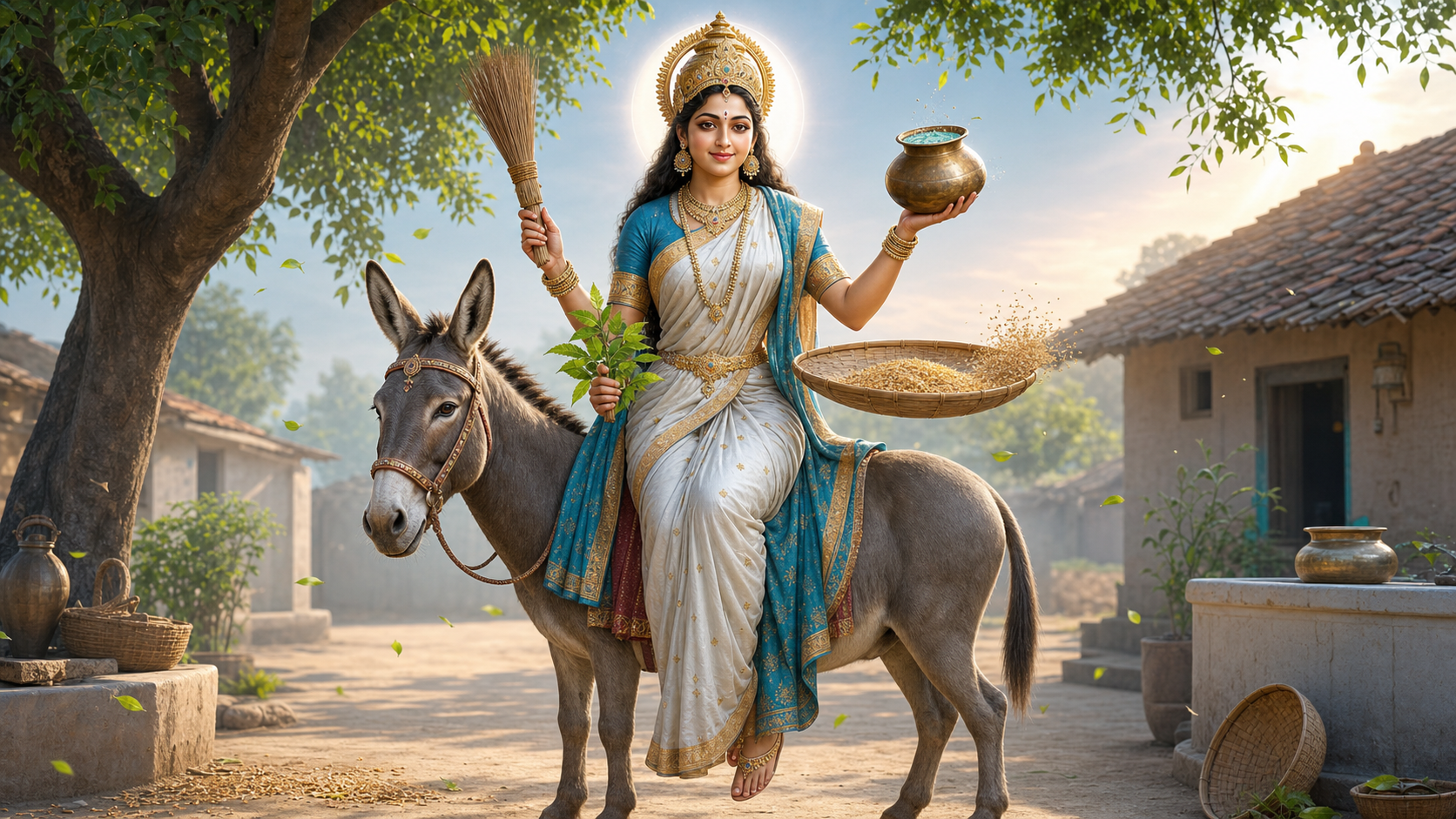
Among the many manifestations of the Divine Mother in Hindu traditions, Shitala Mata occupies a distinctive and deeply compassionate place. Her image does not usually depend on the visual language of royal luxury. Instead of appearing only as a queen on a jeweled throne, she is frequently represented with objects drawn from ordinary domestic and agrarian life: a broom, a waterpot, neem leaves, and a winnowing tray or fan. These apparently simple implements form a sophisticated symbolic system concerned with illness, purification, cooling, nourishment, discernment, and the restoration of social balance.
The meaning of Shitala Mata’s symbols becomes clearer when her name is considered. The Sanskrit element śīta refers to coolness or cold, and the name Śītalā may therefore be understood as ‘the cool one’ or ‘she who cools.’ This coolness is more than a description of temperature. Within the ritual and emotional world surrounding the goddess, it signifies relief from fever, inflammation, fear, agitation, and the destructive intensity historically associated with epidemic disease.
Shitala Mata became especially associated with protection from smallpox and other eruptive illnesses in several regions of South Asia. Before vaccination, virology, and modern epidemiology, communities faced such diseases with limited medical resources and an incomplete understanding of transmission. Devotion to Shitala gave families a religious language through which they could respond to suffering, organize care, express fear, seek protection, and preserve hope. Her worship should therefore be studied not merely as an isolated belief about disease, but as part of a larger cultural response to vulnerability.
The goddess’s iconography is not identical in every region. Paintings, sculptures, oral traditions, temple practices, and household rituals may emphasize different attributes. A widely known visualization associated with the Shitala devotional tradition describes her riding a donkey, carrying a broom and waterpot, and bearing a winnowing fan. Neem branches are especially prominent in popular worship and healing customs, even when they do not appear in every formal description. A careful interpretation must therefore distinguish between widespread themes and supposedly universal rules.
How Sacred Iconography Communicates
Hindu iconography is rarely a collection of arbitrary accessories. A deity’s posture, vehicle, gesture, ornament, weapon, plant, vessel, or tool may communicate several levels of meaning at once. One level may arise from the object’s everyday function; another may come from ritual practice; a third may develop through regional legends or philosophical interpretation. The same attribute can consequently express protection and correction, material care and spiritual insight, or physical cleanliness and moral discipline without being reduced to a single definition.
This principle of multiple meanings is particularly important in the case of Goddess Shitala. Her broom is an instrument of cleaning, but it can also suggest the removal or dispersal of disorder. Her waterpot cools and sustains, while also evoking consecration and renewed life. Neem leaves belong to the practical ecology of traditional households and simultaneously represent protective purity. The winnowing tray separates grain from unwanted material, creates a cooling current of air, and becomes an image of discernment.
The familiar character of these objects gives Shitala Mata’s image unusual emotional power. A household does not need access to royal treasures to understand her visual language. Water must be carried, floors must be cleaned, grain must be sorted, and useful plants must be cultivated. By elevating such tools into sacred emblems, the iconography declares that care performed in kitchens, courtyards, fields, and sickrooms possesses profound dignity.
The Broom: Cleansing, Discipline, and the Removal of Disorder
The broom is among the most immediately recognizable attributes of Shitala Mata. In Sanskrit descriptions it may be identified with the mārjanī, an implement associated with sweeping or cleansing. At the practical level, the connection is direct: sweeping removes dust, decaying matter, refuse, and other visible sources of disorder from inhabited space. Within the goddess’s iconography, that ordinary act becomes a model for the restoration of health and harmony.
The broom’s symbolic meaning is not limited to modern ideas about sterilization. Historical communities did not possess the contemporary germ theory of disease, and it would be inaccurate to claim that every ritual use of the broom anticipated microbiology. Nevertheless, sustained attention to cleanliness could have practical value. The image links healing with the disciplined maintenance of the environment rather than presenting health as a purely private or passive condition.
At a psychological level, sweeping represents the deliberate removal of accumulated distress. Illness disrupts routines, generates fear, and can leave a family feeling powerless. The repeated act of cleaning provides visible structure amid uncertainty. In symbolic terms, Shitala Mata’s broom gathers scattered anxiety and confronts the chaos that disease brings into domestic and communal life.
The broom can also be read ethically. Just as a neglected courtyard accumulates dirt, an undisciplined mind accumulates resentment, confusion, harmful habits, and indifference. Ritual purity should not be confused with social superiority or prejudice; in its constructive sense, it concerns the removal of conditions that cause harm. Shitala’s broom can therefore signify self-examination, responsible conduct, and the willingness to correct what has been neglected.
There is also a forceful aspect to the emblem. Sweeping is not merely decorative: it moves unwanted material and changes the condition of a place. The goddess is compassionate, but her compassion is active rather than sentimental. She confronts disorder, compels attention, and restores boundaries. This combination of tenderness and authority helps explain why disease-protecting goddesses may inspire both affection and awe.
The broom further complicates conventional distinctions between sacred and ordinary labor. Tasks historically performed in domestic spaces or by socially undervalued workers become part of a divine image. The symbolism does not justify social hierarchy; instead, it can be interpreted as a reminder that sanitation and caregiving are indispensable forms of service. A society that celebrates purity while disregarding the dignity and safety of those who maintain it has misunderstood the emblem’s ethical force.
For contemporary readers, the broom may represent prevention. Healing is often imagined as something that begins only after illness appears, yet public health also depends on clean surroundings, waste management, safe infrastructure, and collective responsibility. Shitala Mata’s broom makes prevention visible. It suggests that protection is created through repeated, sometimes unglamorous acts of care.
The Waterpot: Cooling, Life, and Restorative Grace
The waterpot carried by Shitala Mata is commonly understood as a vessel of cooling and restoration. Fever produces an immediate human longing for relief: coolness, hydration, shade, and rest. The pot answers that longing visually. It presents the goddess not as distant from bodily suffering, but as approaching the afflicted with the elemental substance on which life depends.
Water has an exceptionally rich place in Hindu ritual culture. It cleanses the body, prepares sacred space, accompanies hospitality, and is used in consecration. Water from a kalasha or other ritual vessel may signify abundance, fertility, divine presence, continuity, and the potential from which life emerges. In Shitala Mata’s hands, these associations become focused on the recovery of balance.
The vessel is as significant as its contents. A pot gathers and preserves what would otherwise flow away. It therefore represents containment, measured use, and the responsible holding of healing power. During a crisis, care requires more than good intention; resources must be collected, protected, and distributed. The waterpot embodies this organized dimension of compassion.
Its symbolism also depends on the contrast between heat and coolness. In many South Asian religious and medical idioms, excessive heat can signify fever, anger, inflammation, danger, or divine intensity. Cooling does not mean suppressing all vitality. It means bringing excessive force back into proportion. Shitala Mata’s water therefore expresses regulation rather than lifelessness and peace rather than mere absence.
This distinction provides a valuable psychological interpretation. Fear can become fever-like: it accelerates thought, narrows attention, and spreads through a community. The cooling pot suggests composure, patience, and emotional steadiness. Shitala does not deny suffering; she offers a way to meet it without allowing panic to become another source of injury.
The waterpot can also be understood ecologically. Clean and accessible water is essential to health, dignity, food preparation, agriculture, and ritual life. The emblem quietly links sacred wellbeing to the protection of shared natural resources. Reverence for a vessel of healing water becomes incomplete if rivers, wells, and groundwater are treated carelessly.
Water in Shitala worship must not be interpreted as a substitute for appropriate medical treatment. Hydration and cooling measures can support comfort in some circumstances, but serious fever, dehydration, rash, infection, or altered consciousness requires qualified clinical evaluation. The enduring symbolic lesson is that healing should be delivered with gentleness, purity, and care, not that ritual water cures every disease.
Neem Leaves: Protective Ecology and the Living Pharmacy of the Household
Neem leaves are among the most widely recognized natural emblems connected with Shitala Mata. The neem tree, Azadirachta indica, has long been used in South Asian households, agriculture, and traditional systems of health. Its leaves, bark, seeds, and oil have served different purposes, although their preparation, safety, and suitability vary considerably. In the goddess’s worship, fresh branches may be placed near sacred images, doorways, beds, or ritual spaces.
Neem’s symbolic reputation arises partly from observable qualities. The tree remains resilient in hot climates, provides shade, and produces intensely bitter leaves. Bitterness is frequently associated with purification, restraint, and medicinal potency in South Asian cultural contexts. Its hardy greenery makes it an apt sign of life persisting in difficult conditions.
Modern laboratory research has identified numerous biologically active compounds in neem, and extracts have shown insecticidal, antimicrobial, and anti-inflammatory activity under particular experimental conditions. Such findings help explain the plant’s long practical reputation, but they do not establish neem leaves as a universal or clinically proven cure. Results obtained from isolated compounds or laboratory preparations cannot automatically be transferred to household remedies.
This medical caution is especially important because natural substances can cause adverse effects, interact with medications, or become toxic when consumed in unsuitable forms or doses. Neem should not replace vaccination, diagnosis, prescribed treatment, or emergency care. The neem leaves associated with Shitala Mata are best understood as cultural and ritual symbols whose history intersects with traditional healthcare, not as permission for unsupported medical claims.
Historically, neem branches could also function as visible markers of a household affected by illness or undergoing protective observances. Practices differed across communities, and their effects should not be romanticized. Nevertheless, the plant could communicate that a space required caution, quiet, or special care. In this sense, neem participated in a social language of illness as well as a religious one.
The leaves’ association with cooling is equally significant. A leafy branch can provide shade, create a gentle current of air, and visually soften the harshness of a sickroom. Green foliage signifies renewal after the dryness of fever. The symbolism integrates sensory experience with devotion: touch, scent, color, movement, and prayer all contribute to an atmosphere of attentive care.
Neem also represents an intimate relationship between household knowledge and local ecology. The tree is neither a rare jewel nor a remote celestial substance. It grows in inhabited landscapes and becomes useful through observation accumulated across generations. Shitala Mata’s association with neem honors this practical knowledge while also encouraging it to be evaluated responsibly in the light of contemporary evidence.
At the ethical level, neem’s bitterness conveys a difficult but valuable principle: what protects life is not always immediately pleasant. Discipline, quarantine during contagious illness, vaccination, sanitation, and medical treatment may all demand patience or discomfort. The bitter leaf becomes a symbol of care that accepts short-term difficulty for the sake of long-term wellbeing.
The Winnowing Tray: Discernment, Nourishment, and Cooling Air
The winnowing tray or fan, often called a śūrpa, belongs to the traditional processing of grain. By tossing or moving harvested material in a controlled current of air, the tool helps separate useful grain from lighter chaff and debris. Its sacred meaning begins with this practical function: health and nourishment depend on the ability to distinguish what sustains life from what must be removed.
As a symbol of discernment, the winnowing tray resembles the philosophical idea of viveka, the capacity to distinguish wisely. Not every inherited claim, emotional impulse, or proposed remedy has equal value. Discernment examines evidence, context, purpose, and consequence. Shitala Mata’s tray can therefore represent the intellectual responsibility required to separate knowledge from rumor, especially during a health crisis.
This interpretation has striking contemporary relevance. Epidemics are frequently accompanied by misinformation, stigma, miracle cures, and misplaced blame. A winnowing process is needed to distinguish verified medical guidance from speculation. Devotion and scientific care need not be presented as enemies: spiritual practice can provide meaning and emotional support, while evidence-based medicine addresses diagnosis, prevention, and treatment.
The tray is also inseparable from food security. Grain must be cleaned before it can nourish a household, and the labor of winnowing connects field, harvest, kitchen, and community. By wearing or carrying this agrarian implement, Shitala Mata links healing to adequate nutrition. Recovery is not only the defeat of a pathogen; it also requires food, rest, safe shelter, caregiving, and the resources that allow a body to regain strength.
Its movement creates air, adding another layer to the goddess’s cooling symbolism. A fan offers relief from oppressive heat and brings comfort to an exhausted person. The winnowing tray thus performs two related actions: it separates and it cools. Intellectually, it removes confusion; physically and emotionally, it offers relief.
The tray’s broad, open form may also suggest receptivity. Unlike a sealed container, it displays its contents for examination. Healing benefits from such openness: symptoms must be recognized, conditions assessed, and harmful practices questioned. Concealment born of shame can worsen suffering, whereas compassionate attention creates the possibility of help.
In some depictions, the winnowing fan is associated with Shitala Mata’s head or appears almost like a crown. This is an especially powerful reversal of conventional status. An agrarian tool becomes a mark of divine authority. The image suggests that wisdom is not confined to palaces or formal institutions; it also resides in fields, kitchens, workshops, and the accumulated experience of ordinary communities.
Four Emblems as a Unified Process of Healing
The four attributes are most illuminating when read together. The winnowing tray distinguishes what is useful from what is harmful. The broom removes accumulated disorder. The waterpot cools, cleanses, and restores. Neem offers a living sign of protection, resilience, and ecological knowledge. Rather than functioning as four unrelated objects, they outline a coherent movement from diagnosis and purification toward relief and renewal.
This sequence should not be treated as a fixed ritual formula, since regional traditions do not necessarily arrange the symbols in that order. It is better understood as an interpretive model. Healing requires clear perception, decisive action, compassionate support, and continued protection. Shitala Mata’s iconography brings all four requirements into a single sacred composition.
The objects also connect several scales of wellbeing. The broom concerns the condition of shared space. The pot concerns essential resources. Neem connects the household to the living environment. The tray connects health with food and agricultural labor. Shitala Mata’s symbolism consequently extends from the individual body to the family, village, ecosystem, and moral community.
Another unifying feature is disciplined simplicity. None of the four objects is intrinsically luxurious, yet each performs indispensable work. Their presence challenges the assumption that divine power must always be displayed through wealth, conquest, or ornament. Here, power appears as the capacity to clean, cool, nourish, protect, and remain near those who suffer.
The Donkey and the Goddess’s Deliberate Humility
Although the central focus falls on the four emblems, Shitala Mata’s donkey vehicle helps complete their meaning. The donkey is a working animal associated with endurance, burden-bearing, and life beyond elite spaces. It is not usually treated as a royal mount. Its inclusion reinforces the goddess’s accessibility and her identification with communities whose labor is essential but often overlooked.
The donkey may also be interpreted as an image of persistence in harsh conditions. Epidemic disease historically crossed social boundaries, but its burden was rarely distributed equally. Poor households often faced greater exposure and fewer resources. A goddess who travels on a humble animal and carries domestic tools appears close to vulnerable people rather than insulated from them.
Some textual visualizations describe Shitala in an austere form, while popular images may dress her richly and emphasize maternal beauty. These are not necessarily contradictions. Sacred traditions routinely permit multiple visual registers. Austerity communicates immediacy and freedom from status; ornament expresses reverence, celebration, and the devotee’s desire to honor the goddess.
Shitala Mata, Smallpox, and Historical Memory
Any serious account of Goddess Shitala must acknowledge her historical relationship with smallpox. The disease caused fever, pain, scarring, blindness, disability, and death on a vast scale. Its unpredictability made it a source of intense social and religious concern. Shitala devotion provided a framework in which the disease could be addressed as a relationship requiring care, restraint, propitiation, and communal attention.
Descriptions of the goddess as both capable of sending disease and able to remove it express an older religious understanding of dangerous power. The same divine force may correct and protect, burn and cool, or disrupt and restore. Such language should be interpreted within its historical worldview rather than reduced to the simplistic claim that worshippers merely feared a punitive deity.
Ritual responses to illness were diverse. Some practices may have encouraged rest, reduced disturbance, marked affected households, or mobilized caregiving. Others may not have aligned with modern infection control, and no tradition should be idealized at the cost of evidence. Historical understanding requires both respect for the emotional intelligence of communities and honesty about the limits of premodern medical knowledge.
Smallpox was ultimately eradicated through coordinated vaccination, surveillance, case identification, and public-health action, with global eradication certified in 1980. This achievement does not make Shitala Mata culturally irrelevant. It changes the setting in which her symbolism is interpreted. Her attributes can now speak more broadly about prevention, caregiving, sanitation, ecological responsibility, maternal protection, and recovery from collective trauma.
The historical record also offers an important lesson about cooperation. Epidemic control succeeds when households, health workers, researchers, institutions, and communities share reliable information and accept mutual responsibility. Shitala Mata’s ordinary tools fit this collective ethic. Each one is effective because someone uses it carefully and consistently for the wellbeing of others.
Domestic Knowledge and the Sacred Feminine
The prominence of a broom, pot, leaves, and grain-processing tray reflects the historical importance of domestic knowledge. Women in many communities carried substantial responsibility for water, food preparation, cleanliness, childcare, nursing, and ritual continuity. Shitala Mata’s iconography recognizes these activities as sources of social survival and sacred intelligence.
This recognition should not be used to confine women to domestic roles. The deeper implication is that care work possesses public, intellectual, and spiritual value regardless of who performs it. The goddess turns tools associated with service into signs of authority. Her image can therefore support a broader appreciation of caregivers, sanitation workers, agricultural laborers, nurses, community health workers, and everyone whose often-unseen effort protects life.
Maternal imagery in Shitala worship is similarly complex. A mother may soothe, but she also establishes boundaries, recognizes danger, and insists on necessary discipline. Shitala Mata’s compassion is practical. She does not merely promise comfort; her symbols demand cleaning, sorting, conserving, cooling, and protecting.
Regional Diversity and Responsible Interpretation
Shitala traditions developed through regional languages, village customs, temple networks, devotional songs, family observances, and exchanges with local disease-protecting deities. Her name may appear as Shitala, Sheetala, Sitala, or in other localized forms. Related protective goddesses may possess distinct histories and should not automatically be treated as identical simply because they share associations with fever or eruptive disease.
The emphasis placed on each attribute also varies. One community may foreground the neem branch, another the cooling waterpot, and another the winnowing fan. Images may show two arms or four, different gestures, distinctive clothing, or accompanying figures. Such variation is not evidence of confusion. It reflects the adaptive and locally rooted character of Hindu sacred art.
For this reason, claims about a single, universal symbolic code should be approached cautiously. Iconographic interpretation is strongest when it combines textual description, the object’s practical function, regional testimony, ritual context, and historical evidence. A symbolic meaning may be plausible and illuminating without being the only meaning recognized by every worshipping community.
A Dharmic Ethic of Compassion and Shared Responsibility
Shitala Mata belongs specifically to Hindu religious worlds, and that distinct identity should be respected. At the same time, the ethical values expressed through her symbols can contribute to constructive dialogue among Hindu, Buddhist, Jain, and Sikh communities. Compassion for suffering, reverence for life, disciplined conduct, service, and responsibility toward the wider community are recognizable concerns across Dharmic traditions, even when their theology and ritual practice differ.
Unity does not require erasing those differences or claiming that every tradition worships the same form. It can arise through cooperation around shared human needs. A broom can represent the dignity of service; water can signify care freely offered; neem can evoke responsible engagement with the natural world; and the winnowing tray can encourage discernment. These principles provide a practical foundation for solidarity without flattening religious diversity.
The goddess’s imagery also discourages stigma. Disease is not evidence that a person has less dignity, deserves exclusion, or belongs to an impure community. Illness calls for informed caution and compassionate assistance. When purity symbolism is used to humiliate the sick or marginalized, it moves away from the healing purpose embodied by Shitala Mata.
Contemporary Lessons from Shitala Mata’s Symbols
The broom teaches that prevention begins with sustained attention to shared environments. Clean water, safe sanitation, responsible waste disposal, ventilation, and hygienic public facilities are not minor conveniences. They are foundations of human dignity. The sacred emblem converts this practical responsibility into a moral obligation.
The waterpot teaches that care must be both available and preserved. Communities require reliable water systems, healthcare access, emergency planning, and fair distribution of essential resources. A vessel that is empty, contaminated, or inaccessible cannot offer relief. The symbolism therefore asks not only whether healing resources exist, but also who can reach them.
Neem teaches ecological attentiveness joined with scientific responsibility. Traditional knowledge can preserve valuable observations about plants and local environments, while modern research can test efficacy, dosage, safety, and interaction. Respectful evaluation is more constructive than either dismissing all inherited knowledge or accepting every traditional claim without evidence.
The winnowing tray teaches discernment in an age of information overload. Health claims should be examined according to evidence, expertise, risk, and context. Rumor must be separated from reliable guidance, and devotional confidence must not become an excuse to endanger vulnerable people. The tray’s ancient agricultural function becomes an urgent metaphor for digital literacy.
Together, the four objects also offer a model for responding to personal distress. Disorder is identified, harmful accumulation is cleared, the overheated mind is calmed, and conditions supportive of recovery are cultivated. This is not a clinical treatment plan, but it is a psychologically intelligible pattern of attentive care.
The emotional appeal of Shitala Mata lies partly in her nearness. Her tools can be found in the spaces where ordinary life unfolds, and her power is expressed through actions available to ordinary people. A family may not be able to control every threat, but it can clean, conserve water, prepare nourishing food, care for the vulnerable, seek reliable treatment, and resist the spread of fear.
The Enduring Meaning of Shitala Mata’s Iconography
Shitala Mata’s broom, waterpot, neem leaves, and winnowing tray transform the material culture of everyday survival into a sacred philosophy of healing. The broom removes neglect and disorder. The waterpot cools, sustains, and renews. Neem expresses resilient life, protective ecology, and the disciplined bitterness sometimes required by care. The winnowing tray separates what nourishes from what harms while offering the relief of cooling air.
Their combined message is neither a rejection of medicine nor a promise that symbolic objects alone can prevent disease. It is a statement about the values that should guide every healing response: cleanliness without stigma, discipline without cruelty, tradition without credulity, scientific care without emotional coldness, and spiritual hope without denial of material reality.
Seen in this light, Goddess Shitala represents more than the historical memory of smallpox. She embodies a durable ideal of compassionate preparedness. Her sacred emblems teach that peace is created through practical attention, that purity should serve life, and that genuine healing joins knowledge with humility. The simplest household object can become a profound Hindu symbol when it is placed in the service of protection, dignity, and the wellbeing of all.
Inspired by this post on Hindu Blog.










Leave a Reply
You must be logged in to post a comment.