

The featured discourse by His Grace Deena Bandhu Prabhu on Śrīmad-Bhāgavatam 11.3.23 invites careful reflection on one of the most practical teachings in the Bhāgavata tradition: how a sincere practitioner should relate to the mind, to saintly association, and to all living beings. The verse appears in the Eleventh Canto, Chapter Three, traditionally titled “Liberation from the Illusory Energy,” where the instructions of the sages guide spiritual seekers away from restless material attachment and toward disciplined devotional awareness.
The Sanskrit of Śrīmad-Bhāgavatam 11.3.23 reads: “sarvato manaso ’saṅgam ādau saṅgaṁ ca sādhuṣu dayāṁ maitrīṁ praśrayaṁ ca bhūteṣv addhā yathocitam.” Its teaching is concise but far-reaching. A sincere disciple is instructed to detach the mind from material entanglement, cultivate association with saintly persons, show mercy, develop friendship, offer reverence where appropriate, and learn to behave properly with all living beings.
This verse is not merely a moral suggestion; it is a structured map of spiritual psychology. The first movement is inward: “sarvato manaso ’saṅgam,” the gradual dissociation of the mind from unhealthy attachments. In the Bhāgavata framework, the mind is not rejected as an enemy, but trained as an instrument. Detachment therefore does not mean emotional coldness or social withdrawal. It means freeing attention from compulsive dependence on temporary objects, unstable praise, sensory excess, and identities that obscure the deeper self.
The second movement is relational: “ādau saṅgaṁ ca sādhuṣu,” association with sādhus, or saintly persons, is placed at the beginning of the path. This is technically significant. The verse does not advise solitary self-improvement as the primary method. It presents spiritual growth as something nourished through disciplined company, living example, shared practice, and humility before those whose lives embody śāstra, bhakti, and steadiness.
In the Vaiṣṇava tradition, sādhu-saṅga is more than social belonging. It is the environment in which the restless mind learns a new taste. The practitioner sees how devotional values are embodied in speech, worship, restraint, service, and compassion. This makes the teaching especially relevant in a time when digital noise often replaces real guidance and when spiritual curiosity can easily become fragmented by endless opinions. The Bhāgavata emphasizes living association because transformation requires more than information.
The verse then gives a refined social ethic: “dayāṁ maitrīṁ praśrayaṁ ca.” These three terms may be translated as mercy, friendship, and respectful humility. They indicate that spiritual maturity is measured not only by ritual performance or philosophical knowledge, but by the quality of one’s relationships. Mercy is extended toward those who are suffering or less spiritually developed. Friendship is cultivated with equals. Reverence is offered to those who are advanced in realization and character.
This triadic ethic prevents two common distortions in religious life. It prevents arrogance, because reverence toward the spiritually advanced keeps the practitioner teachable. It prevents isolation, because friendship with sincere equals sustains courage and accountability. It prevents indifference, because mercy toward those in difficulty turns spiritual life outward in service. In this way, Śrīmad-Bhāgavatam 11.3.23 links inner detachment with active compassion.
His Grace Deena Bandhu Prabhu’s teaching context is especially meaningful because the verse belongs to a living devotional culture, not an abstract literary archive. The Bhāgavata has always been studied through hearing, recitation, commentary, and lived practice. A lecture on this verse is therefore not only a discussion of Sanskrit grammar or theological categories; it is an invitation to examine how the mind forms attachments, how community shapes consciousness, and how humility becomes visible in daily conduct.
The theme of detachment in this verse also requires precision. Detachment in Hindu spirituality is often misunderstood as negation of the world. In the Bhāgavata, genuine detachment is not contempt for creation, family, society, or responsibility. It is freedom from possessiveness and misplaced identification. When the mind is less dominated by egoic craving, it becomes more capable of service, gratitude, and steady remembrance of Śrī Krishna.
The phrase “bhūteṣv addhā yathocitam” expands the scope of the teaching to all living beings. The practitioner is expected to respond appropriately according to circumstance, relationship, and spiritual need. This realism is important. Compassion is not sentimental uniformity. Friendship, reverence, instruction, service, and restraint may each be appropriate in different settings. The Bhāgavata therefore offers an ethical intelligence grounded in spiritual vision.
Within the broader dharmic landscape, this teaching resonates with several shared concerns across Hinduism, Buddhism, Jainism, and Sikhism, while preserving the distinctiveness of each tradition. Hindu bhakti emphasizes loving service to Bhagavān and association with devotees. Buddhist traditions analyze attachment as a root of suffering and cultivate compassion. Jain dharma gives profound attention to non-harm and disciplined conduct toward living beings. Sikh teachings emphasize sangat, humility, seva, and remembrance of the Divine. These resonances show how dharmic traditions, while doctrinally diverse, often converge around inner discipline, compassion, community, and reverence.
Such comparison should not erase theological differences. The Bhāgavata’s devotional center is Śrī Krishna, and its recommended process is bhakti-yoga supported by guru, sādhu, and śāstra. At the same time, its ethical concerns are not narrow. Mercy, friendship, humility, disciplined mind, and respect for living beings are values that strengthen dharmic unity without flattening the unique contribution of each sampradāya.
The verse also has practical value for contemporary spiritual communities. A community can have impressive rituals, strong institutions, and visible cultural activity, yet still struggle if relationships are marked by pride, rivalry, or indifference. Śrīmad-Bhāgavatam 11.3.23 provides a diagnostic standard: spiritual association should reduce selfish attachment, increase compassion, deepen respectful learning, and make friendship more truthful.
For householders, students, professionals, and seekers balancing spiritual aspiration with ordinary duties, the instruction is deeply applicable. Detachment begins with the mind’s priorities: what is repeatedly remembered, feared, pursued, compared, and defended. Association then becomes a deliberate choice: which voices are allowed to shape one’s conscience. Mercy becomes visible in how one treats those with less power. Friendship becomes visible in honesty and mutual upliftment. Reverence becomes visible in the willingness to learn.
From a theological standpoint, the verse assumes that conduct toward living beings is inseparable from devotion to the Supreme Lord. Bhakti is not an escape from ethics; it refines ethics by rooting them in spiritual identity. If every living being is connected to the Divine, then cruelty, arrogance, and exploitation become signs of spiritual forgetfulness. Conversely, humility, service, and compassion become expressions of remembrance.
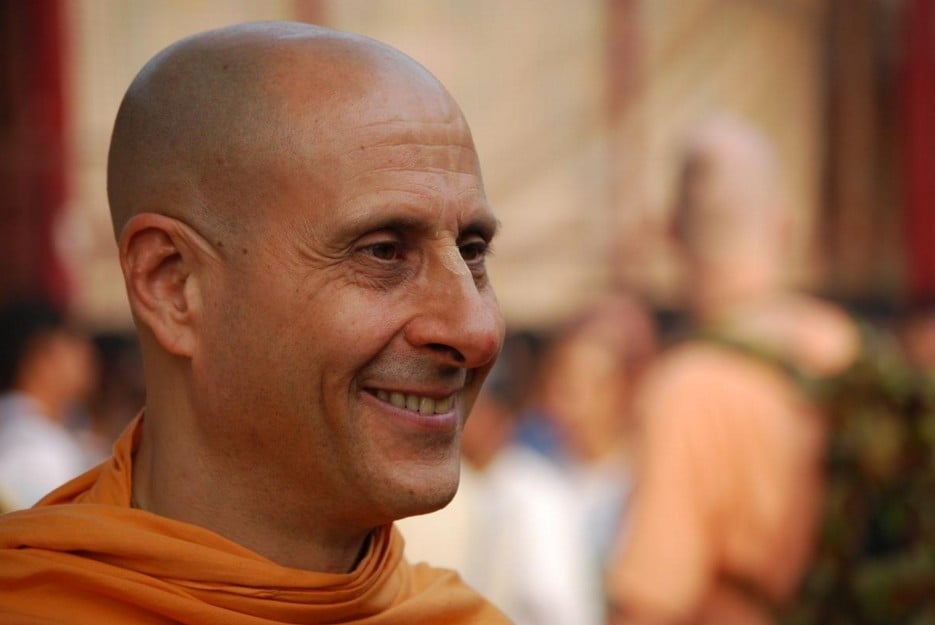
The lecture title identifies the speaker as His Grace Deena Bandhu Prabhu, a respected voice within the ISKCON and Gaudiya Vaishnava devotional setting. The selected verse aligns closely with the heart of Krishna consciousness: transformation through hearing, saintly association, devotional service, and compassionate engagement with the world. The teaching does not ask practitioners to abandon intelligence or social responsibility. It asks them to purify intention and deepen relationship with Krishna, guru, devotees, and all living beings.
In academic terms, Śrīmad-Bhāgavatam 11.3.23 may be read as a compact model of devotional formation. It begins with cognitive discipline, moves into communal formation, and culminates in ethical conduct. It teaches that liberation from illusion is not merely metaphysical knowledge, but a reordering of attachment, association, and behavior. This makes the verse enduringly relevant for anyone seeking spiritual clarity in a distracted age.
The enduring power of this teaching lies in its balance. It does not romanticize the mind, yet it offers a path for training it. It does not idolize community, yet it insists that saintly association is necessary. It does not reduce spirituality to social service, yet it makes mercy indispensable. It does not promote hierarchy for domination, but reverence as a discipline of humility. In that balance, the Bhāgavata offers a mature vision of spiritual life.
Seen through this lens, the featured discourse is not only a video entry but an opportunity for reflection on the foundations of dharmic living. The verse calls for a mind gradually freed from material fixation, a heart softened by compassion, friendships rooted in shared aspiration, and reverence directed toward genuine spiritual wisdom. Such a life strengthens bhakti, supports dharmic unity, and makes scriptural study practically transformative.
Inspired by this post on Dandavats.









Leave a Reply
You must be logged in to post a comment.