
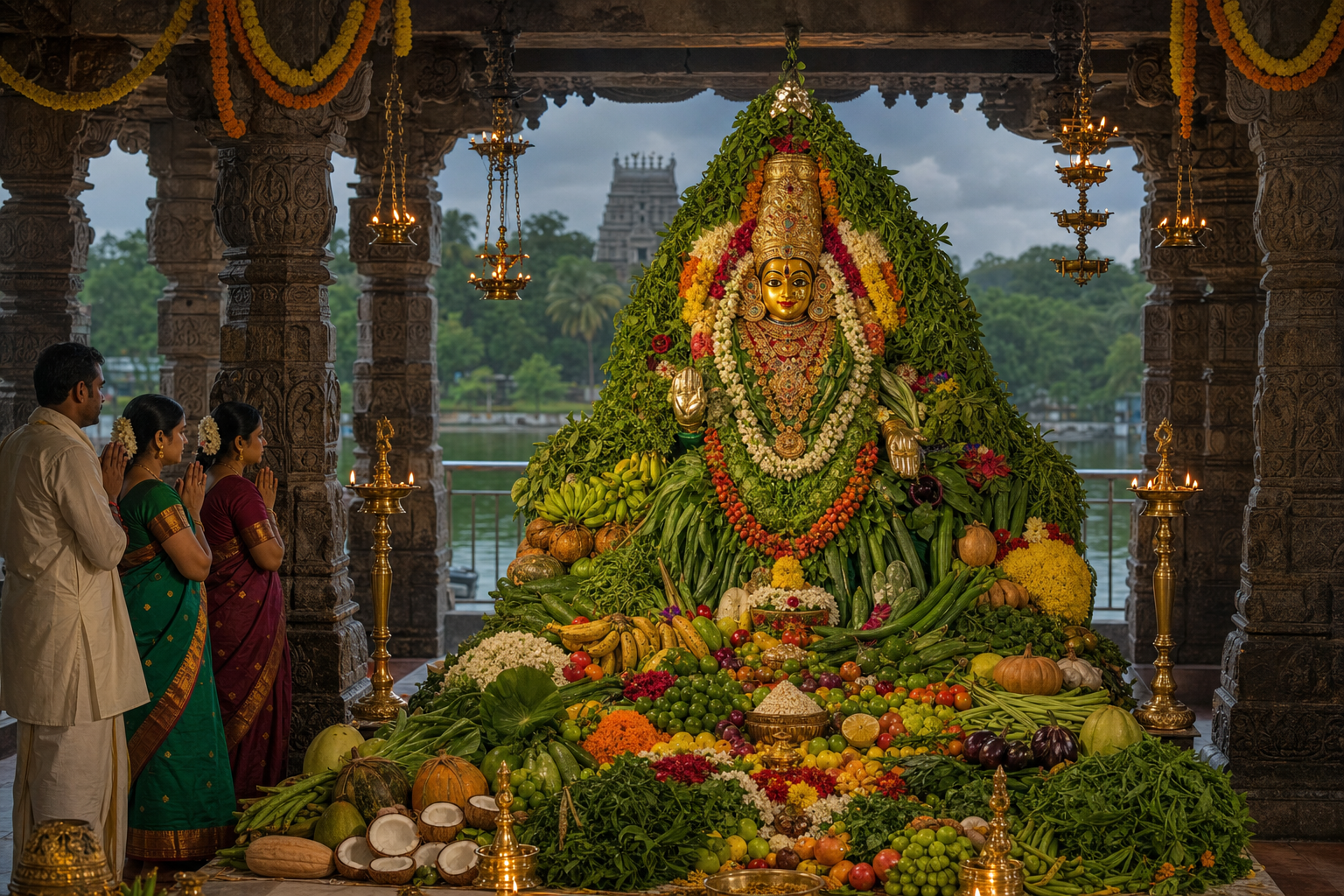
Shakambari Navratri at Bhadrakali Temple in Hanamkonda, Warangal, is among the most visually meaningful Ashada masam observances in Telangana. In 2026, Shakambari Utsavalu is observed from July 15 to July 29 at the historic shrine of Bhadrakali Ammavaru, a revered Shakti Peetha dedicated to the Mother Goddess. The festival is centered on Shakambari Devi, the nourishing form of the Divine Mother associated with vegetation, fertility, rainfall, food security, and the compassionate protection of living beings.
The name Shakambari carries a direct theological and ecological meaning. It is traditionally understood as the goddess who bears or provides vegetables, greens, fruits, roots, and food-bearing plants. In the sacred imagination of Hindu tradition, she is not merely a symbolic provider of harvests; she is the living principle of nourishment itself. During times of scarcity, drought, fear, and social anxiety, Shakambari represents the assurance that nature, when honored with reverence and restraint, sustains life.
At Hanamkonda, this meaning becomes especially powerful because Bhadrakali Ammavaru is worshipped as a fierce, protective, and deeply compassionate manifestation of Devi Shakti. Goddess Bhadrakali is often understood as a ferocious form of the Mother Goddess who destroys adharma, guards devotees, and restores moral balance. When she is worshipped in the Shakambari alankaram during Ashada masam, her fierce protective energy is presented through the gentler language of food, vegetation, abundance, and maternal care.
Bhadrakali Temple in Hanamkonda occupies a significant place in the religious and cultural memory of Telangana. The shrine is associated with the sacred landscape of Warangal, the Kakatiya legacy, and the continuing worship of Shakti in South India. The temple is widely known for its powerful icon of Bhadrakali, her expressive eyes, and the surrounding lake landscape that gives the site a distinctive atmosphere of antiquity, devotion, and regional identity.
Historical accounts commonly connect the temple with early medieval South Indian political and devotional culture. The shrine is traditionally linked to the Chalukya period and later to the Kakatiya rulers, who gave special importance to goddess worship in the Warangal region. The Kakatiya association is especially important because it places Bhadrakali Temple within a wider network of temple architecture, sacred water bodies, fortifications, inscriptions, and public religious life that shaped Telangana’s civilizational landscape.
Shakambari Utsavalu 2026, beginning on July 15 and concluding on July 29, therefore should not be seen only as a seasonal temple festival. It is a layered observance in which ritual, ecology, memory, agriculture, aesthetics, and community devotion come together. The festival belongs to the living rhythm of Ashada masam, a monsoon-linked period in which prayers for rainfall, agricultural prosperity, health, and protection carry special emotional weight for households and farming communities.
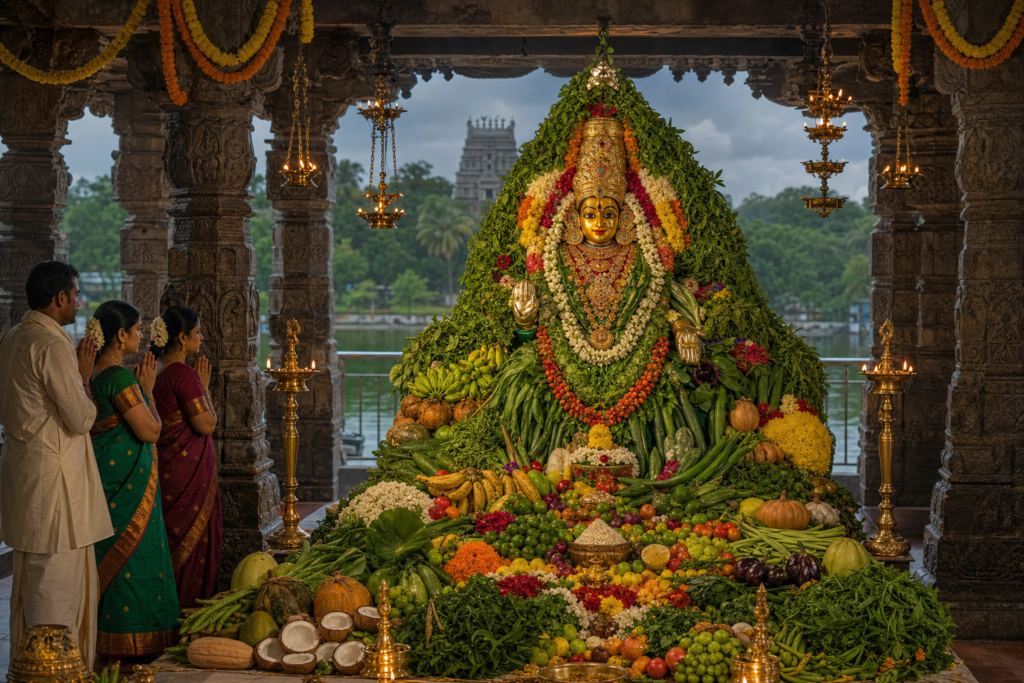
One of the most striking features of Shakambari worship is the decoration of the goddess and temple space with vegetables, fruits, leafy greens, flowers, grains, and other produce. This ritual art is not ornamental in a superficial sense. It is a theological statement. The offerings remind devotees that the Divine Mother is present in the food chain, in the soil, in rainfall, in seed, in cultivation, in the kitchen, and in the shared meal that sustains family and community life.
The use of vegetables and fruits in Shakambari alankaram also makes the festival accessible to ordinary devotees. Gold, jewels, and rare ritual objects may belong to formal temple wealth, but vegetables, greens, grains, and fruits belong to every household. Their offering creates a devotional bridge between the sanctum and the home. A farmer, a market vendor, a cook, a parent preparing a meal, and a pilgrim standing in a darshan queue can all recognize the sacredness of nourishment in a direct and relatable way.
In Puranic tradition, Shakambari Devi is associated with the relief of drought and famine. Narratives describe the goddess manifesting in response to suffering and providing food-bearing vegetation to restore life. This story carries ecological intelligence as well as devotional beauty. It teaches that hunger is not merely an economic condition but a spiritual and social concern. A society that honors Shakambari must also value food, farmers, water bodies, seeds, forests, and the ethical distribution of resources.
This is why Shakambari Navratri remains relevant far beyond ritual performance. In an age of climate uncertainty, water stress, soil degradation, and changing food systems, the festival offers a dharmic vocabulary for ecological responsibility. The worship of the Goddess as nourishment encourages gratitude toward the Earth without reducing nature to a commodity. It reminds communities that prosperity is not measured only by consumption, but by the ability to protect life-supporting systems for future generations.
The Ashada masam timing deepens this meaning. In many parts of India, Ashada is associated with monsoon expectation, agricultural beginnings, vows, temple festivals, and forms of Devi worship that emphasize protection and fertility. Devotees visiting Bhadrakali Temple during this period often carry prayers for family well-being, children’s health, marriage harmony, livelihood stability, crop protection, and relief from difficulties. These prayers may be personal, but together they form a collective devotional atmosphere.
During Shakambari Utsavalu, the temple experience is shaped by darshan, alankaram, archana, abhishekam, deeparadhana, mantra recitation, and offerings made with devotion. The central experience is the vision of Bhadrakali Ammavaru adorned as Shakambari Devi. For many devotees, this darshan is emotionally moving because the goddess appears not only as the destroyer of fear but also as the mother who feeds, heals, and sustains.
The relationship between Bhadrakali and Shakambari also reveals the depth of Hindu Goddess theology. The Divine Mother is not confined to a single mood or function. She can be Kali, Durga, Bhadrakali, Annapurna, Lakshmi, Saraswati, Parvati, or Shakambari, depending on the need of the world and the inner state of the devotee. The same Shakti who confronts injustice also becomes food for the hungry, rain for the fields, courage for the fearful, and wisdom for the confused.
This theological flexibility is one of the reasons Navaratri traditions have remained so enduring across regions. Navaratri is not a single uniform festival practiced identically everywhere. It adapts to regional calendars, temple traditions, local ecology, agricultural cycles, and community memory. Shakambari Navratri in Hanamkonda reflects the Telangana devotional environment, while related Shakambari observances in other regions may have different dates, durations, local foods, and ritual customs.
The Hanamkonda observance is also important for understanding the continuity of Shakti worship in the Deccan. Telangana’s sacred geography includes major temples, village goddesses, jatara traditions, Bonalu-related forms of devotion, family deities, and powerful local expressions of the Divine Feminine. Bhadrakali Temple stands at the intersection of classical temple worship and regional devotional culture, making Shakambari Utsavalu a valuable subject for both devotees and students of Hindu religious history.
The visual dimension of the festival deserves careful attention. A goddess decorated with vegetables and fruits may appear unusual to someone unfamiliar with the tradition, but within Hindu ritual aesthetics it is deeply coherent. Alankaram is a form of theology through beauty. The materials used in decoration communicate the nature of the deity being invoked. Flowers indicate fragrance and impermanence; lamps indicate consciousness; turmeric indicates auspiciousness; food-bearing plants indicate nourishment and abundance.
In Shakambari alankaram, the sanctum becomes a sacred map of the natural world. Gourds, pumpkins, leafy greens, bananas, coconuts, grains, and seasonal produce become offerings of gratitude. Their colors and textures transform the temple into an image of fertility and life. The devotee is invited to see the market, the field, the kitchen, and the temple as connected spaces rather than separate worlds.
There is also a subtle social teaching in this festival. Food is never merely private. It is grown by someone, transported by someone, cooked by someone, served by someone, and received by someone. Shakambari worship honors that chain of interdependence. It encourages humility before the visible and invisible labor that makes a meal possible. In that sense, the festival strengthens community consciousness as much as individual devotion.
For pilgrims planning to visit Bhadrakali Temple during Shakambari Utsavalu 2026, the most important dates to remember are July 15 to July 29, 2026. Since temple crowds can increase during major utsavalu, visitors generally benefit from planning early, allowing extra time for darshan, and following temple instructions on queues, offerings, and ritual participation. Devotees traveling from outside Warangal should also account for local traffic, weather conditions during the monsoon period, and accommodation availability.
Hanamkonda and Warangal are well connected within Telangana, and the temple is part of a larger sacred and historical circuit. A visit to Bhadrakali Temple often becomes more meaningful when seen alongside Warangal’s wider heritage, including Kakatiya-era sites, temple architecture, tanks, and regional cultural spaces. The journey becomes not merely a festival visit but an encounter with the continuity of dharmic civilization in the Telugu-speaking region.
The festival also offers a meaningful opportunity for families to introduce children to Hindu traditions in a tangible way. Concepts such as Devi Shakti, Shakti Peetha, Navaratri, Ashada masam, prasadam, and alankaram can seem abstract when explained only through words. But when children see the goddess decorated with vegetables and fruits, the lesson becomes immediate: food is sacred, nature is sacred, and gratitude is a form of worship.
From a dharmic unity perspective, Shakambari Navratri also speaks to shared values across Hinduism, Buddhism, Jainism, and Sikhism. While the ritual form belongs to Hindu Goddess worship, the ethical themes of compassion, nourishment, restraint, gratitude, and service resonate across dharmic traditions. Feeding others, protecting life, honoring interdependence, and cultivating reverence for the natural world are values that can strengthen harmony among diverse spiritual paths.
This broader interpretation does not dilute the Hindu identity of the festival. Instead, it clarifies its civilizational depth. Shakambari Devi is worshipped as the Mother who nourishes all beings, not only a select group. Her symbolism encourages a generous spiritual imagination in which devotion to one deity can deepen respect for life as a whole. Such a reading supports the larger goal of unity among dharmic traditions while remaining faithful to the specific ritual context of Bhadrakali Temple.
Academically, Shakambari Utsavalu can be studied through several lenses: Goddess theology, temple ritual, regional history, agricultural symbolism, environmental ethics, material culture, and community participation. The festival’s offerings are perishable, but their meaning is enduring. They show how Hindu ritual preserves ecological memory through repeated practice, seasonal timing, and embodied devotion.
Emotionally, the festival endures because it speaks to a universal human concern: the need to be nourished and protected. Every household understands the anxiety of scarcity and the relief of abundance. Every community depends on rain, crops, and shared food systems. In the presence of Shakambari Devi, these ordinary realities are lifted into sacred awareness. The meal becomes prasadam, the harvest becomes blessing, and the Mother Goddess becomes the source of both strength and tenderness.
Shakambari Navaratri Utsavalu 2026 at Bhadrakali Temple, Hanamkonda, is therefore a significant observance for devotees, cultural researchers, and anyone interested in the living traditions of Telangana. From July 15 to July 29, the temple honors Bhadrakali Ammavaru as Shakambari Devi, the nourishing Mother whose worship links divine power with ecological gratitude. The festival’s message is clear and enduring: protection and nourishment are not separate gifts of the Divine Mother, but two expressions of the same compassionate Shakti.
Inspired by this post on Hindu Pad.




Leave a Reply
You must be logged in to post a comment.