
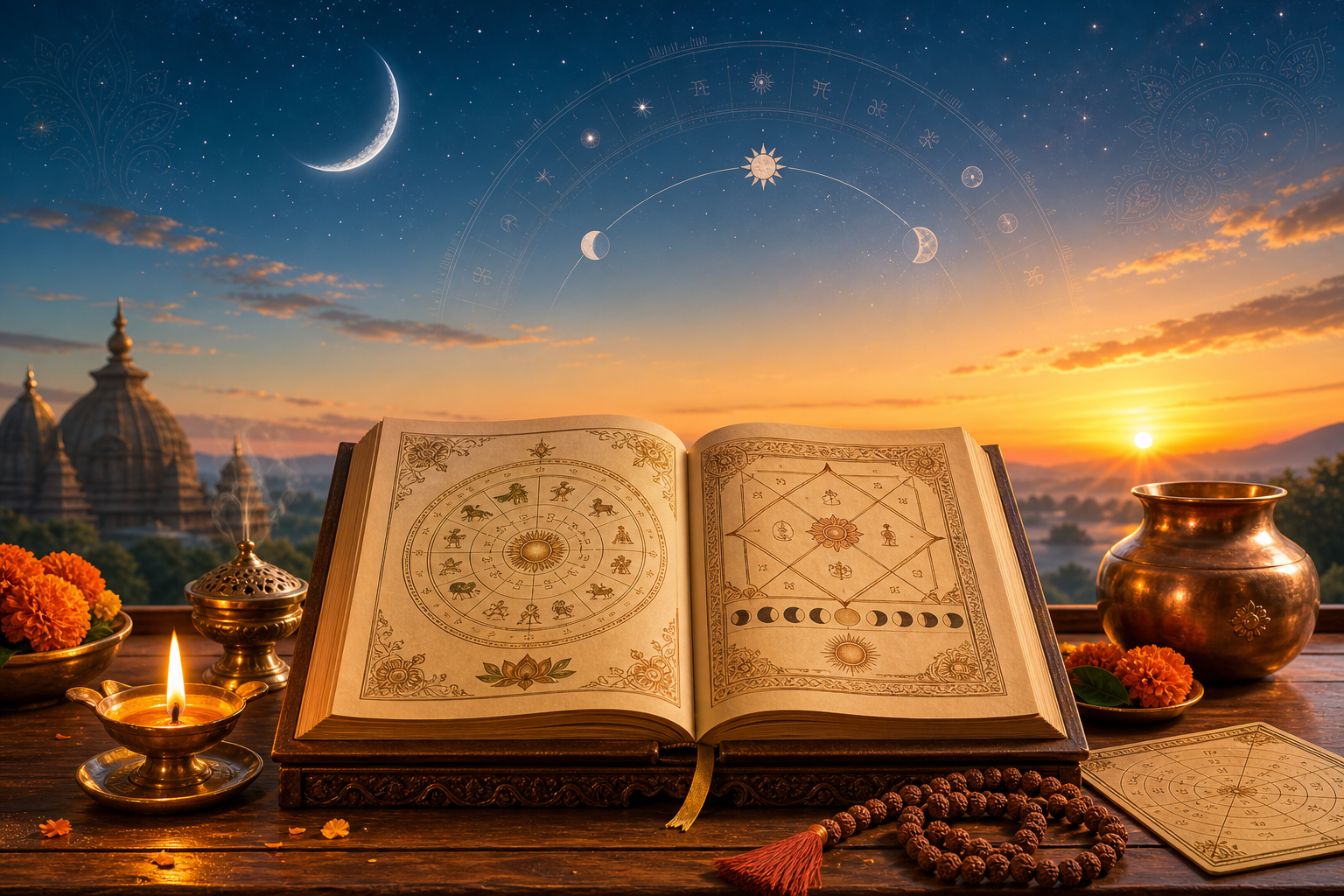
Wednesday, July 15, 2026, carries a distinct place in the Hindu calendar because it marks the opening movement of Shukla Paksha, the waxing phase of the Moon. In most Panchang traditions, this is the period immediately after Amavasya when the lunar disc begins to grow again in visibility and symbolic strength. The day is therefore not merely a calendar entry; it is a disciplined way of reading time through Tithi, Nakshatra, Rashi, Yoga, Karana, sunrise, sunset, and daily muhurta.
The central Tithi for July 15, 2026 is Shukla Paksha Pratipada, the first lunar day of the bright fortnight. According to the provided Panchang note, Shukla Paksha Pratipada continues until 1:22 PM on July 15, after which Shukla Paksha Dwitiya begins. Location-based Panchang calculations can differ because sunrise, longitude, latitude, ayanamsha, and local time settings affect the displayed clock time. For example, a New Delhi reference Panchang lists Pratipada up to 11:50 AM, followed by Dwitiya.
This variation does not weaken the value of the Panchang; rather, it illustrates the technical precision of Hindu timekeeping. A Tithi is not a civil date running from midnight to midnight. It is calculated from the angular distance between the Sun and the Moon. Each Tithi covers 12 degrees of lunar elongation from the Sun, and because the Moon does not move at a uniform apparent speed, a Tithi may end at any time of the day or night.
Shukla Paksha begins after Amavasya and continues until Purnima. Pratipada, as the first Tithi of this waxing sequence, represents renewal, emergence, and the careful beginning of a new lunar cycle. In lived Hindu practice, this is the kind of day on which many families instinctively slow down, observe the calendar before acting, and allow the first step of the fortnight to be taken with clarity rather than haste.
Pratipada is often understood as a starting point, but it is not always treated as a blanket approval for every major undertaking. Panchang interpretation is cumulative. The Tithi must be read with Nakshatra, weekday, Yoga, Karana, Rahu Kalam, Yamaganda, Gulikai Kalam, Varjyam, and the intended nature of the activity. This is why the Panchang remains a sophisticated calendar system rather than a simple list of lucky and unlucky dates.
After the Pratipada period ends, Dwitiya begins. Dwitiya is the second lunar day of Shukla Paksha and belongs to the early expansion of the bright fortnight. If Pratipada is the moment of first emergence, Dwitiya may be understood as a stage of stabilization. For ordinary household life, this transition can be read as a shift from inward preparation toward measured action.
The lunar month connected with this date is Ashadha in many North Indian Purnimanta traditions. In Amanta traditions followed in several western and southern regions, the naming of the lunar month may be handled differently. This is one of the most important points for readers of Hindu calendar material: India does not use a single uniform ritual calendar in every region. The same civil date may be interpreted through regional Panchang systems, temple customs, family parampara, and local sunrise rules.
For a New Delhi reference calculation, the Nakshatra on July 15, 2026 is Pushya until 9:46 PM, followed by Ashlesha. Pushya is traditionally considered one of the highly regarded Nakshatras in many muhurta traditions, associated with nourishment, learning, discipline, and spiritual maturity. Ashlesha, which follows, is more inward, intense, and psychologically subtle. These meanings should be applied carefully and never in isolation from the full Panchang.
The Moon sign, or Chandra Rashi, for the New Delhi reference is Karka Rashi. Karka, associated with the Moon itself in Jyotisha, gives the day a strong lunar emphasis. This can be interpreted as a period in which domestic matters, emotional intelligence, memory, care, protection, and devotional reflection gain prominence. The Sun sign in the same reference remains Mithuna, placing solar attention in a field associated with communication, analysis, and exchange.
The five classical limbs of the Panchang are Tithi, Vara, Nakshatra, Yoga, and Karana. On July 15, 2026, the Vara is Budhawara, or Wednesday. Budhawara is associated with Budha, the planetary principle linked with intellect, speech, calculation, trade, adaptability, and learning. This makes the day especially meaningful for study, planning, writing, accounting, dialogue, and thoughtful communication, provided inauspicious periods are respected according to one’s tradition.
Yoga and Karana add further technical detail. In a New Delhi reference Panchang, Harshana Yoga continues until 8:04 AM, followed by Vajra Yoga until the early hours of July 16. The Karana sequence includes Bava up to the end of Pratipada, then Balava, followed by Kaulava. These divisions are especially important in traditional muhurta selection because they refine the quality of time beyond the broader Tithi and Nakshatra framework.
Sunrise and sunset are essential because many ritual calculations are sunrise-based. For New Delhi on July 15, 2026, sunrise is listed at 5:33 AM and sunset at 7:21 PM. Moonrise is listed at 6:20 AM and moonset at 8:19 PM. These values are not universal for all places, but they show why the Panchang is always tied to geography. A reader in Chennai, Mumbai, Kolkata, London, Toronto, or New York should use a local Panchang for exact observance.
The good times for this day should be understood with the same location-aware caution. For the New Delhi reference, Brahma Muhurta falls from 4:12 AM to 4:52 AM, Pratah Sandhya from 4:32 AM to 5:33 AM, Vijaya Muhurta from 2:45 PM to 3:40 PM, Godhuli Muhurta from 7:20 PM to 7:40 PM, and Amrit Kalam from 4:00 PM to 5:27 PM. Abhijit Muhurta is listed as absent for this Wednesday reference.
Brahma Muhurta is traditionally valued for japa, meditation, svadhyaya, pranayama, and quiet preparation before the obligations of the day gather momentum. Pratah Sandhya supports morning worship and reflection. Vijaya Muhurta is often considered useful for purposeful action, especially when the work requires confidence and discipline. Godhuli Muhurta, the twilight period, carries a gentle devotional atmosphere in many households and temple traditions.
Inauspicious timings also require attention. For the New Delhi reference, Rahu Kalam runs from 12:27 PM to 2:10 PM, Yamaganda from 7:17 AM to 9:00 AM, Gulikai Kalam from 10:44 AM to 12:27 PM, Dur Muhurtam from 11:59 AM to 12:55 PM, and Varjyam from 7:22 AM to 8:48 AM. These periods are generally avoided for initiating major auspicious activities, though routine duties, already-started work, and necessary responsibilities continue.
Rahu Kalam is especially familiar to many Hindu households because it is checked before travel, financial commitments, ceremonial beginnings, and important meetings. Its purpose is not to create fear but to cultivate timing discipline. A practical way to use this knowledge is to schedule important beginnings outside Rahu Kalam while using the period for routine tasks, review, cleaning, correspondence, or quiet work that does not require ceremonial initiation.
The day also carries observances such as Chandra Darshana and Ishti in some Panchang listings. Chandra Darshana after Amavasya has a quiet emotional power because it marks the first visible return of the Moon. For many families, seeing the young Moon is not only a ritual act but also a reminder that renewal often begins delicately. The light is small at first, yet it is real, and it grows through consistency.
Ashadha Navratri is also associated with this period in certain traditions. Unlike the more publicly visible Chaitra and Sharad Navratri observances, Ashadha Navratri is often more inward and sadhana-oriented. It is connected with Devi worship, mantra practice, austerity, and disciplined devotion. This makes July 15, 2026 significant not only as a Panchang date but as part of a wider spiritual rhythm in the Hindu year.
From a practical perspective, the morning can be used for cleansing routines, lighting a lamp, offering water, reciting a chosen mantra, and reviewing the day before beginning work. Since Pratipada continues into the day according to the provided note, the period before its transition to Dwitiya may be used for intentional beginnings of a modest and sattvic nature. Large ceremonies, contracts, travel, or property decisions should still be checked against a full local muhurta.
After Dwitiya begins, the energy of the lunar fortnight becomes slightly more settled. This may be suitable for follow-up actions, planning, study, household coordination, and continuing work already initiated with care. In an academic reading of the Panchang, such interpretations are symbolic and ritual-cultural rather than mechanical guarantees. The Panchang guides attention; it does not remove human responsibility, ethical judgment, or practical planning.
The emotional value of a daily Panchang lies in its ability to make time feel meaningful. Modern life often reduces a date to appointments, deadlines, and notifications. The Hindu calendar adds a deeper grammar: the Moon has a phase, the day has a quality, the Nakshatra has a temperament, and the household has a chance to act with awareness. This is why even a brief Tithi note can become a complete meditation on time, duty, and inner order.
It is also important to avoid fatalism. Panchang study should not be used to frighten people or divide communities through rigid claims. Hindu tradition contains many regional calendars, sectarian customs, temple paddhatis, and family practices. A mature reading respects plurality. The same spirit supports unity among Dharmic traditions, where discipline, compassion, ethical action, self-cultivation, and reverence for sacred time remain shared civilizational values.
For readers from Hindu, Buddhist, Jain, and Sikh backgrounds, the deeper lesson is not merely technical astrology but mindful living. Lunar observances, fasting disciplines, sacred recitation, ethical restraint, seva, meditation, and remembrance appear in different forms across Dharmic life. A Panchang entry such as July 15, 2026 can therefore be read as an invitation to honor one’s own tradition while recognizing the wider Indic habit of treating time as sacred and morally meaningful.
Those using this Panchang for puja should verify the local sunrise and Tithi ending time for their city. This is particularly important for vrata, sankalpa, temple rituals, samskara-related rites, and festival observances. A family in India and a family in North America may share the same devotion but not always the same clock time for Tithi, Nakshatra, or moonrise. Good practice is to use the local Panchang while understanding the general significance from broader calendar notes.
For July 15, 2026, the concise working summary is clear: the day is Wednesday, Shukla Paksha Pratipada continues until the listed transition time in the source note, and Dwitiya follows afterward. The Nakshatra reference for New Delhi is Pushya until the evening and Ashlesha after that. The Moon is in Karka Rashi in the New Delhi reference. Good periods such as Brahma Muhurta, Vijaya Muhurta, Godhuli Muhurta, and Amrit Kalam may support spiritual and practical discipline.
The best use of this day is therefore balanced. It supports renewal, prayer, study, family steadiness, and conscious planning. It asks for caution during Rahu Kalam and other inauspicious intervals. It also encourages humility because Panchang reading depends on location, tradition, and purpose. When used with knowledge rather than anxiety, the Hindu calendar becomes a refined instrument for aligning action with cosmic rhythm and ethical awareness.
For location-specific verification, readers may compare their regional almanac with a Panchang calculator such as https://www.drikpanchang.com/panchang/day-panchang.html?date=15/07/2026. The provided source note remains the basis for the 1:22 PM Pratipada transition mentioned here, while the New Delhi reference demonstrates how exact timings may differ by place. This distinction is essential for accuracy, especially when the Panchang is used for worship, vrata, travel, or major life decisions.
Inspired by this post on Hindu Blog.
