
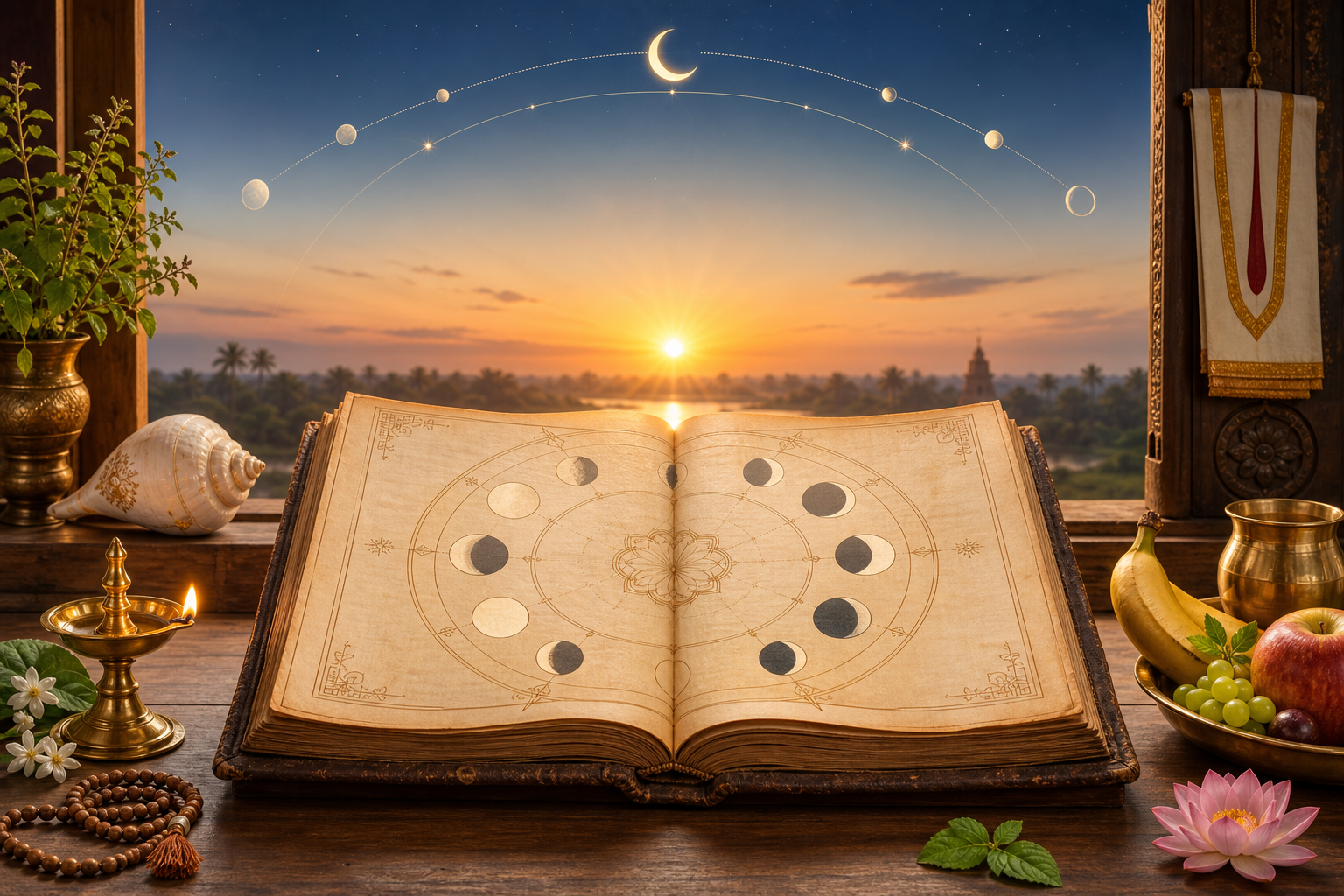
Anandapaksha Ekadashi, also referred to as Anandapaksham, is a specialized Vedic calendar condition connected with Ekadashi, the eleventh lunar day or Tithi. It is not simply the name of one annual festival; it is a calendrical classification used to understand how the Ekadashi observance should be aligned when the eleventh lunar day extends toward, or overlaps with, Dwadashi, the twelfth lunar day, around sunrise. In traditional Hindu timekeeping, this detail matters because sunrise is the practical anchor by which a lunar Tithi is applied to a lived religious day.
The subject may appear technical at first, yet it touches the heart of Hindu fasting culture. A devotee does not observe Ekadashi merely by looking at a printed date on a modern civil calendar. The correct observance depends on the Panchang, local sunrise, the beginning and ending of the Tithi, and the relationship between Ekadashi and Dwadashi. Anandapaksha Ekadashi therefore represents the disciplined precision of the Hindu calendar and the devotional sensitivity with which sacred time is approached.
Ekadashi itself is among the most widely observed fasting days in Hindu traditions, especially within Vaishnava practice, where it is associated with Lord Vishnu and the cultivation of self-restraint, clarity, and devotion. The word Ekadashi refers to the eleventh Tithi in either Shukla Paksha, the bright fortnight, or Krishna Paksha, the dark fortnight. Since each lunar month contains two fortnights, Ekadashi normally occurs twice in a lunar month and roughly twenty-four times in a year, with additional observances in years that include an Adhika Masa.
The technical foundation of Anandapaksha Ekadashi lies in the meaning of Tithi. A Tithi is not identical to a twenty-four-hour civil day. It is calculated from the angular distance between the Sun and the Moon, with each Tithi representing a twelve-degree separation. Because the Moon’s motion is variable, a Tithi can begin or end at any time of the day or night. It may be shorter or longer than a solar day, and this is why Ekadashi can sometimes begin after one sunrise and continue beyond the next.
In the Hindu calendar, sunrise has a decisive role. The Tithi prevailing at sunrise is generally used to assign ritual significance to that civil day. This principle allows communities to translate the moving lunar rhythm into practical observance. When Ekadashi is present at sunrise, that day is usually treated as the Ekadashi day. When Dwadashi is present at the following sunrise, it becomes the natural time for Parana, the formal breaking of the fast, subject to the rules of the specific tradition being followed.
Anandapaksha Ekadashi becomes relevant when the Ekadashi Tithi extends in such a way that its relationship with Dwadashi at sunrise must be carefully assessed. The essential contrast is between an ordinary Ekadashi alignment and a more complex alignment in which the eleventh lunar day continues close to, or into, the period associated with Dwadashi. In such cases, the Panchang does more than announce a date; it interprets the quality of the day so that the fast, worship, and Parana remain ritually coherent.
This rule is best understood through the broader logic of Hindu timekeeping. A sacred day is not determined only by midnight-to-midnight reckoning. Instead, it is shaped by the presence of the relevant Tithi at sunrise, the avoidance of unsuitable overlap, and the preservation of the intended ritual sequence. Ekadashi fasting is traditionally followed by Dwadashi Parana, so the timing of both Tithis must be considered together. Anandapaksha Ekadashi highlights this relationship between restraint on Ekadashi and completion on Dwadashi.
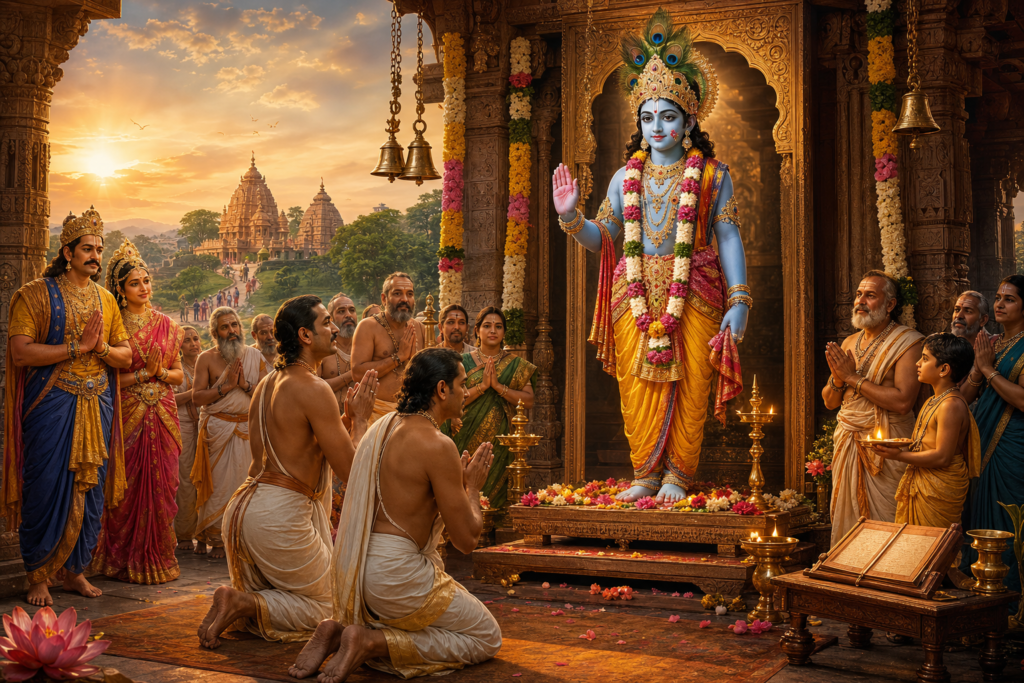
The practical importance is especially visible for those who follow Ekadashi with seriousness. A family may prepare grain-free food, adjust meals on Dashami, plan worship on Ekadashi, and wait for the proper Parana window on Dwadashi. If the Tithi alignment is misunderstood, the observance can become confused. Anandapaksha Ekadashi reminds practitioners that devotion in Sanatana Dharma often combines inner sincerity with careful attention to inherited systems of time, astronomy, and ritual discipline.
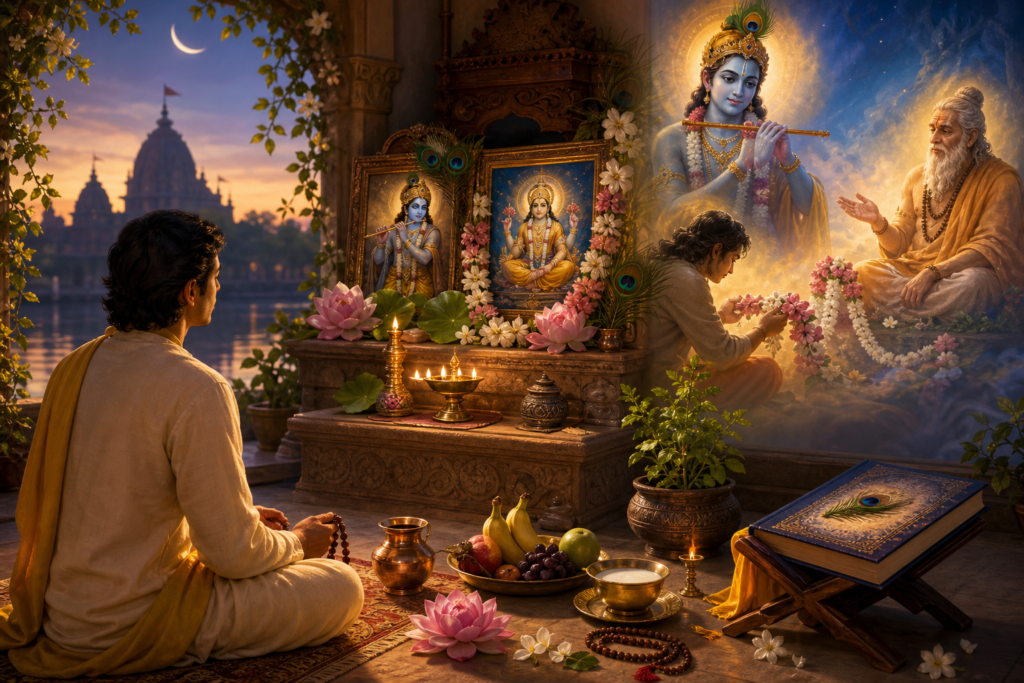
In many homes, the emotional force of Ekadashi comes from this blend of cosmic order and personal practice. The day is felt not only as a fast but as a pause from routine indulgence. For some, it is a day of light food and quiet prayer; for others, it includes stricter fasting, Japa, temple worship, reading of scriptures, or service. Anandapaksha Ekadashi adds another layer of awareness: the devotee is invited to notice that sacred discipline is not casual, but timed according to the subtle movement of the lunar calendar.
Different traditions may apply Ekadashi rules with slight variations. Smarta, Vaishnava, and regional Panchang systems can sometimes differ in how they handle sunrise, Tithi overlap, Dashami influence, and Dwadashi Parana. This diversity should not be seen as contradiction in a negative sense. It reflects the living plurality of Hindu traditions, where shared reverence for Dharma coexists with distinct Sampradaya methods. The larger aim remains spiritual refinement, not sectarian disagreement.
Within Vaishnava practice, special care is often taken to avoid observing Ekadashi when it is considered affected by Dashami at sunrise, and to ensure that Parana occurs properly on Dwadashi. This concern is rooted in the view that a vrata gains strength when observed in its correct ritual frame. Anandapaksha Ekadashi belongs to this wider field of calendrical judgment, where the day’s sanctity is read through the interaction of Ekadashi, Dwadashi, sunrise, and the prescribed fasting sequence.
The term Anandapaksha itself suggests a classified side or condition of the lunar fortnight rather than a simple festival title. In usage, Anandapaksham is discussed as a calendar configuration, and therefore it should be distinguished from named Ekadashis such as Nirjala Ekadashi, Vaikunta Ekadashi, Mokshada Ekadashi, or Utpanna Ekadashi. Those names identify particular Ekadashi observances in the annual cycle, while Anandapaksha Ekadashi identifies a specific timing condition that can affect how the observance is understood.
For a general reader, the key point is straightforward: the Hindu calendar is lunisolar, and its ritual days are determined by astronomical and scriptural principles rather than by fixed civil dates alone. This is why an Ekadashi date may vary by location. A Panchang prepared for one city may not always apply perfectly to another city because sunrise and Tithi boundaries differ by geography. Locality matters, and this is one reason traditional calendars often provide city-specific fasting and Parana times.
The Parana rule is central to the subject. Ekadashi fasting is not considered complete merely because the day has passed. It is ritually completed by breaking the fast on Dwadashi within an appropriate time window. If Dwadashi is too short, or if the Tithi changes quickly after sunrise, the Panchang may recommend a specific early Parana period. In Anandapaksha-type discussions, the relationship between Ekadashi and Dwadashi is therefore not a minor technicality but part of the integrity of the vrata.
This technical care also has a philosophical dimension. Ekadashi is often interpreted as a discipline for the senses and the mind. Food restraint, reduced distraction, and devotional remembrance together create a pattern of self-regulation. The lunar calendar gives that discipline a cosmic rhythm, while the Panchang gives it practical form. Anandapaksha Ekadashi shows how Hindu Fasting is not merely abstinence; it is an embodied relationship with time, intention, and sacred order.
At the same time, the observance should be approached with balance. Hindu traditions have long recognized variations in capacity. Some devotees observe Nirjala fasting without water, while others take water, milk, fruit, or simple non-grain foods according to health, age, medical needs, and family duties. The essence of Ekadashi lies in discipline and devotion, not in harming the body. A careful Panchang can guide timing, but personal health and responsible judgment should guide the form of fasting.
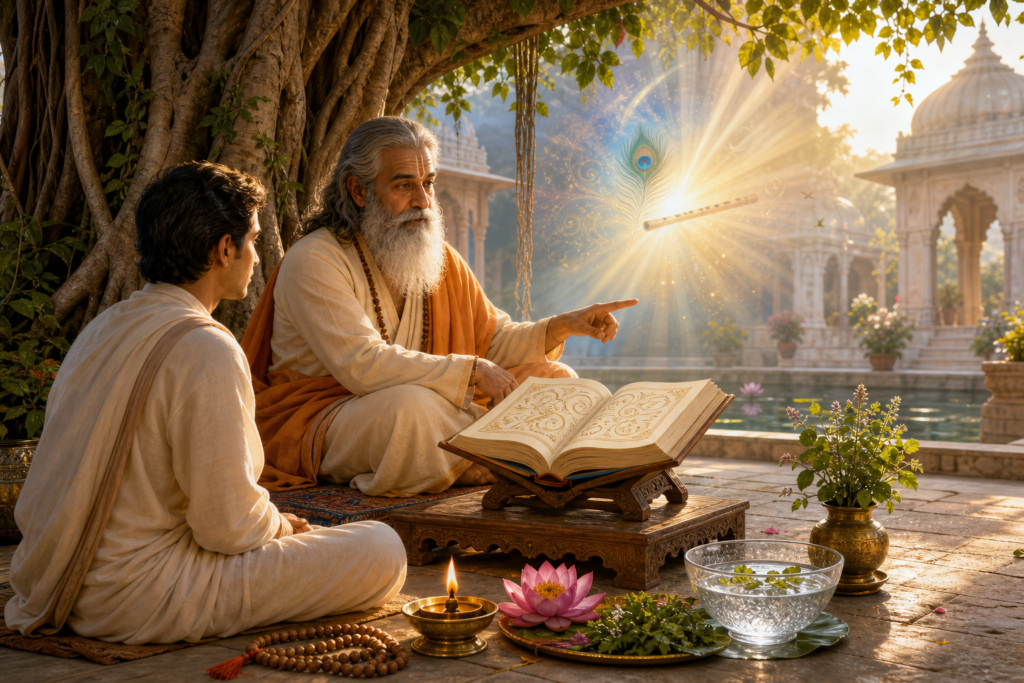
Anandapaksha Ekadashi also illustrates why traditional knowledge systems deserve patient study. Terms such as Tithi, Paksha, Dwadashi, Parana, sunrise, and Panchang form a technical vocabulary. Without that vocabulary, a sacred calendar may seem inconsistent. With it, the calendar reveals a coherent structure. The same date can carry different ritual implications depending on the exact lunar condition, and this is precisely the kind of nuance preserved in Vedic Tradition.
The unity of Dharmic traditions is strengthened when such subjects are explained with clarity and respect. Hinduism, Jainism, Buddhism, and Sikhism each preserve distinctive relationships with time, discipline, remembrance, and ethical living. Ekadashi is specifically rooted in Hindu practice, yet its broader themes of restraint, mindfulness, compassion, and spiritual attention resonate across Dharmic life. A technical calendar rule can therefore become a point of deeper reflection rather than mere ritual complexity.
For temple communities and household practitioners, the most practical recommendation is to consult a reliable local Panchang for the correct Ekadashi and Dwadashi timings. General internet calendars can be helpful, but they may not always reflect the local sunrise or the particular tradition followed by a family or temple. When a Panchang identifies a special configuration such as Anandapaksha Ekadashi, it is signaling that the observance requires careful timing rather than casual date selection.
The deeper value of Anandapaksha Ekadashi is that it makes sacred time visible. It teaches that a vrata is not only an individual act of will but also participation in an inherited calendar shaped by astronomy, scripture, and community memory. The devotee becomes attentive to the Moon’s motion, the discipline of sunrise, the sanctity of Ekadashi, and the completion offered by Dwadashi. In that attentiveness, technical knowledge becomes spiritual practice.
Thus, Anandapaksha Ekadashi should be understood as a refined calendrical concept within the larger Ekadashi tradition. It clarifies how the eleventh lunar day is treated when its timing intersects with Dwadashi around sunrise, and why Panchang-based observance remains essential. For modern readers, its lesson is both practical and contemplative: sacred discipline becomes more meaningful when devotion, knowledge, and correct timing work together.
Inspired by this post on Hindu Pad.




Leave a Reply
You must be logged in to post a comment.