
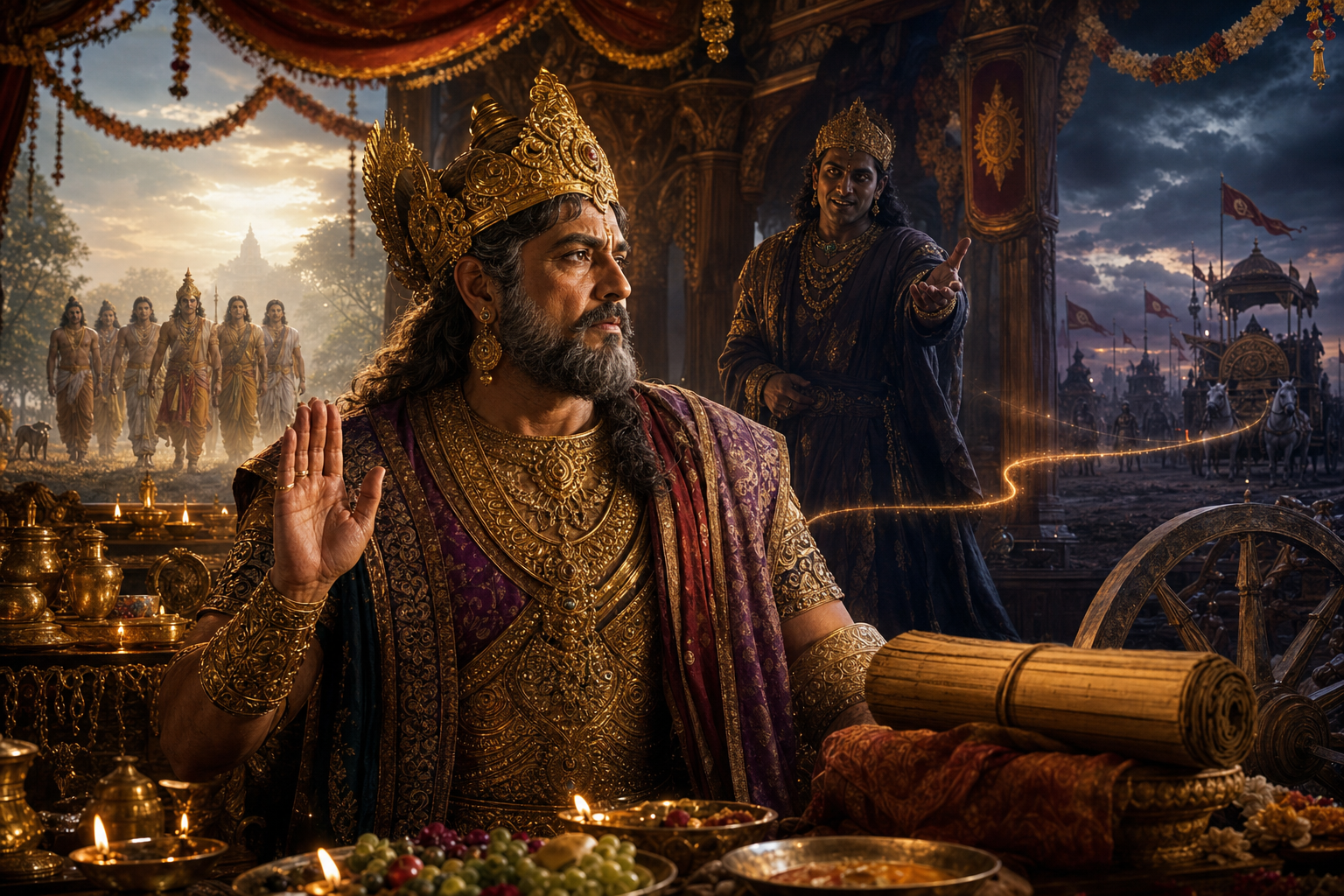
The episode of King Shalya of Madra in the Mahabharata is one of the epic’s most revealing studies of deception, duty, kinship, political intelligence and moral destiny. Though it does not always receive the attention given to the Bhagavad Gita, Draupadi’s humiliation, Bhishma’s vow or Karna’s tragedy, the Shalya episode in the Udyoga Parva opens a subtle window into how words, hospitality, pride and promises can alter the direction of history. It shows that a single commitment, made under manipulated circumstances, can bind even a noble person to a painful course of action.
Shalya was the king of Madra and the maternal uncle of Nakula and Sahadeva, the twin sons of Madri and Pandu. His natural emotional and familial alignment was therefore with the Pandavas. As the Kurukshetra War approached, he set out with a large army intending to support Yudhishtira and his brothers. In ordinary political terms, this should have strengthened the Pandava side. In moral terms, it also seemed appropriate, since Shalya’s affection for his sister’s sons made his support appear almost inevitable. Yet the Mahabharata rarely allows human intention to move in a straight line. It places intention under the pressure of circumstance, strategy and dharma.
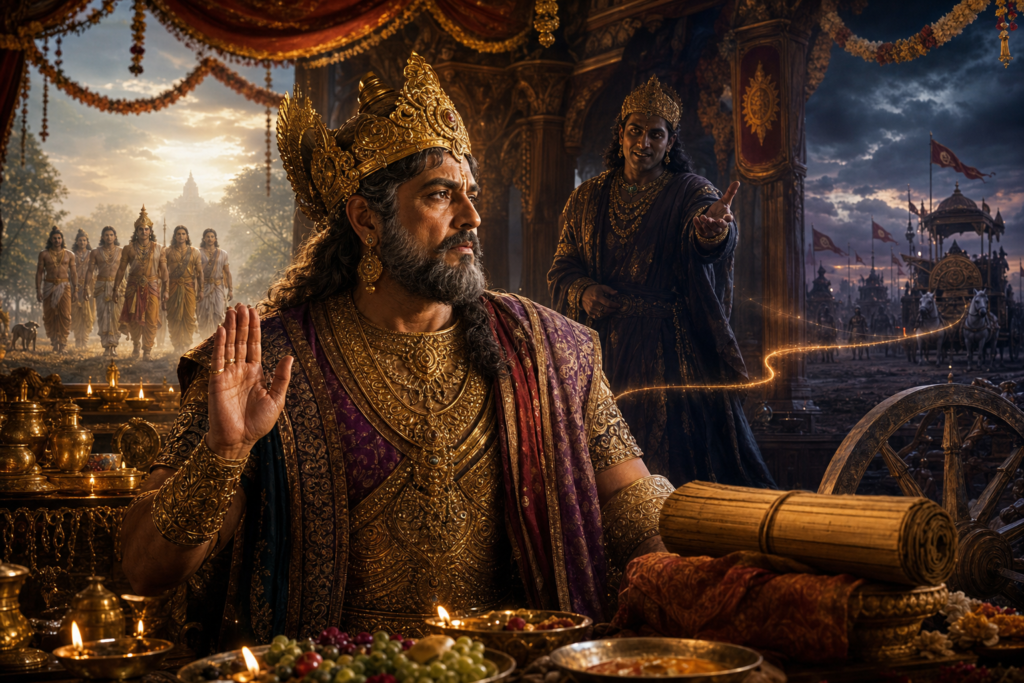
Duryodhana, aware of Shalya’s importance, did not confront him through open argument. Instead, he used royal hospitality as a political instrument. According to the narrative, Duryodhana arranged magnificent receptions for Shalya and his army along the route. Shalya believed that such generous arrangements had been made by Yudhishtira. Delighted by what he assumed was his nephew’s honour and affection, he declared that he would grant a boon to the person responsible for the hospitality. When Duryodhana revealed himself as the benefactor, Shalya was trapped by his own word. A king’s promise, once spoken, carried immense weight. Duryodhana asked him to fight on the Kaurava side, and Shalya, bound by the ethics of his pledge, accepted.
This moment is often read as Duryodhana’s deception, but the episode is more layered than a simple tale of trickery. Duryodhana certainly exploited the cultural sanctity of hospitality and the royal obligation to honour a boon. Yet Shalya’s response also reveals the ancient Indian concern with satya, honour and the binding force of speech. In the world of the Mahabharata, words are not casual sounds. They create obligations. A vow can become destiny, and a promise can become a battlefield.
Shalya’s predicament raises a difficult ethical question: when a promise is obtained through deception, does dharma require obedience to it? The epic does not answer in a simplistic way. Shalya does not abandon his promise, because the social and moral order of his time gives sacred force to declared commitments. At the same time, his heart is not fully with Duryodhana. This tension makes him a deeply human figure. He is not a villain; nor is he entirely free of weakness. He is a ruler caught between family loyalty, personal honour, political manipulation and the terrifying momentum of war.
When Shalya later met Yudhishtira, the emotional complexity of the episode became clearer. Yudhishtira did not simply condemn him. Instead, he understood the bind created by Duryodhana’s strategy and by Shalya’s own code of honour. This response is significant. The Pandava understanding of dharma was not merely rigid rule-following; it required discernment, context and restraint. Yudhishtira asked Shalya for a different kind of assistance: if he became Karna’s charioteer, he should weaken Karna’s confidence through speech at the crucial moment.
Here the narrative becomes especially subtle. Shalya, though physically present on the Kaurava side, becomes psychologically aligned with the Pandavas in a limited but decisive way. His role as Karna’s charioteer during the later phase of the war is not accidental. In epic warfare, the charioteer is not merely a driver. He is strategist, witness, counsellor and stabilizing presence. Krishna serves Arjuna in this role, guiding him not only through the battlefield but through a crisis of consciousness. Shalya’s role with Karna becomes a dark mirror of that relationship. Where Krishna elevates Arjuna’s clarity, Shalya unsettles Karna’s confidence.
Karna’s tragedy is inseparable from pride, loyalty, social humiliation, generosity and inner conflict. By the time Shalya becomes his charioteer, Karna carries the weight of many curses, choices and unresolved wounds. Shalya’s sharp words and repeated comparisons do not create Karna’s downfall by themselves, but they intensify the psychological pressure already surrounding him. The episode shows that war in the Mahabharata is fought not only with arrows, maces and celestial weapons, but also through morale, memory, speech and perception.
The contrast between Krishna and Shalya is one of the most powerful interpretive keys to this episode. Krishna’s guidance to Arjuna is rooted in dharma, self-knowledge and cosmic vision. Shalya’s words to Karna are rooted in irony, criticism and strategic demoralization. Both charioteers influence warriors through speech. The difference lies in purpose and spiritual orientation. One restores alignment with duty; the other exposes instability within a warrior whose loyalty is heroic but morally compromised by association with adharma.
The Shalya episode also demonstrates the political sophistication of the Udyoga Parva. This section of the Mahabharata is not only a prelude to war; it is a study of diplomacy, alliance-building, negotiation, psychological strategy and the failure of peace. Duryodhana’s handling of Shalya shows his capacity for tactical brilliance. He understands timing, pride and royal etiquette. Yet the same act also reveals the moral poverty of his statecraft. He wins Shalya’s body but not his heart. He gains an ally by manipulation, not by justice. The epic repeatedly shows that such victories are unstable.
From the perspective of dharma, this distinction matters. A political alliance created through deceit may produce temporary advantage, but it corrodes trust. Dharma is not opposed to strategy; the Mahabharata contains many examples of complex strategic action. However, strategy severed from righteousness becomes adharma. Duryodhana’s conduct toward Shalya is therefore not merely clever diplomacy. It is a symptom of a deeper disorder: the belief that human beings can be converted into instruments through manipulation.
Shalya’s own character must also be examined without sentimentality. His commitment to honour is admirable, but his vanity makes him vulnerable. He is pleased by lavish hospitality and eager to reward the one who honours him. The epic does not present this as unusual; kingship in that world was inseparable from honour, recognition and ceremonial exchange. Yet the narrative quietly warns that even noble people can be misled when pride is touched. In this sense, Shalya’s destiny is not created only by Duryodhana. It is also shaped by Shalya’s own susceptibility to praise and grandeur.
This is where the episode becomes relevant beyond the battlefield. Human beings often believe that major ethical failures begin with dramatic wickedness. The Mahabharata suggests something more unsettling: moral confusion often begins with small moments of vanity, haste, assumption and unexamined obligation. Shalya assumed that the hospitality came from Yudhishtira. He spoke before verifying. He promised before knowing. That sequence is psychologically familiar even in modern life. People commit themselves under emotional pressure, social pressure or incomplete knowledge, and only later discover the cost.
The episode therefore offers a durable lesson in discernment. Gratitude is virtuous, but gratitude must be joined with clarity. Honour is necessary, but honour must not become mechanical obedience to manipulation. Speech is sacred, but speech must be governed by wisdom before it becomes a vow. In dharmic traditions, the ethical life is not merely about good intention; it also requires attention, discrimination and self-mastery. Shalya’s story makes this principle concrete.
The unity of dharmic traditions can also be reflected through this episode. Hindu, Buddhist, Jain and Sikh ethical frameworks all place deep value on self-awareness, truthful conduct, restraint and the consequences of action. While their metaphysical vocabularies differ, they converge on the insight that unexamined desire and ego can bind the individual. Shalya’s story is not only a Hindu epic episode; it is a civilizational meditation on how intention, speech and action create consequences. The dharmic emphasis on mindfulness, viveka, ahimsa, satya and responsibility helps illuminate why this episode continues to matter.
There is also a profound lesson in Yudhishtira’s response. He does not reduce Shalya to betrayal. He recognizes the complexity of the situation and works within it. This is a mature ethical stance. In a world increasingly quick to judge, the Mahabharata offers a more demanding model: understand the web of obligation before assigning blame. Yudhishtira’s response is not passive. He still seeks strategic benefit. But he does so with awareness of Shalya’s predicament rather than with blind anger. This balance of realism and restraint is one of the epic’s enduring contributions to political and moral thought.
Shalya’s later role as commander of the Kaurava army after Karna’s death further deepens the irony. A king who originally set out to aid the Pandavas eventually leads the opposing army. Destiny, in the epic, does not mean that human choices are irrelevant. Rather, destiny often appears as the accumulated force of choices, vows, weaknesses, loyalties and prior actions. Shalya’s path to command is therefore tragic. He is not where his heart first intended to be, yet he is not entirely innocent of how he arrived there.
His death at the hands of Yudhishtira is equally symbolic. Yudhishtira, often remembered for patience, truth and moral seriousness rather than battlefield ferocity, becomes the one who kills Shalya. This outcome is not incidental. The king of dharma must confront the consequences of distorted dharma. Shalya’s honour, once manipulated, becomes part of the machinery of adharma. Yudhishtira’s victory over him represents the painful necessity of restoring order even when the opponent is not purely evil. The Mahabharata repeatedly insists that dharma-yuddha is never emotionally simple.
The question in the title, whether this is Duryodhana’s deception or Shalya’s destiny, is best answered by holding both together. Duryodhana’s deception is undeniable. He deliberately created a situation in which Shalya would be morally cornered. Yet Shalya’s destiny also unfolds through his own speech, pride, honour and acceptance of obligation. The epic refuses to let any character become a flat symbol. It portrays moral life as layered, relational and consequential.
For readers of the Mahabharata, the Shalya episode is especially valuable because it shifts attention from dramatic combat to the ethics before combat. Wars are not born only on battlefields. They are prepared in conversations, promises, insults, ambitions, silences and compromises. The Udyoga Parva shows that by the time armies assemble at Kurukshetra, many decisive battles have already been fought within the chambers of diplomacy and within the human heart.
The story also warns against confusing external alignment with inner conviction. Shalya stands with the Kauravas, but his emotional and moral sympathies remain divided. This divided loyalty makes him dangerous, tragic and instructive. Organizations, families and societies still face similar dilemmas. People may appear to support a side because of obligation, fear, gratitude or prior commitment, while inwardly recognizing another truth. The Mahabharata understands this psychological complexity with remarkable precision.
In contemporary ethical language, Shalya’s story is a study in manipulated consent. He agrees to Duryodhana’s request, but the agreement is engineered through incomplete knowledge. The epic does not use modern terminology, yet it understands the moral problem clearly. Consent obtained through deception is ethically compromised. At the same time, the narrative acknowledges that once a public promise is made, social reality changes. Shalya must then navigate the difficult terrain between truth, honour and consequence.
This makes the episode a powerful teaching for leadership. Leaders must be careful not only about what they promise but also about the conditions under which they promise. They must distinguish generosity from entrapment, loyalty from manipulation and honour from ego. Shalya’s fall is not a failure of courage. It is a failure of discernment at a crucial moment. The difference is important, because courage without discernment can still be redirected toward destructive ends.
The Shalya episode also clarifies Duryodhana’s character. He is not unintelligent. In fact, his intelligence makes his adharma more consequential. He knows how to read people. He knows how to exploit etiquette. He knows how to convert social obligations into political advantage. His flaw is not lack of ability; it is the misuse of ability. This is one of the Mahabharata’s most consistent teachings: talent without dharma becomes dangerous.
Karna’s involvement gives the episode an additional tragic dimension. Shalya’s eventual assignment as Karna’s charioteer brings together two wounded forms of nobility. Karna is generous, brave and loyal, yet bound to Duryodhana’s cause. Shalya is honourable and royal, yet bound by a manipulated promise. Their pairing is therefore unstable from the beginning. Both men possess greatness, but both are placed in the service of a cause that cannot ultimately stand because it is rooted in injustice.
In this sense, the Shalya episode is not peripheral to the Mahabharata; it is central to the epic’s moral architecture. It demonstrates how dharma can be obscured by technical correctness. Shalya keeps his word, yet the circumstances of that word are tainted. Duryodhana honours hospitality, yet weaponizes it. Karna receives a charioteer, yet not one who strengthens him. Yudhishtira seeks help from Shalya, yet must eventually fight and kill him. Every action contains layers, and every layer demands interpretation.
The enduring power of this story lies in its refusal to offer easy comfort. It does not say that good intentions always protect a person. It does not say that deception always appears ugly. It does not say that family loyalty automatically triumphs over public duty. Instead, it shows that dharma requires vigilance. The righteous path is not sustained by sentiment alone; it must be protected by clarity, courage, humility and disciplined speech.
For modern readers, Shalya’s journey can be read as a caution against impulsive commitments and performative honour. In public life, professional life and personal relationships, people are often pressured into promises before all facts are known. The Mahabharata asks readers to slow down before speaking binding words. It teaches that integrity is not merely keeping promises; it is also ensuring that promises arise from truth.
At the same time, the episode should not be read cynically. It does not reject hospitality, gratitude or honour. These remain sacred values within dharmic civilization. What it rejects is their corruption. Hospitality should nourish trust, not trap the guest. Gratitude should express sincerity, not become a tool of coercion. Honour should support righteousness, not imprison conscience. This distinction is essential for preserving the ethical spirit of Sanatana Dharma and the wider dharmic family of traditions.
Ultimately, Shalya’s story is a meditation on the power of a fateful promise. It reveals how deception can bend duty, how destiny can emerge through choice, and how dharma must be interpreted with intelligence rather than habit. In the vast landscape of the Mahabharata, Shalya stands as a reminder that the most decisive battles often begin before weapons are raised. They begin in the mind, in the ego, in the spoken word and in the subtle moment when discernment either awakens or fails.
Inspired by this post on Hindu Blog.



Leave a Reply
You must be logged in to post a comment.