
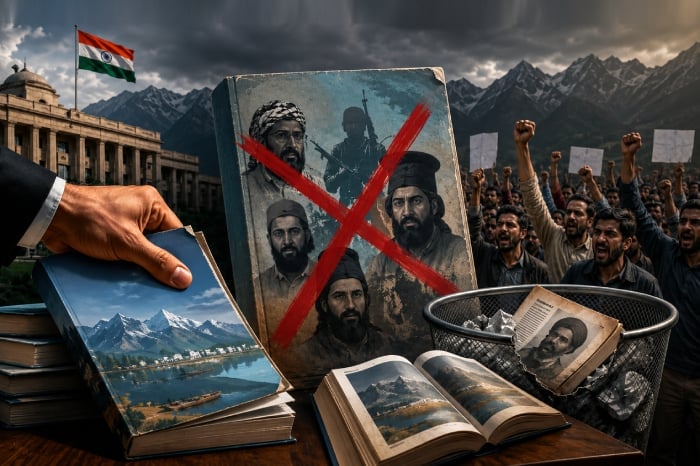
The controversy in Jammu and Kashmir over books supplied to government school libraries has become more than a routine administrative lapse. It has raised serious questions about educational oversight, ideological screening, public accountability, and the responsibility of state institutions in a region where narratives around terrorism, separatism, and national security carry deep social consequences.
According to media reports, the Jammu and Kashmir administration suspended eight officials from the School Education Department after books allegedly glorifying terrorists and separatists were found in government school libraries. A contractual employee was also reportedly terminated, and an inquiry was ordered to examine how such material entered the library procurement process under the Samagra Shiksha framework.
The immediate concern was not merely that a disputed book had reached students, but that public funds and official channels may have enabled the circulation of content described by critics as inappropriate for schoolchildren. In a sensitive region like Jammu and Kashmir, the selection of educational material is not a clerical formality. It is a matter of institutional trust, civic responsibility, and social stability.
Reports identified one of the controversial titles as Personalities and Legends of J&K. The book allegedly used terms such as “India-occupied Kashmir” and “Indian-held Kashmir” and reportedly referred to Maqbool Bhat as “Shaheed”. Such terminology is politically charged because it frames the constitutional and security realities of Jammu and Kashmir through a separatist vocabulary rather than through the language of Indian sovereignty and public education.
The distinction between historical study and ideological glorification is crucial. Schools should be able to teach difficult histories, including conflict, militancy, political alienation, and state policy, but they must do so with discipline, context, and balance. A school library cannot become a vehicle for romanticising violence or presenting individuals connected to separatist militancy as inspirational figures without rigorous academic framing.
The administration’s decision to suspend officials and withdraw the books reflects an acknowledgment that procurement systems require stronger safeguards. Library selection generally involves recommendation, review, approval, purchase, distribution, and post-supply verification. A failure at any one of these stages can be serious; a failure across several stages suggests a deeper problem in governance and accountability.
Police searches at the Samagra Shiksha office in Jammu and at a publisher’s office in Noida, as reported, indicate that the inquiry has moved beyond simple internal discipline. Investigators appear to be examining the chain through which the books were selected, approved, printed, supplied, and placed in government school libraries. That chain matters because it may reveal whether the lapse was negligent, ideological, procedural, or systemic.
From an educational policy perspective, the episode shows why content vetting must be multidisciplinary. A book for school libraries in Jammu and Kashmir should not be examined only for grammar, printing quality, or general readability. It should also be reviewed for historical accuracy, constitutional sensitivity, age appropriateness, security implications, and the risk of normalising extremist narratives before impressionable readers.
This does not mean that students should be shielded from complex realities. On the contrary, mature education requires students to understand why terrorism damages societies, why separatist propaganda can exploit grievance, and why constitutional democracy depends on both rights and duties. The problem arises when educational material blurs the line between explaining violence and venerating those associated with it.
For parents, teachers, and ordinary citizens, the emotional dimension is easy to understand. A school library is expected to be a place of learning, safety, and moral formation. Families send children to government schools with the belief that the institution will expand knowledge, not expose students to narratives that could romanticise armed extremism or weaken respect for civic peace.
The issue also touches the memory of communities that have suffered from terrorism in Jammu and Kashmir, including Kashmiri Hindus, security personnel, teachers, migrant workers, and ordinary Muslim civilians who have been targeted by extremist violence. Any educational framing that appears to soften or glorify militancy risks reopening wounds for families who have lived through displacement, fear, targeted killings, and prolonged insecurity.
A responsible academic approach must therefore hold two principles together. First, Jammu and Kashmir’s modern history must be studied with seriousness, including political developments, social trauma, and competing narratives. Second, public education must not legitimise terrorism, separatist violence, or propaganda that undermines constitutional order. These principles are not contradictory; they are necessary for an honest and peaceful curriculum.
The controversy has also generated political reactions, with the Bharatiya Janata Party demanding accountability from the Jammu and Kashmir government and questioning how such books were approved. Political debate is expected in a democracy, but the core institutional issue should not be lost. The most important question is how the system allowed contested material to reach school libraries and what reforms will prevent repetition.
There is a larger lesson here for India’s education system. Textbooks and library books shape the imagination of young citizens. They influence how students understand history, identity, violence, duty, belonging, and national life. In regions affected by conflict, even a single phrase can carry ideological weight. Words such as “martyr”, “occupation”, and “liberation” are not neutral when placed before schoolchildren without careful context.
For a civilisational society rooted in dharmic traditions, education has never been merely the transfer of information. Hindu, Buddhist, Jain, and Sikh traditions all emphasise discernment, restraint, ethical conduct, and the pursuit of truth. A curriculum that strengthens social harmony must encourage inquiry without glorifying violence, courage without hatred, and historical awareness without ideological manipulation.
The principle of dharma in public life demands that educational institutions protect young minds from both ignorance and indoctrination. This includes resisting sectarian hatred, separatist romanticism, communal provocation, and any narrative that turns violence into moral heroism. The aim should be informed citizenship, not emotional radicalisation.
Effective reform should begin with transparent procurement rules. Every book selected for government school libraries should have a documented review trail, including the names of reviewers, approval dates, subject classifications, age suitability, and reasons for selection. Sensitive historical or political content should undergo additional scrutiny by panels that include educators, historians, child-development experts, and security-aware administrators.

There should also be a post-distribution audit mechanism. Once books reach schools, a sample review should verify whether supplied titles match approved lists and whether any objectionable content has bypassed screening. Digital cataloguing can make this process easier by creating searchable records of all library books supplied to government schools across districts.
Teacher training is equally important. Teachers and librarians should be able to identify politically loaded or extremist content and escalate concerns without fear. A well-trained librarian is not merely a custodian of shelves; in a school setting, the librarian is part of the moral and intellectual ecosystem that shapes students’ reading habits.
The inquiry in Jammu and Kashmir should therefore not end with suspensions alone. Administrative punishment may address immediate negligence, but durable reform requires a clearer policy architecture. The public deserves to know how the books were selected, who approved them, whether warnings were ignored, and whether similar materials were supplied elsewhere.
At the same time, the response must remain evidence-based. Allegations should be investigated through due process, and responsibility should be fixed according to documentary records rather than political noise. A factual inquiry will carry more legitimacy than a symbolic crackdown, especially in an environment where education, identity, and security are intensely contested.
The Jammu and Kashmir school book controversy is ultimately a reminder that education is a national security concern when it intersects with extremism. It is also a social responsibility. Children deserve books that make them thoughtful, compassionate, historically aware, and rooted in constitutional values. They do not deserve material that confuses violence with virtue or separatist propaganda with scholarship.
A mature society does not fear difficult history, but it does refuse to glorify terror. The way forward is not censorship for its own sake, nor careless openness without review. The way forward is disciplined education: accurate history, transparent oversight, civic responsibility, and a firm commitment to unity among communities that have suffered too long from the consequences of violent ideologies.
Inspired by this post on Hindu Jagruti Samiti.




Leave a Reply
You must be logged in to post a comment.