
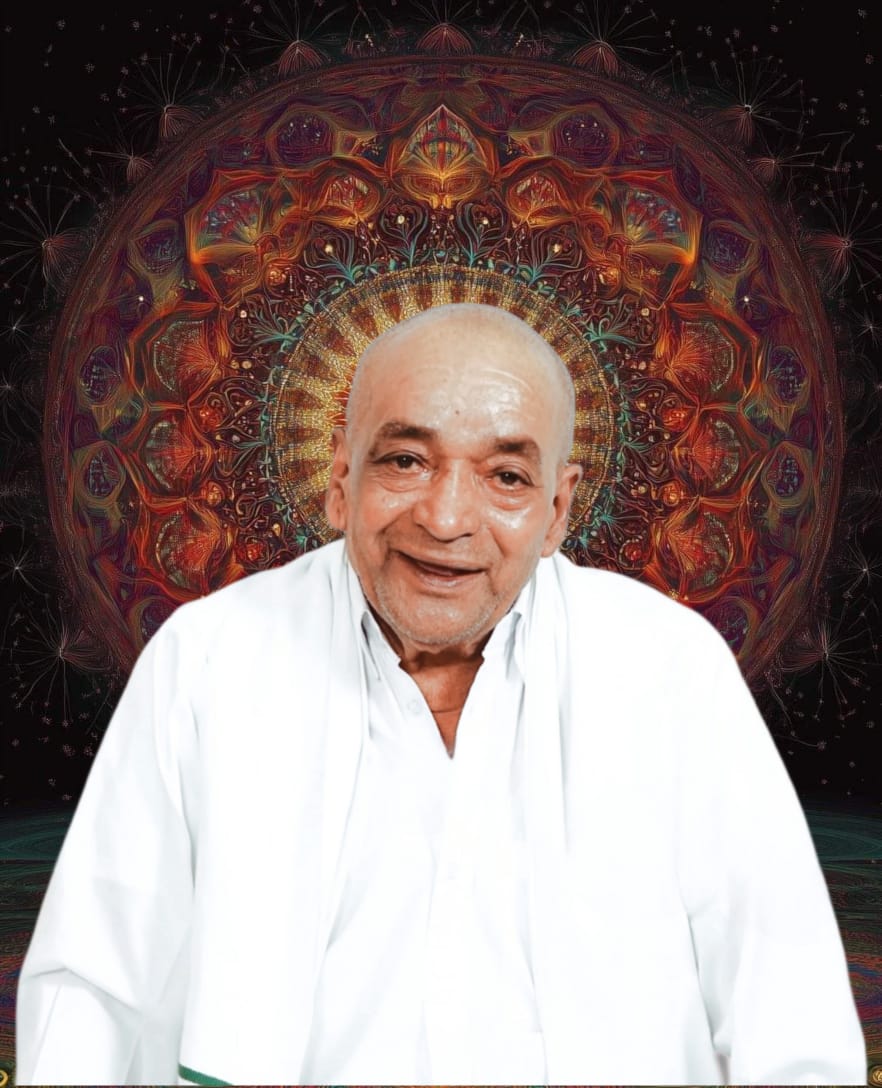
In the sacred geography of South India, Srikalahasti holds a distinctive place as one of the Pancha Bhoota Siva Kshetras, the five great Shaiva temples associated with the elemental principles of existence. Srikalahasti represents the Vayu (Air) Tattwa, and this symbolism offers a fitting interpretive frame for the life of Sadguru Subrahmanyam Garu, whose presence is remembered not as institutional power or public display, but as quiet movement, invisible influence, and inward transformation.
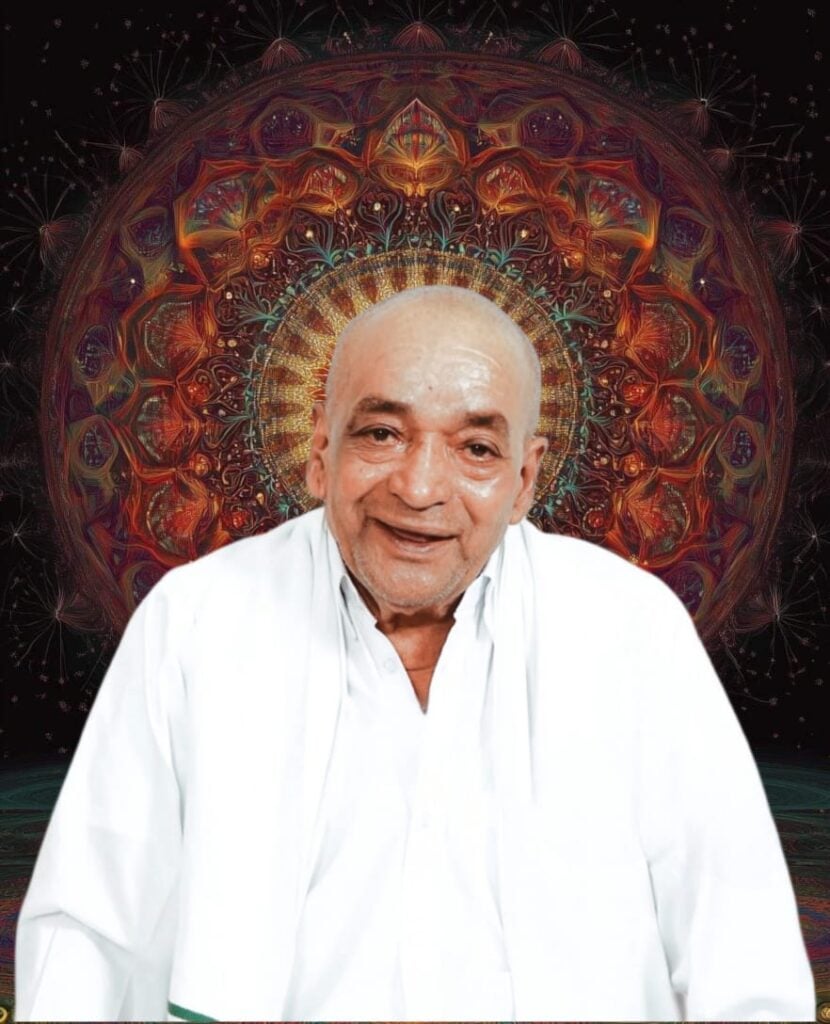
Sadguru Subrahmanyam Garu, with “Garu” used in Telugu as a respectful honorific, is described by devotees as a realized householder-saint of Srikalahasti. Outwardly, he appeared simple: a retired schoolteacher, a family man, and a gentle elder often seen sitting near his home. Yet those who came into his presence perceived an unusual stillness, the kind of peace associated in the Hindu spiritual tradition with a jnani, one established in direct knowledge of the Self.
His life is significant because it refuses the easy divide between household life and spiritual realization. In many Dharmic traditions, from Vedanta to Bhakti, the deepest question is not whether one has withdrawn from the world, but whether ego, attachment, and restlessness have loosened their hold. Sadguru Subrahmanyam Garu’s life becomes instructive precisely because it presents self-realization within ordinary circumstances: family responsibilities, teaching work, social obligations, grief, service, and silence.
Early Life and Formation
Subrahmanyam was born in Konathaneri in Chittoor district, Andhra Pradesh, into an agricultural family rooted in piety and simplicity. His parents, Sri Siddaiah and Smt. Vijayalakshmi, appear in the preserved accounts not as figures of wealth or social prominence, but as carriers of devotional culture. Such a background is important in understanding the moral and spiritual grammar of his life: restraint, reverence, humility, and faith were not adopted as abstractions but absorbed as lived values.
Much about his childhood remains undocumented, and this absence itself is meaningful. The lives of many saints of India are known less through formal biographies than through memory, oral testimony, and the devotional records of disciples. In the case of Sadguru Subrahmanyam Garu, the writings of Sri T.V.N. Babu provide the most important window into his personality, spiritual temperament, and teachings.
At the age of nineteen, Subrahmanyam married Smt. Padmavati, affectionately known as Vayyamma. Their family life was modest and blessed with three sons. He worked as a schoolteacher, a vocation that suited his disciplined and patient nature. Yet beyond his professional identity, he spent available hours in meditation, reflection, and the company of saints. This combination of teaching, contemplation, and domestic responsibility shaped the distinctive character of his later satsangs.
After the death of his father and the division of ancestral property, he moved with his family to Srikalahasti in 1975. This relocation became a decisive moment in his spiritual flowering. In that sacred town associated with Lord Shiva and the Vayu principle, his home gradually became a place where seekers gathered, listened, questioned, and absorbed the silence that later came to be associated with the Sri Ramana Satsangs.
The Bhagavad Gita’s ideal of the sthita-prajna, the one whose wisdom remains steady amid pleasure and pain, offers a useful framework for understanding his conduct. Accounts portray him as inwardly undisturbed by life’s fluctuations. This does not mean that he lived outside sorrow, hardship, or responsibility. Rather, it suggests that he met them from a center of inner clarity, without dramatizing the self or claiming special status.
The Discipline of Guru-Bhakti
A central feature of Sadguru Subrahmanyam Garu’s life was his obedience to his Guru, Tat Baba Garu, also remembered as Thatha Garu Swamy. Unlike seekers who follow a formal spiritual program of fixed practices, austerities, and initiatory stages, his path unfolded through radical trust. His Guru tested him through situations that often defied ordinary logic, social convention, and personal preference.
One frequently recounted episode concerns Tat Baba Garu sitting before temple deities, lighting a pipe of ganja, opening a book on Pothuluri Veerabrahmendra Swamy at random, and instructing Subrahmanyam to read aloud. The reading continued page after page and hour after hour. Subrahmanyam did not object, bargain, or complain. When he inwardly resolved to continue until instructed otherwise, Tat Baba Garu suddenly said, “Enough!” The incident is remembered by devotees as a sign of the Guru’s direct perception of the disciple’s inner state.
Such stories should be approached with care. In academic terms, they belong to the hagiographical and oral-devotional mode of Indian spiritual memory, where outer events are preserved not merely as chronology but as teaching-symbols. Their purpose is not spectacle. They reveal how patience, surrender, and trust were understood by the community around Sadguru Subrahmanyam Garu.
Even more striking is the account that Tat Baba Garu once bowed with folded hands before Subrahmanyam. Within the ordinary hierarchy of Guru and disciple, such a gesture would seem unusual. Yet in the non-dual traditions of Hindu spirituality, the realized Self is not bound by social rank. The incident is therefore remembered as a moment in which the Guru recognized the spiritual stature concealed beneath Subrahmanyam’s humility.
Sadguru Subrahmanyam Garu summarized this relationship simply: “I had full faith in my Guru. I abided by his word. Everything else happened on its own.” This statement is central to his spiritual psychology. It does not present realization as a personal achievement. It frames awakening as the fruit of grace, obedience, receptivity, and the mysterious working of the Guru-Shishya Tradition.
Mata Jillellamudi Amma, Anasuya Devi, expressed a related insight when she taught that a true Sadguru draws the disciple by his own power and that the search for a Guru is itself God’s doing. This understanding appears repeatedly across Dharmic traditions: the Guru is not merely a teacher of doctrines but a living bridge between the seeker’s confusion and the seeker’s own deepest reality.
Padmavatamma, the Silent Strength
No account of Sadguru Subrahmanyam Garu is complete without Padmavatamma, lovingly called Vayyamma. Her role demonstrates a profound but often underexamined dimension of Indian spiritual history: the quiet spiritual labor of women who sustain households, protect the conditions for sadhana, and serve without public recognition.
Padmavatamma managed family life with patience, grace, and cheerfulness, even under difficult circumstances. Devotees remember her not merely as the wife of a saint but as a disciple in spirit. She treated her husband with reverence while also supporting the unusual demands created by Tat Baba Garu’s presence and commands.
Some of those commands were difficult to understand at the ordinary level. Relatives might be sent away unexpectedly; stray dogs might be sheltered as divine guests. Padmavatamma accepted such events as Guru leela. Her response illustrates an important principle in Guru Seva: service is not always grand or visible. It is often expressed through endurance, hospitality, trust, and the willingness to bear discomfort without resentment.
On 14 January 1999, after years of service to her husband and his Guru, Padmavatamma passed away with “Om Siva” on her lips. Her body was laid to rest on the banks of the Swarnamukhi River, where a small Samadhi Mandir continues to be associated with daily worship. Sadguru Subrahmanyam Garu stated that her liberation came through lifelong Guru Seva, a teaching that honors service as a direct path to spiritual fulfillment.
Sri Veeraiah Garu and the First Turning Toward Grace
Two saints are especially important in the formation of Sadguru Subrahmanyam Garu: Sri Veeraiah Garu and Thatha Garu Swamy. Though Sadguru’s later teachings reflected non-duality, where the deepest distinction between Guru and disciple dissolves, his life also demonstrates the importance of embodied lineage, blessing, and reverence.
Sri Veeraiah Garu, his first spiritual guide, was connected to Sambhu Guru Swamy, who was a devotee of Easwaramma, the descendant of the great Siddha Pothuluri Veerabrahmendra Swamy. This lineage places Sadguru Subrahmanyam Garu within a broader South Indian spiritual world shaped by saints, samadhis, prophecy traditions, mantra, and direct transmission.
Veeraiah Garu, born into a cowherd background, spent much of his life near the Samadhi of Sambhu Guru Swamy. According to preserved accounts, he received a radiant vision of the saint and was initiated with a mantra. Thereafter, he became known for spiritual insight, healing, and the ability to perceive the future through divine grace.
One dramatic account narrates that skeptics mocked Veeraiah Garu for claiming the blessing of a Guru who had passed away centuries earlier. In response, Veeraiah entered the Samadhi, and Sambhu Guru Swamy is said to have appeared before the gathered villagers in living form. Whether read devotionally or symbolically, the episode communicates a central claim of Indian sacred biography: the Guru’s presence is not limited by physical death.
Veeraiah Garu was also Sadguru Subrahmanyam Garu’s brother-in-law, being Padmavatamma’s brother. Subrahmanyam recognized his greatness and surrendered to him. Veeraiah blessed him, saying, “You will have a son first; name him after our Guru.” In fulfillment of that blessing, Sadguru’s firstborn son was named Sambhu Prasad.
When Veeraiah Garu wished to offer Guru Dakshina, Sadguru humbly refused. Veeraiah instead assured him, “My blessings will always remain with you.” Sadguru later attributed much of his spiritual movement toward realization to Veeraiah’s grace. Veeraiah’s Samadhi at Surayapalem near the temple of Sri Umameswara Swamy in Nellore district remains a site of reverence for devotees.
Thatha Garu Swamy and the Freedom Beyond Convention
If Veeraiah Garu awakened longing and devotion, Thatha Garu Swamy intensified and refined Sadguru Subrahmanyam Garu’s inner life. Thatha Garu was an ascetic of Srikalahasti remembered for unpredictable conduct, fierce compassion, and freedom from convention. His life challenges superficial definitions of holiness that depend only on external austerity or social polish.
Thatha Garu revered his consort Nanamba, Lord Siva, Lord Subrahmanya, and the poet-saint Yogi Vemana. He is also said to have met Shirdi Sai Baba and described Baba as a Madhwa Brahmin. Such details reveal a devotional universe that was at once specific and expansive, anchored in Shaiva and Subrahmanya devotion while open to saints across regional and sampradaya boundaries.
His early life was marked by renunciation. After repeated tragedies in the family into which he was born, he was given as a baby to a mendicant. Before the mendicant’s death, the child received ochre robes with the words, “I have nothing else to offer you.” He wore them and did not return to conventional worldly life.
Accounts of Thatha Garu in advanced age are vivid: he walked briskly, smoked beedies, drank tea, and ate biryani once or twice a year. Such details are not incidental. They show that in the world of realized beings, renunciation cannot be reduced to outward gestures alone. The deeper renunciation is freedom from compulsion, possessiveness, ego, and the need to perform sanctity for others.
Under Thatha Garu’s guidance, Sadguru Subrahmanyam Garu undertook a ninety-day fast, walking barefoot in the heat without complaint. On the final day, he returned home physically weak and ended the penance with soaked rice grains. The austerity was not displayed as a public achievement. Its quiet completion reflects a larger pattern in his life: what mattered most was inner transformation, not social recognition.
Another incident reveals the boldness of his faith. Thatha Garu once wrote several mantras for curing ailments. Sadguru tore the paper. When asked why, he replied, “It doesn’t appeal to me. A person’s problems should be resolved just by uttering your name.” Moved by this trust, Thatha Garu blessed him: “Subrahmanyam, only those whose problems can truly be solved will come to you.”
Thatha Garu is said to have revealed that he had once been declared dead at thirty before reviving miraculously. When he passed away on 18 October 1990, devotees remembered his body as supple and radiant. In accordance with his wish, no Samadhi was built. His remains were cremated on the banks of the Swarnamukhi River, the same sacred river later associated with Padmavatamma’s Samadhi.
Sri T.V.N. Babu and the Preservation of Living Memory
The life and teachings of Sadguru Subrahmanyam Garu are known in large part through Sri T.V.N. Babu, his lifelong devotee and chronicler. Babu’s family lived near the Master’s home, and his father was a close friend of Sadguru. Babu first saw him in 1975, when he was about five years old, accompanying his classmate Krishna Prasad, Sadguru’s son.
Babu’s recollections are valuable because they preserve not only formal teachings but the atmosphere around the Master. He remembered Sadguru’s daily puja, which was performed not to conventional idols but to a few pictures, including one inscribed with “Nēnu”, meaning “I.” This word later became central to Parama Vedam, a teaching that points toward the supreme “I” consciousness at the heart of Advaita Vedānta and Atma Vichara.
Among the sacred objects was also Veeraiah Garu’s hand stick, revered as a relic. In devotional traditions, such objects are not treated as mere memorabilia. They function as tangible links to grace, memory, lineage, and the subtle continuity between Guru and disciple.
In Nenu – Satyam, Babu recounts several mystical episodes around Sadguru Subrahmanyam Garu, including flocks of pigeons descending near him and a goat, once offered to Allah, visiting him daily and gazing into his eyes. Such accounts, while unusual, are best understood within the larger Indian recognition that spiritual presence may be sensed not only by humans but by the wider field of life. This is consonant with the Dharmic view that consciousness is not an isolated human possession but the subtle ground of existence.
By 1988, Babu and his friend Devi Prasad began spending evenings with Sadguru, listening to his words and resting in his silence. Babu received initiation into the Maha Mantra and practiced it with devotion. These intimate meetings gradually became the Sri Ramana Satsangs, named in reverence to Sri Ramana Maharshi and the path of Atma Vichara, or self-enquiry.
The Sri Ramana Satsangs
The Sri Ramana Satsangs began as informal evening conversations and slowly drew more seekers. Their appeal did not lie in elaborate ritual, organizational authority, or philosophical display. Seekers came for clarity. They encountered a soft-spoken teacher whose words addressed life, ego, the mind, devotion, and the Self with luminous simplicity.
Sadguru Subrahmanyam Garu’s teaching was closely aligned with the insight that the search for God outside oneself can become a movement away from the truth that is already present within. His instruction may be summarized through one of his remembered teachings: “When you look for God outside, you move away from yourself. Turn within — you will find He was never elsewhere.”
This is not a rejection of temples, devotion, or sacred forms. In the wider Hindu philosophical context, it is a movement from outer support to inner recognition. The temple, mantra, Guru, and scripture prepare the mind; self-enquiry reveals the one who seeks. In this sense, Sadguru’s teaching preserved the unity of Bhakti and Jnana rather than opposing them.
The satsangs were first held near his home and later in a small room on Naikal Street. Those who attended often remembered the atmosphere as much as the spoken teaching. Silence, pauses, and simple observations carried transformative force. This recalls the teaching style associated with Sri Ramana Maharshi, where the highest instruction may occur in stillness rather than argument.
Sri T.V.N. Babu recorded these dialogues with care. His Telugu works, including Sri Ramana Satsangalu, Jnana Prasnalulu, Parama Vedam, and other texts, preserve Sadguru’s teachings for later generations. Babu referred to himself humbly as “Jnana Shishu,” the child of wisdom, acknowledging that his understanding flowed through Sadguru’s grace.
The Meaning of “Nēnu” and the Path of Self-Enquiry
The word “Nēnu”, meaning “I,” stands at the center of Sadguru Subrahmanyam Garu’s teaching as remembered by his devotees. In ordinary speech, “I” refers to personality, body, profession, memory, preference, and social identity. In Vedantic inquiry, however, the “I” is examined until the false identifications fall away and the Self shines as pure awareness.
This approach resonates with Sri Ramana Maharshi’s question “Who am I?” Yet it also emerges through Sadguru’s own experiential insight and local idiom. The value of such teaching lies in its directness. It does not ask the seeker to construct a new belief system. It asks the seeker to notice the root sense of identity and trace it inward.
Technically, this belongs to the Advaita Vedānta emphasis on the distinction between the transient and the real. Thoughts arise and pass. Emotions rise and dissolve. Roles change. The body ages. Yet the witnessing awareness in which these changes are known remains constant. Self-Realization is the recognition of this ever-present awareness as one’s true nature.
At the practical level, this teaching has immediate relevance. Much suffering begins when the mind clings to passing identities as absolute. Sadguru’s life and satsangs pointed seekers toward a more stable center. This was not escapism. It was a disciplined inwardness that enabled one to live in the world without being consumed by it.
Householder Realization and Dharmic Unity
Sadguru Subrahmanyam Garu’s example is especially important for contemporary seekers because it presents realization within the life of a householder. He did not found a large institution, pursue fame, or claim ownership over disciples. His life demonstrates that spiritual depth can mature in the midst of family, work, grief, social complexity, and everyday routine.
This insight supports a broader unity among Dharmic traditions. Hinduism, Buddhism, Jainism, and Sikhism all preserve, in distinct ways, the disciplines of self-knowledge, ethical restraint, compassion, service, meditation, and liberation from egoic bondage. Sadguru’s life belongs specifically to the Hindu and Advaitic stream, yet its central lessons are intelligible across the Dharmic family: humility is stronger than self-display, service purifies the heart, and inner awareness is the key to freedom.
His teaching “Be in the world, but let not the world be in you” captures this shared wisdom. It does not demand rejection of life. It demands freedom from inner enslavement. For householders, professionals, parents, students, and seekers, this teaching remains both practical and demanding. It asks for participation without possession, relationship without egoic control, and action without the loss of inward clarity.
The Legacy of Light in Srikalahasti
Sadguru Subrahmanyam Garu’s legacy continues through daily satsangs, readings from his books, meditation gatherings, and the living memory of devotees. His teaching combines the self-enquiry associated with Sri Ramana Maharshi, the Guru-bhakti transmitted through Veeraiah Garu and Thatha Garu Swamy, and the direct experiential clarity of his own realization.
For many seekers, the Sri Ramana Satsangs are not merely records of discourse. They are remembered as a living vibration, an invitation to turn inward and discover the same stillness that radiated through the Master of Srikalahasti. Such remembrance is not nostalgia. It is a mode of practice, because the mind returns again and again to the question at the heart of all sadhana: what is the Self that remains unchanged through every experience?
One devotee’s reflection summarizes the essence of his life: “He did not teach us how to reach God — he made us aware that we already are That.” This statement captures the highest movement of Advaita without diminishing devotion. God is not reduced; the seeker is awakened to the divine ground already present as consciousness.
Beneath the quiet skies of Srikalahasti, Sadguru Subrahmanyam Garu’s life continues to speak through silence, humility, Guru Seva, and Self-Realization. His example shows that the Supreme Self is not reached by spectacle, argument, or spiritual ambition. It is recognized when the restless “I” becomes transparent to the luminous “Nēnu”, the ever-present awareness that neither comes nor goes.
Inspired by this post on Indica Today.


Leave a Reply
You must be logged in to post a comment.