
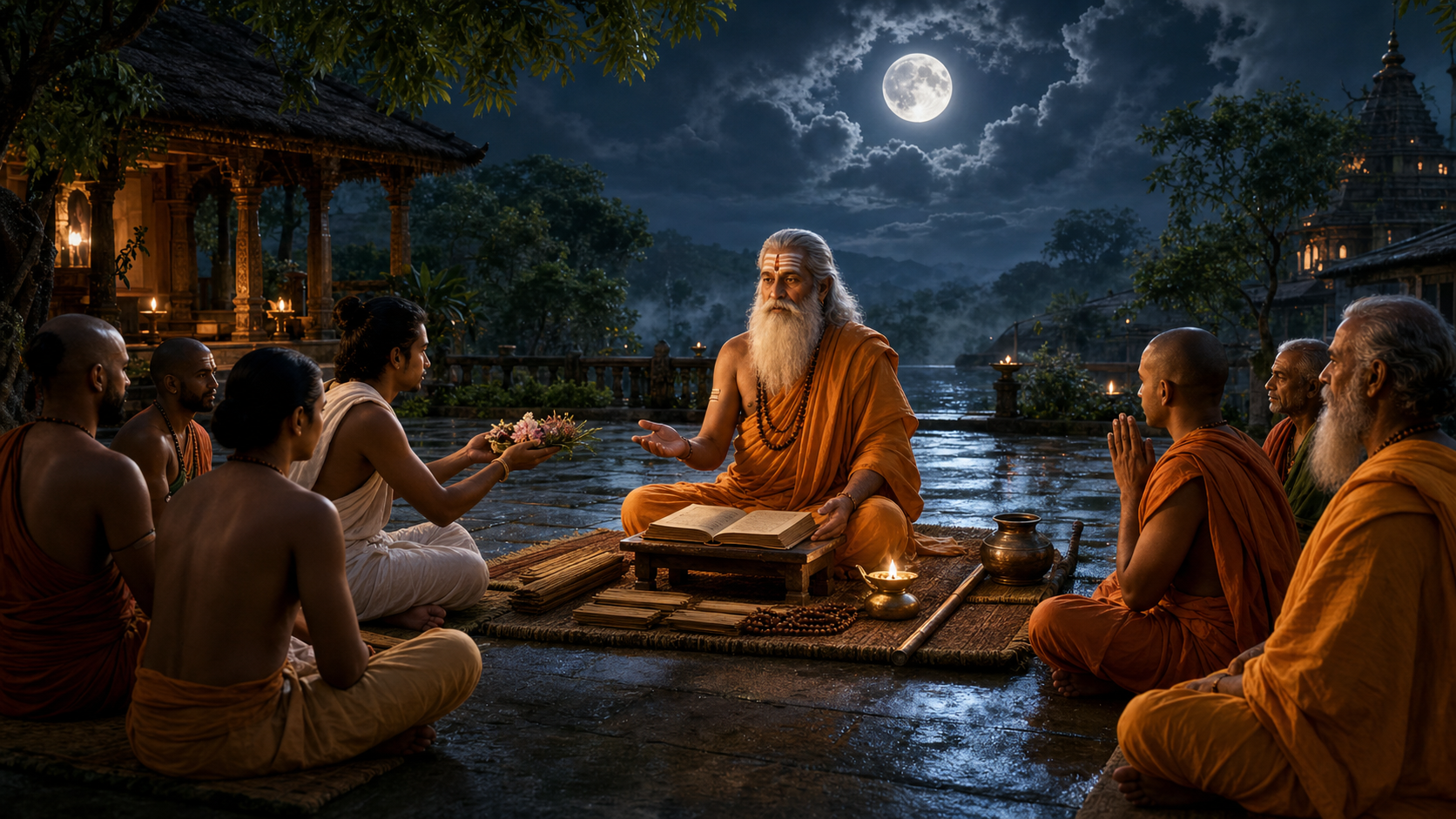
Ashada Purnima occupies a deeply respected place in the Hindu calendar because it brings together three major spiritual themes: reverence for the guru, gratitude to Maharishi Veda Vyasa, and the disciplined beginning of Chaturmasya for many Hindu sannyasis and yatis. Falling on the full moon day of the month of Ashada, usually in June or July, this sacred observance is also widely known as Guru Purnima and Vyasa Purnima. Its importance is not limited to ritual celebration. It marks a shift in the rhythm of spiritual life, especially for renunciates who treat this day as the threshold of a more inward, settled, and scripture-centered phase of the year.
For Hindu sannyasis, Ashada Purnima is not merely a festival date. It is a moment of spiritual accounting. The wandering monk, who may spend much of the year moving from village to village, tirtha to tirtha, and community to community, traditionally pauses at the onset of the monsoon. This pause is not a retreat from responsibility but a refinement of it. The discipline of staying in one place during Chaturmasya protects small forms of life that emerge during the rainy season, encourages sustained study, and creates a stable opportunity for householders and renunciates to interact through teaching, seva, satsanga, and dharmic reflection.
The word Ashada refers to the lunar month that precedes the full force of the monsoon across much of Bharat. Purnima means the full moon, a time traditionally associated with fullness, illumination, and completion. In this context, the moon becomes more than an astronomical marker. It symbolizes the fullness of knowledge received through parampara, the lineage of teachers who transmit not only information but a way of seeing reality. The day therefore becomes especially meaningful in traditions where learning is understood as sacred, disciplined, and transformative.
The association of Ashada Purnima with Guru Purnima rests on the centrality of the guru-shishya tradition in Hindu Dharma. A guru is not simply an instructor in the modern academic sense. The guru is a guide who helps the disciple move from confusion to clarity, from spiritual restlessness to steadiness, and from borrowed belief to lived insight. In the life of a sannyasi, this relationship is foundational. Renunciation is not sustained by outer symbols alone, such as ochre robes, danda, kamandalu, or a monastic name. It is sustained by obedience to discipline, fidelity to teachings, and a continuous return to the wisdom received from the guru.
Ashada Purnima is also called Vyasa Purnima because it honors Bhagavan Veda Vyasa, the great sage traditionally credited with arranging the Vedas, composing or compiling the Mahabharata, authoring the Brahma Sutras, and preserving Puranic knowledge for future generations. Whether approached through devotion, traditional history, or philosophical reverence, Veda Vyasa stands as a symbol of scriptural organization and intellectual compassion. He represents the effort to make vast spiritual knowledge accessible across generations. For sannyasis, who live by the study and teaching of Vedanta, Yoga, Dharma Shastra, Itihasa, and Purana, Vyasa Purnima is a day of profound gratitude to the source of the textual civilization they inherit.
The significance of Veda Vyasa becomes clearer when the technical structure of Hindu learning is considered. The Vedas preserve mantra and ritual knowledge. The Upanishads probe the nature of Brahman, Atman, consciousness, and liberation. The Brahma Sutras systematize Vedantic inquiry. The Mahabharata, including the Bhagavad Gita, places dharma within the complexity of human life, politics, grief, duty, and moral uncertainty. A sannyasi engaged in serious study does not treat these as separate fragments. They form an integrated universe of spiritual reasoning, practice, and realization. Ashada Purnima honors the sage who made that universe intelligible.
Chaturmasya, literally the four-month sacred period, is closely linked with Ashada Purnima in many monastic lineages. The exact starting point may vary by sampradaya and regional tradition. Some begin Chaturmasya from Ashada Purnima, while others observe it from Ashadha Shukla Ekadashi or another related tithi. This variation is not a contradiction but a reflection of the diversity within Sanatana Dharma. The larger principle remains consistent: the rainy season is used for restraint, study, worship, teaching, and deepening of sadhana.
For sannyasis and yatis, the beginning of Chaturmasya has practical, ecological, and spiritual dimensions. Practically, heavy rains historically made travel difficult. Ecologically, the monsoon brings forth insects, seedlings, and delicate life forms that could be harmed by constant movement. Spiritually, the restriction on travel turns the mind away from external motion and toward inner steadiness. The sannyasi accepts limitation as a form of freedom. By reducing movement, speech, food variety, and external engagements, the renunciate creates conditions for sharper awareness and deeper contemplation.
This discipline reveals an important principle shared across dharmic traditions, including Hinduism, Jainism, Buddhism, and Sikhism: spiritual maturity requires mindful restraint. Jain monks observe rainy-season discipline with exceptional care for non-violence. Buddhist monastic traditions preserve the vassa, or rains retreat, as a time of settled practice. Hindu sannyasis observe Chaturmasya as a period of intensified scriptural study, tapas, and teaching. Sikh tradition, while not monastic in the same manner, places strong emphasis on the Guru, seva, sangat, and disciplined remembrance of the Divine. Ashada Purnima can therefore be understood as part of a wider dharmic respect for learning, humility, restraint, and reverence.
The guru is central to this day because knowledge in Hindu spirituality is not viewed as a commodity. It is a sacred transmission that must purify the mind and transform conduct. A disciple may read many texts, but without humility and guidance, learning can easily become intellectual pride. Guru Purnima corrects this tendency by placing gratitude before scholarship. The sannyasi bows not only to an individual teacher but to the living current of parampara. This bow is a philosophical act. It acknowledges that the individual mind is not self-sufficient and that liberation requires guidance from those established in truth.
In Advaita Vedanta, the guru helps the student understand the mahavakyas and the identity of Atman and Brahman. In Vishishtadvaita and Dvaita traditions, the guru opens the path of devotion, surrender, and service to the Supreme. In Shaiva, Shakta, Smarta, Vaishnava, and other Hindu sampradayas, the guru may guide the disciple through mantra diksha, ritual discipline, meditation, scripture, or devotional practice. Ashada Purnima does not flatten these differences. It honors them as legitimate paths within the broad spiritual architecture of Hindu Dharma.
The observance of Ashada Purnima among sannyasis often includes Guru Puja, Vyasa Puja, recitation of sacred texts, discourses, vows for Chaturmasya, and renewed commitment to personal discipline. In some mathas and ashrams, the seat of Vyasa is symbolically worshipped before teaching begins. This is significant. The teacher does not claim independent ownership of knowledge. The act of worshipping Vyasa before giving discourse reminds both teacher and listener that authentic teaching belongs to a lineage larger than personality, charisma, or institutional authority.
The Chaturmasya vrata may include restrictions on particular foods, increased japa, additional study, silence for certain periods, reduced travel, and greater attention to puja and meditation. The details vary among sampradayas. Some observe dietary rules month by month, avoiding leafy vegetables, curd, milk, or certain pulses according to traditional prescriptions. Others emphasize scriptural discourse and community instruction. The essence is not austerity for display. The purpose is to discipline desire, simplify life, and give the mind fewer excuses to remain scattered.
For householders, Ashada Purnima provides an opportunity to reconnect with the deeper purpose of religious life. Many people approach the day by offering respects to teachers, visiting temples or ashrams, listening to spiritual discourses, reading the Bhagavad Gita or other sacred texts, and reflecting on the role of guidance in their lives. The emotional power of the day lies in its simplicity. Almost everyone has received knowledge from someone: a parent, grandparent, acharya, school teacher, music guru, yoga teacher, spiritual mentor, or quiet elder whose conduct became instruction. Guru Purnima gives that gratitude a sacred form.
The first-person emotional tone often associated with spiritual writing can be expressed here through shared human experience rather than personal narration. Many seekers recognize that the most important lessons in life are not always received in moments of comfort. A guru may correct, challenge, question, or refuse to flatter the ego. Such guidance can feel difficult at first, but it often becomes meaningful later, when the disciple sees that discipline was a form of compassion. Ashada Purnima therefore carries both tenderness and seriousness: tenderness in gratitude, seriousness in responsibility.
The importance of Ashada Purnima to Hindu sannyasis also rests on the relationship between renunciation and society. A sannyasi renounces personal ambition, family identity, property, and ordinary social roles, yet does not necessarily renounce concern for the welfare of society. During Chaturmasya, when sannyasis remain in one place, communities receive sustained access to teaching. This creates a bridge between the ascetic and the householder. The monk receives support in the form of bhiksha and hospitality, while society receives instruction in dharma, self-control, devotion, and spiritual discrimination.
This mutual relationship is one of the strengths of Hindu civilization. The sannyasi is not merely an isolated mystic, and the householder is not merely a material supporter. Both are participants in a larger dharmic ecosystem. The householder sustains the visible institutions of family, economy, temple, and community. The renunciate sustains the memory of the ultimate goal, moksha. Ashada Purnima reminds society that prosperity without wisdom becomes restless, and renunciation without compassion becomes incomplete.
From a philosophical standpoint, the full moon of Ashada is also a fitting symbol for the guru principle. The moon does not generate light independently; it reflects the light of the sun. Similarly, the guru reflects the light of truth, scripture, realization, and divine grace. The disciple, in turn, becomes capable of reflecting that light through conduct. This is why Guru Purnima is not limited to praise. It asks a practical question: has the teaching become visible in life? Has anger reduced? Has greed softened? Has speech become more truthful? Has devotion deepened? Has knowledge produced humility?
Ashada Purnima also brings attention to the discipline of time in the Hindu calendar. The Hindu calendar is not merely a way of counting days. It maps human life onto cosmic rhythm through tithi, nakshatra, paksha, masa, and seasonal transition. Ashada Purnima appears at a moment when the outer world is changing: heat gives way to rain, travel slows, the earth becomes fertile, and life becomes more inward. The sannyasi reads this transition as instruction. Nature itself becomes a teacher, showing that renewal often begins with stillness.
The academic study of Ashada Purnima should therefore avoid reducing it to folklore or sentiment. It is a layered institution of religious time, monastic discipline, ecological sensitivity, scriptural gratitude, and social education. Its endurance across centuries suggests that it answers a recurring human need: the need to pause, remember one’s sources, simplify one’s habits, and return to disciplined practice. For sannyasis, this return is formal and rigorous. For householders, it can be adapted through study, prayer, ethical restraint, charity, and respect for teachers.
The connection with Maharishi Veda Vyasa also helps explain why learning is not treated as separate from liberation. Vyasa is revered not merely as a compiler but as a compassionate organizer of knowledge for the benefit of humanity. The Mahabharata famously presents dharma as subtle, contextual, and demanding. This is especially relevant to sannyasis, whose life depends on viveka, the capacity to discriminate between the eternal and the temporary. Guru Purnima renews that commitment to viveka. Without it, renunciation can become external. With it, even silence becomes teaching.
In many Hindu institutions, Ashada Purnima is also the day when disciples offer Guru Dakshina. Traditionally, Guru Dakshina is not a commercial payment but an offering of gratitude. It may take the form of service, support for the ashram, commitment to practice, or moral transformation. The highest offering is not material. It is the sincere effort to live the teaching. For a sannyasi, the offering may be renewed obedience to the vows of sannyasa. For a householder, it may be a commitment to truthfulness, self-restraint, study, and compassionate action.
The day’s importance also lies in its capacity to correct modern misunderstandings about the guru tradition. Genuine guru bhakti is not blind personality worship. Classical Hindu thought repeatedly emphasizes examination, discipline, scriptural grounding, and ethical conduct. A true guru guides the disciple toward freedom, not dependency. A true disciple cultivates humility without surrendering discrimination. Ashada Purnima, properly understood, honors this refined relationship. It is reverence joined with responsibility.
The unity of dharmic traditions becomes especially visible through this emphasis on disciplined guidance. Hinduism honors the guru as spiritual preceptor. Buddhism preserves deep respect for the Buddha, Dharma, Sangha, and lineage teachers. Jainism reveres the Tirthankaras, acharyas, upadhyayas, and sadhus who embody restraint and right knowledge. Sikhism places the Guru at the center of spiritual life, culminating in reverence for Guru Granth Sahib as the living Guru. These traditions differ in metaphysics and practice, yet they share a civilizational insight: human beings require guidance to overcome ignorance, ego, and moral confusion.
For this reason, Ashada Purnima should be seen not only as a Hindu festival but as a reminder of a broader dharmic ethic. It teaches that knowledge must be honored, teachers must be respected, discipline must be renewed, and spiritual life must be protected from superficiality. In an age of quick opinions and fragmented attention, the sannyasi’s Chaturmasya discipline has renewed relevance. It invites society to ask whether constant movement, consumption, and distraction have weakened the capacity for contemplation.
The emotional resonance of Ashada Purnima often comes from memory. Families remember teachers who shaped their values. Students remember a mantra, a correction, a blessing, or a sentence that altered the direction of life. Devotees remember darshan of a saint or the quiet stability of an elder. Monastics remember the day they received diksha, the discipline of their guru, and the obligations of the ochre robe. These memories are not private nostalgia alone. They become part of a living tradition when expressed through gratitude and ethical conduct.
Technically, the observance of Ashada Purnima also illustrates the integration of karma, bhakti, jnana, and yoga. Karma appears in service and disciplined action. Bhakti appears in devotion to the guru, Bhagavan, and sacred lineage. Jnana appears in scriptural study and inquiry into the Self. Yoga appears in restraint, meditation, breath discipline, and control of the senses. The sannyasi’s life ideally integrates all these dimensions. Chaturmasya intensifies that integration by removing unnecessary dispersion.
Ashada Purnima is therefore not a single-day observance that ends with ritual. It opens a season. The four months that follow are meant to test whether reverence can become practice. The full moon may inspire devotion, but Chaturmasya demands continuity. This continuity is central to sadhana. A single emotional experience, however powerful, does not transform the mind unless it is followed by repetition, discipline, and reflection. The sannyasi understands this clearly, and the householder can learn from it without abandoning worldly duties.
In contemporary life, the lessons of Ashada Purnima can be applied with care. One may choose a text for sustained study during the Chaturmasya period, such as the Bhagavad Gita, Upanishads, Yoga Sutras, or a work from one’s sampradaya. One may reduce unnecessary consumption, simplify food habits, increase japa, attend satsanga, support dharmic institutions, or reconnect with teachers. The point is not to imitate monastic life superficially. The point is to bring some measure of monastic seriousness into ordinary life.
For Hindu sannyasis, Ashada Purnima remains especially sacred because it renews the very foundation of renunciation. It recalls the guru who gave direction, the parampara that preserved knowledge, the sage Vyasa who organized sacred learning, and the Chaturmasya discipline that turns movement into stillness. Its power lies in this convergence. It is a day of gratitude, a vow of restraint, a celebration of knowledge, and a reminder that true freedom is not found in restless choice but in disciplined alignment with truth.
Ultimately, Ashada Purnima teaches that spiritual civilization survives through memory, discipline, and transmission. Sannyasis embody this teaching in a visible and demanding form, but the message belongs to all seekers. To honor the guru is to honor the possibility of transformation. To honor Veda Vyasa is to honor the preservation of wisdom. To begin Chaturmasya is to accept that stillness can be more powerful than movement. In that sense, Ashada Purnima continues to illuminate Hindu spirituality with a fullness worthy of the sacred moon under which it is observed.
Inspired by this post on Hindu Blog.





Leave a Reply
You must be logged in to post a comment.