
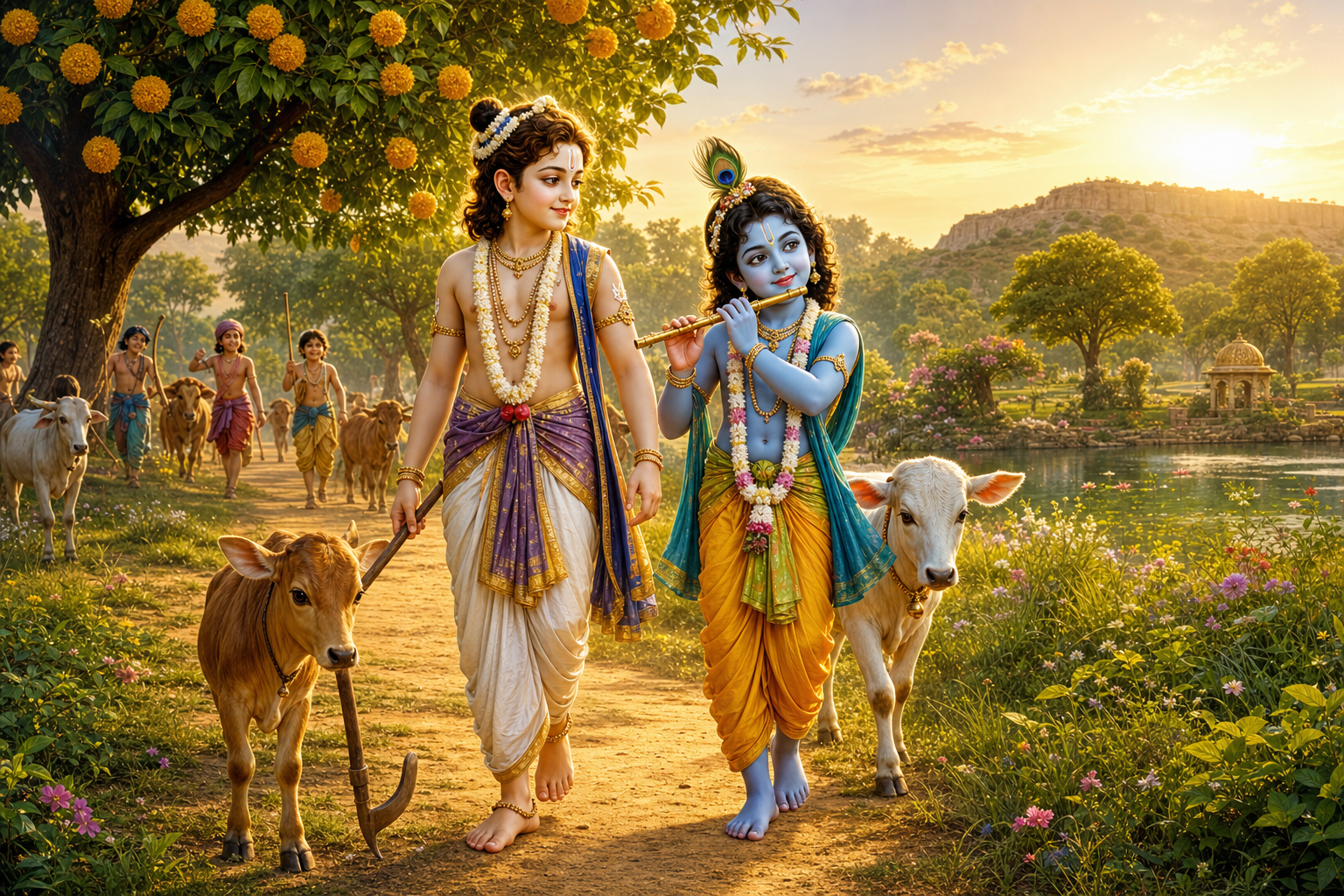
In the sacred geography of Braj, devotion is rarely abstract. It is remembered through places, gestures, names, stories, songs, trees, ponds, shrines, and the emotional language of relationships. Among these intimate forms of remembrance, Luk Luk Dauji occupies a deeply affectionate place because it presents Balarama not merely as a powerful divine figure, but as the elder brother whose attention never wanders away from Krishna. The name evokes a simple yet profound image: Dauji looking again and again, watching, protecting, and delighting in the presence of his younger brother.
The expression Dauji itself carries cultural warmth. In the Braj region, Balarama is widely addressed as Dauji, a familiar and reverential form meaning elder brother. This is not a distant theological title; it is a household word, shaped by affection. It suggests nearness, responsibility, seniority, playfulness, and belonging. Through this name, Balarama enters the devotional imagination as the one who stands beside Krishna in the fields of Vraja, joins him in childhood sports, shares his pastoral world, and guards him with the natural vigilance of an elder sibling.
Luk Luk Dauji may be understood through this emotional grammar of Braj Bhakti. The phrase points toward Dauji’s repeated, loving gaze upon Krishna. It is not a surveillance born of anxiety, but a devotional watchfulness born of love. In ordinary human experience, an elder sibling often keeps glancing toward a younger child during play, not to restrict freedom, but to ensure safety. Braj transforms that familiar family gesture into sacred theology. The divine elder brother watches Krishna because love itself has become attentive.
Balarama’s role in Krishna tradition is vast and layered. In Vaishnava understanding, he is Krishna’s elder brother, companion, protector, and expansion of divine strength. The Srimad Bhagavatham, Harivamsa traditions, and later devotional literature remember him in connection with Krishna’s childhood, pastoral sports, protection of the cowherd community, and the joyful life of Vrindavan. His identity is not limited to physical power, though strength is central to him. He represents steadiness, support, fraternal loyalty, dharmic protection, and the sacred bond that holds divine play within a framework of care.
Theologically, Balarama is often associated with Sankarshana, the principle of divine support and spiritual strength. In many Vaishnava traditions, he is understood as the source of service to Krishna and as the foundation upon which the Lord’s pastimes unfold. This makes the image of Luk Luk Dauji especially meaningful. His gaze is not passive. It is a form of seva. To look upon Krishna with love, to remain alert to his movements, and to be present in his childhood world is itself a sacred act.
In Braj, theology is frequently communicated through rasa, the refined experience of sacred emotion. The relationship between Balarama and Krishna belongs especially to the emotional world of family affection and companionship. Their bond includes brotherhood, friendship, shared adventure, laughter, protection, and pastoral simplicity. When devotees remember Luk Luk Dauji, they are not only recalling an image or local tradition; they are entering a devotional mood in which divine love appears through ordinary relational tenderness.
This is one reason the story resonates so strongly with devotees. The human heart understands the language of a protective elder brother. It understands the instinct to look back, to check whether the beloved is near, to feel uneasy when the loved one is out of sight, and to feel joy when the beloved is seen again. Luk Luk Dauji gives sacred dignity to that instinct. It teaches that watchfulness can be an expression of love when it is free from possession and rooted in service.
The sacred land of Braj provides the ideal setting for this memory. Braj is not merely a geographical region around Mathura, Vrindavan, Govardhan, Gokul, Nandgaon, Barsana, and surrounding villages. For devotees, it is a living landscape of Krishna’s childhood and youth. Every grove, pathway, pond, and pasture may be associated with a lila, a divine episode. In such a world, even a glance can become sacred. Dauji’s repeated looking toward Krishna becomes part of the living archive of Braj.
The phrase Luk Luk also carries a suggestive sound. It resembles the rhythm of repeated looking, peeking, or glancing. Whether preserved in oral memory, temple tradition, or regional devotional usage, it has the intimacy of spoken Braj culture. Such phrases are important because they preserve theology in a form that ordinary devotees can feel immediately. One does not need a formal philosophical vocabulary to understand Dauji’s love. The name itself carries the meaning.
Balarama’s protective role appears repeatedly in Krishna narratives. He accompanies Krishna in the cowherd fields, joins him in play with the gopas, and stands as a force of courage during moments of danger. The child Krishna may be the Supreme Lord in theological terms, yet the sweetness of Braj lies in the way the divine allows himself to be loved, protected, fed, scolded, dressed, awakened, and watched over. Balarama’s elder-brother affection participates in this mystery. His care does not reduce Krishna’s divinity; it reveals the fullness of divine intimacy.
In this sense, Luk Luk Dauji is also an important corrective to overly abstract readings of Hindu spirituality. Sanatana Dharma includes high metaphysics, Vedanta, yoga, ritual theory, and subtle philosophy, but it also honors the sacredness of relationship. The divine is not only contemplated as Brahman or worshipped as cosmic ruler; the divine is also loved as child, friend, brother, mother, beloved, and guide. Balarama’s watchful gaze belongs to this relational theology, where love becomes a valid path of knowledge.
The image also illuminates the concept of darshan. In Hindu temple culture, darshan is not simply seeing an image. It is a reciprocal encounter in which the devotee sees and is seen by the divine. Luk Luk Dauji deepens this idea by placing the act of seeing within divine relationship itself. Dauji looks toward Krishna, and devotees look toward Dauji looking toward Krishna. The gaze becomes layered: Krishna is the focus of love, Balarama is the exemplar of loving attention, and the devotee learns how to see with reverence.
The elder-brother symbolism is especially significant in dharmic ethics. An elder sibling in traditional Indian family life is expected to guide without arrogance, protect without harshness, and participate in responsibility without losing affection. Dauji embodies the ideal form of that role. His strength is not domination; it is support. His seniority is not separation; it is service. His vigilance is not control; it is loving presence. This makes Luk Luk Dauji an enduring model for family relationships and community life.
From a cultural perspective, the devotion to Dauji demonstrates how local Hindu traditions preserve fine emotional distinctions. A single deity may be worshipped as cosmic, heroic, pastoral, familial, or philosophical depending on region and sampradaya. In Braj, Balarama is not remembered only through grand narratives of strength, such as his plough, mace, and heroic force. He is also remembered through the smaller tenderness of his attention. This balance between power and affection is one of the reasons Balarama remains so beloved.
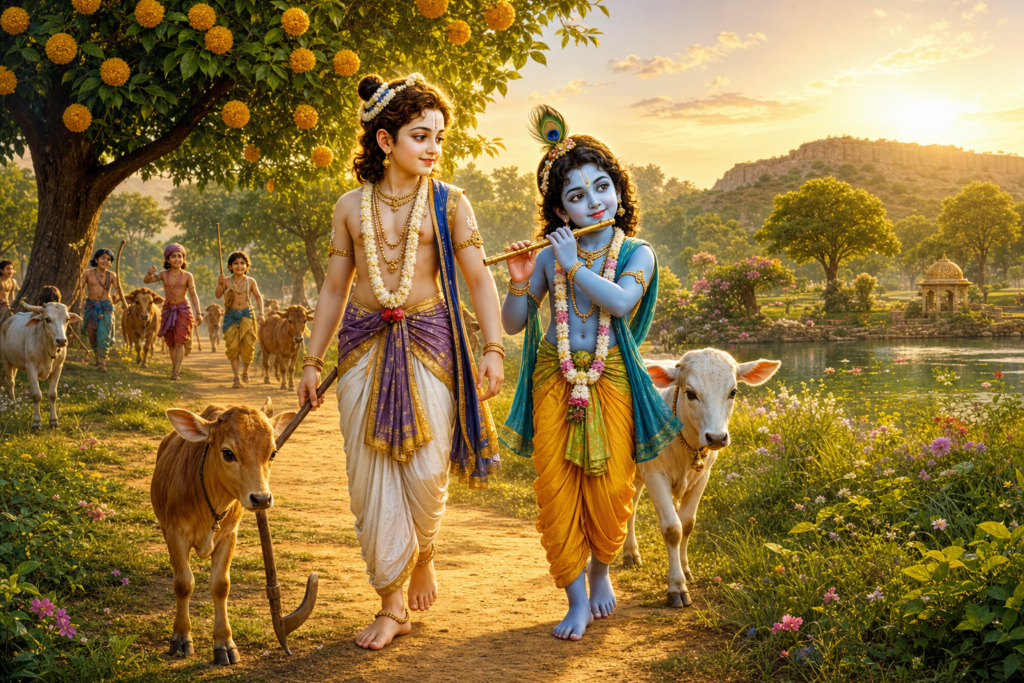
The plough associated with Balarama also enriches the meaning of Dauji in Braj. The plough links him to agriculture, earth, fertility, and the settled life of pastoral communities. Krishna’s flute calls the heart toward divine beauty, while Balarama’s plough suggests grounding, nourishment, and strength. Together, the brothers represent complementary dimensions of sacred life: sweetness and stability, play and protection, beauty and discipline, rasa and dharma.
In many devotional traditions, Krishna’s lila is understood as spontaneous, playful, and overflowing with sweetness. Yet that play unfolds within a world held together by relationships. Yashoda’s maternal care, Nanda’s fatherly responsibility, Radha’s devotion, the gopas’ friendship, the gopis’ love, the cows’ affection, and Balarama’s elder-brother guardianship all form the emotional ecology of Braj. Luk Luk Dauji belongs to this ecology. It shows that divine play is not isolated from care; it is surrounded by it.
The story also has a subtle psychological depth. Love often expresses itself through attention. What the heart values, the eyes seek. In spiritual practice, scattered attention is one of the great obstacles. The mind looks everywhere and settles nowhere. Dauji’s gaze offers a devotional lesson: the heart becomes steady when its attention rests lovingly upon the divine. Luk Luk Dauji is therefore not only a charming image from Braj; it can also be read as a discipline of remembrance.
This discipline is close to the bhakti practice of smarana, remembrance. Devotees remember Krishna’s names, forms, qualities, and pastimes. Balarama’s repeated looking becomes a model for repeated remembrance. Just as Dauji does not let Krishna disappear from his sight, the practitioner tries not to let Krishna disappear from consciousness. The form is affectionate, but the spiritual principle is rigorous: love matures through sustained attention.
At the same time, the tradition should not be reduced to psychology alone. For devotees, Krishna and Balarama are living divine realities, not merely symbols. Academic interpretation can clarify themes, but Braj Bhakti is ultimately rooted in lived devotion. Pilgrims do not approach Dauji only as an idea. They approach him as a presence, as the elder brother of Krishna, as the strong and tender protector whose nearness sanctifies the landscape.
The emotional force of Luk Luk Dauji becomes clearer when placed beside Krishna’s childhood vulnerability in Braj narratives. The child Krishna crawls, plays, steals butter, wanders with calves, enters forests, confronts danger, and enchants everyone around him. To the devotees of Braj, his divinity is hidden within sweetness. Balarama, as elder brother, participates in the same world but with a slightly different emotional position. He plays, laughs, and joins Krishna, yet he also watches. He is inside the play and also attentive to it.
This combination of participation and protection is spiritually powerful. It suggests that true guardianship does not require distance from joy. Dauji does not stand outside Krishna’s childhood as a stern sentinel. He shares the games, fields, meals, and friendships. His protection arises from belonging. In human terms, this is a profound model: the most meaningful forms of care often come from those who share life closely, not from those who supervise from afar.
The devotional memory of Dauji also supports the broader unity of dharmic traditions. Hinduism, Buddhism, Jainism, and Sikhism each preserve distinctive teachings, yet all honor disciplined attention, compassion, ethical responsibility, and the refinement of consciousness. Luk Luk Dauji belongs specifically to Krishna Bhakti and Vaishnava tradition, but its moral insight is widely intelligible across dharmic life: love is not careless, strength should serve tenderness, and spiritual attention transforms ordinary perception into reverence.
Within Hinduism itself, Balarama’s presence also bridges multiple modes of reverence. He is honored in Vaishnava theology, celebrated in Krishna lila, remembered in rural and agricultural symbolism, and loved in the intimate devotional culture of Braj. His figure demonstrates that Hindu traditions need not be flattened into a single interpretive scheme. The same sacred personality can be approached through scripture, temple worship, regional memory, philosophical reflection, and emotional devotion.
The title Luk Luk Dauji therefore preserves more than a charming local sentiment. It preserves a complete theology of sight, service, and sibling affection. It teaches that Balarama’s greatness is not only in his strength but in the direction of his strength. His power is oriented toward Krishna. His attention is absorbed in Krishna. His love is visible through watchfulness. This is why the image remains spiritually compelling even when explained in simple language.
For pilgrims and readers encountering this tradition, the most accessible entry point is the tenderness of the scene. One can imagine the young brothers in the dust of Braj, surrounded by cowherd boys, calves, groves, and the music of village life. Krishna moves with playful freedom, and Dauji keeps looking toward him. The gesture is quiet, but it holds a universe of meaning. It is affection, protection, recognition, and worship in one act.
The sacredness of Braj often lies precisely in such small gestures. A footprint, a flute note, a butter pot, a forest path, a glance, or a call of the name can become a doorway into the divine. Luk Luk Dauji belongs to this devotional world where nothing touched by Krishna remains ordinary. Even the elder brother’s glance becomes a pilgrimage of the heart.
In contemporary life, the image has renewed relevance. Modern relationships often suffer from distraction, hurriedness, and emotional absence. Luk Luk Dauji offers a different model of presence. It suggests that to love is to notice, to remain available, to protect without suffocating, and to keep the beloved within the field of care. In spiritual terms, it also suggests that devotion requires disciplined attention, not occasional sentiment alone.
This does not mean that Dauji’s love should be sentimentalized or detached from scripture and tradition. Balarama is a major theological figure, deeply embedded in Vaishnava thought and Krishna narratives. Yet the greatness of the tradition lies in its ability to hold theology and tenderness together. The same Balarama who represents divine strength can also be remembered as the elder brother who keeps glancing toward Krishna with affection. The cosmic and the domestic are not opposed in Braj; they illuminate each other.
Luk Luk Dauji ultimately invites a refined way of seeing. It asks the devotee to recognize that sacred love is attentive, that divine strength is protective, and that the simplest family bond can become a profound spiritual teaching. In the watchful eyes of Dauji, Braj remembers the beauty of elder-brother devotion. In Krishna, Dauji sees the center of his love. In Dauji, devotees see how love itself learns to keep Krishna always in sight.
Inspired by this post on Hindu Blog.







Leave a Reply
You must be logged in to post a comment.