
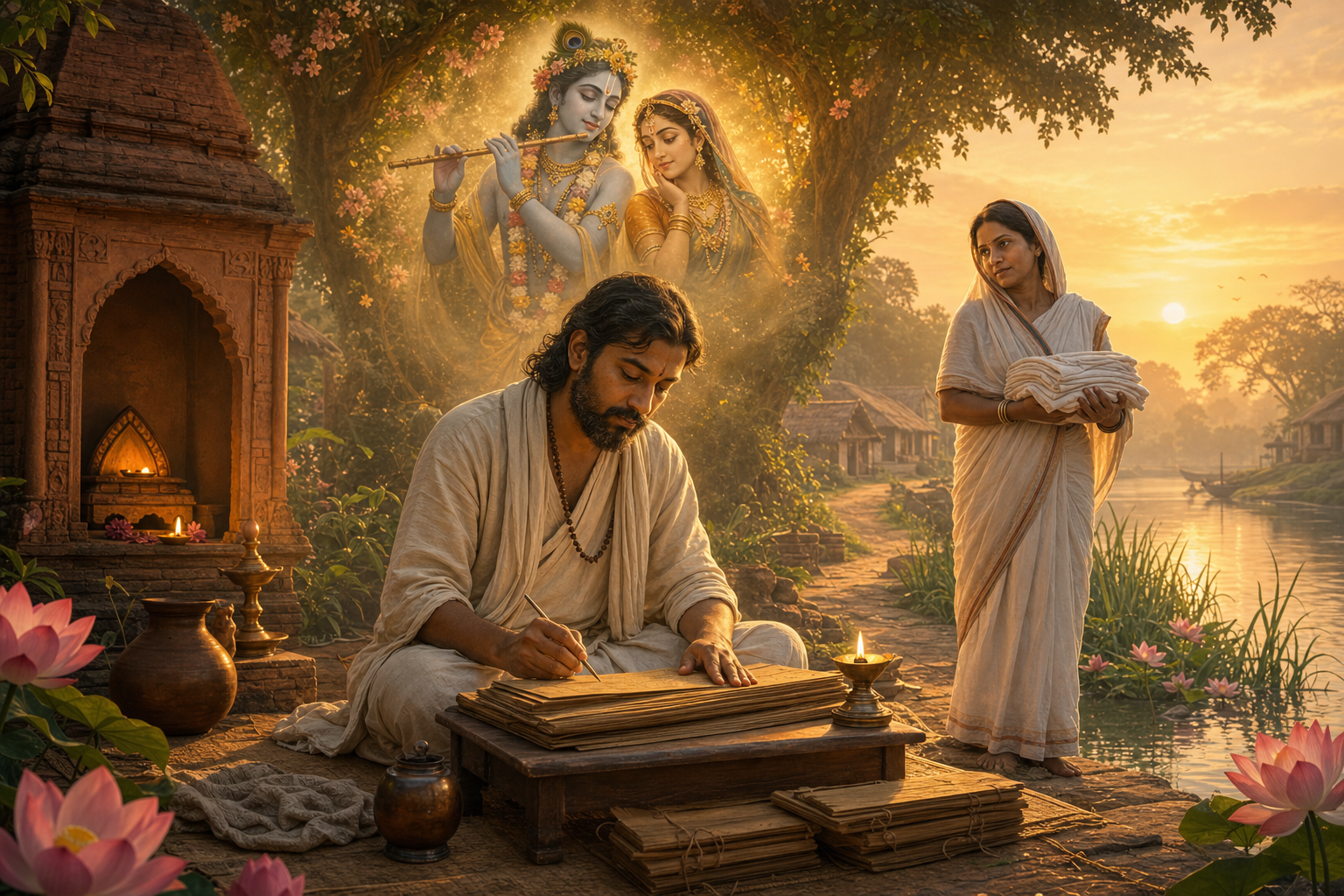
Chandidas occupies a luminous and complicated place in Bengali literature, Hindu spirituality, and the history of Bhakti. Remembered in popular tradition as a temple priest from Nanur in present-day Birbhum, Bengal, he is associated with the worship of Bashuli, a local form of the Goddess often linked with Durga or Vishalakshi. Yet his enduring fame does not rest only on ritual learning or priestly status. It rests on the emotional and theological intensity of his poems on Krishna and Radha, and on the story of a love that social convention could not easily contain.
The figure called Chandidas is not historically simple. Bengali literary history preserves more than one poet under that name, including Baru Chandidas, Dvija Chandidas, and Dina Chandidas. Scholars have debated their dates, regions, authorship, and textual connections. The famous medieval work Srikrishnakirtan, generally linked with Baru Chandidas, is often placed around the fourteenth or early fifteenth century, though exact chronology remains uncertain. This uncertainty does not diminish the tradition. It instead reveals how deeply the name Chandidas entered Bengal’s devotional memory, becoming less a single biographical fact than a living symbol of love, poetry, social discomfort, and divine longing.
In the devotional imagination of Bengal, Chandidas is often presented as a Brahmin priest whose heart turned toward Rami, also known as Rajakini, a woman from a washerfolk community. Their relationship was remembered as forbidden because it crossed boundaries of caste, ritual purity, and social expectation. In a society where priestly identity carried visible obligations, such affection was not treated as a private matter. It became a challenge to inherited hierarchy. The legend therefore cannot be read merely as romance. It is a moral drama in which human dignity confronts the fear of social exclusion.
The emotional force of this story is inseparable from Chandidas’s poetry. His songs turn repeatedly to Radha and Krishna, not as distant mythological figures alone, but as living embodiments of longing, separation, union, vulnerability, and surrender. Radha’s yearning for Krishna becomes the language through which the human soul seeks the Divine. Krishna’s presence and absence become the rhythm of spiritual life. In this world, love is not decorative sentiment. It is a discipline that breaks pride, exposes weakness, and demands an honesty that ritual performance alone cannot provide.
This is why Chandidas remains important within the wider Bhakti tradition. Bhakti, across many Hindu sampradayas, gave devotional experience a language that could be sung, remembered, and shared beyond elite scholastic circles. It did not reject learning, but it insisted that learning without humility could become dry and self-protective. Chandidas’s Radha-Krishna poems belong to this transformative current. They show how the heart, when purified by longing, becomes capable of receiving divine grace. They also show how human love, when freed from possession and ego, can become a metaphor for spiritual awakening.
The relationship between Chandidas and Rami has often been interpreted through the same devotional lens. Rami is not merely a figure of scandal in the legend. She becomes a mirror in which society’s assumptions are tested. If the Divine can be approached through love, humility, and truthfulness, then birth-based arrogance cannot be the final measure of spiritual worth. This insight resonates with a broad Dharmic sensibility found not only in Hindu Bhakti, but also in Buddhist compassion, Jain reverence for the soul’s ethical refinement, and Sikh emphasis on devotion, seva, and equality before the Divine.
A saying widely attributed to Chandidas declares that humanity stands above all, and nothing stands above humanity. The exact textual history of this attribution is debated, but the moral meaning has shaped Bengali cultural memory. It does not deny Dharma. Rather, it points toward a Dharmic principle often repeated across Indian traditions: spiritual life loses its truth when it becomes divorced from compassion. The dignity of the person, the sincerity of devotion, and the recognition of the Divine presence in all beings are not modern additions to Bhakti. They are among its deepest intuitions.
Chandidas’s poetry also matters linguistically. Medieval Bengali was still developing as a literary medium capable of carrying sophisticated religious emotion. Sanskrit remained a great language of theology, philosophy, and sacred learning, but vernacular poetry allowed devotion to enter the courtyard, the village path, the riverbank, and the shared musical gathering. Chandidas helped make Bengali a language of refined spiritual feeling. His work stands within the larger movement through which Indian regional languages became vehicles of sacred expression, from Marathi abhangas and Tamil bhakti hymns to Kannada vachanas and Braj devotional songs.
The Radha-Krishna theme in Chandidas is technically rich. The poems rely on the emotional grammar of viraha, or separation, which becomes a heightened state of devotion. In ordinary experience, separation causes grief. In Bhakti poetics, separation can intensify remembrance until the absent beloved becomes inwardly present. Radha’s anguish is therefore not merely personal suffering. It is the soul’s awareness that worldly life feels incomplete without Krishna. Her longing becomes a spiritual method, and her vulnerability becomes a form of knowledge.
This devotional psychology explains why Chandidas’s poems continue to feel intimate. Readers and listeners often recognize in Radha’s longing their own experience of distance: distance from a beloved, from meaning, from community, from the Divine, or even from the best version of the self. The poems do not flatten these experiences into easy consolation. They allow longing to remain painful while also showing that longing can refine consciousness. In this sense, Chandidas offers not escape from human emotion, but a sacred reorientation of it.
The legend of forbidden love also requires careful interpretation. It should not be reduced to a modern slogan, nor should it be romanticized without regard for historical context. Medieval society had its own structures, obligations, and anxieties. Yet the story’s endurance shows that Bengali memory found something spiritually compelling in a priest whose heart moved beyond rigid social approval. The point is not that Dharma is lawlessness. The point is that Dharma, rightly understood, cannot be separated from truth, compassion, and the recognition that divine grace is not the property of social status.
Chandidas’s association with Bashuli worship adds another layer to his significance. Bengal’s religious culture has long held together Shakta, Vaishnava, folk, Tantric, and village devotional streams. A priest serving the Goddess and a poet singing Radha-Krishna bhakti need not be seen as contradictory. This layered religiosity reflects the capacious character of Hindu civilization, where multiple forms of devotion may coexist without erasing one another. The same cultural soil could honor Durga, Krishna, Shiva, local deities, saints, gurus, and household traditions in an integrated sacred landscape.
In this integrated landscape, Chandidas becomes a bridge. His life story, whether read historically or symbolically, connects temple service with poetic vulnerability, social conflict with spiritual insight, and human affection with divine longing. His poems do not teach contempt for the world. They show that the world becomes meaningful when seen through devotion. Love for Krishna does not cancel human tenderness; it purifies and expands it. Love for another person, when deepened by humility, can become a doorway into the mystery of Radha and Krishna.
Chandidas also prepared the emotional ground for later Vaishnava currents in Bengal. The flowering of Gaudiya Vaishnavism around Sri Chaitanya in the fifteenth and sixteenth centuries gave Radha-Krishna devotion a powerful theological, musical, and communal expression. Chandidas’s songs were cherished within this devotional world because they carried the intensity of love that Gaudiya Vaishnava practice would later cultivate through kirtan, remembrance, and surrender. His poetry helped establish the emotional vocabulary through which Bengal could speak of divine love.
The literary value of his work lies in its ability to unite simplicity and depth. The surface of the poems may appear direct: a beloved waits, complains, trembles, hopes, or grieves. Beneath that surface lies a sophisticated theology of desire. Desire can bind the mind when it is ruled by ego. Yet desire can also be transformed into devotion when directed toward Krishna as the supreme beloved. Chandidas’s poetry explores this delicate transformation without turning it into abstract doctrine. It allows the reader to feel theology before analyzing it.
His legacy is therefore both aesthetic and ethical. Aesthetic, because he helped shape Bengali devotional lyricism with emotional precision. Ethical, because the remembered story of Rami and Chandidas questions the cruelty that can hide behind claims of purity. In a Dharmic framework, purity is not merely external separation. It is also purity of intention, speech, conduct, and heart. When society forgets this, saints and poets often become necessary correctives. They disturb complacency so that compassion may return to the center of religious life.
This corrective remains relevant in the modern world. Communities still struggle with boundaries of identity, status, language, sect, and inherited prejudice. Chandidas’s memory invites a more generous reading of Dharma, one that honors tradition while refusing to reduce human beings to social labels. Such a reading supports unity among Hindu, Buddhist, Jain, and Sikh traditions, not by erasing their differences, but by recognizing shared commitments to self-discipline, compassion, truthfulness, reverence, and liberation from ego.
Chandidas should therefore be approached with both devotion and scholarly caution. The historical records are layered, the authorship questions are real, and the legends developed over time. Yet the cultural truth of his legacy is unmistakable. Bengal remembered him because his poetry gave voice to a universal human condition: the longing to be loved without hypocrisy, the longing to reach the Divine without pride, and the longing to find grace even when society names one’s love as impossible.
In the end, Chandidas’s forbidden love and Radha-Krishna poems are not separate subjects. They illuminate each other. The human story explains why his devotional voice feels so urgent, and the devotional poetry explains why the human story has survived. Through Radha’s longing, Krishna’s sweetness, Rami’s remembered dignity, and Chandidas’s poetic courage, Bengal received a language in which love could become theology and sorrow could become surrender.
His enduring message is not rebellion for its own sake. It is the deeper Dharmic insight that love, when disciplined by truth and illumined by devotion, can break the hard shell of pride. Chandidas remains powerful because he speaks to the place where human longing meets divine grace. In that meeting, poetry becomes prayer, social pain becomes spiritual reflection, and Radha-Krishna bhakti becomes a path toward compassion, humility, and inner freedom.
Inspired by this post on Hindu Blog.





Leave a Reply
You must be logged in to post a comment.