
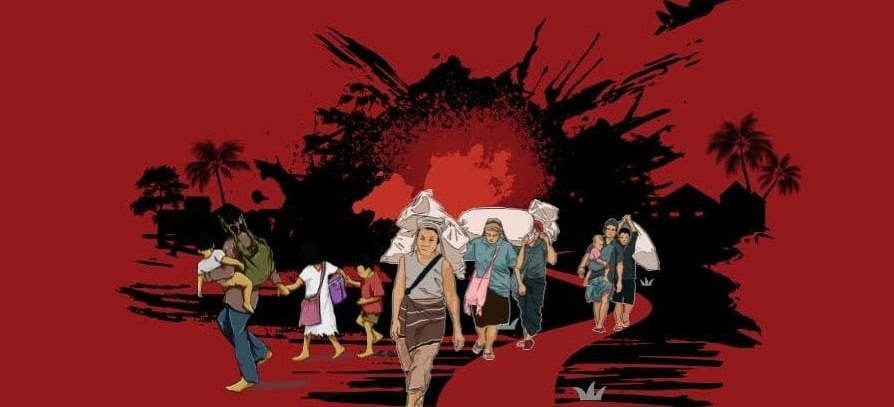
Myanmar, also known as Burma or Brahmadesh, has become one of South and Southeast Asia’s gravest humanitarian and geopolitical crises. World Refugee Day on 20 June offered a necessary moment of global reflection, but in Myanmar’s case it also exposed a painful reality: millions of ordinary people have been pushed into displacement, poverty, fear, and stateless uncertainty by a conflict that has steadily deepened since the military coup of 1 February 2021.
The crisis is not merely a matter of political instability in Naypyitaw. It is a layered national collapse involving armed conflict, refugee flows, shattered public services, food insecurity, regional border pressure, and the erosion of civic freedoms. Reports associated with the United Nations and conflict monitoring organisations indicate that more than 5.3 million people from Myanmar are living in acute distress, either as refugees, internally displaced persons, or civilians trapped in conflict-affected regions with little reliable access to safety.
More than one million people have fled Myanmar into neighbouring countries, especially Bangladesh, Thailand, and India. In India, the humanitarian effects are felt most directly in the north-eastern states of Manipur and Mizoram, where kinship ties, ethnic affinities, porous borders, and security concerns intersect in complex ways. Around 3.7 million people are also reported to be internally displaced inside Myanmar, many of them concentrated in border regions where food, healthcare, shelter, and education have become uncertain or unavailable.
This displacement has unfolded alongside severe economic decline. Chronic poverty is now reported to affect nearly 80 percent of Myanmar’s population of about 55 million. Such figures are not abstract indicators; they represent families selling belongings to buy rice, children leaving school, patients unable to reach clinics, and communities forced to choose between hunger and flight. A society once described through its monasteries, river valleys, markets, and ethnic diversity is now increasingly described through checkpoints, refugee camps, airstrikes, and ruined villages.
The turning point remains the military coup of 1 February 2021, when the elected government associated with Daw Aung San Suu Kyi and the National League for Democracy was removed by the armed forces under Min Aung Hlaing. What followed was not a short-lived political emergency but a prolonged breakdown of constitutional order. Protests, arrests, repression, armed resistance, and counterinsurgency campaigns transformed the country into a fragmented conflict zone.
Since the coup, hundreds of villages have reportedly been abandoned as residents fled airstrikes, house burnings, targeted killings, forced recruitment, and arbitrary detention. In many rural areas, the military’s approach has appeared less like law enforcement and more like collective punishment. When villages are burned or bombed, the damage is not limited to buildings. Agricultural cycles are interrupted, local temples and monasteries lose their social role, schools close, and intergenerational memory is scarred.
Min Aung Hlaing’s transition from coup leader to president after the disputed elections held in December 2025 and January 2026 has not resolved the legitimacy crisis. The elections were widely criticised because voting was impossible in many conflict zones, major opposition forces were excluded, and the military retained structural power through the political system. The formal language of civilian administration therefore sits uneasily beside the reality of military dominance.
Myanmar’s neighbours have responded through a mixture of caution, strategic interest, and diplomatic calculation. India and China both have major interests in the country. For India, projects such as the Kaladan Multi-Modal Transit Transport Project and the India-Myanmar-Thailand Trilateral Highway carry strategic significance because they connect the Indian mainland and Northeast India with Southeast Asia. For China, Myanmar remains critical for access to the Indian Ocean, energy routes, and influence along its southwestern frontier.
Yet infrastructure diplomacy cannot erase humanitarian suffering. Red-carpet engagements and strategic agreements may serve national interests, but they do not automatically protect civilians in Rakhine, Sagaing, Chin, Kachin, Kayah, or the borderlands. The core question remains whether regional diplomacy can balance security and connectivity with accountability, humanitarian access, and the dignity of displaced communities.
Territorial control inside Myanmar is now deeply fragmented. The military-aligned administration reportedly controls only a limited share of the country’s territory, while ethnic resistance organisations and People’s Defence Forces administer large areas. Other regions remain contested through continuing armed conflict. This fragmentation has turned governance into a patchwork, with different groups controlling roads, taxation, local policing, courts, education systems, and humanitarian access.
The Arakan Army has emerged as one of the most powerful ethnic armed organisations in this environment. In Rakhine State, it is reported to control a large portion of the territory after capturing most of the state’s townships. Its advance toward Sittwe, the state capital, has made Rakhine one of the most strategically significant fronts in the civil war. The conflict there also carries a deep humanitarian burden because Rakhine has long been marked by ethnic tension, displacement, poverty, and restricted access to aid.
The human cost of the war is staggering. Earlier United Nations-related estimates placed deaths in the tens of thousands, while conflict monitoring by the Armed Conflict Location & Event Data Project has pointed to more than 100,000 deaths since the 2021 coup. ACLED has also identified more than one thousand distinct armed groups operating across Myanmar, a sign of how thoroughly the country’s conflict has decentralised.
Such fragmentation makes peacebuilding extraordinarily difficult. A conventional negotiation between a government and a single opposition force cannot resolve a battlefield involving ethnic armies, local defence groups, militias, military units, political coalitions, and community-level armed actors. Myanmar’s crisis therefore resembles a civil war, a state-collapse emergency, and a regional security challenge at the same time.
Air power has become one of the most feared instruments of the military campaign. Reports from human rights bodies and conflict monitors describe the use of fighter jets, drones, and paramotors to drop explosives on civilian areas. Schools, clinics, religious sites, refugee settlements, and marketplaces have reportedly been struck. The pattern is especially devastating because communities with no air defence capacity are forced to live under a permanent sense of vulnerability.
The use of paramotors and other low-cost aerial platforms has added a new tactical dimension to the conflict. These devices can be difficult to detect, can operate at low altitude, and can terrorise villages with limited warning. For civilians, the technical distinction between a fighter jet, drone, or paramotor matters less than the psychological result: the sky itself becomes a source of fear.
Education has suffered one of the most consequential blows. More than six million children and young people are expected to remain out of school in the 2026-27 academic year, meaning that nearly half of Myanmar’s estimated school-age population may be deprived of formal education. This is not only a temporary interruption. A generation without stable schooling faces long-term damage in literacy, professional skills, civic confidence, and social mobility.
The collapse of education also weakens community resilience. Schools are not only places of instruction; they are social anchors where children encounter discipline, friendship, language, history, and shared civic identity. When schools close or become unsafe, the loss spreads into every household. Parents carry anxiety, teachers lose livelihoods, and young people become vulnerable to forced labour, recruitment, trafficking, migration, and despair.
Healthcare has deteriorated in parallel. Doctors, nurses, and health workers have been killed, arrested, displaced, or forced underground. Clinics have been struck in aerial attacks, and some private hospitals have reportedly been shut down by authorities. In conflict regions, even routine medical needs become life-threatening. Pregnancy, infection, injury, chronic illness, and childhood disease all become harder to treat when hospitals are closed or roads are blocked.
The attack on healthcare also has a moral dimension. In every civilisational tradition rooted in compassion, including the dharmic traditions of Hinduism, Buddhism, Jainism, and Sikhism, the protection of the vulnerable is a basic ethical obligation. Myanmar is a Buddhist-majority nation, but the suffering now visible there transcends religious identity. It asks a universal question: whether power can be restrained by conscience when civilians stand between armies and ambition.
Media freedom has entered one of its darkest periods since Myanmar’s independence. Alongside thousands of political prisoners, 215 media workers have reportedly been targeted over the past five years. The Geneva-based Press Emblem Campaign has stated that more than 15 journalists remain in detention. The cancellation of licences for outlets such as Myaelatt Athan, Red News Agency, and Asia Citizens has reportedly expanded the list of media organisations facing legal harassment.
The silencing of journalists is not a secondary issue. When independent reporting is criminalised, atrocities become easier to deny, corruption becomes easier to hide, and displaced people become invisible. A country at war needs credible information more than ever, because humanitarian agencies, neighbouring states, investors, and local communities all depend on reliable facts to make decisions.
The National Unity Government, formed after the coup by lawmakers mainly associated with the National League for Democracy and other democratic forces, continues to position itself as a parallel civilian authority. It has demanded the unconditional release of Daw Aung San Suu Kyi and other political prisoners, while warning international investors to respect transparency, accountability, and local communities.
The NUG’s warning to investors raises a serious legal and ethical issue. Economic agreements made with a contested authority may carry political, financial, operational, and reputational risks. Companies entering conflict-affected regions must consider whether their projects strengthen local livelihoods or deepen militarised control. In a country where territory, legitimacy, and law are all contested, investment cannot be separated from conflict dynamics.
For India, the Myanmar crisis is especially sensitive. India shares a long border with Myanmar, and instability directly affects Manipur, Mizoram, Nagaland, and Arunachal Pradesh. Refugee movements, insurgent mobility, narcotics trafficking, arms flows, and ethnic tensions all intersect with India’s Northeast. At the same time, India cannot ignore the humanitarian bonds that connect communities across the border.
A balanced Indian approach requires strategic patience and moral clarity. Border security is necessary, but so is humane treatment of displaced families. Connectivity projects matter, but they cannot substitute for political stability. Engagement with those who hold power may be unavoidable, but it should not become silence about civilian suffering. This balance is difficult, yet it is essential for long-term regional stability.
Bangladesh also continues to carry a heavy burden, particularly due to the long-running displacement of Rohingya communities from Rakhine State. Thailand faces its own border pressures as refugees and migrant workers seek safety. ASEAN has struggled to produce a decisive response, partly because of its non-interference tradition and partly because Myanmar’s conflict is now too fragmented for simple diplomatic formulas.
The international community’s response has therefore remained uneven. Sanctions, statements, humanitarian appeals, and diplomatic pressure have not stopped the violence. At the same time, complete isolation of Myanmar risks pushing suffering communities further away from aid and information. The challenge is to target military impunity while preserving humanitarian channels and supporting local civil society.
Myanmar’s tragedy also reminds South Asia and Southeast Asia that civilisational heritage alone cannot protect a society from political breakdown. A land associated with pagodas, monasteries, Buddhist learning, ethnic diversity, and ancient cultural routes is now struggling with fear and fragmentation. The lesson is sobering: institutions, accountability, rule of law, and respect for human dignity must be actively maintained.
The ethical response to Myanmar must begin with civilians. Refugees should not be reduced to demographic pressure. Internally displaced persons should not be treated as collateral damage. Students without schools, doctors without hospitals, journalists without freedom, and villagers without homes must remain central to any discussion of diplomacy, investment, security, or peace.
There is no quick settlement visible. The military remains entrenched, resistance forces remain active, ethnic armed organisations have expanded territorial control, and the humanitarian crisis continues to widen. Even if a political negotiation begins, restoring trust, rebuilding public services, resettling displaced people, and addressing wartime abuses will take years.
Myanmar’s future will depend on whether power can be decentralised without permanent fragmentation, whether armed actors can be drawn into a credible federal democratic settlement, and whether neighbouring countries can support stability without legitimising repression. Until then, the dust will not settle quickly. For millions of people, the crisis is not a distant geopolitical event; it is the daily struggle to survive with dignity in a nation still searching for peace.
Inspired by this post on Hindu Post.







Leave a Reply
You must be logged in to post a comment.