

In Hindu astrology, or Jyotisha, a horoscope is not judged by one planet, one sign, or one dramatic placement in isolation. Its strength is traditionally understood through the relationship between planets, houses, signs, aspects, dignities, yogas, and divisional charts. Each house, known as a bhava, represents a distinct field of life, and the careful study of these houses is essential for any meaningful interpretation of a birth chart. Among the twelve houses, the seventh house holds special importance because it stands directly opposite the ascendant and reveals how the individual meets the world through relationship, commitment, negotiation, desire, and social exchange.
The seventh house is traditionally called the Matrimonial House or Kalatra Sthana. The Sanskrit word Kalatra is commonly associated with spouse, marital union, and conjugal life. In a broader interpretive sense, this house does not merely describe marriage as a social ceremony; it indicates the quality of partnership, the nature of the spouse, the capacity for mutual adjustment, and the karmic lessons that emerge when two lives become interdependent. This makes the seventh house one of the most emotionally significant areas of a Hindu horoscope.
Technically, the seventh house is counted from the Lagna, or ascendant, and therefore forms the horizon opposite the first house. The first house represents selfhood, bodily identity, temperament, and the way life is approached from within. The seventh house represents the other: the spouse, partner, client, opponent, public audience, and anyone with whom a person must interact on relatively equal terms. This opposition between the first and seventh houses is central to Vedic astrology because it shows that personal identity matures through relationship.
For this reason, Kalatra Sthana is never limited to romance alone. It includes marriage, long-term companionship, business alliances, contractual agreements, public dealings, negotiation, sexual compatibility, and the ability to cooperate. A strong seventh house may indicate dependable partnerships, social grace, and constructive alliances. An afflicted seventh house may suggest delay, misunderstanding, instability, unrealistic expectations, or recurring conflict in relationships. These indications are always assessed with the rest of the horoscope, not through a single placement alone.
The seventh house belongs to the Kama group of houses, along with the third and eleventh houses. Kama refers to desire, emotional fulfillment, attraction, and the pursuit of relational satisfaction. In this context, marriage is not treated only as a legal or ritual institution but also as a field of human longing, companionship, pleasure, responsibility, and dharma. Hindu thought generally places marriage within a wider ethical framework, where desire is ideally guided by duty, restraint, mutual respect, and family continuity.
In traditional chart analysis, the condition of the seventh house lord is often more important than the mere presence or absence of planets in the seventh house. The sign occupying the seventh house shows the style through which partnership themes may express themselves, while the lord of that sign reveals where and how those themes unfold. If the seventh lord is strong, well placed, and supported by benefic influences, the chart may indicate stability and constructive partnership. If the seventh lord is debilitated, combust, hemmed by malefics, placed in difficult houses, or severely afflicted, the marriage field may require greater maturity and conscious effort.
Classical Jyotisha also gives attention to Venus, known as Shukra, as a major significator of marriage, affection, attraction, pleasure, refinement, and relationship harmony. In many interpretive traditions, Jupiter is also considered important for assessing marital wisdom, family expansion, and the quality of spouse-related blessings, especially in charts where traditional gendered frameworks are applied. Modern readers should approach such rules with care: the symbolic principles remain useful, but rigid gender assumptions should not overshadow the deeper astrological concern with mutual respect, compatibility, and ethical partnership.
The Navamsa chart, or D9 divisional chart, is especially important in the study of marriage and dharmic maturity. A birth chart may show visible circumstances, while the Navamsa is often studied to understand the deeper strength of planets and the inner quality of married life. A planet that appears strong in the main birth chart but weak in the Navamsa may require more careful interpretation. Similarly, a seventh lord that gains dignity or support in the Navamsa may improve the promise of partnership over time.
The seventh house must also be studied with related houses. The second house reflects family continuity, speech, shared wealth, and the household environment after marriage. The fourth house indicates domestic peace and emotional settlement. The fifth house shows romance, affection, children, and the intelligence of the heart. The eighth house reveals intimacy, vulnerability, longevity of marriage, shared resources, and sudden transformations. The eleventh house indicates fulfillment of desires and social networks, while the twelfth house relates to bed comforts, sacrifice, private life, and spiritual release. A mature reading connects all these houses rather than isolating Kalatra Sthana.
When benefic planets influence the seventh house, traditional texts often read them as supportive of cooperation and harmony, though each planet has its own nature. Jupiter may bring wisdom, counsel, generosity, and ethical grounding. Venus may bring affection, attraction, artistic sensibility, and the desire for companionship. Mercury may bring communication, adaptability, youthfulness, and intellectual exchange. A well placed Moon may create emotional responsiveness and domestic sensitivity. Yet even benefics require strength, dignity, and proper context; a weak or afflicted benefic cannot be interpreted mechanically.
Malefic planets in the seventh house require careful and nuanced judgment. Mars may create passion, initiative, and courage, but can also bring conflict, impatience, or dominance when poorly placed. Saturn may delay marriage or create seriousness, distance, duty, and endurance; when mature and well supported, it can indicate commitment and long-lasting responsibility. The Sun may bring pride, visibility, authority, or ego tension in partnership. Rahu may intensify desire, unconventional unions, foreign connections, or instability; Ketu may create detachment, spiritualization, or difficulty with ordinary expectations of intimacy. None of these placements should be treated as automatic doom.
Mangala Dosha, often discussed in relation to marriage, is one of the most misunderstood topics in Hindu astrology. It generally refers to the placement of Mars in certain houses from the ascendant, Moon, or Venus, with the seventh house being especially relevant. Traditional astrologers examine whether Mars creates excessive heat, conflict, or instability in marriage. However, responsible analysis also considers cancellations, planetary strength, sign placement, aspects, mutual compatibility, and the overall dignity of the chart. Fear-based interpretations of Mangala Dosha can harm families and relationships when they are applied without learning or compassion.
The seventh house is also associated with open enemies and legal disputes because it represents those who stand opposite the native. This does not mean every seventh-house placement creates hostility. Rather, it shows that the same field that produces marriage and partnership also produces confrontation, negotiation, and public accountability. A spouse, business partner, client, legal opponent, or competitor may all appear through the seventh house because each involves direct engagement with another person.
In business and professional life, the seventh house can indicate partnerships, contracts, trade, consulting relationships, and the ability to work with clients. A strong seventh house may support entrepreneurship, diplomacy, law, advisory roles, sales, public relations, counseling, and professions requiring direct interaction. When the seventh house is weak or afflicted, one may need to be more cautious with agreements, written contracts, expectations, and dependency on partners. In practical terms, this house teaches the value of clarity before commitment.
The sign in the seventh house shapes the psychological texture of relationship. Fiery signs may seek dynamism, confidence, and directness. Earth signs may prefer stability, duty, material security, and practical support. Air signs may emphasize dialogue, ideas, sociability, and fairness. Water signs may look for emotional depth, protection, tenderness, and shared feeling. These elemental tendencies are only starting points; the seventh lord, planetary influences, nakshatra, Navamsa, and dasha periods refine the interpretation.
Dasha timing is essential in Hindu horoscope analysis because a promised event generally manifests during the planetary periods connected to that promise. Marriage may occur during the dasha or antardasha of the seventh lord, Venus, planets placed in the seventh house, planets aspecting the seventh house, the Navamsa seventh lord, or other marriage-related significators. Transits, especially of Jupiter and Saturn, may activate the relevant houses, but transits alone are not enough. The natal promise must first be present in the chart.
Traditional compatibility, often called Kundali matching, studies factors such as guna matching, the Moon nakshatra, temperament, health, prosperity, family harmony, progeny, and longevity of relationship. While these systems remain culturally influential, they should be used as tools for reflection rather than instruments of fatalism. A high score cannot replace character, communication, shared values, emotional maturity, and family ethics. A lower score does not automatically condemn a relationship when the broader charts show support and both individuals act with responsibility.
From a dharmic perspective, the seventh house carries a deeper lesson: relationship is a discipline. Marriage and partnership reveal habits that remain hidden when life is lived only from the first house of self. Pride, fear, attachment, generosity, patience, speech, loyalty, forgiveness, and self-control all become visible in the mirror of another person. This is why Kalatra Sthana can be read not only as a house of spouse but as a house of self-knowledge through shared life.
The emotional importance of the seventh house is easy to understand in ordinary experience. People may succeed in education, profession, and public reputation, yet still feel unsettled if their closest relationships are strained. Conversely, a supportive partnership can become a source of courage, resilience, and ethical balance. Hindu astrology recognizes this human reality by giving the seventh house a central place in chart interpretation. It treats companionship as both a worldly need and a field of karmic learning.
At the same time, the seventh house should not be used to reduce a person’s life to marital status. A horoscope contains twelve houses, multiple planetary periods, and many layers of meaning. Some charts may show early marriage, some delayed marriage, some unconventional partnership, some intense spiritual orientation, and some strong public or professional expression through seventh-house themes. The dignity of the person remains greater than any single astrological factor.
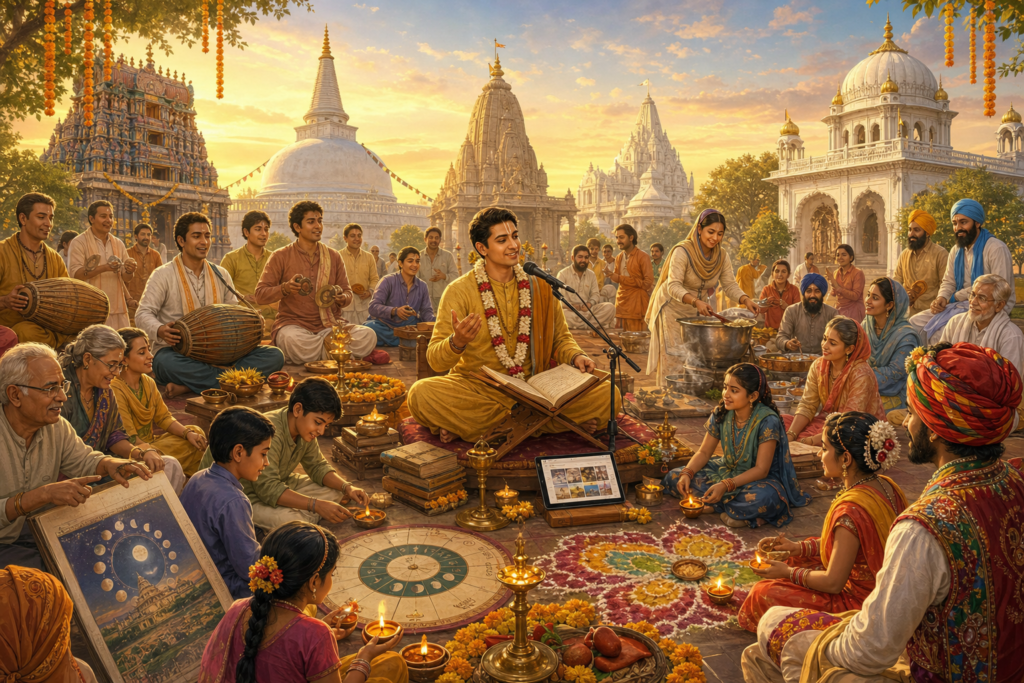
In the larger family of dharmic traditions, relationship is often understood through responsibility, compassion, restraint, and awareness. Hinduism, Buddhism, Jainism, and Sikhism each place emphasis, in their own ways, on ethical conduct and the transformation of the self through right relationship with others. A thoughtful study of the seventh house can therefore support unity among dharmic traditions when it is approached without superstition, sectarian judgment, or social rigidity. Its highest use is not fear, but discernment.
A balanced reading of the seventh house in a Hindu horoscope therefore requires technical discipline and humane interpretation. The astrologer studies the seventh house, its lord, Venus, Jupiter, the Navamsa, relevant dashas, aspects, yogas, and connected houses. The student of astrology also remembers that charts describe tendencies, not excuses. Partnership becomes healthier when astrological insight is joined with communication, patience, self-awareness, and dharmic conduct.
The seventh house, or Kalatra Sthana, remains one of the most powerful areas of Jyotisha because it shows how destiny unfolds through relationship. It explains why marriage is not merely a personal preference but a major karmic field involving family, society, desire, duty, intimacy, and growth. When studied carefully, the seventh house reveals that the strength of a horoscope lies not only in individual achievement but also in the capacity to honor commitments, meet others truthfully, and transform companionship into a path of wisdom.
Inspired by this post on Hindu Blog.








Leave a Reply
You must be logged in to post a comment.