
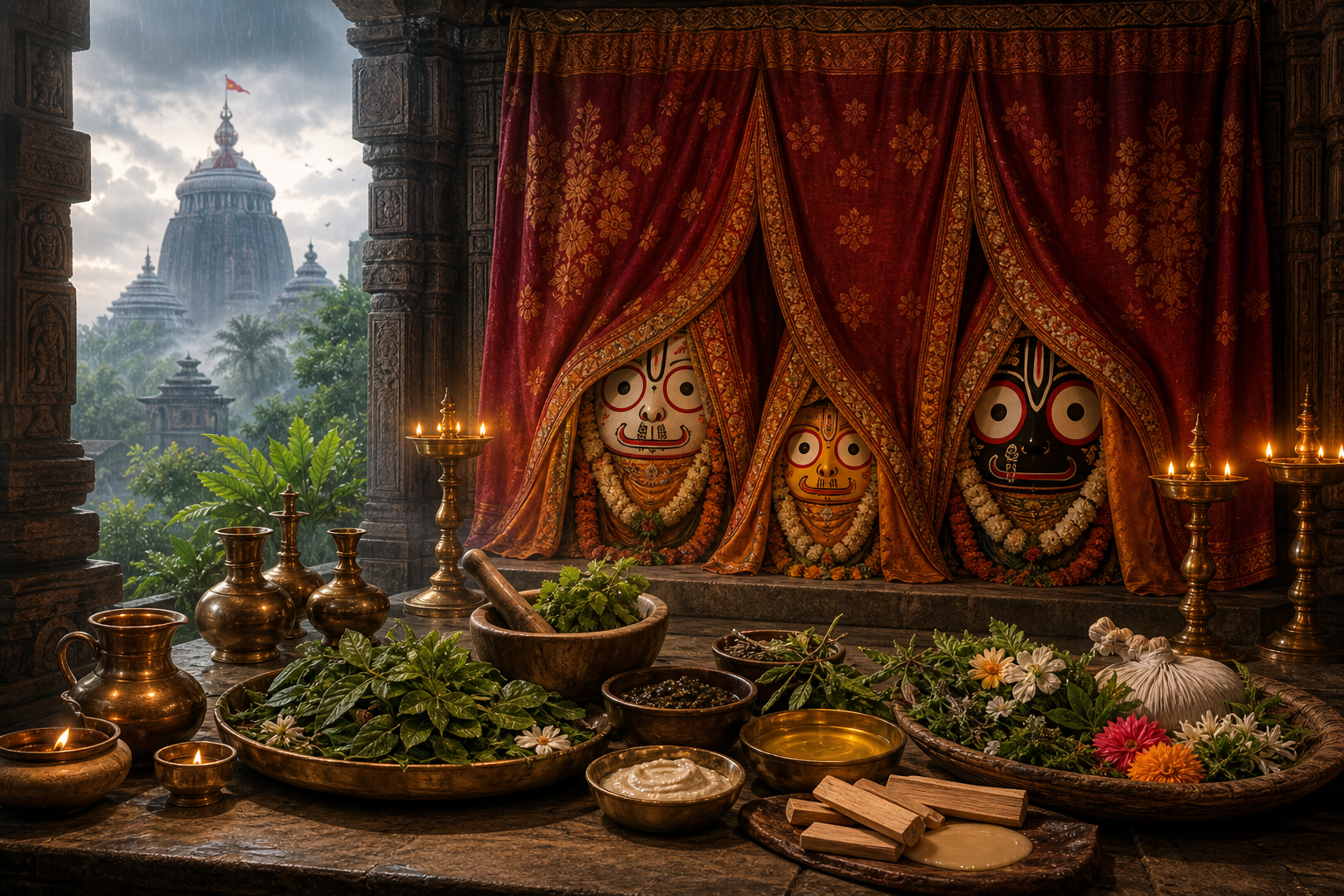
Among the living temple traditions of Bharat, the Anasara of Puri Jagannath occupies a remarkable place because it presents illness, rest, treatment, diet, seclusion, and recovery through the language of sacred ritual. After the ceremonial bathing of Snana Purnima, Bhagavan Jagannath, Balabhadra, and Subhadra are understood to develop fever and are withdrawn from public view. This period is not a mere interruption in worship; it is a carefully preserved cultural model of healing that reflects Ayurveda, seasonal transition, disciplined care, and the profound emotional relationship between deity and devotee.
The word Anasara, often connected with Anavasara, refers to the period when the deities are unavailable for public darshan. In the Puri Srimandir tradition, this sacred seclusion begins after Snana Purnima, when the deities are bathed with 108 pots of sanctified water. The grandeur of the ritual bath is followed by a strikingly human episode: the deities are said to suffer from fever due to the intense bathing. They are then taken to the Anasara Ghara, where special servitors attend to them until their renewed appearance before Ratha Yatra.
At one level, this is a devotional narration filled with tenderness. The Lord of the universe becomes vulnerable, and the community responds not with abstraction but with care. At another level, the ritual expresses a deeply practical understanding of the body. Sudden exposure, seasonal change, heavy bathing, digestive disturbance, fever, restricted diet, rest, herbal therapy, and gradual restoration are all familiar concerns in traditional Indian medical thought. Anasara therefore becomes a temple-based grammar of health, where theology and medicine are not enemies but partners.
Ayurveda places great emphasis on rhythm. The human body is not treated as a machine isolated from nature, but as a living organism shaped by season, food, sleep, digestion, emotion, and environment. The period around Snana Purnima falls near a seasonal transition, when heat, humidity, and the onset of monsoon conditions can disturb bodily balance. The Ayurvedic idea of ritu sandhi, or the junction between seasons, is especially relevant here. It is a time when dietary discipline, rest, and gradual adaptation are advised because the body is more vulnerable to imbalance.
Seen through this lens, the illness of Jagannath after Snana Purnima carries a practical message. Excess, even when sacred, must be followed by restoration. A body that has undergone intense exposure requires quiet, warmth, suitable food, and proper treatment. The ritual does not glorify exhaustion. It teaches that recovery has its own dignity. In a modern world that often treats rest as weakness, Anasara offers a civilizationally rooted correction: even the divine form is ritually honored through convalescence.
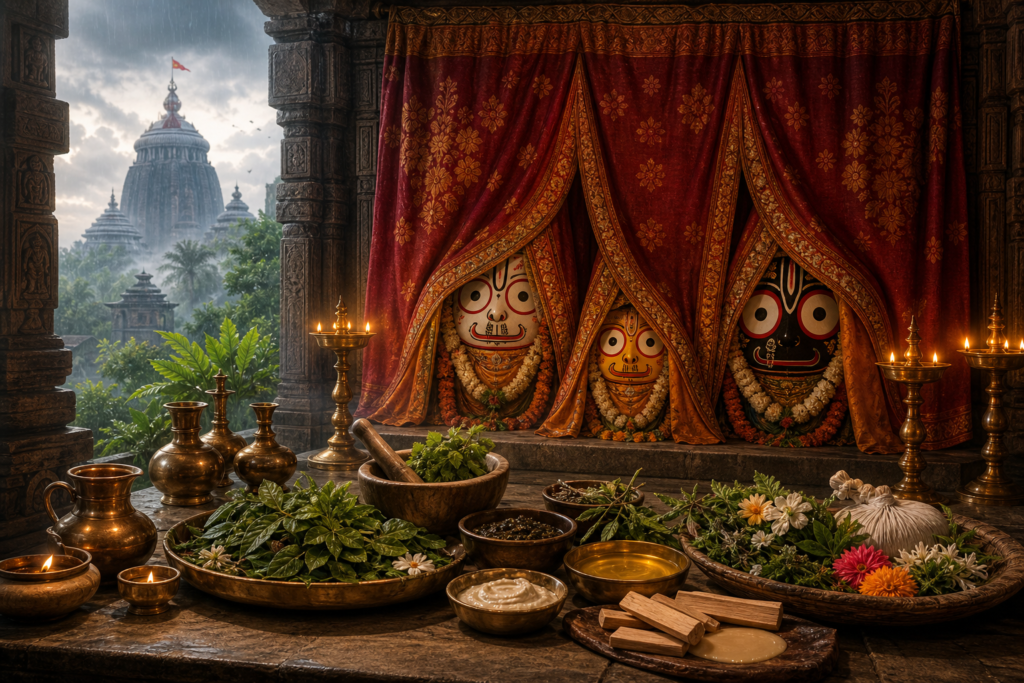
The medical symbolism becomes more visible in the care given during this period. The deities are not offered the regular public worship in the same way. Their food, dress, and daily routine change. The emphasis shifts toward healing. Traditional accounts describe the use of herbal preparations, including medicated oil and restorative formulations associated with fever care and bodily recovery. The famous Phuluri Tela, a scented herbal oil traditionally prepared in connection with the Jagannath Temple, is part of this healing framework. The ritual use of such preparations reflects the broader Ayurvedic confidence in oil, herbs, massage, warmth, and controlled nourishment.
In Ayurveda, fever is not treated only as a temperature reading. It is understood as a systemic disturbance involving digestion, strength, circulation, and vitality. Rest is essential because agni, the digestive and metabolic fire, becomes weak during illness. Heavy foods are avoided, and the body is supported with lighter, suitable substances until strength returns. The Anasara observances echo this logic in ritual form. The deities are cared for in seclusion, their intake is regulated, and their return to public view occurs only after renewal.
This is why Anasara can be understood as a sacred lesson in medical restraint. It does not encourage panic during fever. It does not deny the body’s need for treatment. It presents healing as a process: withdrawal, diagnosis through tradition, appropriate medicine, diet, quietude, observation, and gradual re-emergence. The sequence resembles the wisdom of households where elders once knew that recovery from seasonal fever required patience, not haste. The temple magnifies that household wisdom into a public theology of care.
The role of the Daitapati servitors is especially meaningful. During Anasara, they serve the deities with an intimacy that reflects kinship rather than distant ritual formalism. Jagannath is not merely worshipped as a majestic sovereign; He is attended like a beloved family member. This devotional intimacy has psychological significance. It creates an emotional culture in which illness is not shameful, care is sacred, and service to the vulnerable becomes a form of worship. Such a view resonates across dharmic traditions, where compassion, seva, self-discipline, and reverence for life remain central values.
The withdrawal of the deities from public view also has a contemplative dimension. Devotees who cannot see Jagannath during Anasara are invited to experience longing. This longing is not empty deprivation; it deepens relationship. In many spiritual traditions of India, absence sharpens remembrance. When the eyes cannot receive darshan, the mind turns inward. The devotee learns that sacred presence is not limited to immediate visibility. This is a subtle teaching in bhakti, but it also mirrors a psychological truth: periods of pause can renew attention and affection.
Anasara therefore integrates three levels of healing. The first is physical, represented through fever, herbs, oil, diet, and rest. The second is emotional, represented through care, longing, tenderness, and reunion. The third is spiritual, represented through the mystery of a deity who accepts human-like vulnerability to educate humanity. Together, these levels form a holistic model of health. This is why the tradition continues to feel relevant, not only as ritual heritage but as a living reflection on how human beings should treat the body, the mind, and one another.
The connection with Ratha Yatra is equally important. Anasara is followed by renewal, and renewal is followed by movement. After seclusion, Jagannath appears in fresh form, radiating new vitality before the great chariot festival. This sequence is profoundly symbolic. A community that pauses for healing becomes capable of movement. A body that rests becomes capable of pilgrimage. A civilization that remembers its rhythms becomes capable of renewal. Ratha Yatra, in this sense, is not merely a festival after illness; it is the public celebration of restored strength.
Modern health discourse often separates medicine from meaning. Clinical treatment may address symptoms, while emotional and spiritual dimensions remain neglected. Anasara offers a different model without rejecting practical care. It reminds society that health includes environment, timing, diet, rest, touch, fragrance, community, and hope. Its ritual structure makes healing visible. It tells the public that recovery is not private weakness but a sacred phase of life.
The tradition also has ecological intelligence. Ayurveda’s seasonal framework assumes that climate matters. Human beings must adjust food, activity, and habits according to changes in nature. The transition toward the rainy season can affect digestion, immunity, and energy. Anasara places a major temple observance precisely within this larger awareness of seasonal vulnerability. The message is not superstition but disciplined adaptation: when nature changes, the body must listen.
For contemporary readers, the most practical lesson may be the dignity of convalescence. Many people return to work, travel, social pressure, and digital overstimulation before the body has recovered. Anasara teaches the opposite through sacred drama. Fever requires quiet. Weak digestion requires suitable food. Recovery requires time. The body should not be bullied into performance. When this lesson is placed in the life of Jagannath, it becomes impossible to dismiss as ordinary advice. It becomes dharma applied to health.
There is also a powerful social lesson in the way devotees accept the closed doors of the temple during this period. Darshan is precious, yet the tradition accepts that care must come before display. The deity is not forced into public availability. This has ethical value in a world where constant visibility is often demanded from individuals, leaders, families, and even spiritual institutions. Anasara protects sacred privacy. It teaches that withdrawal can be responsible, healing can be communal, and absence can be meaningful.
The term “medical science” must be understood carefully in this context. Anasara is not a modern hospital protocol, nor should ritual be presented as a substitute for qualified medical treatment. Its importance lies in the medical wisdom embedded in cultural practice: seasonal awareness, fever care, rest, regulated diet, herbal support, and gradual recovery. These principles are consistent with many traditional health systems and remain relevant as complementary wisdom. The tradition is strongest when appreciated with both reverence and intellectual honesty.
The Jagannath tradition has always carried an inclusive spirit. Jagannath belongs to kings and commoners, scholars and workers, ascetics and householders, local communities and pilgrims from across the world. The Anasara period deepens that inclusiveness by showing that vulnerability is universal. Illness crosses social boundaries. Care becomes the shared dharma. This message can nourish unity among Hindu, Buddhist, Jain, and Sikh communities, all of which honor compassion, discipline, self-restraint, service, and the pursuit of inner balance.
In Buddhist thought, mindful attention to suffering leads to compassion and wisdom. In Jain traditions, restraint and care for life are central ethical disciplines. In Sikh tradition, seva and concern for the suffering are essential expressions of devotion. In Hindu Ayurveda and bhakti, health and sacred relationship are woven together. Anasara can therefore be appreciated as part of a wider dharmic civilizational insight: healing is not merely technical repair; it is a moral, emotional, ecological, and spiritual responsibility.
The emotional power of Anasara comes from its simplicity. Every family understands illness. Every household has witnessed fever, fatigue, restricted food, anxious care, and the relief of recovery. By placing these experiences in the sacred life of Jagannath, the tradition brings theology into the home and brings household care into the temple. The distance between divine and human narrows. Devotees are reminded that the sacred does not float above life; it enters the body’s realities and sanctifies them.
The renewed appearance of Jagannath after Anasara is therefore not merely visual. It is therapeutic for the community. Devotees who waited through the period of absence encounter the deity as restored, refreshed, and ready for the journey of Ratha Yatra. The cycle of bathing, fever, treatment, seclusion, renewal, and public movement becomes a complete philosophy of life. Human beings too pass through exposure, exhaustion, retreat, healing, and return. The temple makes this cycle sacred and intelligible.
Anasara of Puri Jagannath remains one of the finest examples of how Indian sacred traditions preserve practical knowledge through ritual memory. It teaches that health depends on rhythm, humility, care, and time. It honors Ayurveda without reducing devotion to medicine, and it honors devotion without ignoring the body. Its enduring wisdom lies in this balance. When Bhagavan is lovingly nursed back to strength, humanity is reminded to treat its own bodies, families, and communities with the same patience and reverence.
Inspired by this post on Hindu Blog.








Leave a Reply
You must be logged in to post a comment.