
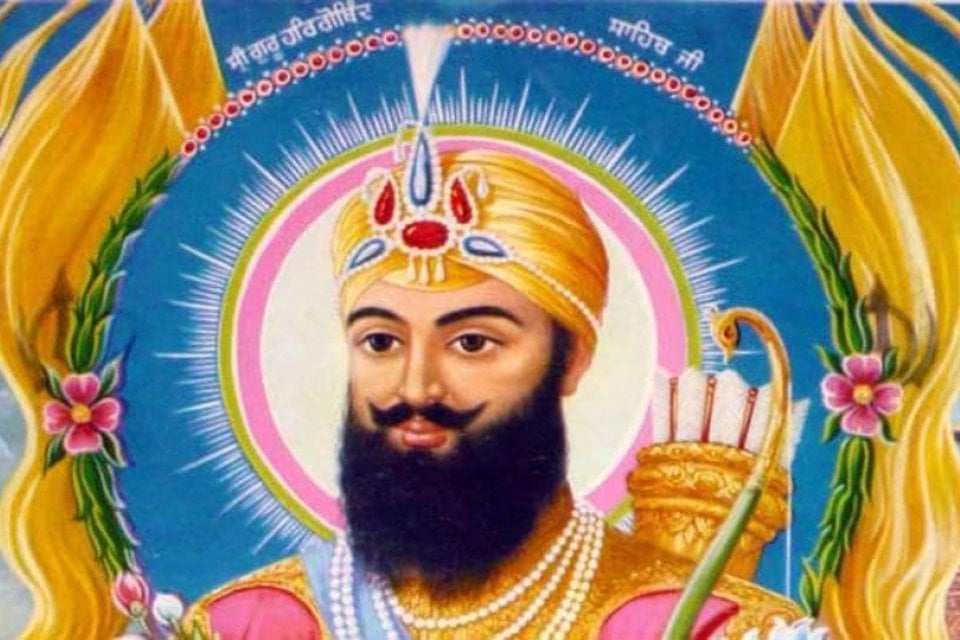
Guru Hargobind Sahib occupies a decisive place in Sikh history because his life joined two forces that are often treated as opposites: divine grace and martial valor. As the sixth Sikh Guru, he inherited a spiritual tradition shaped by Guru Nanak Sahib’s vision of truth, service, humility, remembrance of the Divine, and equality among human beings. Yet he also inherited a historical crisis. The martyrdom of Guru Arjan Sahib in 1606 revealed that a community rooted in devotion could not remain indifferent to political oppression, social insecurity, and the moral duty to protect the vulnerable. Guru Hargobind Sahib’s response was neither a rejection of spirituality nor a turn toward aggression. It was a disciplined rearticulation of dharma through the Sikh doctrine of Miri-Piri: the inseparable balance of spiritual sovereignty and temporal responsibility.
Born in 1595 at Guru Ki Wadali near Amritsar, Guru Hargobind Sahib was the son of Guru Arjan Sahib and Mata Ganga Ji. His childhood unfolded within a sacred environment shaped by kirtan, seva, scriptural learning, and the growing institutions of the Sikh Panth. The community around Amritsar had already developed a strong spiritual and social identity through the work of the earlier Gurus. The compilation of the Adi Granth under Guru Arjan Sahib, the building of Harmandir Sahib, the practice of langar, and the insistence on human dignity had transformed Sikh life into a living discipline of devotion and social ethics.
The transition from Guru Arjan Sahib to Guru Hargobind Sahib came under traumatic circumstances. Guru Arjan Sahib’s martyrdom under Mughal authority became a turning point not only for Sikhs but also for the wider moral history of the Indian subcontinent. It demonstrated that spiritual communities, when they become centers of social confidence and ethical autonomy, may face pressure from imperial power. Guru Hargobind Sahib was only about eleven years old when he assumed the Guruship, yet the symbolic and institutional measures he introduced showed extraordinary clarity. He did not abandon the path of bhakti, remembrance, and compassion. Instead, he taught that devotion must have the strength to defend justice.
The most enduring expression of this vision was Miri-Piri. Guru Hargobind Sahib is traditionally remembered as wearing two swords: one representing Piri, or spiritual authority, and the other representing Miri, or temporal responsibility. Piri affirmed that the foundation of Sikh life remained spiritual discipline, reverence for the Divine, and moral refinement. Miri affirmed that spiritual life could not be confined to inward experience alone; it had to enter the world of institutions, justice, protection, and public responsibility. Together, the two swords created a profound philosophical statement: power without spirituality becomes domination, while spirituality without responsibility can become withdrawal from suffering.
This principle remains important for understanding the unity of Dharmic traditions. Hindu, Buddhist, Jain, and Sikh thought each contain rich reflections on self-discipline, compassion, restraint, and the ethical use of power. Ahimsa, in these traditions, is not moral laziness or helplessness. It is a disciplined refusal to harm unnecessarily, combined with a responsibility to prevent injustice where possible. Guru Hargobind Sahib’s life demonstrates this mature ethical balance. His martial vision was not rooted in hatred of any community. It was rooted in the defense of dignity, faith, and freedom.

The establishment of the Akal Takht became the institutional heart of this transformation. Located opposite Harmandir Sahib in Amritsar, the Akal Takht represented the temporal and ethical authority of the Sikh Panth. Its placement carried deep meaning. Harmandir Sahib symbolized humility, devotion, and openness to the Divine; the Akal Takht symbolized justice, counsel, governance, and collective responsibility. Their relationship expressed the Sikh conviction that spiritual contemplation and public duty must remain in dialogue. The devotee who bows in humility must also learn to stand upright when truth requires courage.
Guru Hargobind Sahib’s court at the Akal Takht was not merely a political imitation of royal culture. It was a new grammar of sovereignty. The Guru received petitions, guided the community, trained Sikhs in discipline, and cultivated a public ethic in which service and strength belonged together. In a society marked by hierarchy, imperial pressure, and periodic violence, this was a radical development. It taught ordinary people that spiritual life did not require social timidity. A Sikh could meditate, serve langar, sing the Divine Name, and also learn horsemanship, archery, and the responsible bearing of arms.
The martial dimension of Guru Hargobind Sahib’s leadership must be understood carefully. It was defensive, ethical, and restrained. Historical memory associates him with the strengthening of the Sikh community’s armed capacity and with conflicts that arose under changing Mughal political conditions, especially during the reign of Shah Jahan. Yet his legacy cannot be reduced to battles. His deeper contribution was the formation of a disciplined community capable of preserving faith under pressure while resisting the temptations of vengeance, cruelty, or conquest. The sword, in this framework, was not an ornament of pride. It was a responsibility governed by conscience.
This is why Guru Hargobind Sahib’s legacy is often connected with the later ideal of the sant-sipahi, the saint-soldier. The term captures a demanding inner discipline. The saint without courage may become ineffective in the face of injustice; the soldier without saintliness may become dangerous. Guru Hargobind Sahib’s model required both inner purification and outer readiness. A life of prayer was expected to produce steadiness, compassion, and fearlessness. A life of valor was expected to remain answerable to truth, restraint, and service.

The episode of Gwalior Fort and the title Bandi Chhor are central to the emotional power of Guru Hargobind Sahib’s memory. Sikh tradition holds that the Guru, when released from imprisonment, secured the freedom of fifty-two detained rulers along with himself. The episode is remembered during Bandi Chhor Divas, a celebration associated with liberation, justice, and the refusal to accept freedom as a private privilege when others remain bound. Even when historians discuss details and dates with scholarly caution, the ethical meaning of the tradition is unmistakable. True spiritual authority does not walk out of captivity alone when it can help others walk out as well.
That lesson remains profoundly relevant. Many people encounter injustice first as a private wound, but Guru Hargobind Sahib’s example transforms personal suffering into public responsibility. His life suggests that pain can either harden the heart or enlarge it. The memory of Guru Arjan Sahib’s martyrdom did not lead him to bitterness against humanity. It led him to organize, protect, guide, and uplift. This emotional discipline is one of the most striking aspects of his legacy. It shows how grief, when anchored in dharma, can become courage without becoming cruelty.
Guru Hargobind Sahib also preserved continuity with the earlier Gurus. His courtly bearing, martial training, and institutional innovations did not replace the Sikh foundations of naam simran, seva, sangat, and langar. The Guru’s life remained centered on remembrance of the Divine and service to the community. This continuity matters because it prevents a shallow reading of Sikh militarization. The Sikh tradition did not become martial because it abandoned spirituality. It became martially prepared because spirituality demanded protection of truth, dignity, and freedom of conscience.
The Guru’s social vision also carried a strong householder orientation. Sikh teachings had long rejected the idea that liberation required withdrawal from ordinary life. Guru Hargobind Sahib reinforced this approach by demonstrating that governance, family, community defense, work, devotion, and ethical responsibility could coexist. This is a major contribution to Dharmic thought. The world is not merely a distraction from spiritual life; it is the field in which spiritual truth is tested. Courage at home, integrity in public life, and compassion toward others become forms of practice.

His leadership also shaped Sikh geography and institution-building. Amritsar remained central, while places such as Kiratpur Sahib became associated with the later phase of his life and with the continuing development of Sikh communal life. These sacred centers were not only places of worship. They were spaces of memory, education, discipline, refuge, and collective identity. In this sense, Guru Hargobind Sahib helped build a durable civilizational framework in which spirituality was embodied through institutions rather than left as abstract sentiment.
From a historical perspective, Guru Hargobind Sahib’s period also reveals the complexity of Sikh relations with Mughal power. The issue was not a simplistic conflict between religious communities. It was a conflict shaped by imperial authority, political suspicion, autonomy, and the growing confidence of a spiritually rooted community. This distinction is essential for responsible historical writing. Guru Hargobind Sahib’s legacy should never be misused to encourage hostility toward ordinary people of any faith. Its proper meaning is the defense of religious freedom, human dignity, and ethical sovereignty.
His example also invites comparison with broader Indian ideas of rajadharma and dharma-yuddha. In classical Dharmic discourse, the ruler or protector is not free to use power arbitrarily. Power must be restrained by duty, guided by truth, and oriented toward the protection of the vulnerable. Guru Hargobind Sahib’s Miri-Piri expresses a Sikh articulation of this larger ethical concern. It affirms that force, when unavoidable, must remain subordinate to moral law. This is not militarism. It is the disciplined protection of justice.
The emotional appeal of Guru Hargobind Sahib’s legacy lies in its refusal to separate tenderness from strength. A community may sing kirtan and still train for defense. A person may cultivate humility and still resist humiliation. A spiritual tradition may honor peace and still recognize that peace sometimes requires courage, organization, and sacrifice. This balance speaks to modern life as much as to seventeenth-century Punjab. Families, communities, and nations still struggle with the same question: how can goodness remain strong without becoming harsh, and how can strength remain ethical without becoming oppressive?

Guru Hargobind Sahib answers through example rather than abstraction. He embodied disciplined sovereignty. He transformed a wounded community into a resilient one. He expanded Sikh self-understanding without severing it from the earlier Gurus. He honored the memory of martyrdom without allowing martyrdom to become despair. He gave the Sikh Panth a language of courage rooted in Divine remembrance. The result was a legacy that prepared the way for later Sikh history, including the sacrifices of Guru Tegh Bahadur Sahib and the Khalsa discipline established by Guru Gobind Singh Sahib.
For contemporary readers, the significance of Guru Hargobind Sahib lies not only in historical admiration but in ethical application. His life challenges passive spirituality, performative religiosity, and reckless anger alike. It asks whether devotion produces responsibility. It asks whether courage is guided by compassion. It asks whether communities can defend themselves without losing their moral center. These questions are urgent in every age, especially when public life is marked by polarization, historical misunderstanding, and the temptation to turn sacred memory into grievance.
Within the wider family of Dharmic traditions, Guru Hargobind Sahib’s legacy strengthens the shared commitment to truth, self-mastery, compassion, and protection of the righteous. His life does not stand apart from the civilizational search for harmony; it enriches it. The sword of Miri and the sword of Piri remain symbols of balance: action and contemplation, justice and mercy, courage and humility, sovereignty and surrender to the Divine. They remind the seeker that spiritual maturity is not escape from the world but purified participation in it.
Guru Hargobind Sahib’s legacy can therefore be understood as a luminous doctrine of responsible strength. Divine grace gave the community its inner center; martial valor gave it the capacity to protect that center in history. His life teaches that the highest courage is not aggression, but disciplined fearlessness in service of truth. His memory continues to guide Sikhs and all sincere seekers who understand that faith must be compassionate, freedom must be defended, and power must remain accountable to dharma.
Inspired by this post on SikhNet – News.







Leave a Reply
You must be logged in to post a comment.