
Every year on June 30, Hul Diwas restores to public memory one of the most powerful anti-colonial movements in Indian history: the Santal Hul of 1855. The uprising began two years before the better-known Revolt of 1857, yet it emerged from the same broad historical world of colonial extraction, economic coercion, and political humiliation. In the forests, fields, and hill settlements of eastern India, ordinary cultivators confronted the East India Company and the local structures that had made colonial power unbearable in everyday life.
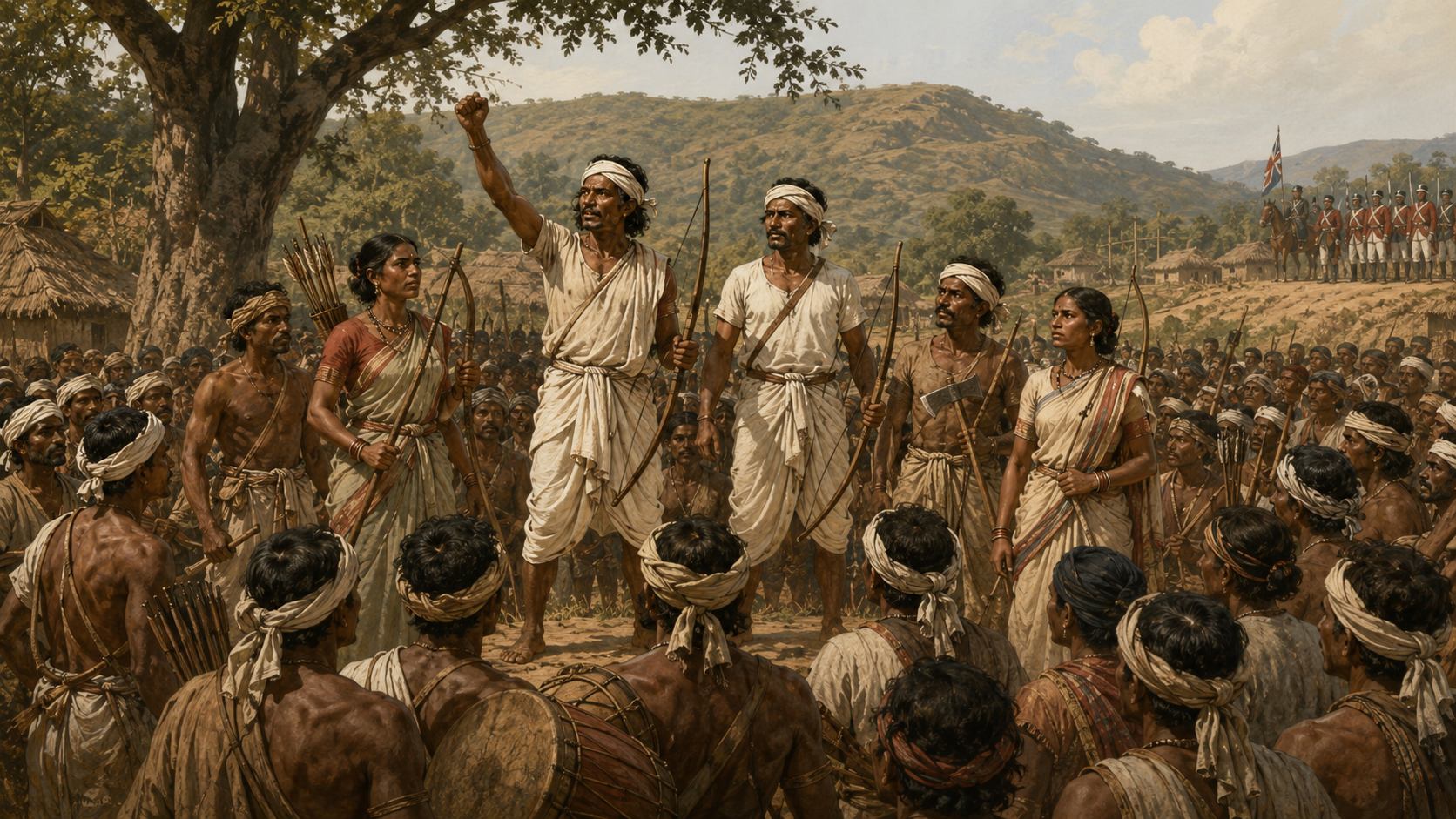
The Santal Hul was not a sudden disturbance or a local episode of anger. It was a disciplined and morally charged rebellion against a system that had turned land into a mechanism of dispossession and justice into a privilege of the powerful. Its centre was Bhognadih, in present-day Jharkhand, where Sido Murmu and Kanhu Murmu, joined by their brothers Chand and Bhairav, called the Santals to organise against British authority, oppressive landlords, predatory moneylenders, corrupt officials, and police violence. Santal memory also honours their sisters Phulo and Jhano Murmu as courageous organisers and fighters whose role is essential to any serious account of the movement.
The historical background of the Hul lies in the transformation of Damin-i-koh, the forested region around the Rajmahal hills. In the early nineteenth century, the East India Company encouraged Santal settlement in this area because Santal cultivators were known for clearing forests, building villages, and making land agriculturally productive. Their labour created revenue, settlement, and order where colonial administrators wanted taxable land. Yet the very productivity built by Santal communities soon exposed them to exploitation by the colonial revenue system and its intermediaries.
As Santal villages expanded, moneylenders, traders, zamindars, police functionaries, and court agents entered the region with increasing authority. Debt became one of the sharpest instruments of domination. Loans were often tied to unfair interest, false accounts, manipulated records, and coercive recovery. When cultivators could not pay, their land, crops, cattle, and labour were taken. What had begun as settlement and cultivation turned into a structure of dependency in which those who worked the soil could be reduced to bonded labour or pushed away from the very fields they had reclaimed.
The word “Hul” is commonly understood as rebellion, uprising, or a movement of liberation. In the Santal context, it carried more than a military meaning. It expressed a collective refusal to accept humiliation as fate. It also signalled a desire for self-rule, social dignity, and restoration of moral order. The Santals were not merely resisting taxes or individual acts of cruelty; they were rejecting an entire political economy that placed colonial revenue, moneylending power, and administrative indifference above community life.
On June 30, 1855, thousands of Santals gathered at Bhognadih in response to the leadership of Sido and Kanhu Murmu. The gathering has remained central to Hul Diwas because it marks the moment when suffering became public resolve. Oral traditions, songs, drums, messengers, and village gatherings carried the call across settlements. Communication did not depend on printed manifestos or urban associations. It moved through community networks, kinship, memory, ritual space, and the deep trust of village society.
The organisational capacity of the Santal Hul deserves careful attention. The rebels created systems for communication, supplies, intelligence, and defence. They drew support not only from Santal cultivators but also, in several accounts, from other marginalised rural groups who understood the violence of the colonial order. Armed mainly with bows, arrows, axes, and traditional weapons, they faced colonial troops equipped with firearms and supported by a state machinery that could mobilise troops, legal proclamations, and punitive expeditions.
The rebellion spread across areas connected to present-day Jharkhand, Bihar, and Bengal. It challenged Company officials, attacked symbols of exploitative authority, and unsettled the confidence of colonial administration. The East India Company eventually responded with overwhelming force. Military operations, village destruction, executions, arrests, and mass violence were used to crush the uprising. Thousands were killed, and many settlements were devastated. The suppression of the Hul revealed the asymmetry between a colonised rural community defending its land and a modern colonial state determined to preserve revenue and authority.
Yet the Hul cannot be measured only by its military outcome. It forced the colonial state to recognise that Santal grievances could not be dismissed as isolated disorder. The creation of the Santal Parganas as a separate administrative arrangement after the uprising, and later land-protection measures such as the Santhal Parganas Tenancy framework, reflected the pressure created by Santal resistance. These reforms did not erase colonial domination, but they showed that organised indigenous resistance could compel the state to alter its methods.
The Santal Hul also challenges the conventional timeline of the Indian freedom struggle. Public memory often begins the armed phase of anti-British resistance with 1857, but the hills and forests of eastern India had already risen in 1855. This does not reduce the importance of 1857; rather, it expands the national story. Freedom did not grow only in cantonments, legislatures, courts, cities, or elite political circles. It also grew in village assemblies, forest clearings, agricultural fields, and oral traditions that preserved the courage of communities excluded from formal histories.
The place of Phulo and Jhano Murmu in Santal memory is especially important. Colonial documents rarely treated Adivasi women as political actors, and written records about their exact actions remain limited. This absence in official archives must not be confused with absence from the movement itself. Oral traditions remember Phulo and Jhano as organisers, mobilisers, and fighters who encouraged women to participate in the struggle. They are associated with carrying messages, arranging food and supplies, gathering information, strengthening morale, and joining resistance against colonial camps.
Their remembrance corrects a male-centred view of rebellion. Women experienced the same world of dispossession, hunger, debt, police violence, and displacement. They protected households, sustained supply lines, carried memory, and stood in defence of village society. In many indigenous traditions, resistance was not separated from community survival; therefore, the participation of women was not symbolic but structural. Phulo and Jhano represent that broader reality, even where colonial records remain silent or dismissive.
Hul Diwas therefore carries a double responsibility. It honours Sido, Kanhu, Chand, and Bhairav for transforming suffering into organised resistance. It also honours Phulo and Jhano for ensuring that the moral energy of the Hul moved through the whole community. Together, the six siblings embody leadership rooted in land, kinship, courage, and collective duty. Their memory belongs not to one region alone, but to the larger history of Indian resistance to British colonial rule.
The Santal Hul also speaks to the ethical foundations shared across India’s dharmic and indigenous civilisational landscape: reverence for land, community duty, social dignity, respect for ancestors, and resistance to adharma when power becomes predatory. The movement was grounded in Santal cultural life and should be understood on its own terms. At the same time, its moral force resonates with a wider Indian civilisational instinct that land is not merely property, community is not merely labour, and justice cannot be reduced to the convenience of rulers.
Modern India must read the Hul not as a distant tribal episode but as a foundational lesson in freedom, governance, and historical justice. The questions raised by the uprising remain relevant: whether tribal land is genuinely protected, whether indigenous voices are heard in development decisions, whether oral traditions are treated as historical memory, and whether national history gives adequate space to Adivasi heroes. A society that remembers only its urban and elite struggles risks misunderstanding the true depth of its freedom movement.
The emotional power of Hul Diwas lies in this recognition. When the names Sido, Kanhu, Chand, Bhairav, Phulo, and Jhano are spoken, they recall not only martyrdom but also a disciplined assertion of human dignity. The Santals had cleared the land, built villages, sustained community life, and defended their right to live without exploitation. Their rebellion was crushed by force, but its meaning survived through songs, stories, ceremonies, and collective remembrance.
Remembering the Santal Hul before 1857 makes Indian history more complete. It restores the forests and hills to the national map of freedom. It recognises that the struggle against British colonialism was not a single event but a long civilisational resistance involving peasants, Adivasis, monks, soldiers, scholars, women, village communities, and regional leaders. The Hul stands as one of the earliest and most powerful assertions that political authority without justice has no moral legitimacy.
Hul Diwas is therefore not only an anniversary. It is a call to remember with accuracy, humility, and gratitude. The Santal Hul of 1855 teaches that freedom is protected when communities defend land, dignity, and truth against systems of exploitation. Its heroes deserve a central place in Indian history, not a footnote at its margins. Before 1857, the hills had already risen, and their echo continues to speak to India’s conscience.
Inspired by this post on Hindu Post.



Leave a Reply
You must be logged in to post a comment.