
Thiruppaan Alvar, also known as Tiruppan Azhwar, occupies a uniquely luminous place in the Sri Vaishnava sampradaya. His life is remembered not merely as the biography of a Tamil poet-saint, but as a profound theological statement: before the Divine, sincere bhakti carries a dignity that no social hierarchy can diminish. Among the twelve Alvars, whose hymns form the devotional foundation of the Naalayira Divya Prabandham, Thiruppaan Alvar stands as a powerful witness to the truth that spiritual realization is not inherited through social birth, wealth, scholarship, or ritual privilege; it flowers through surrender, purity of heart, and unwavering love for Lord Vishnu.
The traditional accounts place Thiruppaan Alvar in Uraiyur, near the sacred region of Srirangam in Tamil Nadu. He is associated with the Panar community, a community historically known for music, poetry, and devotional performance. This detail is central to understanding his legacy, because his path to God was not framed through institutional authority or social power. It emerged through song, contemplation, and inward absorption in Lord Ranganatha, the reclining form of Vishnu enshrined at the great Srirangam Ranganathaswamy Temple, one of the most celebrated Divya Desams of the Sri Vaishnava tradition.
The Alvars transformed the religious landscape of South India by giving refined theological experience a poetic Tamil voice. Their hymns made devotion intimate, emotionally rich, and accessible to ordinary people. Thiruppaan Alvar’s contribution is brief in quantity but immense in significance. His ten pasurams, known as Amalanadhipiran or Amalanatipiran, are included in the Naalayira Divya Prabandham, the four-thousand-verse Tamil devotional canon cherished by Sri Vaishnavas. The very brevity of his work adds to its intensity: in ten verses, he offers a complete contemplative ascent through the divine form of Ranganatha, beginning from the feet and rising toward the face.
Traditional Sri Vaishnava memory often identifies Thiruppaan Alvar with the Srivatsa, the sacred mark on the chest of Lord Vishnu. This symbolic association is deeply meaningful. The chest of Vishnu is the place of Sri Mahalakshmi, compassion, grace, and refuge. To associate Thiruppaan Alvar with that region is to place him close to the heart of the Divine. His devotional identity is therefore not peripheral; it is intimate, central, and filled with theological tenderness.
His life is inseparable from music. The Panar tradition valued the capacity of song to move listeners into states of emotion, reflection, and devotion. Thiruppaan Alvar is remembered as one who carried the veena and sang the glories of Vishnu with total absorption. He did not approach devotion as performance in the ordinary sense. His music became sadhana, his voice became worship, and his attention became a continuous offering. For many devotees, this remains one of the most relatable aspects of his life: spiritual depth does not always begin in formal discourse; it may begin in a song, a repeated divine name, a vision of the temple tower, or a moment of stillness before the presence of the sacred.
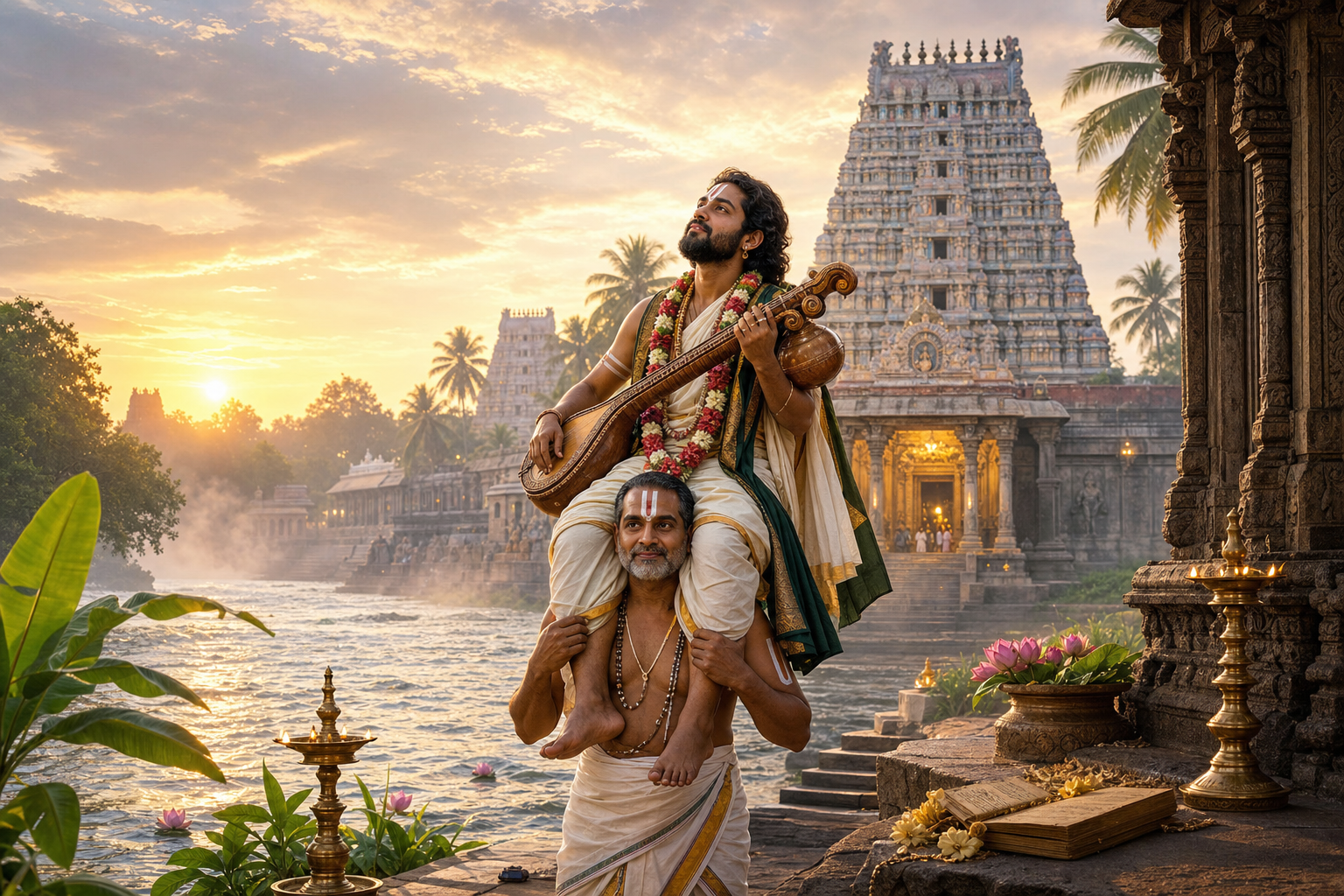
The most famous episode in his life is remembered as the Muni Vahana legend. According to Sri Vaishnava tradition, Thiruppaan Alvar would stand on the banks of the river Kaveri, facing the Srirangam temple, singing in praise of Lord Ranganatha. Because of social conventions of the time, he is said to have considered himself unfit to enter the temple precincts. This point should be read with care. The story is not a celebration of exclusion; it is a spiritual critique of exclusion. Its enduring power lies in the way divine grace overturns human notions of purity, rank, and entitlement.
One day, the temple priest and sage Lokasaranga came to the Kaveri to draw water for temple worship. Thiruppaan Alvar, absorbed in devotion, did not hear the call to move aside. In some versions of the account, Lokasaranga, impatient or unaware of the saint’s inward state, threw a small stone to get his attention. The stone struck Thiruppaan Alvar on the forehead, causing him to bleed. The devotee, realizing that he had obstructed a servant of Ranganatha, quietly withdrew without anger. The moral gravity of the episode rests precisely here: the socially marginalized devotee responds with humility, while the established ritual functionary must learn a higher lesson from God Himself.
When Lokasaranga returned to the temple, tradition says he saw blood on the forehead of Lord Ranganatha. The wound of the devotee had appeared on the deity. This moment is the theological center of the legend. It teaches that the Lord is not distant from the pain of His bhakta. An injury to a devotee is an injury to the Divine. Such a message has deep resonance across dharmic traditions, where compassion, humility, and reverence for the inner spiritual worth of beings are treated as marks of true religious maturity.
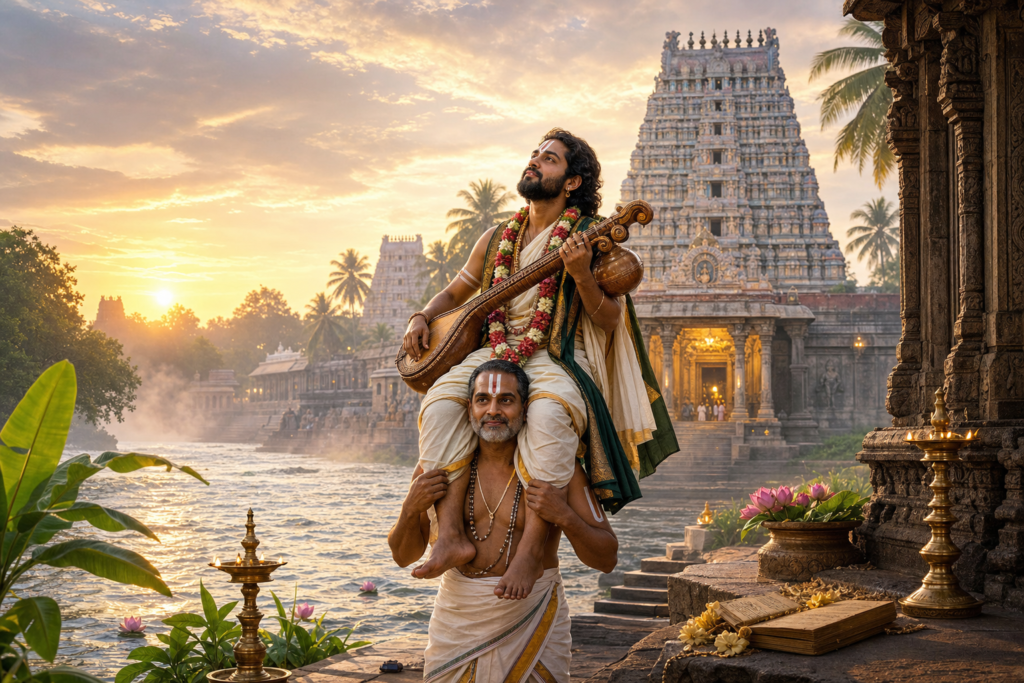
That night, Lord Ranganatha is believed to have appeared to Lokasaranga in a dream and instructed him to bring Thiruppaan Alvar into the temple. When the priest approached the saint, Thiruppaan Alvar refused to step into the sacred space, not from lack of devotion, but from extreme humility and the social conditioning of the time. Lokasaranga then carried him on his shoulders into the temple. This is why the episode is remembered through the title Muni Vahana, meaning the saint who was borne by the sage. The image is unforgettable: the religious representative who had once failed to recognize the devotee’s sanctity now becomes the vehicle through which that sanctity is publicly honored.
The legend offers a refined vision of social equality rooted in spiritual ontology. It does not simply say that all human beings deserve kindness, though that is certainly true. It goes further and asserts that bhakti can reveal a person’s divine intimacy more truly than outward status can. In the presence of Ranganatha, hierarchy collapses. What remains is devotion, surrender, and grace. This is why Thiruppaan Alvar’s story has remained so powerful in discussions of caste, dignity, and spiritual access within Hindu society.
When Thiruppaan Alvar entered the sanctum and beheld Lord Ranganatha, he composed the ten hymns of Amalanadhipiran. These verses are not merely descriptive poetry. They form a theological meditation on darshan. The Alvar begins with the divine feet, the traditional place of refuge in Vaishnava devotion, and then moves upward through the form of the Lord. This progression is not accidental. It reflects the inner movement of the devotee from surrender to wonder, from humility to intimacy, and from vision to union.
The opening movement toward the feet is especially important. In Sri Vaishnava theology, the feet of the Lord represent refuge, protection, and the path of prapatti, or complete surrender. To begin there is to acknowledge that the devotee does not conquer God through intellect or ritual power. The devotee is received by grace. Thiruppaan Alvar’s vision therefore becomes a model for temple worship itself: one approaches with humility, receives darshan gradually, and allows the divine presence to reshape the heart.
As the hymns proceed, the Alvar contemplates the beauty of Ranganatha’s form: the garments, the ornaments, the chest, the lips, and finally the eyes. This movement from feet to face is sometimes described as a complete visual pilgrimage through the divine body. Theologically, it affirms the sacredness of the form of Vishnu. Emotionally, it shows the psychology of bhakti: the devotee does not merely see an image; the devotee is seen, claimed, and transformed by the Lord’s presence.
The final experience of Thiruppaan Alvar is described in tradition as a merging with Lord Ranganatha. Whether read devotionally, symbolically, or theologically, this conclusion expresses the highest aspiration of bhakti: the self, purified by love, finds its fulfillment in the Divine. The Alvar’s life therefore moves from social distance to divine intimacy, from the riverbank outside the temple to union in the sanctum. That arc gives the story its emotional force and its continuing relevance.
Vedanta Desika, one of the great acharyas of the Sri Vaishnava tradition, gave special attention to Thiruppaan Alvar’s hymns. His work Munivahana Bhogam reflects on the depth of the Alvar’s experience, and the very title recalls the central legend of being carried by Lokasaranga. Vedanta Desika’s reverence shows that the ten verses of Amalanadhipiran were not treated as a minor contribution because of their brevity. They were recognized as dense with theological insight, devotional intensity, and contemplative power.
In the broader history of Tamil bhakti, Thiruppaan Alvar helps demonstrate how the Alvars made spiritual literature socially expansive. Their works were composed in Tamil, not only in Sanskrit, and they spoke to the lived religious world of temple, landscape, music, longing, and surrender. This does not diminish Sanskritic learning; rather, it shows the dharmic ability to honor multiple channels of revelation, devotion, and cultural expression. Tamil devotional literature and Vedic theology meet in the Sri Vaishnava tradition as complementary streams, not competing worlds.
Thiruppaan Alvar’s memory is also closely connected with Srirangam. The Ranganathaswamy Temple is not simply a backdrop to his story; it is the sacred stage on which the meaning of his life becomes visible. The temple, the Kaveri, the deity, the priest, the devotee, and the hymn all form one integrated sacred narrative. In annual observances, the saint is honored with processions, recitations, and ritual respect. These practices preserve the story not as a distant legend, but as a living memory enacted through temple culture.
The celebration of Thiruppaan Alvar’s thirunakshatram, especially in the Srirangam and Uraiyur region, reinforces the continuity of the tradition. The recitation of Amalanadhipiran during worship allows devotees to participate in the Alvar’s vision. The devotee who hears these verses is invited to stand, inwardly, where the Alvar stood: before Ranganatha, with no claim except love. This is why the hymns remain spiritually useful even for those who approach them centuries later and from very different social contexts.
The social teaching of Thiruppaan Alvar’s life should not be reduced to a modern slogan, yet it has unmistakable relevance for modern society. It reminds communities that ritual life without compassion becomes incomplete. It also reminds reform-minded readers that social dignity need not be separated from sacred tradition; in this case, the tradition itself preserves a story in which God corrects social arrogance and publicly honors the devotee whose love is pure. That is a profound internal resource for ethical reflection within Hindu dharma.
His life also supports a broader dharmic principle shared in different forms across Hinduism, Buddhism, Jainism, and Sikhism: inner transformation matters more than inherited identity. Each tradition articulates this insight in its own vocabulary, but the shared moral intuition is clear. Humility, compassion, self-discipline, devotion, and truthfulness reveal spiritual worth more reliably than social labels. Thiruppaan Alvar’s story is therefore especially valuable for a blog committed to unity among dharmic traditions, because it presents equality not as a rejection of sacredness, but as its natural expression.
The emotional appeal of the story lies in its simplicity. A devotee sings outside the temple. A priest fails to recognize him. The deity intervenes. The devotee is carried into the sanctum. A hymn is born. Yet within this simple structure lies an entire theology of grace. The Lord hears the one whom society overlooks. The Lord identifies with the wounded devotee. The Lord commands that humility be restored through service. The Lord receives the song of the bhakta as an offering worthy of preservation for generations.
From a literary perspective, Amalanadhipiran belongs to the finest stream of Tamil devotional poetry because it combines precision of image with intensity of experience. The poem does not wander into abstraction. It sees. It lingers. It allows the divine form to unfold gradually. This is one reason the work has been treasured by acharyas, temple reciters, musicians, and devotees. It gives language to a form of darshan in which beauty becomes theology and vision becomes liberation.
Thiruppaan Alvar’s legacy also challenges contemporary readers to examine how spiritual communities recognize holiness. A tradition may possess rich scriptures, beautiful rituals, and ancient institutions, yet its deepest truth is tested in how it responds to the humble devotee. The Muni Vahana episode teaches that spiritual authority is purified when it bows before bhakti. Lokasaranga’s transformation is therefore as important as Thiruppaan Alvar’s exaltation. The priest becomes greater not by defending status, but by obeying divine instruction and carrying the devotee with reverence.
This is why Thiruppaan Alvar remains more than a historical or hagiographical figure. He is a continuing ethical presence within Sri Vaishnava memory. His life teaches that devotion can be musically expressed, socially transformative, theologically profound, and personally tender at the same time. It teaches that a temple is truly sacred when it reflects the compassion of the deity within it. It teaches that the Lord’s grace may choose the person whom society least expects and then ask everyone else to learn from that choice.
In the final assessment, Thiruppaan Alvar’s life is a radiant chapter in Hindu spirituality, Tamil heritage, and the Bhakti Tradition. His ten verses in the Naalayira Divya Prabandham continue to draw seekers toward Lord Ranganatha’s feet, while his story continues to call communities toward humility and social equality. His message is not only that God loves the devotee; it is that God refuses to be separated from the devotee’s dignity. That insight gives his life its enduring power and makes his memory essential for anyone seeking to understand the spiritual heart of Sri Vaishnavism.
Inspired by this post on Hindu Pad.






Leave a Reply
You must be logged in to post a comment.