
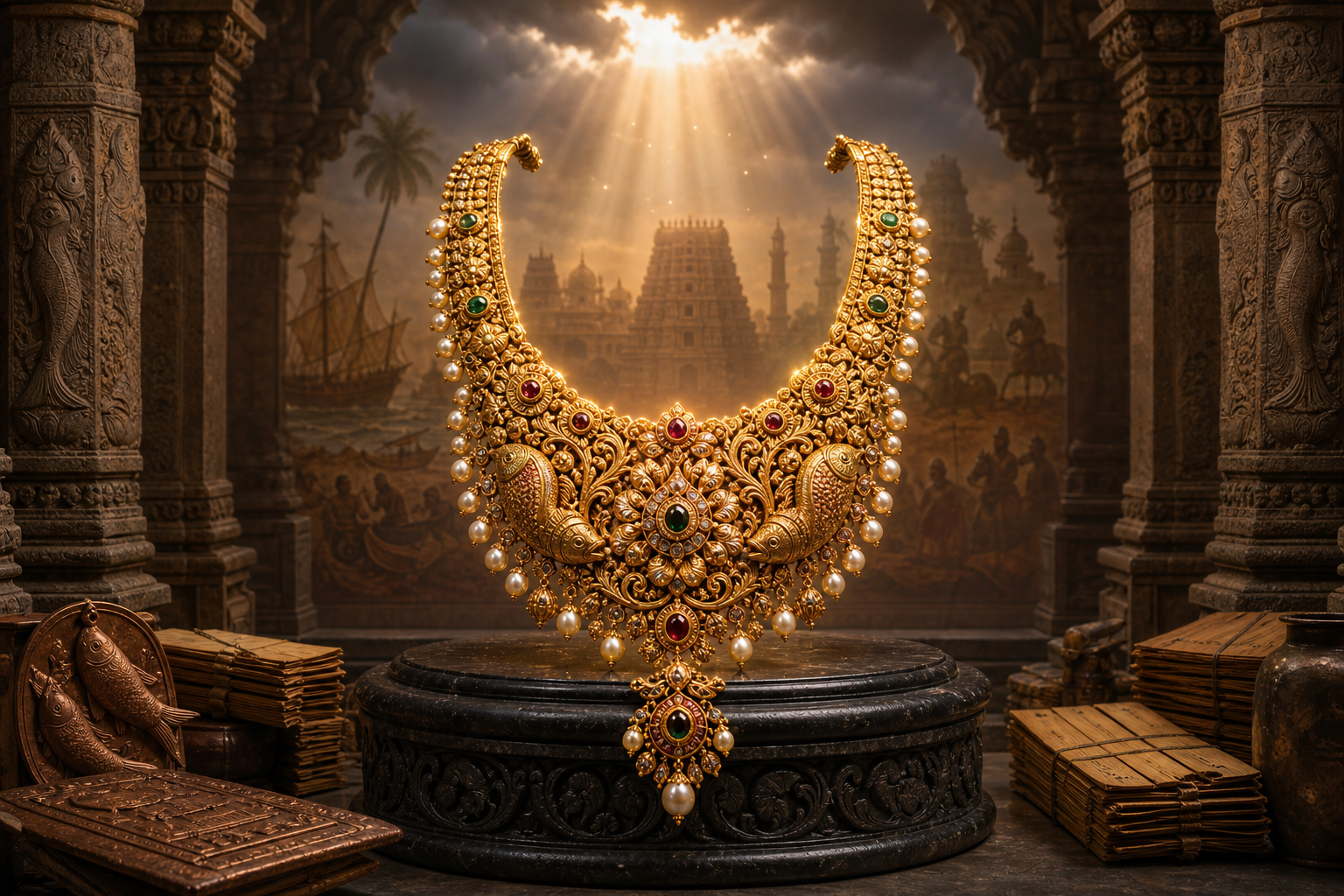
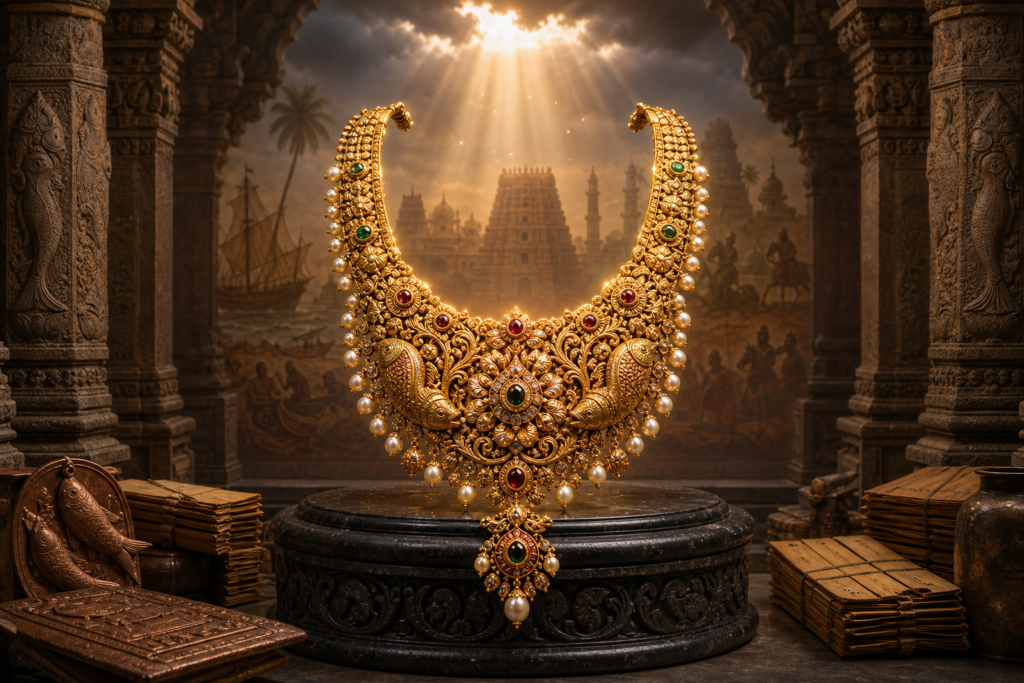
Indra Haram occupies a fascinating place in Tamil historical imagination because it brings together three powerful worlds: sacred mythology, royal legitimacy, and literary memory. The term is generally understood as a divine golden ornament, traditionally described as a precious haram or necklace associated with Lord Indra and said to have been presented to an ancient Pandiyan King. Though the surviving reference is brief, its cultural meaning is expansive. It is not merely a jewel in a physical sense; it is a symbol of divine favor, royal authority, and the remembered prestige of the Pandiyan line.
For many readers, the name Indra Haram first becomes meaningful through the world of Ponniyin Selvan, Kalki Krishnamurthy’s celebrated Tamil historical novel. The novel, first serialized in the early 1950s and later published in five volumes, draws readers into the 10th-century political atmosphere of the Chola Empire, the Pandiyan resistance, and the complex emotional lives of rulers, warriors, spies, queens, ascetics, and common people. Within that literary universe, royal objects carry more than decorative value. Crowns, swords, jewels, seals, and ornaments become instruments of memory, proof of lineage, and symbols around which loyalty and rivalry gather.
The traditional description of Indra Haram as divine golden jewellery gifted by Lord Indra to a Pandiyan ruler reflects a broader Indian pattern in which kingship is linked to cosmic approval. In dharmic thought, a ruler is not honored only for military conquest or inherited power. A legitimate ruler is expected to preserve order, protect sacred institutions, support learning, and act within dharma. When a royal ornament is linked to a deity, its meaning becomes ethical as well as political. It suggests that sovereignty must be worthy of divine trust.
The Pandiyan association is especially important. The Pandya dynasty was one of the great ancient Tamil lineages, remembered along with the Cholas and Cheras as part of the classical Tamil political world. Madurai, the great Pandiyan center, became inseparable from Tamil literature, temple culture, and sacred geography. Sources on ancient Tamil history connect the Pandyas with early Tamil poetry, inscriptions, trade, pearls, patronage, and the religious diversity of South India, including Hindu, Jain, and Buddhist traditions across different periods. In that setting, a jewel such as Indra Haram functions as a compact symbol of a much larger civilizational memory.
The word haram itself invites attention. In South Indian usage, a haram is a necklace or long ornament worn around the neck, often associated with dignity, beauty, ritual importance, and auspiciousness. Gold, in temple and royal contexts, is not merely wealth. It is brightness, permanence, purity, and offering. A golden ornament worn by a ruler could mark status, but when imagined as divine in origin, it also points toward a sacred responsibility. The ruler who possesses it is expected to embody restraint, generosity, courage, and protection.
In the narrative atmosphere surrounding the Cholas and the Pandiyas, objects such as Indra Haram help explain why royal treasures mattered so deeply. They were not isolated valuables stored in palaces. They were signs of continuity. A lost jewel could represent a wounded kingdom. A recovered ornament could signal the restoration of honor. A divine necklace could become the silent witness of a dynasty’s rise, humiliation, exile, and hope for renewal.
This is why Ponniyin Selvan remains such an important point of entry for modern readers. The novel is historical fiction, not a documentary archive, yet it is rooted in a serious engagement with the Chola period, Tamil landscape, inscriptions, legends, and political memory. Its portrayal of Chola-Pandiyan tensions helps readers understand how dynastic conflict could carry emotional and symbolic weight. A ruler’s emblem, a royal jewel, or a secret regalia could become more powerful than a battlefield because it preserved the idea of sovereignty even after military defeat.
The Chola world also deepens the significance of Indra Haram. Rajaraja Chola I, born Arul Mozhi Varman and remembered as one of the greatest Chola rulers, expanded Chola influence across South India and Sri Lanka and helped establish a powerful Indian Ocean presence. The Chola period was marked by temple construction, administrative organization, maritime activity, and a sophisticated political culture. When literary memory places Pandiyan treasures beside Chola ambition, it presents history as a contest not only for territory but for legitimacy, prestige, and sacred inheritance.
At the same time, the story should not be reduced to rivalry alone. A dharmic reading of Indra Haram allows a broader and more unifying interpretation. Chola, Pandiyan, Chera, Jain, Buddhist, Shaiva, Vaishnava, and other traditions all contributed to the layered cultural life of South India. The jewel becomes a reminder that civilizational heritage is not owned by one dynasty in isolation. It belongs to the larger memory of a people who preserved temples, poetry, ethical teachings, ritual practices, maritime networks, philosophical inquiry, and artistic excellence across centuries.
The figure of Lord Indra also matters. In Vedic and Puranic traditions, Indra is associated with divine kingship, the heavens, rain, power, and the protection of cosmic order. A gift from Indra to a human king symbolizes more than favor; it suggests a bond between earthly rulership and celestial responsibility. Such motifs are common in Indian sacred storytelling, where divine gifts are never casual possessions. They test character. They ask whether the recipient can uphold dharma without being consumed by pride, greed, or violence.
Seen in this way, Indra Haram becomes a teaching object. It asks what makes an ornament truly valuable. Is it the gold? The craftsmanship? The royal owner? The divine association? Or is it the ethical memory attached to it? The most meaningful answer lies in the combination of all these layers. Its value is material, artistic, political, and sacred, but its highest value is civilizational. It reminds later generations that treasures endure when they carry ideals greater than personal possession.
There is also a deeply human dimension to such legends. Readers are often drawn to royal jewels because they condense large histories into something tangible. A person may not remember every battle, every inscription, or every succession dispute, but the image of a divine golden necklace remains vivid. It gives memory a shape. It lets the mind hold a dynasty, a temple city, a lost kingdom, and a sacred promise in a single image. That emotional clarity is one reason such symbols survive in literature and oral tradition.
From a historical perspective, care is necessary. Indra Haram should be approached as a sacred-literary and cultural motif unless supported by direct inscriptional, archaeological, or museum evidence. Academic study must distinguish between verifiable artifact history and inherited narrative memory. Yet this distinction does not make the motif unimportant. Many civilizational symbols begin in story, ritual, and poetic imagination before becoming subjects of historical inquiry. Their value lies in what communities remember through them.
The Pandya dynasty itself is well attested through literary, inscriptional, and external references. Ancient Tamil sources celebrate Pandiyan rulers, while inscriptions and wider South Asian records help establish the dynasty’s long presence in Tamilakam. The Pandyas were associated with Madurai, Korkai, pearls, trade, temple patronage, and the religious life of the Tamil region. This historical foundation gives depth to any legend connected with a Pandiyan King, even when a specific object such as Indra Haram belongs more securely to the symbolic and literary imagination than to confirmed material history.
Indra Haram also reveals how Indian historical memory often works through sacred aesthetics. A jewel is beautiful, but its beauty is never merely ornamental. It becomes a carrier of rasa, devotion, authority, grief, longing, and remembrance. In temple culture, jewellery offered to deities expresses love and reverence. In royal culture, jewellery expresses rank and sovereignty. In literature, jewellery often reveals hidden identity, lost inheritance, or moral conflict. Indra Haram stands at the meeting point of all three meanings.
The connection with Tamil literature is equally significant. Ponniyin Selvan has shaped the modern imagination of the Chola age for generations of readers. Its appeal lies not only in political intrigue but in its ability to make history emotionally accessible. Through characters such as Arul Mozhi Varman, Kundavai, Vandiyathevan, Nandini, Azhwarkadiyan Nambi, and others, the novel presents a world where personal loyalty and public duty constantly collide. In that kind of world, an object like Indra Haram can become a quiet but powerful sign of unresolved history.
For contemporary readers, the lesson is not to chase royal glamour alone. The deeper lesson is to understand how societies encode values in objects. A sacred ornament can teach humility if it reminds people that wealth must serve dharma. A royal jewel can teach historical awareness if it leads readers toward the study of Tamil history, temple inscriptions, classical literature, and regional traditions. A legendary necklace can teach unity if it is understood as part of a shared dharmic inheritance rather than a narrow dynastic possession.
This unifying approach is essential. South Indian history contains moments of rivalry, conquest, alliance, patronage, devotion, and cultural exchange. The Cholas and Pandiyas competed, but both contributed to the greatness of Tamil civilization. Jain monks, Buddhist institutions, Shaiva saints, Vaishnava poets, temple architects, merchants, scholars, and rulers all helped shape the region’s heritage. Indra Haram, when read generously, becomes a symbol not of division but of the shared sacred imagination that allowed many paths to coexist within a larger civilizational framework.
The continued interest in Indra Haram also reflects a modern need. In an age when history is often consumed quickly and selectively, such symbols encourage slower attention. They invite readers to ask better questions: What did kingship mean in ancient Tamil society? How did sacred objects create legitimacy? How did literature preserve memories that formal chronicles did not always record? How can myths be respected without confusing them with proven archaeology? These questions make the subject richer and more responsible.
The most compelling way to understand Indra Haram is therefore layered. At the surface, it is divine golden jewellery. In literary memory, it is connected with the world of Ponniyin Selvan, the Cholas, and the Pandiyas. In cultural history, it evokes the prestige of the Pandya dynasty and the sacred aura of Madurai. In spiritual interpretation, it symbolizes divine trust, dharmic kingship, and the obligation to protect order. In modern reflection, it becomes a bridge between scholarship and devotion, between fact and memory, between regional pride and civilizational unity.
Indra Haram ultimately shines because it is more than gold. It is a remembered jewel of Tamil historical consciousness, a sacred image through which readers encounter the grandeur of the Pandiyan tradition, the drama of Chola-Pandiyan history, and the enduring power of dharmic symbolism. Its story encourages careful study, reverence for heritage, and respect for the many traditions that have shaped Bharat’s spiritual and cultural life.
Further context may be explored through resources on Indra Haram, Ponniyin Selvan, the Pandya dynasty, and Rajaraja Chola I, with the understanding that literary tradition and documented history should be read together but not treated as identical categories.
Inspired by this post on Hindu Pad.






Leave a Reply
You must be logged in to post a comment.