
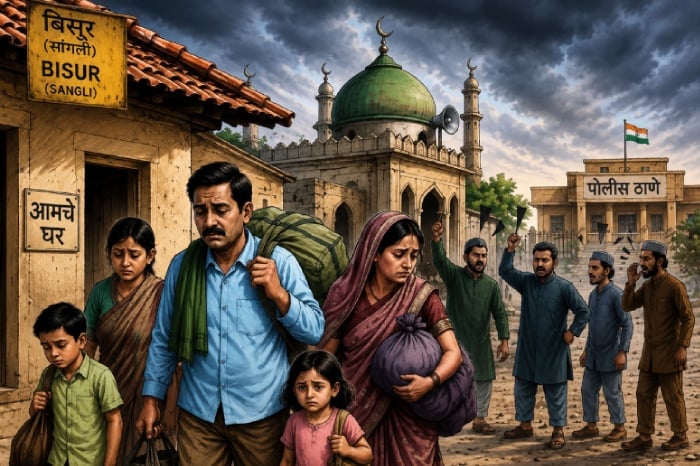
The situation reported from Bisur village in Maharashtra’s Sangli district raises a serious question about local security, community confidence, and the responsibility of public institutions when ordinary families begin to feel unsafe in their own neighbourhoods. According to the available account, around 10 Hindu families in the village are allegedly preparing to leave their homes because of continued harassment by fanatical elements said to be present near a local mosque. The claim also states that some of those involved may have come from other districts or states, which makes the issue not only a matter of local tension but also one requiring careful police verification.
Such incidents must be discussed with precision. The available information is brief, and the allegations require investigation by competent authorities. At the same time, when residents say they are living under fear and are considering displacement, the matter cannot be dismissed as a routine neighbourhood dispute. Fear itself becomes a social fact when it changes daily movement, family decisions, economic security, and the ability of citizens to remain rooted in their ancestral homes.
Hindu Ekta Andolan has reportedly demanded immediate police intervention and warned that stronger action may follow if the alleged harassment continues. The demand for intervention reflects a wider expectation that law enforcement should act early, transparently, and without political hesitation. In a constitutional democracy, the most important response to local intimidation is not retaliatory mobilisation but impartial enforcement of law, protection of vulnerable families, and a clear message that no group may dominate public space through fear.

The core issue in Bisur is the reported erosion of a basic civic assurance: that families should be able to live, worship, travel, work, and raise children without being subjected to intimidation. For Hindu families in a village setting, home is rarely only a private asset. It is often connected to family memory, local temples, kinship networks, agricultural or small business livelihoods, seasonal festivals, and a social world built over generations. When families contemplate leaving, the loss is therefore not merely residential. It can become cultural displacement.

From an administrative perspective, the first requirement is fact-finding. Police must identify whether harassment occurred, who was involved, whether the accused are local residents or outside elements, whether there are prior complaints, and whether any pattern of intimidation is visible. If the allegations are verified, preventive measures, arrests where legally warranted, peace bonds, surveillance of sensitive locations, and regular patrolling may be necessary. If misinformation or exaggeration is discovered, that too must be addressed through public communication so that rumours do not deepen communal suspicion.
The reported reference to harassment near a mosque requires particular care. Places of worship should never become zones of coercion, provocation, or territorial control. They should remain spaces of prayer, discipline, and ethical reflection. The same principle applies to temples, gurudwaras, Jain derasars, Buddhist viharas, churches, mosques, and all sacred institutions. When any religious space becomes associated with fear in the minds of neighbouring residents, community elders and law enforcement both have a duty to restore confidence.

A mature civic response must distinguish between a religious community and alleged fanatical actors. The concern reported from Bisur is not a licence to blame all members of any faith. It is a call to identify and restrain those who may be using numbers, location, or organised pressure to harass ordinary residents. This distinction is essential for social harmony. It protects innocent citizens while ensuring that extremists cannot hide behind collective identity.
For dharmic communities, including Hindus, Buddhists, Jains, and Sikhs, the safety of households has always been linked with the larger idea of dharma: social order grounded in justice, restraint, and mutual responsibility. A society that permits intimidation weakens dharma because it allows fear to replace rightful conduct. A society that responds with fairness, courage, and lawful discipline strengthens dharma because it protects both the vulnerable and the public order on which coexistence depends.

The emotional dimension should not be underestimated. Families who speak of leaving their homes are often not making a symbolic statement. They may be weighing children’s safety, elderly parents’ anxiety, women’s mobility, business losses, social isolation, and the painful possibility of abandoning land or property that carries family history. In village life, relocation is not simple. It can mean the breaking of relationships, the loss of informal support systems, and the humiliation of feeling unprotected in a place one has long called home.
This is why early police intervention matters. Once fear hardens into migration, administrative failure becomes difficult to repair. A prompt visit by senior officers, recording of statements, visible patrolling, complaint registration, and direct communication with affected families can prevent escalation. Equally important is engagement with local religious and community leaders so that the message is unambiguous: harassment, threats, and coercive behaviour will not be tolerated from anyone.
In such cases, documentation is critical. Families should be encouraged to record incidents lawfully, preserve messages or threats if any exist, note dates and times, identify witnesses, and file written complaints. Community organisations can assist by helping residents navigate legal procedures without inflaming the situation. A disciplined documentation process makes it easier for police and courts to separate fact from rumour and targeted harassment from ordinary disagreement.
The alleged involvement of people from outside the village, if verified, would deserve additional scrutiny. External actors can intensify local disputes because they do not bear the long-term social cost of damaged relations. Villages often rely on everyday coexistence: shared markets, water sources, transport routes, schools, festivals, and agricultural cooperation. Outside agitation can disturb these arrangements quickly. Therefore, police should examine whether there is any organised pattern, external funding, political patronage, or deliberate attempt to create communal tension.
At the same time, community leaders must avoid turning fear into collective hostility. The objective should be protection, not escalation. The language of public response should remain firm, factual, and legally grounded. When the issue concerns the safety of Hindu families, advocacy must centre on their rights as citizens: the right to residence, dignity, religious freedom, freedom of movement, and protection from intimidation. These rights are strongest when defended through constitutional language rather than uncontrolled rhetoric.
Maharashtra has a long history of social reform, devotional movements, local self-organisation, and robust public debate. The moral inheritance of the region includes both courage and restraint. In that context, the Bisur episode should be treated as a test of administrative seriousness. If the allegations are genuine, the state must act decisively. If tensions are being manipulated, that manipulation must also be exposed. Either way, silence is not a solution.
The broader lesson is that communal harmony cannot be sustained by asking frightened families to remain quiet. Harmony requires justice. It requires institutions that respond before citizens lose faith. It requires community elders who discourage provocation. It requires religious spaces that reject intimidation. It also requires public discourse that does not erase the pain of minority clusters within localities, even when those families belong to a national religious majority.
The reported plight of Hindu families in Bisur therefore deserves careful attention from the Sangli administration, Maharashtra Police, civil society, and local community representatives. The immediate priority should be safety and confidence-building. The longer-term priority should be prevention: mapping sensitive areas, ensuring fair enforcement, discouraging outside mischief, and creating a local mechanism through which grievances can be heard before they become crises.
No family should be forced, directly or indirectly, to abandon its home because of harassment. No place of worship should become a site around which fear gathers. No community should be collectively blamed for the alleged conduct of fanatical elements. The path forward lies in lawful firmness, factual investigation, and a dharmic commitment to protect the dignity of every peaceful household.
Inspired by this post on Hindu Jagruti Samiti.









Leave a Reply
You must be logged in to post a comment.