
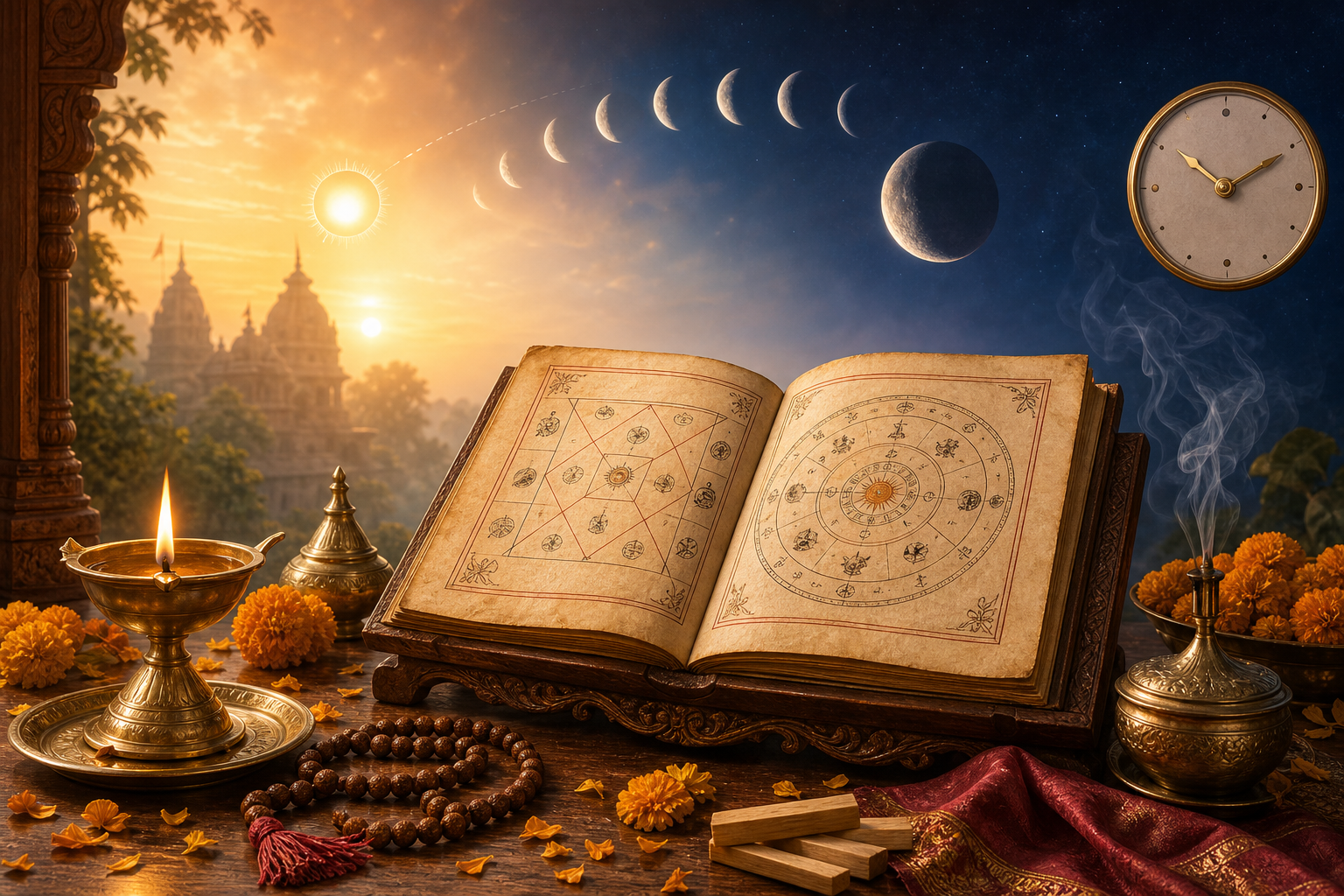
On Monday, July 6, 2026, the Hindu calendar marks Krishna Paksha Sashti tithi in most regions, followed by Krishna Paksha Saptami after 9:26 AM. This means the day begins under the sixth lunar day of the waning phase of the moon and then moves into the seventh lunar day. In the language of Panchang, this transition is not a minor detail; it is the central rhythm by which many households, temples, and practitioners organize worship, vrata observance, travel, study, and other meaningful activities.
Krishna Paksha refers to the dark or waning fortnight of the lunar month, the period after Purnima when the visible moon gradually decreases. In Hindu time-reckoning, this phase is often associated with introspection, discipline, reduction, remembrance, and inward-oriented sadhana. Such interpretations vary across regions and sampradayas, yet the broad cultural idea remains familiar: as the moon wanes, attention naturally turns toward restraint, reflection, and the quieter forms of spiritual practice.
The tithi active at sunrise often carries practical importance in the traditional reading of a day. Since Krishna Paksha Sashti is present until 9:26 AM on July 6, 2026, the early part of the day is identified with Sashti. After that time, Krishna Paksha Saptami begins. For those who consult the Panchang for vrata, puja, sankalpa, temple worship, or family observances, this timing helps clarify which lunar day is in force at a particular moment.
Technically, a tithi is not the same as a civil date. A civil date runs from midnight to midnight, while a tithi is determined by the angular distance between the Sun and the Moon. One tithi corresponds to a 12-degree difference in their relative positions. Because the Moon’s motion is not identical to the fixed rhythm of the clock, a tithi may begin or end at any time of day. This is why Panchang entries frequently specify exact transition times, such as the 9:26 AM change from Krishna Paksha Sashti to Krishna Paksha Saptami on this date.
Sashti, the sixth tithi, has a respected place in Hindu tradition. In many communities, Sashti is associated with discipline, protection, health, and devotion, and it is often connected with worship of deities such as Lord Subrahmanya, Skanda, Murugan, or Kartikeya, depending on regional practice. Not every Sashti has the same ritual weight, and local calendars may distinguish special Sashti observances from ordinary ones. Still, the presence of Sashti in the morning gives the day a recognizable devotional character for many practitioners.
Saptami, the seventh tithi, begins after 9:26 AM. Saptami is widely known in relation to Surya worship, especially on certain named Saptami days such as Ratha Saptami. The July 6, 2026 entry does not by itself identify a major festival, but the movement from Sashti to Saptami remains significant for daily Panchang interpretation. It reminds readers that Hindu calendar time is layered: a single civil day can carry more than one lunar influence.
For practical use, this Panchang information is most helpful when read with location in mind. Traditional Panchang calculations depend on sunrise, lunar longitude, solar longitude, and local time. A time such as 9:26 AM should therefore be treated as the stated reference timing for the calendar entry, while serious ritual observance may still require confirmation from a regional Panchang, temple priest, family tradition, or locally calculated calendar.
The title of this daily Hindu calendar entry also points toward Nakshatra, Rashi, and good time, but the supplied source text provides only the tithi transition. A careful and factual interpretation should therefore avoid inventing missing Nakshatra or Rashi details. In the wider Panchang system, Nakshatra indicates the lunar mansion occupied by the Moon, while Rashi indicates the zodiac sign relevant to the Moon’s position. These factors are often studied together with tithi, yoga, karana, sunrise, sunset, Rahu Kaal, Gulika Kaal, and Yamaganda when selecting a suitable time for specific activities.
The idea of a “good time” in Panchang should also be understood with nuance. Hindu tradition does not treat time merely as a mechanical measurement. Time is interpreted as a field of qualities, tendencies, and relational suitability. A time may be appropriate for prayer, study, charity, vrata, ancestor remembrance, temple visit, household work, or quiet contemplation, while another time may be avoided for initiating major worldly undertakings. This is not fatalism; it is a traditional discipline of aligning action with cosmic and social rhythm.
For many families, the daily Panchang is not only an astronomical table but a living cultural habit. A date such as July 6, 2026 becomes meaningful because it connects the ordinary Monday schedule with a much older lunar framework. The movement from Krishna Paksha Sashti to Krishna Paksha Saptami invites a pause before action: what should be completed early, what can begin later, and what form of worship or self-discipline feels appropriate for the day?
This daily Hindu calendar entry is also a reminder of the unity within Dharmic traditions. Hinduism, Buddhism, Jainism, and Sikhism have distinct theological and ritual frameworks, yet all preserve deep respect for disciplined living, remembrance, ethical conduct, and sacred time. In the Hindu Panchang context, tithi becomes a way to cultivate awareness. It teaches that time is not empty; it is lived, observed, honored, and made meaningful through right intention.
Readers using the July 6, 2026 Panchang for spiritual planning may therefore treat the morning as Krishna Paksha Sashti until 9:26 AM and the rest of the day as Krishna Paksha Saptami. Those performing formal rituals should confirm local sunrise-based rules and regional observances. Those using the Panchang for personal reflection may take the waning lunar phase as an invitation to simplify, review, pray, and move through the day with steadiness.
In summary, the essential Panchang note for Monday, July 6, 2026 is clear: Krishna Paksha Sashti continues until 9:26 AM, after which Krishna Paksha Saptami begins. This tithi transition gives the day its lunar structure and offers a meaningful framework for worship, reflection, and daily conduct within the Hindu calendar tradition.
Inspired by this post on Hindu Blog.





Leave a Reply
You must be logged in to post a comment.