
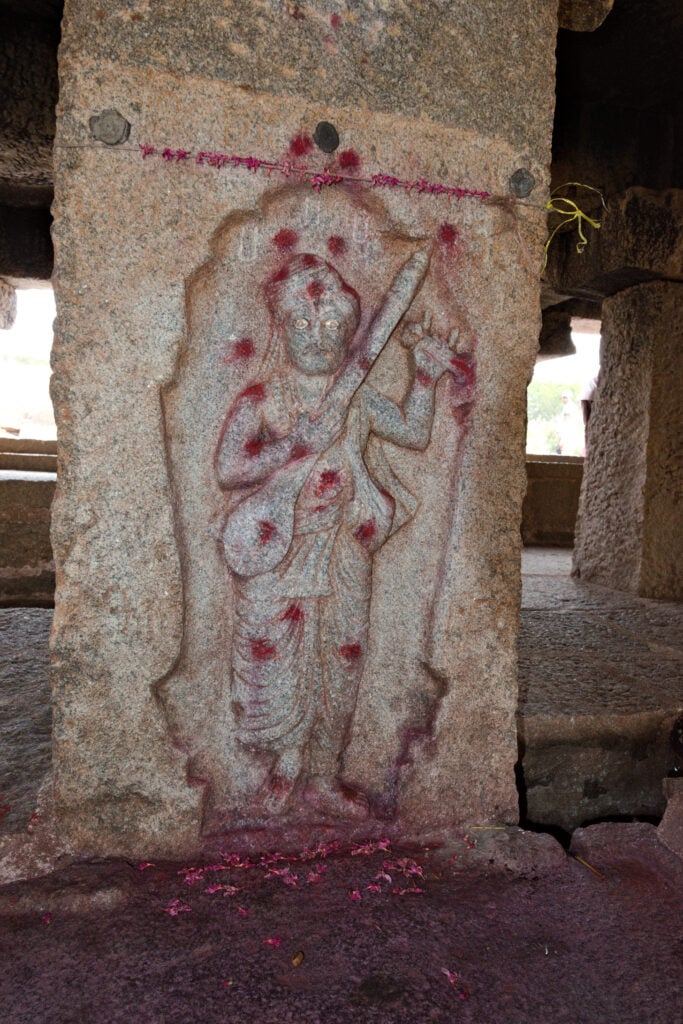
A December evening in Chennai, during Margazhi, still carries the sound of a much older world. A Carnatic concert begins, as so many have begun, with Purandaradāsa’s Lambōdara Lakumikara, an invocation to Ganesha before the music unfolds. The hall grows quiet, the tāmpurā settles into pitch, and the first line enters a space already prepared by memory, ritual, and inherited discipline.
What appears to be a familiar devotional opening is also a remarkable case of cultural continuity. The composition belongs to the first half of the sixteenth century, to the world of Hampi and the Vijayanagara Empire. Hampi was devastated in 1565 after the Battle of Tālikōṭa, yet the song, its Kannada idiom, its devotional purpose, and its melodic life continued to travel across homes, maṭhas, temples, concerts, and teaching lineages. Between the hand of Purandaradāsa and the voice of a modern singer stand nearly five centuries of political upheaval, colonial language policy, social change, and institutional reconfiguration. The transmission did not break.
This continuity is not an accident of nostalgia. It is the result of a carefully layered pedagogical system created within the Madhva sampradāya of Karnataka. The Haridāsa movement did not merely produce devotional poetry; it built a durable method for carrying Vedantic thought, musical discipline, Kannada literary expression, and household piety across generations. Its achievement belongs to the history of bhakti, but also to the history of education, institutional design, oral transmission, and cultural resilience.
Purandaradāsa is rightly remembered as Saṅgīta Pitāmaha, the patriarch of Carnatic music. His songs are sung in concert halls, taught to children before they fully understand their meanings, heard during Mārgaśīrṣa observances, and carried into domestic worship. Yet the persistence of his compositions cannot be explained by musical beauty alone. Many medieval devotional movements left behind brilliant texts, small lineages, and scholarly editions. The Haridāsa corpus left something wider: a living daily presence across Karnataka, Tamil Nadu, and the broader South Indian devotional world.
The central question, therefore, is structural. Why did this tradition endure with such strength? Why did it remain audible in the voice of the grandmother at ārati, the student in music class, the pontiff in a maṭha, and the professional musician on stage? The answer lies in five design moves associated with five key figures and lineages: Śrī Śrīpādarāja, Śrī Vyāsatīrtha, Purandaradāsa, Kanakadāsa, and the later Haridāsas such as Vijaya Dāsa, Gopāla Dāsa, and Jagannātha Dāsa.
Mulbagal and the First Design Move: Śrī Śrīpādarāja
Śrī Śrīpādarāja, associated with the maṭha at Mulbagal in present-day Kolar district, entered Brindavana around 1480. In the Madhva sampradāya, a Brindavana is not merely a memorial. It marks the sacred site where a sannyāsi-pontiff enters eternal samādhi, and it continues to function as a living point of reverence and lineage memory. Śrī Śrīpādarāja’s Brindavana at Mulbagal remains part of that continuing sacred geography.
By his time, the Madhva philosophical tradition had already developed a rich Sanskrit corpus. Śrīman Madhvācārya’s Brahmasūtra Bhāṣya, Anuvyākhyāna, and Mahābhārata Tātparya Nirṇaya circulated among scholars trained in śāstric study. These works carried the intellectual architecture of Dvaita Vedanta. But the language of that architecture was not accessible to the majority of householders who sustained devotional life.
This was the first major problem of transmission: the tradition’s deepest philosophical resources existed in Sanskrit, while much of its lived devotional community functioned in Kannada and other regional idioms. Such a gap is not unique to the Madhva world. Many premodern traditions faced the same difficulty: the conceptual core of the system resided in a learned language, while its emotional and ritual life depended on people who did not have direct access to that language.
Śrī Śrīpādarāja responded by strengthening the Kannada devotional channel. Earlier precedents existed, including Kannada hymns attributed to Śrī Naraharitīrtha, a direct disciple of Śrīman Madhvācārya. Yet Śrī Śrīpādarāja made the vernacular channel systematic. He composed devaranāmas that carried Madhva-Dvaita philosophical content in a form that could be sung, remembered, and circulated. Works attributed to him, including Bhramaragīta, Veṇugīta, Gopīgīta, and Madhvanāma, show how doctrine could be translated into memorized devotion without losing its theological identity.
The method can be seen in a phrase preserved in the tradition:
ಭೂಷಣಕೆ ಭೂಷಣ
bhūṣaṇake bhūṣaṇa
(the ornament of ornaments)
Here, a theological idea concerning Śrī Hari as the source of all value, beauty, and goodness enters a Kannada devotional idiom. A scholar may approach the same idea through Sanskrit reasoning and commentary. A household devotee may arrive through image, song, repetition, and emotional recognition. The levels of access differ, but the movement of meaning remains connected.
This was the first design move: vernacular access without doctrinal abandonment. The Kannada devaranāma became an access layer for Madhva philosophy. It did not replace Sanskrit learning; it carried its essential insights into the devotional life of ordinary people. In modern terms, the system now had multiple interfaces. The scholar had the commentary. The householder had the song. Both belonged to the same tradition.
Hampi and the Institutional Layer: Śrī Vyāsatīrtha
Śrī Vyāsatīrtha, also known as Vyāsarāja, lived from 1460 to 1539. He was one of the great scholar-pontiffs of the Madhva tradition and served as rāja-guru to Krishnadevaraya during the emperor’s reign from 1509 to 1529. His work operated at several levels at once: philosophical, musical, institutional, and political.
In Sanskrit, Śrī Vyāsatīrtha composed major works such as Nyāyāmṛta, Tarka Tāṇḍava, and Tātparya Candrikā. These texts belong to the technical world of Vedantic debate, especially the intellectual dialogue among Dvaita, Advaita, and other philosophical schools. They show a tradition confident enough to argue rigorously within the shared Dharmic arena of śāstra.
In Kannada, he also composed devaranāmas. The best-known among them is Krishna Nī Bēgane Bārō, often sung in raga Yamunakalyāni:
ಕೃಷ್ಣಾ ನೀ ಬೇಗನೇ ಬಾರೋ, ಬೇಗನೇ ಬಾರೋ ಮುಖವನ್ನು ತೋರೋ
kṛṣṇā nī bēgane bārō, bēgane bārō mukhavannu tōrō
(Krishna, come quickly, come quickly and show me your face)
The song now belongs not only to a sectarian archive but to a broad devotional and cultural soundscape. It is sung by trained musicians, household devotees, children, and listeners who may not identify with the Madhva sampradāya in a formal sense. Its reach demonstrates the expansive capacity of bhakti when philosophical identity and musical beauty are held together.
Yet Śrī Vyāsatīrtha’s most decisive contribution to the Haridāsa movement lay in institutional design. Under Krishnadevaraya, the Vijayanagara state offered protection and patronage to religious institutions without fully absorbing them into royal control. The maṭhas received support, trained scholars, preserved manuscripts, fed pilgrims, and sustained teaching networks. This arrangement gave the Haridāsa movement a durable physical and intellectual base.
The arrival of Śrīnivāsa Nāyaka at Hampi in 1525 marks a pivotal moment. A wealthy merchant who had renounced his fortune came with his family to Śrī Vyāsatīrtha, received initiation, and became Purandaradāsa. The maṇṭapa associated with his residence, known as Purandara Dāsa Maṇṭapa, still stands in Hampi’s sacred landscape. In historical memory, this meeting joins the scholar-pontiff, the renunciant-composer, the imperial city, and the vernacular devotional future of South India.
Śrī Vyāsatīrtha did not compose Purandaradāsa’s songs. His role was different and equally consequential. He recognized, protected, and housed the conditions under which such a composer could transform the devotional life of a region. The maṭha became the node where teaching, correction, manuscript preservation, musical memory, and philosophical framing could converge.
When Śrī Vyāsatīrtha entered Brindavana in 1539 at Anegundi, the institutional structure he had strengthened did not disappear with him. When Vijayanagara fell twenty-six years later, the Haridāsa tradition was not destroyed with the capital. This was the second design move: institutional redundancy. A political empire could fall, but a network of maṭhas, teachers, singers, households, and pilgrims could continue.
Purandaradāsa and the Technology of Singability
Purandaradāsa began life as Śrīnivāsa Nāyaka, a wealthy merchant associated with gemstones and money-lending in central Karnataka. Tradition remembers him as Navakoṭi Nārāyaṇa, the man of immense wealth. His transformation is preserved through a hagiographic episode involving Lord Hari appearing as an aged Brahmin who repeatedly asks for support for his son’s sacred-thread ceremony.
Śrīnivāsa Nāyaka refuses the request. The Brahmin later approaches Saraswatī Bāī, the merchant’s wife, who gives him her diamond nose-ring from her strīdhana. When the same ornament appears in the merchant’s shop, Śrīnivāsa Nāyaka recognizes it and locks it in his safe. At home, however, his wife’s ornament box contains the nose-ring again. When he returns to the shop, the safe is empty. The event is understood within the sampradāya as a divine intervention that reveals the emptiness of wealth when it is severed from dharma and generosity.
In 1525, at Hampi, Śrī Vyāsatīrtha initiated him as Purandaradāsa. He then spent decades composing in Kannada, and tradition records his passing in 1564. The number of compositions attributed to him is sometimes given as 475,000, a hagiographic figure. The historically defensible surviving corpus is smaller, yet still immense in influence. The importance lies not in the inflated count but in the method he perfected.
Purandaradāsa used forms such as the kīrtana, the sulādi, and the ugābhoga. His compositions often bear the mudra Purandara Viṭhala, a signature that functions as a marker of devotional authorship and lineage identity. The mudra is not merely decorative. It allows a singing tradition to carry memory of its source even when transmitted orally across centuries.
His genius lay in doctrinal compression. A song such as:
ಜಗದೋದ್ಧಾರನ ಆಡಿಸಿದಳೆಶೋದಾ
jagadōddhārana āḍisidaḷeśōdā
(Yashoda played with the lifter of the world)
compresses a major devotional insight into a single domestic image. The child in Yashoda’s lap is also the sustainer of the universe. The image is tender, accessible, and theologically dense. It allows the listener to grasp, through affection, what a philosophical system may express through categories such as paramātman, saguṇa brahman, dependence, and divine supremacy.
Another example uses the language of food and household experience:
ರಾಮ ನಾಮ ಪಾಯಸಕ್ಕೆ, ಕೃಷ್ಣ ನಾಮ ಸಕ್ಕರೆ
ವಿಠಲ ನಾಮ ತುಪ್ಪವ ಕಲಸಿ ಬಾಯ ಚಪ್ಪರಿಸಿರೋ
rāma nāma pāyasakke, kṛṣṇa nāma sakkare
viṭhala nāma tuppava kalasi bāya capparisirō
(For the sweet-pudding made of Rāma’s name, Krishna’s name is the sugar;
mix in Viṭhala’s name as ghee, and smack your lips)
The theological idea of the divine name becomes a recipe. Rāma, Krishna, and Viṭhala are not treated as abstractions but as ingredients in a devotional sweetness familiar to every household. The grandmother at the grinding stone, the child near the kitchen, the worker humming at dawn, and the trained singer in a sabhā can all carry the same payload. This is not simplification in the shallow sense. It is pedagogical compression.
This was the third design move: singability as a transmission technology. The Haridāsa composition could be learned by ear, corrected by repetition, remembered through rhythm, and applied in daily life. Philosophical precision was distributed across layers: the Sanskrit commentary preserved technical detail, while the Kannada song preserved devotional and conceptual memory. Both channels reinforced each other.
Kanakadāsa and the Open Door of Devotion
Kanakadāsa, conventionally dated from 1509 to 1609, was born Vīra Nāyaka in the Kuruba community of Karnataka. The century-long lifespan belongs to hagiographic reckoning and may not be literal, but his role in the Haridāsa movement is historically and spiritually significant. He became a major composer within the Kannada devaranāma tradition and expanded its social meaning.
The best-known episode associated with Kanakadāsa takes place at the Krishna temple in Udupi. According to the sampradāya, he stood outside the temple, unable to enter through the front gate because of the social conventions of the time. At the back wall, facing west, he sang:
ಬಾಗಿಲನು ತೆರೆದು ಸೇವೆಯನು ಕೊಡೊ ಹರಿಯೇ
bāgilanu teredu sēveyanu koḍo hariye
(Open the door, and grant me service, O Hari)
Tradition records that an opening appeared in the back wall and that the image of Krishna, which had faced east, turned westward toward Kanakadāsa. Śrī Vādirāja Tīrtha, the senior Madhva pontiff of that period, preserved and formalized the opening. It is now remembered as Kanakana Kindi, through which pilgrims still take darśana at Udupi.
Kanakadāsa was not a marginal ornament to the movement. His corpus includes Mohanataraṅgiṇī, Rāmadhānya-caritre, Haribhaktisāra, Nalacaritre, and Nṛsiṁhastava. In Rāmadhānya-caritre, the humble grain rāgi and the refined grain rice are placed in an allegorical contest before Rāma, with rāgi ultimately vindicated. The work uses agricultural and social symbolism to reflect on dignity, humility, and spiritual worth.
The Kanakana Kindi episode matters because it joins devotion, social access, temple architecture, and institutional recognition. A devotee from a non-elite community sings from outside the formal entrance. A pontiff within the orthodox Madhva lineage preserves the opening. The result is not only a story but a permanent ritual feature of the Udupi temple. The tradition does not merely remember Kanakadāsa; it builds his memory into stone.
This was the fourth design move: social distribution. The Haridāsa system did not depend only on elite scholarship or courtly patronage. Its songs could travel across caste, class, region, gender, and levels of formal education. This feature also aligns with a wider Dharmic insight shared across Hindu, Buddhist, Jain, and Sikh traditions: living wisdom must enter the conduct, speech, song, and discipline of communities, not remain confined to specialist circles.
After Tālikōṭa: Continuity Without Empire
In 1565, after the Battle of Tālikōṭa, the Vijayanagara capital was sacked and the political geography of the Deccan changed dramatically. The imperial patronage that had supported many institutions weakened or disappeared. A tradition dependent solely on courtly protection would have faced collapse. The Haridāsa movement did not.
Its continuity became visible in later figures. Vijaya Dāsa lived from 1682 to 1755. Gopāla Dāsa lived from 1721 to 1769. Jagannātha Dāsa lived from 1727 to 1809. Jagannātha Dāsa’s Harikathāmṛtasāra, composed in the eighteenth century, compressed Madhva doctrine into thirty-two sections of Kannada verse and continues to be studied in traditional circles. Women also entered and enriched the parampara, including Heḷavanakaṭṭe Giriyamma and others who helped extend the devotional voice of the movement.
The corpus grew through changing regimes: post-Vijayanagara polities, Mughal influence in the Deccan, Mysore’s transformations, British administration, and independent India. The system endured because it was not housed in one capital, one patron, one manuscript, or one performer. It lived through teachers, students, maṭhas, homes, temples, festivals, and musical practice.
This was the fifth design move: parampara as error correction. A teacher does not transmit only words. A teacher transmits pronunciation, raga, gait, emphasis, theological framing, and emotional discipline. A student does not merely memorize a text; the student is corrected by the teacher’s ear and shaped by the teacher’s interpretation. In such a system, transmission is not perfect, but it is resilient. Variations arise, yet the tradition possesses multiple living carriers who can correct, restore, and reinforce one another.
A manuscript-only tradition can decay when copied by those who do not understand its meaning. A taught tradition possesses embodied redundancy. The Haridāsa system used the body as archive: the voice, the ear, the breath, the hand keeping tāla, the memory of the household, and the discipline of the guru-shishya relationship. This is why a composition could survive the fall of an empire and still be sung in a Dharwad home or a Chennai concert hall.
Dharwad, Chennai, and the Same Living Payload
On the same Margazhi day, one may imagine two scenes separated by distance but joined by lineage. In Dharwad, a grandmother sings a Haridāsa composition during morning ārati in the pūjā room. A child nearby half-listens, absorbing the melody before understanding the doctrine. In Chennai, a trained vocalist opens an evening concert with Purandaradāsa. The settings differ: one domestic, one public; one intimate, one formal. The payload is continuous.
Such scenes explain why the Haridāsa movement remains one of the most important examples of cultural preservation in Indian history. It did not choose between śāstra and song, Sanskrit and Kannada, institution and household, elite debate and popular devotion. It linked them. Śrī Śrīpādarāja opened the Kannada channel. Śrī Vyāsatīrtha secured institutional depth. Purandaradāsa perfected musical compression. Kanakadāsa embodied devotional access across social boundaries. Vijaya Dāsa, Gopāla Dāsa, Jagannātha Dāsa, and later teachers sustained the parampara through centuries of change.
The result was not merely a school of poetry. It was a complete pedagogical architecture. It translated metaphysics into melody, commentary into memory, and doctrine into domestic practice. It used the maṭha as institutional node, the song as portable text, the mudra as authorship marker, the teacher as fidelity mechanism, and the household as a daily runtime environment.
The metaphor of a compiler is therefore apt. The Haridāsas took the high-level philosophical language of Madhva Vedanta and rendered it into forms that could run in the lives of ordinary devotees. The grinding stone, the kitchen, the temple corridor, the music class, the sabhā, and the maṭha all became processors of meaning. A dense intellectual tradition became singable without ceasing to be serious.
This is the enduring lesson of the Haridāsa achievement. Traditions survive when they build strong channels of transmission. They endure when knowledge is not hoarded, when institutions support rather than suffocate, when teachers correct with care, when music carries meaning, and when devotion finds room for every sincere seeker. In that sense, the Haridāsa system remains a powerful model for Dharmic continuity: rooted in theology, refined by art, supported by institutions, and kept alive by the human voice.
Inspired by this post on Indica Today.




Leave a Reply
You must be logged in to post a comment.