
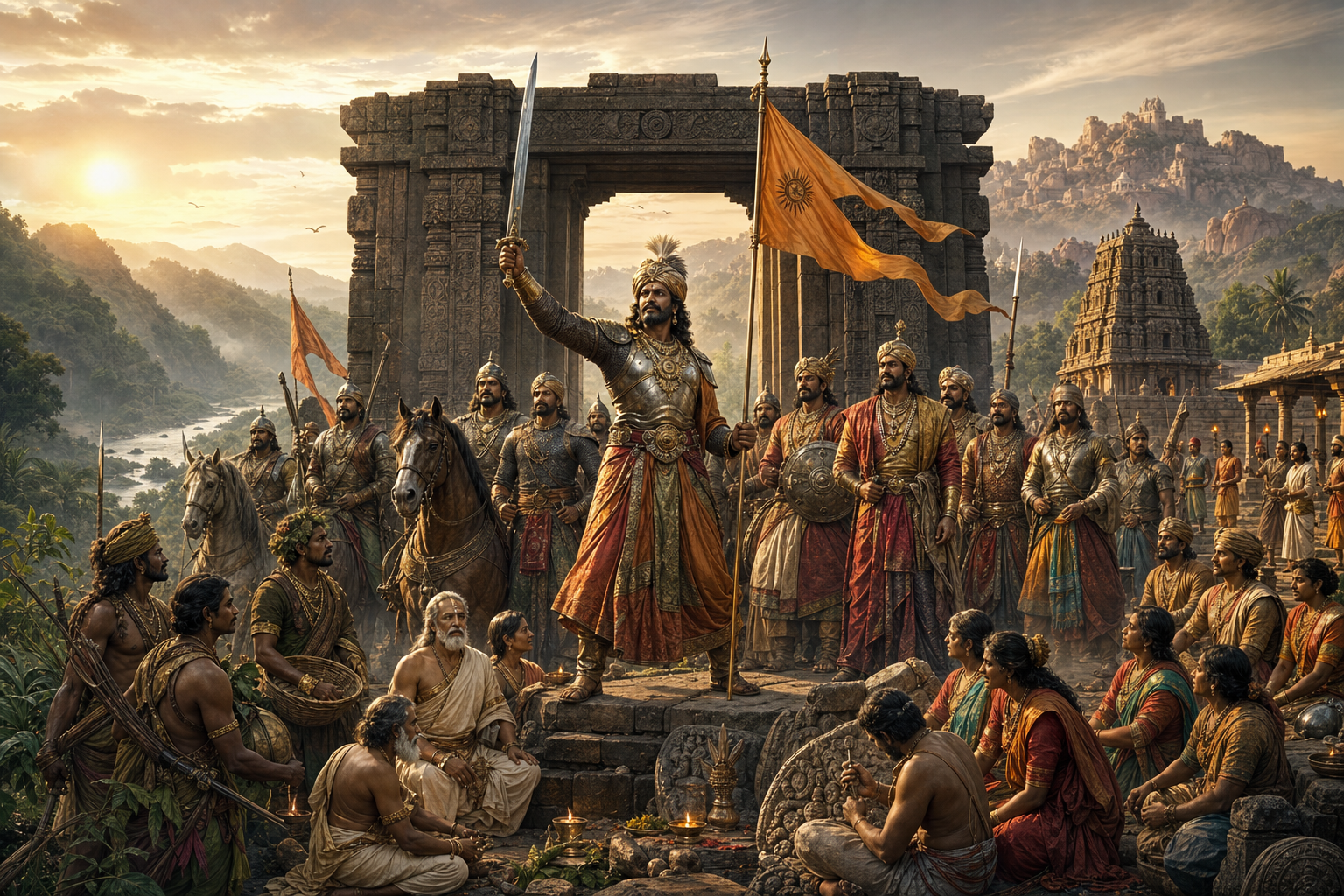
The Kakatiya Collapse and the Crisis in Telugu Country
The fall of the Kakatiya kingdom in the early fourteenth century marked one of the most consequential ruptures in the history of Telugu land. Orugallu, known later as Warangal, had stood not merely as a capital city but as the political, military, and cultural nerve centre of a powerful regional order shaped by rulers such as Rudrama Devi and Prataparudra. When the forces of the Delhi Sultanate finally broke Kakatiya resistance, the shock was felt across the Krishna-Godavari region and far beyond it.
The Tughlaq campaigns did not end with the capture of Orugallu. Forts and administrative centres such as Kondavidu, Kolanaveedu, Kondapalli, Nidadavolu, Rajahmundry, and Nellore came under pressure as the Sultanate pushed deeper into the Deccan and South India. The military momentum extended toward Madurai and affected older powers such as the Hoysalas and Pandyas. For Telugu society, this was not a limited dynastic defeat; it was the collapse of a political world that had held together agrarian settlements, temples, trade routes, warrior lineages, and local chieftaincies.
South India had previously experienced warfare, dynastic rivalry, and temple plunder in different forms, but the expansion of northern imperial power into the region introduced a new phase of administrative extraction and political disruption. Contemporary and later traditions describe heavy taxation, the seizure of wealth, the weakening of temple institutions, social insecurity, and the displacement of local elites. These accounts must be read carefully, with attention to genre and political memory, yet they preserve a consistent image of a society struggling to recover from conquest.
In this climate of upheaval emerged the Musunuri Nayakas, remembered as leaders of a Telugu resistance that attempted to restore local authority, protect sacred institutions, and rebuild the confidence of a shaken society. Their story is significant not only because it records battles and political alliances, but because it reveals how regional communities responded when established sovereignty disappeared. It is a history of military adaptation, social mobility, civilizational memory, and the difficult discipline required to preserve unity under pressure.
The Nayaka System: A Military and Social Innovation
The background to the Musunuri revolt lies in the Kakatiya Nayaka system. Under the Kakatiyas, Nayakas were not simply palace retainers or ceremonial commanders. They were military leaders who held territories, organized resources, maintained fighting men, and served the crown in campaigns. Their authority was local, practical, and often rooted in relationships with agrarian communities, frontier groups, and fortified settlements.
The system was notable for its relative social openness. Leadership could be earned through courage, administrative competence, loyalty, and battlefield ability rather than inherited rank alone. Men from peasant and martial communities could rise into positions of responsibility. In an age when hierarchy remained a powerful fact of social life, this created an important channel of mobility and gave the Kakatiya state a broad military base.
By the reign of Prataparudra, traditions speak of dozens of Nayakas serving the Kakatiya order. Their strength lay in decentralization. Each commander knew his own terrain, his own men, his own revenue base, and his own network of local obligations. This made the system militarily resilient, though it also contained a future risk: when the central monarchy fell, these same leaders could either become pillars of collective resistance or rivals competing for survival.
The Musunuri episode shows both possibilities. The Nayakas became the backbone of Telugu resistance, but their later divisions also contributed to the collapse of that resistance. This tension gives the story its enduring relevance. It demonstrates that decentralized strength can defend a civilization when guided by shared purpose, but it can also fracture when personal rivalry becomes stronger than collective duty.
After Orugallu: Dispersal, Conversion, and Compromise
After the Kakatiya defeat, the old network of Nayakas was scattered. Some attempted to preserve local authority in their own regions. Others were subdued by the new power. Some were absorbed into the Sultanate administration, willingly or under compulsion, as the conquerors sought to govern unfamiliar territory through men who understood local society.
The career of Malik Maqbul illustrates the complexity of the period. He is traditionally identified with Gona Ganappa, a Kakatiya commander who entered Sultanate service after the fall of Warangal and became an important governor. His life represents the difficult choices faced by defeated elites in the aftermath of conquest. It also warns against simplistic historical judgment. In a time of coercion, survival, political calculation, and personal ambition often became entangled.
For many local communities, however, the memory of Kakatiya sovereignty remained alive. Temples, agraharas, pilgrimage networks, village institutions, and warrior houses continued to carry the idea of a regional moral order. The language of Dharma in this setting did not operate only as a theological concept. It described social protection, rightful rule, sacred continuity, and the obligation of power to defend the vulnerable.
Two figures are remembered as important organizers in this transition: Bendapudi Annayya Mantri and Kolanu Rudradeva, both associated with the Kakatiya administrative tradition. Their role was not merely to lament the past but to reconnect scattered leaders. They understood that outrage by itself could not become resistance. A movement needed coordination, legitimacy, resources, and a leader capable of persuading proud commanders to act together.
The Rise of Musunuri Prolayanayaka
Musunuri Prolayanayaka of Vengi emerged as that leader. He is remembered as the son of Pochinayaka and as a member of a family that included Devanayaka, Kammanayaka, and Rajanayaka. His importance did not rest only on lineage or battlefield reputation. What distinguished him was his ability to organize men who were not naturally inclined to submit to a single authority after the collapse of the Kakatiya centre.
Prolayanayaka had to solve a political problem as difficult as any military challenge. The Nayakas were courageous, but they were also divided by local loyalties, ambition, and memories of old disputes. To unite them required persuasion, prestige, restraint, and strategic clarity. He appears in tradition as the man who transformed scattered anger into coordinated resistance.
Among those associated with the wider movement were Addanki Vemareddy, Koppula Prolayanayaka, Recherla Singamanayaka, Manchikonda Ganapatinayaka, and Vundi Vengabhupathi. Their participation reflected a broad coalition rather than a single clan enterprise. The resistance drew strength from regional chiefs, forest communities, former Kakatiya officers, local peasants, and those attached to temple and scholarly institutions.
The emotional power of this episode lies in the contrast between despair and discipline. A modern reader can recognize the pattern: when institutions fall, the first impulse is fragmentation. Prolayanayaka’s achievement was to create enough trust for collective action. His leadership suggests that civilizational recovery begins not with slogans but with the patient rebuilding of confidence among people who have reasons to distrust one another.
Rekapalle, the Vilasa Grant, and the Forest Base of Resistance
The Vilasa grant is one of the crucial records associated with Musunuri Prolayanayaka. It places his authority at Rekapalle, near the Papikondalu hills, and connects him with the Sabari river valley between Papikondalu and Bhadrachalam. This was not a random refuge. It was a strategically intelligent base: forested, difficult to penetrate, linked by river routes, and protected by terrain that favoured mobile local forces over large imperial armies.
The role of the Konda Reddy communities in this setting deserves attention. Forest peoples were not marginal spectators in medieval warfare. Their knowledge of hill paths, river crossings, supply trails, and ambush points could determine the success or failure of campaigns. In the Musunuri resistance, such communities gave the movement geographic depth and tactical flexibility.
The Vilasa grant also preserves a moral memory of devastation: damaged temples, oppressed peasants, disrupted settlements, and the breakdown of older patterns of patronage. As with many medieval inscriptions, its language is political and ideological; it seeks to legitimize a ruler by presenting him as a restorer of order. Yet that itself is historically meaningful. It shows that the Musunuri leadership understood its authority through protection, restoration, and service to Dharma.
Prolayanayaka and his allies could not expect to defeat large Sultanate armies in direct set-piece battles. Their strategy therefore relied on guerrilla warfare, local mobility, forest sanctuaries, and attacks on vulnerable lines of movement. By cutting supplies, striking isolated posts, and using terrain intelligently, they gradually weakened Sultanate control in parts of the coastal belt between the Krishna and Godavari rivers.
This was also a cultural campaign. Tradition credits Prolayanayaka with rebuilding desecrated temples, restoring agraharas, and encouraging scholars and artists. Such acts were not decorative additions to warfare. In medieval South India, temples and scholarly settlements were centres of education, land management, ritual life, employment, artistic production, and social memory. Restoring them was a way of restoring society itself.
Kapayanayaka and the Liberation of Orugallu
As Prolayanayaka grew older, leadership passed to his adopted son Musunuri Kapayanayaka, the son of Rajanayaka. Kapaya inherited not a settled kingdom but a campaign in motion. His task was to carry the resistance from forest warfare and regional recovery toward the recapture of major forts and symbolic centres.
The wider political context worked in his favour. Muhammad bin Tughlaq faced revolts in several parts of his empire. In the South, the establishment of independent authority in Madurai and unrest across the Deccan weakened the ability of Delhi to maintain direct control. Epidemic, distance, fiscal strain, and local rebellion all contributed to the loosening of Tughlaq power.
Kapayanayaka formed an important alliance with Veera Ballala III of the Hoysala line. In the traditional account, the Telugu forces, supported by regional allies, moved against the Sultanate position at Orugallu. Around 1336, thirteen years after the fall of Warangal, Malik Maqbul fled toward Devagiri and Orugallu was reclaimed. The event carried immense symbolic force. A city that had represented defeat now became a sign of restoration.
After the liberation of Warangal, Kapayanayaka emerged as the leading figure of the Telugu resistance. He is associated with titles such as Andhradesādīśwara, Lord of Andhra land, and Andhrasuratrāṇa, Protector of the Andhra people. These titles were political statements. They presented him not only as a commander but as a guardian of a regional community.
Kapaya’s leadership is especially important because he appears to have respected the autonomy of allied Nayakas. Instead of reducing every local chief to a subordinate officer, he allowed a coalition model to continue. This helped preserve unity among strong personalities, at least for a time. It also reflected the older Kakatiya pattern in which military decentralization and royal authority coexisted.
A Southern Wave of Resistance and the Rise of Vijayanagara
The Musunuri struggle did not remain confined to one region. Its success showed that Sultanate authority in the South could be challenged. Dwarasamudra, Kampili, Araveedu, and other centres became part of a broader pattern of local recovery. Vema Reddy is remembered as assisting Kampili, while Kapaya Nayaka and Vema Reddy are associated with support to Somadeva of Araveedu in the Krishna-Tungabhadra doab.
In this unsettled landscape, Harihara and Bukka Raya, formerly linked with the Anegondi region, established their power at Hampi. Their foundation grew into the Vijayanagara Empire, one of the most important states in South Indian history. Vijayanagara became a centre of military resistance, temple patronage, Sanskrit and regional literary production, urban development, and long-distance trade.
The relationship between the Musunuri resistance and Vijayanagara should be understood as historical continuity rather than simple causation. The Musunuris did not create Vijayanagara by themselves, but their struggle formed part of the same southern response to the crisis of the fourteenth century. They helped demonstrate that regional polities could recover, reorganize, and build new centres of power after the shock of conquest.
This is where the story becomes larger than one dynasty. It reveals a civilizational pattern visible across Dharmic traditions: when monasteries, temples, mathas, agraharas, pilgrimage routes, and learned communities are threatened, political resistance and cultural restoration often move together. Hindu, Jain, Buddhist, and Sikh histories all preserve versions of this principle in different periods: knowledge, worship, ethical order, and community life require institutions capable of protection.
The Bahmani Challenge and the Return of Imperial Ambition
The liberation of Telugu land did not end the contest for the Deccan. In 1345, Hassan Gangu rose in revolt against Muhammad bin Tughlaq and later took the royal name Alauddin Bahman Shah. By 1347, the Bahmani Sultanate had emerged as a major Deccan power, first associated with Devagiri and then with Gulbarga. Its rise changed the strategic environment confronting Kapayanayaka.
Kapaya’s decision to assist Bahman Shah against Tughlaq power proved costly in retrospect. At the time, it may have appeared to be a pragmatic move: weakening Delhi could benefit regional rulers. Yet the Bahmani state soon developed its own imperial ambitions in the Deccan. The enemy of one phase became the threat of the next.
This is one of the hardest lessons in the Musunuri story. Resistance movements often require alliances, but alliances made under pressure can create future dangers. Kapaya’s political world was not one of ideal choices. It was a world of shifting powers, incomplete information, and constant military urgency. Still, the later consequences were severe.
Internal rivalry deepened the crisis. Recherla Singamanayaka, whose relationship with Kapaya had been strained by earlier disputes, aligned with the Bahmani side. The betrayal weakened the unity that had made the original resistance successful. Orugallu was attacked in 1350 and again in 1351. Kapaya resisted, but the combined pressure of Bahmani power and Recherla hostility forced him into concessions, including the surrender of forts such as Bhuvanagiri and Kailasakota.
The devastation that followed renewed the trauma of earlier decades. Countryside, fort networks, and revenue bases suffered. What had been rebuilt through discipline and sacrifice became vulnerable because the coalition had lost its moral centre. The Musunuri story therefore refuses to be a simple tale of victory. It is also a study in how fragile unity becomes when personal grievance is allowed to outrank civilizational responsibility.
Vinayaka Deva, Vijayanagara, and the Last Struggles of Kapaya
After Alauddin Bahman Shah’s death, Muhammad Shah inherited the Bahmani throne. Kapayanayaka sought to recover lost positions and sent his son Vinayaka Deva, in alliance with Bukka Raya of Vijayanagara, against Bahmani-held forts. Initial success suggested that the balance might shift again.
The campaign ended in tragedy. Vinayaka Deva was captured and executed. For Kapaya, this was not only a dynastic loss but a profound personal and political blow. In medieval kingship, the death of an heir could weaken morale, succession, diplomacy, and the symbolic authority of a house. The grief of a father and the vulnerability of a ruler converged in one event.
Kapaya continued the struggle, again seeking support from Vijayanagara. Yet the death of Bukka Raya deprived him of a crucial ally. Facing Bahmani pressure without adequate support and with the Recherla Nayakas hostile to him, Kapaya found himself increasingly isolated. Bahmani forces gained control of Golconda and Warangal, and Kapaya was compelled to surrender wealth in tribute, including the famed turquoise throne associated with his authority.
By the late 1360s, years of warfare had exhausted the Musunuri position. Treasury, manpower, alliances, and morale were all strained. The execution of Vinayaka Deva had left a wound that political recovery could not easily heal. The Recherla Nayakas, sensing weakness, asserted independence and moved against the very unity that Kapaya had once tried to preserve.
In 1370, Kapayanayaka fought his final battle at Bhimavaram. He fell on the battlefield, remembered as a warrior who had helped restore Orugallu yet could not survive the combined force of external pressure and internal betrayal. His death brought the Musunuri phase of Telugu resistance to a tragic close.
Historical Meaning and Civilizational Legacy
The Musunuri Nayakas occupy a distinctive place in South Indian history because they stand between two great political worlds: the Kakatiya past and the Vijayanagara future. They inherited the military culture, regional pride, and administrative memory of the Kakatiyas. They also helped create the conditions in which a larger southern response, including Vijayanagara, could take shape.
Their achievement lay in more than the recovery of forts. They restored confidence after collapse. They used terrain intelligently. They mobilized local chiefs without erasing their autonomy. They recognized that temples, agraharas, scholars, artists, peasants, and forest communities were all part of the same social organism. In that sense, their resistance was political, military, cultural, and spiritual at once.
Their failure is equally instructive. The same autonomy that made the Nayaka system flexible also made it vulnerable to rivalry. Personal grudges, competing ambitions, and short-term calculations weakened a coalition built through great sacrifice. Kapayanayaka’s fall demonstrates that external threats are often most dangerous when internal cohesion has already been damaged.
Yet the Musunuri legacy did not disappear. After Kapaya’s death, many Nayakas entered the service of Vijayanagara, where their military traditions and local experience became part of a new imperial structure. The spirit of resistance survived in another form. What had begun as a regional struggle for Telugu land became one strand in the larger history of South Indian resilience.
For readers today, the story of the Musunuri Nayakas offers a sober lesson. Cultural survival requires courage, but courage alone is not enough. It also requires institutional memory, disciplined leadership, respect among allies, and the ability to place Dharma above ego. The rise of Prolayanayaka and Kapayanayaka shows what unity can achieve. Their fall shows what happens when unity is treated as temporary convenience rather than sacred responsibility.
The Musunuri saga therefore remains one of the most powerful chapters of Telugu and South Indian history. It is a story of devastation and recovery, of forests turned into fortresses, of chiefs turned into liberators, of Orugallu lost and reclaimed, and of a heroic movement whose memory continued into the age of Vijayanagara. Its enduring value lies in its reminder that resistance is strongest when it protects not only territory, but the deeper civilizational bonds that make a people whole.
Sources and Historical Anchors
This account is grounded in the traditional narrative of the Musunuri Nayakas, the Vilasa Grant of the fourteenth century, references preserved in Epigraphia Indica and South Indian Inscriptions, regional histories of Warangal, Khammam, Krishna, and Godavari districts, and modern scholarship on the Kakatiyas, Vijayanagara, and medieval South India by historians such as K.A. Nilakanta Sastri, Burton Stein, P.V. Parabrahma Sastry, and M. Rama Rao.
Inspired by this post on Pragyata.




Leave a Reply
You must be logged in to post a comment.