

1. The Persistent Confusion Around Bharatīya Jñāna Paramparā
Across contemporary scholarship on Indian Knowledge Systems, or Bharatīya Jñāna Paramparā, a recurring problem continues to shape interpretation. A vast and continuous civilisational archive is often approached as though it were merely a collection of texts, doctrines, practices, and historical fragments. The result is not simply disagreement over dates or sources. It is a deeper misrecognition of the very kind of knowledge tradition being studied.
This confusion does not arise within living paramparās, where knowledge is encountered through instruction, memory, discipline, correction, contemplation, and practice. It appears most sharply when a transmission-based order is translated into categories formed by text-centred and innovation-driven academic habits. What is internally experienced as a coherent architecture of knowing is then seen externally as scattered data.
The well-known parable of the blind men and the elephant remains an apt analogy. Each observer touches a different part and describes it confidently, yet none grasps the elephant as a whole. The error is not that each description is entirely false; the error is that each partial description is mistaken for total understanding. Much of the modern study of Bharatīya Jñāna Paramparā suffers from a similar limitation. Texts, rituals, philosophical schools, medical works, oral recitation systems, and pedagogical lineages are studied separately, while the integrating structure that holds them together remains invisible.
The symptoms are familiar. Texts belonging to an avowedly oral tradition are repeatedly re-dated. Traditional chronologies extending across vast spans of time are compressed into narrow historical windows, often between the fifth century BCE and the early centuries of the Common Era. Pedagogical restatements are treated as intellectual inventions. Commentaries are read as replacements rather than clarifications. Disciplines that function together are divided into isolated academic compartments.
A similar fragmentation appears in the handling of civilisational evidence. Archaeological continuities from Mehrgarh to Harappa are rarely integrated with śāstric traditions. Medical corpora such as the Caraka and Suśruta Saṃhitās, which preserve sophisticated clinical, anatomical, and surgical knowledge, are often studied apart from the wider intellectual order that made such knowledge meaningful. The result is a civilisational history divided into sealed compartments: archaeology here, Sanskrit texts there, medicine elsewhere, and philosophy somewhere else.
These patterns are frequently treated as evidence about the tradition itself. Yet symptoms are not causes. They reveal more about the instruments of interpretation than about the object being interpreted. To examine a transmission-based epistemic order with tools designed for manuscript-centred intellectual history is like using a microscope to study planetary motion. The instrument may be precise, but the object has been wrongly constituted.
2. The Central Diagnosis: A Category Error
If the instability surrounding Bharatīya Jñāna Paramparā were caused only by insufficient evidence, the accumulation of manuscripts, inscriptions, archaeological reports, and philological studies would gradually resolve the confusion. Instead, the opposite has happened. As the material increases, interpretations multiply, chronologies become more contested, and the larger unity of the tradition remains elusive. This indicates that the difficulty is not merely evidentiary. It is conceptual.
The problem is best understood as a series of category errors. A category error occurs when something is interpreted through a conceptual frame that belongs to a different kind of object. Bharatīya Jñāna Paramparā is often approached through assumptions appropriate to modern text-based intellectual systems, while the tradition itself belongs to a transmission-based, pedagogically regulated, and realisation-oriented order of knowledge.
Modern academic method often assumes that knowledge originates in written formulations, develops through novelty, and leaves documentary traces that reveal progressive stages of intellectual change. Within that model, later texts are expected to modify, supersede, or refine earlier texts. History becomes a sequence of innovations. Authorship, dating, textual stratification, and documentary proof become the privileged markers of intellectual existence.
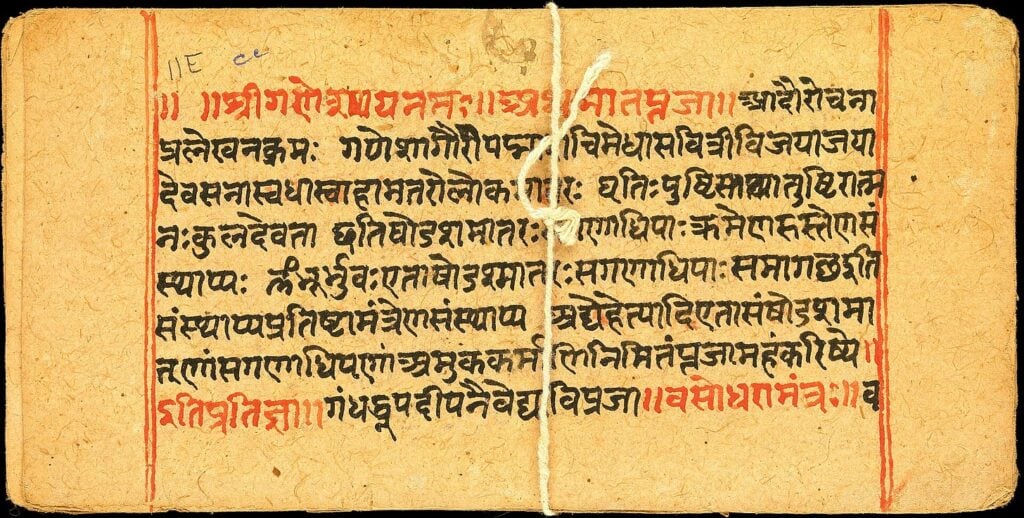
Bharatīya śāstric traditions operate differently. They are organised around oral transmission through the guru–śiṣya paramparā, the primacy of sūtra as condensed knowledge, and the role of bhāṣya as disciplined exposition. Knowledge resides not only in the written text, but in paramparā itself: in pedagogy, memorisation, recitation, correction, debate, contemplation, and embodied instruction. Later texts therefore often function as pedagogical extensions of an already transmitted order, not as isolated moments of invention.
This distinction matters because wrong categories produce wrong questions. A transmission-based tradition should not be approached only by asking when a doctrine was invented, which author introduced a concept, or which manuscript first proves its existence. Such questions may have limited historical value, but they cannot exhaust the structure of the tradition. When they are treated as definitive, the tradition is judged by criteria foreign to its own epistemic organisation.
The resulting historiography can appear rigorous while remaining misaligned. It may produce detailed reconstructions, complex timelines, and elaborate theories of influence, yet still fail to recognise what kind of knowledge order is being studied. The deeper task is therefore not simply to propose a new chronology. It is to ask what Bharatīya Jñāna Paramparā is as an epistemic object.
Four questions become necessary before any adequate historiography can emerge. What kind of knowledge order is Bharatīya Jñāna Paramparā? How are its internal disciplines related? Where does knowledge reside? What does jñāna itself mean within the tradition? Only when these questions are addressed can the sources, disciplines, and histories of Indic learning systems become intelligible without distortion.
3. Architecture Rather Than Flat Accumulation
Modern intellectual history often works with an accumulative model of knowledge. In this view, knowledge advances by addition. New theories replace or refine earlier ones. Later formulations are assumed to be more sophisticated than earlier ones. Intellectual history is then narrated as a progressive sequence moving from primitive beginnings to mature complexity.
Bharatīya paramparā does not fit this model because its internal structure is architectural rather than flatly accumulative. Different layers of the knowledge order operate under different constraints. The Veda, as śabda-pramāṇa, is not treated as a revisable hypothesis. The Vedāṅgas regulate the conditions of transmission, including sound, metre, grammar, etymology, ritual application, and calendrical precision. Foundational darśanic commitments, including the ṣaḍdarśanas, remain epistemically stable even as their articulation may be refined in teaching, commentary, and debate.
Accumulation is more visible in applied śāstras such as Āyurveda, Āgama, Arthaśāstra, and other practical disciplines, where new treatises, institutional practices, and procedural refinements respond to changing social, technological, medical, and ritual conditions. Yet even here, expansion does not necessarily mean rupture. It often means application under established pramāṇic authority.
This layered pattern is crucial. In foundational domains, development often appears as bhāṣya, vārttika, ṭīkā, and pedagogical clarification. These forms do not necessarily create new epistemic grounds. They stabilise and transmit what is already recognised. Apparent innovation at the level of expression can serve conservation at the level of epistemic function.
Vyākaraṇa, Nyāya, and Mīmāṃsā illustrate this architectural structure. Vyākaraṇa regulates language and meaning. Nyāya regulates inquiry, inference, doubt, debate, and valid cognition. Mīmāṃsā regulates interpretation, injunction, duty, and the authority of śabda. These disciplines do not supersede one another. They operate together as coordinated supports of intelligibility.
The tradition’s own classifications reflect this non-linear architecture. A standard enumeration presents the four Vedas with the Vedāṅgas, Nyāya, Mīmāṃsā, Purāṇa, and Dharmaśāstra as fourteen domains of knowledge, later extended to eighteen through Āyurveda, Dhanurveda, Gāndharva, and Arthaśāstra: aṅgāni vedāś catvāro … vidyā hy etāś caturdaśa; āyurvedo dhanurvedo … vidyā hy aṣṭādaśaiva tāḥ. This is not a timeline of historical succession. It is a map of functional interdependence.
When this architecture is ignored, foundational formulations are misread as primitive, commentarial elaborations are mistaken for theoretical progress, and continuity is confused with stagnation. From within the tradition, repetition is not intellectual failure. It is disciplined maintenance. A complex knowledge order survives across centuries precisely because it preserves the conditions under which meaning, validity, and practice remain coherent.
4. The Fragmentation of Śāstra
Another major category error appears in the classification of śāstric disciplines. Modern academic frameworks often divide them into core doctrines and auxiliary tools. Nyāya becomes logic. Mīmāṃsā becomes ritual exegesis. Vyākaraṇa becomes grammar. Śikṣā becomes phonetics. Nirukta becomes etymology. Chandas becomes prosody. Each label contains a partial truth, but each also narrows the discipline in a way that alters its function.
Within the śāstric order, these disciplines are not external tools applied to an already complete body of knowledge. They are constitutive regulators of knowing itself. They determine how sound is preserved, how words bear meaning, how inference is validated, how testimony is authorised, how ambiguity is resolved, and how error is identified. Their function is normative, not merely descriptive.
This distinction is especially important for Vedāṅga studies and Indian philosophy. Śikṣā is not simply the study of sound as an object. It regulates correct recitation so that śabda can remain intact through transmission. Vyākaraṇa is not merely descriptive grammar. It preserves the conditions under which language can carry stable meaning. Nirukta is not only etymology. It is a discipline of semantic clarification. Chandas is not merely prosody. It preserves metrical structures that support memory, recitation, and textual integrity.
Nyāya is similarly reduced when it is treated only as formal logic. In its own setting, Nyāya articulates a complete discipline of inquiry. It identifies pramāṇas, distinguishes valid cognition from error, manages doubt, structures vāda, and recognises nigrahasthānas, the points at which a position becomes untenable. It does not merely teach argument. It governs how claims become assessable as knowledge.
Mīmāṃsā, too, is often reduced when described only as ritual interpretation. It is a sophisticated hermeneutic discipline concerned with śabda, injunction, obligation, interpretive priority, textual coherence, and the conditions under which meaning becomes actionable. Its relevance extends beyond ritual performance into the broader question of how authoritative language is understood.
The fragmentation of śāstra follows from a modern assumption that knowledge consists of detachable content plus technical apparatus. First come doctrines, then come tools. Within śāstric epistemology, this division does not hold. The apparatus is part of the substance. The norms governing language, inference, interpretation, testimony, and transmission are themselves the structure of knowing.
This has practical implications for the study of Hindu philosophy, Buddhist logic, Jain epistemology, Sikh scriptural interpretation, and wider Dharmic traditions. Across these traditions, knowledge is not merely a set of propositions. It is sustained by disciplined methods of listening, reasoning, remembering, debating, interpreting, and realising. The unity of Dharmic intellectual culture becomes clearer when these regulatory disciplines are seen as shared civilisational concerns rather than sectarian compartments.
To separate śāstric disciplines into isolated academic fields is therefore to weaken the very criteria by which knowledge is recognised. What appears as fragmentation is, more accurately, functional differentiation within an integrated epistemic order. Each discipline performs a distinct role, but none is conceptually optional.
5. Text and Transmission
At the centre of the misreading lies one powerful assumption: knowledge resides primarily in texts. This assumption is natural within manuscript cultures and modern universities, where writing is treated as the principal site of intellectual production. What cannot be located securely in documents is then treated as historically uncertain or epistemically secondary.
Bharatīya śāstric traditions operate according to another logic. Jñāna resides in transmission: in the disciplined re-realisation of meaning within a lineage of instruction. Texts matter, but they do not exhaust knowledge. They function as supports for teaching, memory, contemplation, correction, and continuity. They are often mnemonic condensations rather than self-sufficient containers.
The guru–śiṣya paramparā is therefore not merely a social form. It is an epistemic institution. Knowledge is received, tested, clarified, internalised, and transmitted through disciplined relationship. The student does not merely acquire information. The student is formed into a competent knower capable of hearing, retaining, interpreting, and realising what is taught.
This is why oral traditions cannot be treated as preliterate approximations of written culture. In many Bharatīya contexts, oral transmission is not a deficiency awaiting textual completion. It is a rigorous technology of preservation. Recitation systems, mnemonic methods, phonetic discipline, and pedagogical correction create forms of fidelity that can be more exacting than casual manuscript copying.
Once this is recognised, the limits of text-centric historiography become clear. A text may appear late in written form while preserving an older teaching. A commentary may seem innovative because it is more explicit, while its own function may be to clarify what the tradition already transmits. Manuscript variation may reflect the dynamics of transmission rather than linear doctrinal development.
Preservation is often mistaken for creation. When a later textual layer expresses a teaching in more technical language, it is commonly assumed to represent a new stage of thought. In a transmission-based order, however, such articulation may arise because changing pedagogical conditions require greater explicitness. What appears later in writing is not necessarily later in conception. It may be later only in documentation.
This does not mean texts are unimportant. The Vedas, Upanishads, sūtras, bhāṣyas, purāṇic literature, Dharmaśāstra, Āyurveda, and other śāstric works remain indispensable. The issue is their role. They are nodes within a pedagogical continuum, not isolated artefacts floating outside lived transmission. To confuse the support of knowing with knowing itself is to make transmitted understanding invisible.
6. Preservation and Illumination
The distinction between text and transmission leads to a deeper question: what is knowledge? Modern scholarly practice often identifies knowledge with what can be stored, accessed, cited, archived, and reproduced. In this framework, preservation is primarily documentary. What survives in records is treated as what is known.
Śāstric traditions define the matter differently. Jñāna is not merely stored information. It is illumination, the direct apprehension of what is to be known. It occurs in consciousness and is confirmed through the competent knower. The task of preservation is therefore not only to protect formulations, but to preserve the conditions under which valid knowing can occur again.
This changes the meaning of continuity. In a storage-oriented epistemology, repetition may look redundant. In a realisation-oriented epistemology, repetition is discipline. Recitation, meditation, commentary, debate, ritual precision, and ethical formation all help ensure that knowledge remains recognisable and realisable across generations.
Stability, in this setting, is not intellectual stagnation. It is epistemic success. A teaching that can be realised by successive generations has not failed to develop; it has retained its capacity to illuminate. This is especially visible in Dharmic traditions, where continuity across Hindu, Buddhist, Jain, and Sikh modes of learning is often sustained through disciplined practice as much as through written preservation.
Later expositions may therefore become more explicit, systematic, or technical without representing a break from earlier insight. They may serve as protective clarification. Their purpose is not always novelty. Often it is to prevent misunderstanding, stabilise meaning, and make the same truth available under altered historical conditions.
Modern historiography often lacks categories for this kind of intellectual labour. It tends to measure vitality by change and originality. A tradition oriented toward illumination may not display the same markers. Its most serious work may consist in maintaining the conditions of valid knowledge: the right sound, the right interpretation, the right discipline, the right teacher, the right inquiry, and the right inner preparedness.
This is where a relatable human experience helps clarify the point. A musical composition is not alive merely because its notation is preserved on paper. It becomes music when a trained practitioner realises it in sound. A mathematical theorem is not understood merely because it appears in a book. It becomes knowledge when a mind grasps its proof. In a similar way, jñāna within paramparā is not reducible to inscription. It is preserved so that it can be known again.
7. Consequences for Historiography
The cumulative effect of these category errors is instability in historiography. Chronologies remain provisional. Doctrinal genealogies become fragile. Debates are misread as stages of succession. Pedagogical restatements are treated as new inventions. Disciplines are isolated from the architecture that gives them meaning.
These problems are not solved by simply adding more data. More manuscripts, more inscriptions, more archaeological reports, and more translations are valuable, but they cannot by themselves correct a mistaken conceptual frame. A transmission-based, normatively regulated, and realisation-oriented knowledge order must be studied as such. Otherwise, evidence will continue to be reorganised into categories that distort it.
The study of Bharatīya Jñāna Paramparā therefore requires a reconstitution of the epistemic object. It should be approached as an architectural transmission order, not merely as a textual archive. Its disciplines should be read in relation to one another. Its texts should be located within paramparā. Its continuity should be understood as intellectual discipline rather than as absence of development.
This reframing also supports unity among Dharmic traditions. Hindu, Buddhist, Jain, and Sikh traditions differ in doctrine, practice, metaphysics, and historical development, yet they share deep commitments to disciplined transmission, teacher-student formation, contemplative realisation, ethical practice, debate, and the preservation of wisdom across generations. Recognising this shared civilisational concern does not erase difference. It allows difference to be understood within a wider culture of knowledge.
8. Conclusion: Studying the Tradition on Its Own Terms
The central argument is diagnostic rather than merely reconstructive. The persistent confusion surrounding Bharatīya Jñāna Paramparā arises from a misidentification of the epistemic object itself. What appears as fragmentation, repetition, instability, or conservatism is often the result of approaching a transmission-based order of jñāna through categories shaped by text-centred and innovation-driven assumptions.
Bharatīya Jñāna Paramparā is not primarily a corpus of texts arranged along a developmental timeline. It is an architectural order of knowing sustained through paramparā, governed by normative disciplines, and oriented toward the re-realisation of jñāna in the competent knower. Its continuity lies in preserving the conditions under which valid knowing remains possible across generations.
The task before scholarship is therefore conceptual before it is technical. Chronology, philology, archaeology, manuscript studies, and comparative philosophy all remain important. Yet they become more accurate when guided by categories appropriate to the tradition itself. Bharatīya Jñāna Paramparā becomes intelligible when studied as a living transmission architecture of knowledge, not as a disconnected archive of texts.
Such a reframing does more than correct academic method. It restores dignity to the disciplines that preserved Indic knowledge across centuries: recitation, commentary, debate, memorisation, interpretation, contemplation, and practice. It also invites modern readers to recognise that knowledge is not merely what is stored. Knowledge is what can be understood, realised, protected, and transmitted without losing its truth.
Inspired by this post on Pragyata.








Leave a Reply
You must be logged in to post a comment.