
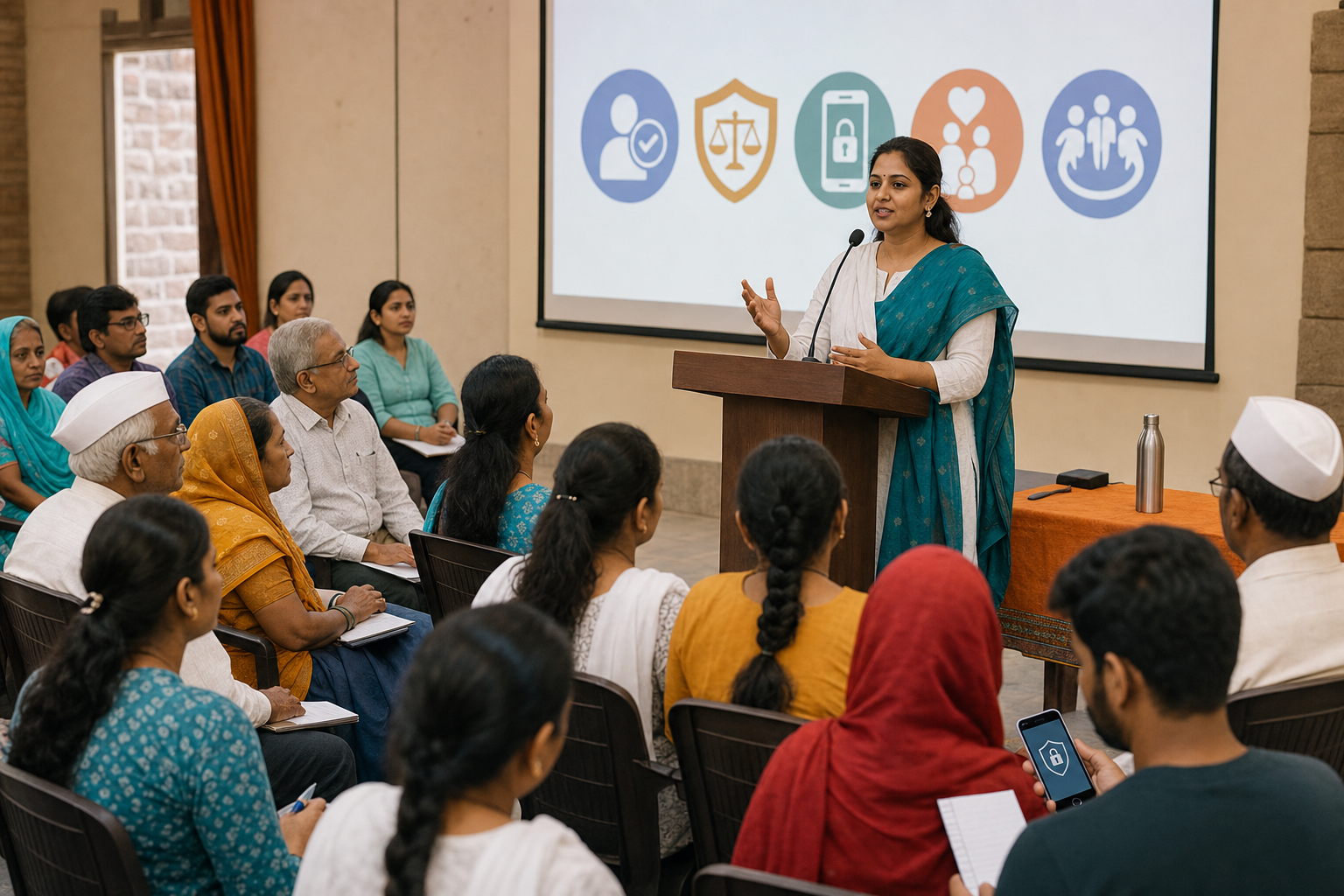
A special lecture held in Peth, in Ambegaon taluka, brought attention to a subject that remains socially sensitive, legally complex, and emotionally charged: allegations of deceptive relationship practices described by some Hindu organisations as “love jihad.” The programme was organised by the Ranaragini branch of the Hindu Janajagruti Samiti (HJS), and its central message urged attendees to remain vigilant, informed, and socially responsible while discussing concerns around relationships, conversion, and community safety.
The available report is brief, so any responsible account must avoid overstating details that are not documented. What can be stated with clarity is that the lecture reflected a wider pattern of community-level mobilisation in Maharashtra, where organisations such as HJS and its women-focused initiatives have periodically conducted awareness programmes on family concerns, cultural identity, religious conversion, and social security. Such meetings are often framed as educational gatherings intended to alert parents, youth, and local residents to perceived risks in modern social interactions.
In academic terms, the phrase “love jihad” is a contested political and social expression. It is used by some groups to describe alleged cases in which romantic relationships are said to involve concealment of identity, emotional manipulation, coercion, or pressure to convert. At the same time, the phrase has also been criticised by others as a term that can encourage suspicion toward interfaith relationships in general. A careful and factual discussion must therefore distinguish between two very different issues: the legitimate need to address deception, coercion, abuse, and forced conversion, and the equally important need to avoid collective blame against any religious community.
This distinction is essential for any dharmic public discourse. Hindu, Buddhist, Jain, and Sikh traditions all place deep value on self-discipline, ethical conduct, compassion, dignity, and the moral agency of the individual. A relationship based on mutual respect, informed consent, transparency, and freedom of conscience cannot be treated in the same category as one involving fraud, threats, blackmail, or coercive religious pressure. The ethical concern is not friendship or dialogue across communities; the ethical concern is manipulation, exploitation, and the denial of personal freedom.
From a legal-awareness perspective, the most constructive outcome of such lectures is the strengthening of practical knowledge. Families and young people benefit when they understand how to identify coercive control, digital blackmail, financial exploitation, stalking, identity deception, and emotional isolation. These concerns are not limited to one community or one type of relationship. They are broader social risks that require calm awareness, evidence-based response, and timely recourse to lawful institutions.
The social setting of Peth and Ambegaon also matters. In smaller towns and semi-rural regions, personal relationships are often embedded within family networks, local reputation, and community structures. A single allegation can quickly become a source of fear, anger, or social division. That is why public lectures on sensitive subjects carry a serious responsibility: they must help people act with discernment, not panic; with documentation, not rumour; and with legal maturity, not mob sentiment.
A community that wishes to protect its daughters and sons must begin with education rather than suspicion. Young people need the confidence to discuss relationships openly with trusted elders, teachers, counsellors, and lawful authorities when they feel unsafe. Parents need to create homes where difficult conversations can happen without humiliation or fear. Social organisations need to offer support systems that protect dignity while guiding individuals toward lawful remedies.
The lecture’s emphasis on vigilance can therefore be interpreted most responsibly as a call for informed social preparedness. Vigilance should mean verifying facts before reacting, preserving evidence in cases of harassment or coercion, supporting victims without shaming them, and approaching police or legal services when credible harm is involved. It should not mean treating ordinary interfaith interaction as inherently suspect. Such a balanced approach protects both community security and social harmony.
For dharmic society, the deeper challenge is to combine cultural confidence with ethical restraint. Sanatana Dharma and allied dharmic traditions have long recognised the importance of truth, self-control, non-harm, justice, and responsibility. These values require society to oppose deception and coercion wherever they occur, while also resisting prejudice, stereotyping, and emotional overreach. A response rooted in dharma must be firm against wrongdoing and fair toward individuals.
The Peth lecture also points to the growing role of women-led community platforms such as Ranaragini. When women’s organisations address safety, relationship awareness, and cultural education, they often speak from lived concerns within families and neighbourhoods. Their contribution can be especially valuable when it moves beyond alarm and helps build practical capacity: legal literacy, counselling access, digital safety awareness, and support for those facing pressure or abuse.
Digital life has added another layer to these concerns. Relationships now often begin through phones, social media, messaging apps, and private online spaces. This creates new possibilities for friendship and understanding, but it also creates risks such as impersonation, grooming, image-based abuse, and pressure tactics. Any serious awareness programme on alleged love jihad tactics or coercive relationship patterns must therefore include digital literacy as a core component.
The most constructive public message from such an event is not fear, but responsibility. Communities should teach young people to recognise warning signs: demands for secrecy, efforts to isolate someone from family, pressure to change faith or identity without free reflection, threats of self-harm, threats of exposure, financial dependence used as leverage, and attempts to control clothing, movement, friendships, or communication. These signs are relevant in many abusive relationships, regardless of religious background.
At the same time, preserving social unity requires precision in language. India’s civilisational strength has always included plural interaction, debate, and coexistence. Hindu-Muslim relations, interfaith dialogue, and diverse social contact are part of lived reality in many regions. Public discourse becomes stronger when it focuses on specific misconduct rather than broad accusations. This protects innocent individuals while keeping attention on genuine cases of coercion, fraud, or unlawful conversion.
In this context, the Peth event can be understood as part of a wider conversation on cultural advocacy, legal awareness, and community preparedness in Maharashtra. Its strongest value lies in encouraging families to be attentive, organised, and informed. Its most important limitation is the need for careful evidence, measured speech, and respect for constitutional rights. When these principles are held together, awareness becomes a tool for protection rather than polarisation.
A mature dharmic response to such concerns should protect personal freedom, uphold women’s dignity, support victims, respect lawful process, and strengthen community bonds. It should reject both naivety and hatred. It should recognise that love, marriage, conversion, and identity are deeply personal matters, while also affirming that deception, coercion, and exploitation have no place in a just society. That balance is where genuine vigilance becomes ethical, disciplined, and socially constructive.
Inspired by this post on Hindu Jagruti Samiti.










Leave a Reply
You must be logged in to post a comment.