
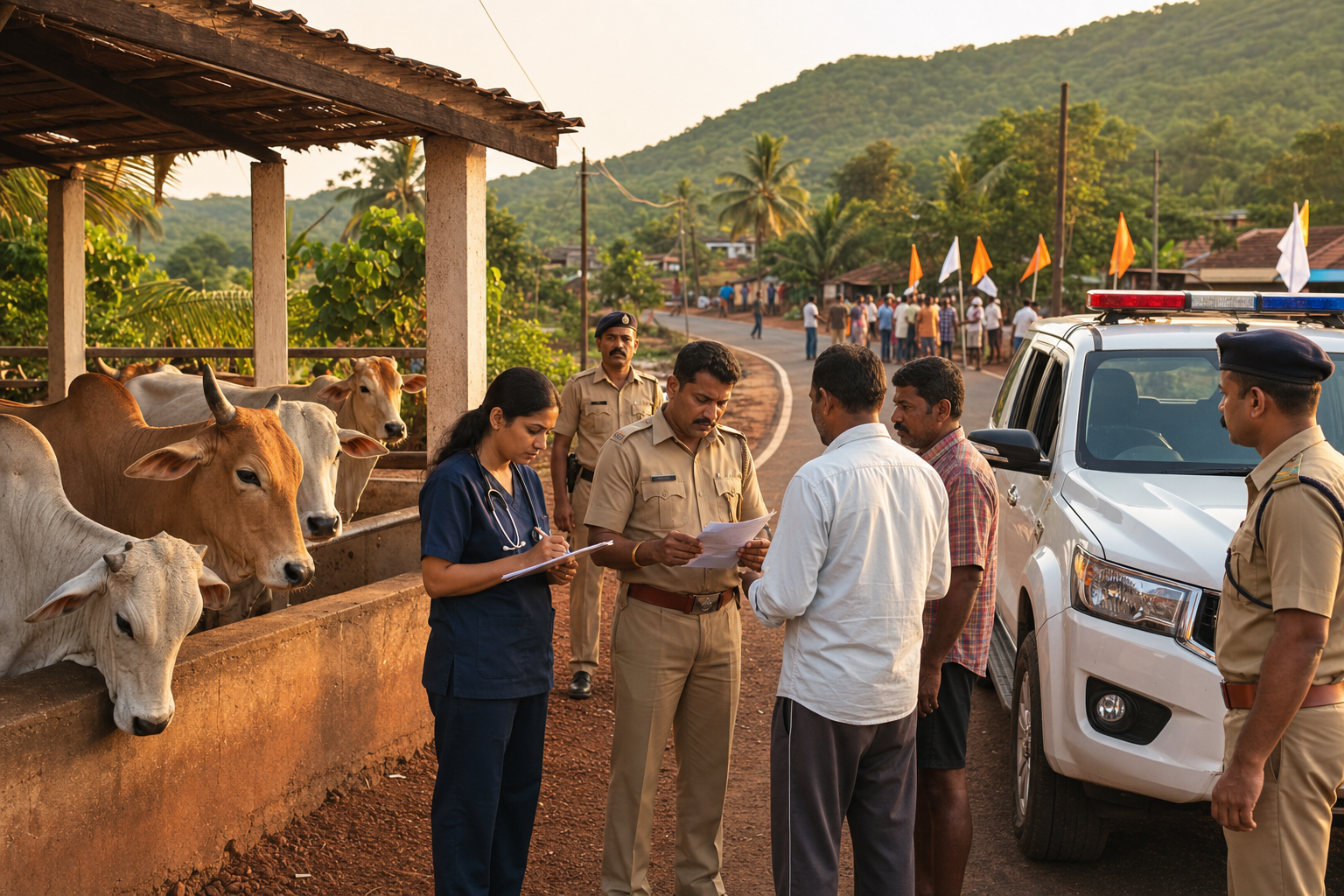
The Ratnagiri development marks more than a routine law-and-order assurance. After a large protest by cow protectors and Hindu organisations over a recent cattle slaughter case, the district Superintendent of Police reportedly assured the protesters that special flying squads would be formed to curb cow slaughter and cattle smuggling. The assurance also included a pledge of strict action against those responsible, placing the matter within the framework of criminal enforcement, public order, and animal protection rather than uncontrolled street confrontation.
In a district such as Ratnagiri, where rural livelihoods, religious sentiment, transport routes, and local policing intersect, illegal cattle slaughter is not merely a question of one isolated offence. It touches the sensitive relationship between community trust and state authority. The protest reflected a familiar concern among sections of Hindu society: that the cow is not viewed only as livestock, but as a living symbol of reverence, service, agriculture, nourishment, and dharmic restraint.
The Superintendent of Police’s promise to create special flying squads is significant because it indicates a move from reactive policing to preventive enforcement. A flying squad, in policing practice, is typically expected to be mobile, alert, intelligence-led, and capable of responding quickly to complaints or suspicious movement. In the context of cattle smuggling, such a unit may be expected to monitor vulnerable routes, respond to local inputs, coordinate with police stations, inspect suspected illegal transport, and ensure that rescued animals are handled through lawful procedures.
The technical challenge in such cases lies in separating lawful animal movement from illegal transport, and lawful trade from criminal smuggling. Enforcement requires documentation checks, veterinary verification, vehicle inspection, inter-district coordination, and careful handling of evidence. If these steps are weak, cases can collapse procedurally. If they are arbitrary, innocent traders and transporters can be harassed. This is why the promise of a special squad must be understood not only as an emotional response to a protest, but as an administrative commitment that will require training, supervision, documentation, and accountability.
Maharashtra has a legal framework that restricts cow slaughter and regulates related offences through animal preservation and cruelty-prevention provisions. The exact application of law depends on facts such as the species involved, the nature of transport, the documents available, the condition of the animals, and whether slaughter, possession, trafficking, or cruelty can be legally established. In this setting, the police assurance in Ratnagiri becomes meaningful only if it leads to legally sustainable action: registration of offences where warranted, arrest of responsible persons where evidence supports it, rescue and protection of animals, and a charge sheet that can withstand judicial scrutiny.
The protest by cow protectors and Hindu organisations also reveals the emotional depth of the issue. For many Hindu families, the cow is associated with Gau Mata, daily worship, agrarian memory, and the ethics of ahimsa. This reverence is not limited to ritual expression; it is embedded in stories of village life, temple culture, household practices, and the idea that human prosperity is tied to the protection of dependent beings. Such sentiment cannot be dismissed as mere agitation, especially when people believe that official inaction allows cruelty or smuggling networks to grow.
At the same time, dharmic public conduct requires discipline. Hinduism, Buddhism, Jainism, and Sikhism all carry deep moral traditions that emphasise compassion, restraint, justice, and social responsibility. The principle of cow protection is most defensible when it remains anchored in lawful action, non-violence, and respect for due process. A community that seeks protection for animals must also insist that enforcement remains constitutional, evidence-based, and free from mob excess. This balance is essential for preserving both dharma and civil peace.
The SP’s assurance therefore carries two expectations at once. The first expectation is firmness: illegal slaughter and cattle smuggling should not be allowed to operate through fear, bribery, political patronage, or administrative neglect. The second expectation is fairness: every complaint must be investigated through lawful procedure, and no private group should take over the role of the police. A special flying squad can succeed only when it strengthens public confidence in the state, not when it becomes a symbolic announcement without operational depth.
From a governance perspective, effective flying squads would need clear jurisdiction, designated officers, defined reporting channels, rapid-response capacity, and coordination with veterinary officials and local administration. They would also need a mechanism for receiving complaints from citizens without encouraging rumours or vigilantism. A credible complaint system should record the time, place, vehicle details, animal condition, and available evidence, while discouraging public road blockades or confrontations that can create law-and-order risks.
The Ratnagiri case also highlights the importance of intelligence gathering. Cattle smuggling, where it exists as an organised activity, rarely depends on a single vehicle or a single offender. It may involve handlers, transporters, storage points, forged documents, night routes, informal payments, and destination networks. A purely visible police presence may deter some activity, but sustained enforcement requires mapping patterns, identifying repeat offenders, following financial and logistical links, and ensuring that earlier cases are not treated as disconnected incidents.
Public protest often emerges when communities feel unheard. In that sense, the protest in Ratnagiri functioned as a pressure point for administrative response. However, the deeper test lies after the crowd disperses. The formation of a special squad must be followed by measurable outcomes: patrol records, seizures where legally justified, animal rescue reports, arrests based on evidence, prosecution updates, and periodic communication with the public. Without transparency, even sincere police action can be perceived as inadequate.
There is also a broader social lesson. Cow protection cannot be reduced to a conflict between communities. It is better understood as a question of law, compassion, rural economy, and civilisational ethics. When framed responsibly, it can bring together animal welfare advocates, dharmic organisations, farmers, gaushalas, veterinary professionals, and police authorities. When framed irresponsibly, it can deepen mistrust and weaken the very moral claim it seeks to defend.
For Hindu society, the emotional injury caused by cattle slaughter cases is real. The cow occupies a sacred place in Hindu culture, and the protection of cattle has long been tied to ideas of dharma, seva, agriculture, and social harmony. Yet dharma also requires order. The ethical response is not private punishment, but organised civic vigilance that supports lawful enforcement. Citizens may report, document, and demand accountability; the state must investigate, prosecute, and prevent recurrence.
The Ratnagiri SP’s pledge is therefore important because it acknowledges both community concern and state responsibility. It signals that illegal cow slaughter and cattle smuggling are not to be treated casually, especially when they trigger deep religious sentiment and public anger. It also reminds the administration that delayed enforcement can create a vacuum in which rumours, resentment, and confrontation grow.
The most constructive outcome would be a model in which the special flying squads act professionally, respond swiftly, and operate within the law. Such a model would protect cattle, reassure Hindu organisations, reduce the scope for illegal networks, and prevent public anger from spilling into disorder. In a society guided by dharmic values, the protection of Gau Mata is strongest when joined with ahimsa, lawful discipline, and equal commitment to public peace.
Inspired by this post on Hindu Jagruti Samiti.









Leave a Reply
You must be logged in to post a comment.