
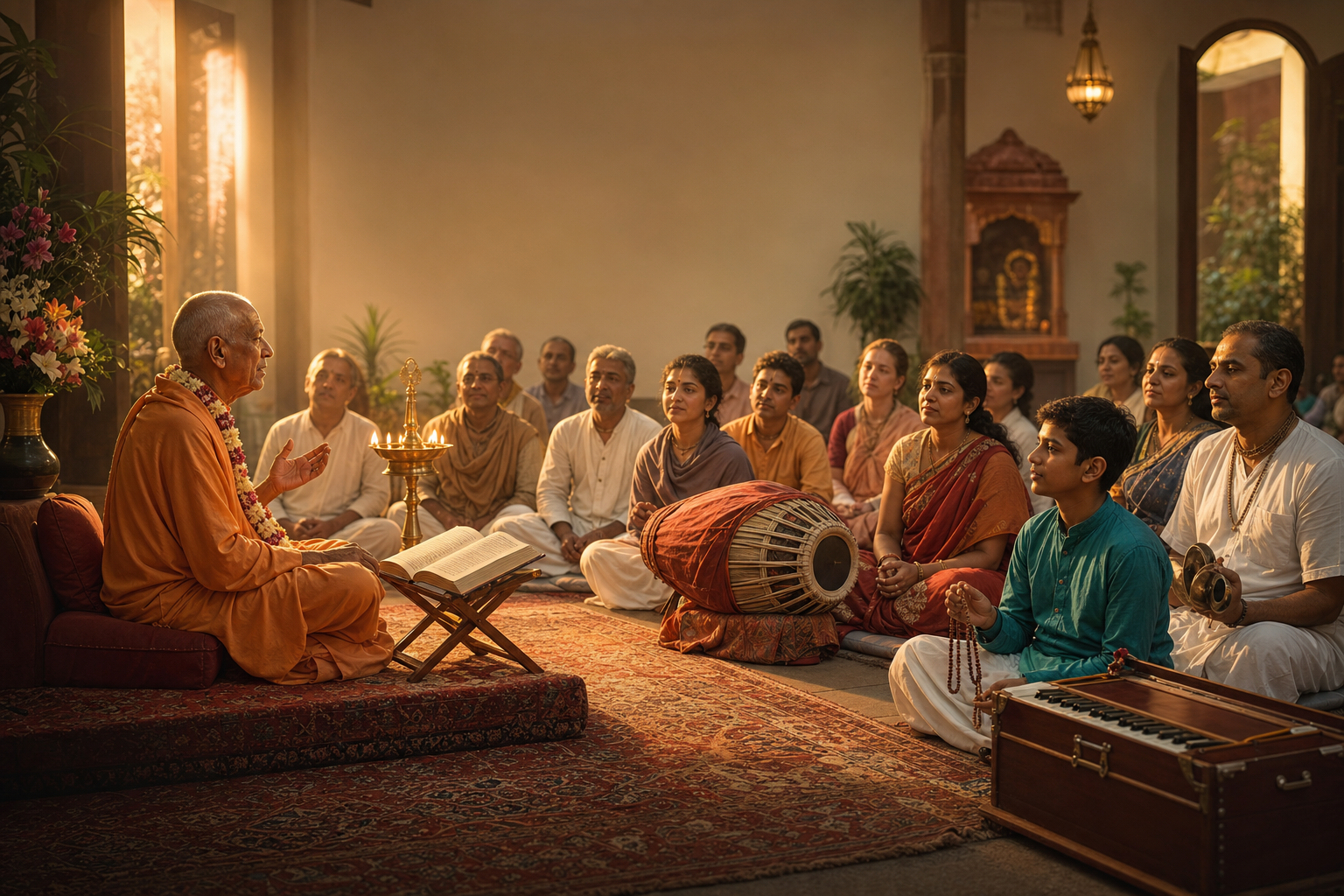
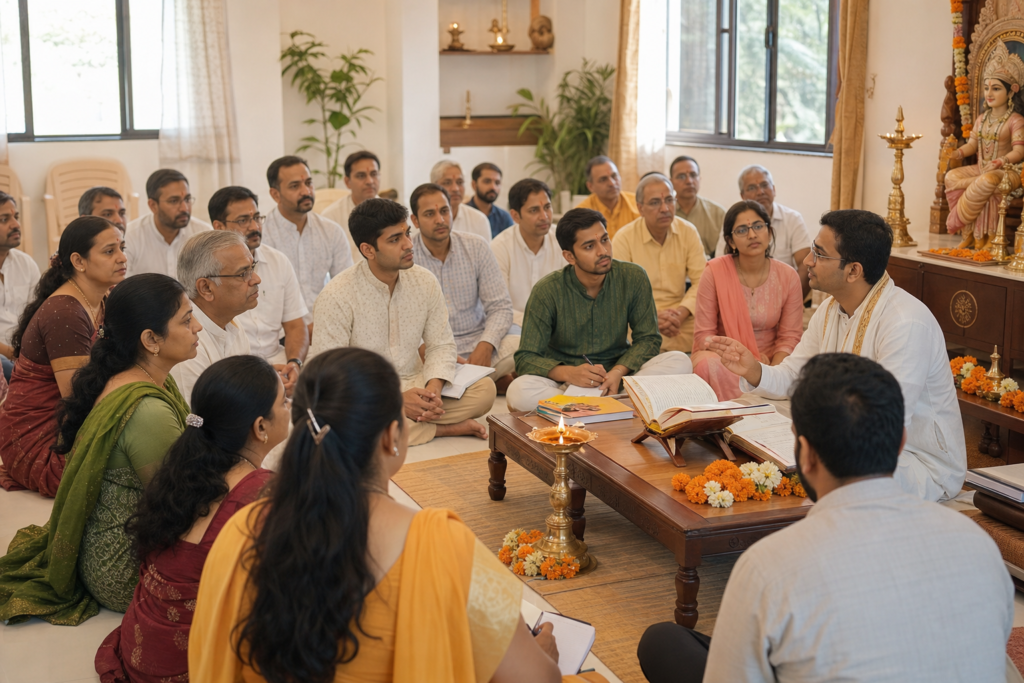
The program titled Evening With HH Candramauli Swami, dated June 25, 2026, points to a familiar and deeply meaningful form of Dharmic community life: the evening satsanga. In the Gaudiya Vaishnava and wider Hindu devotional context, such a gathering is not merely a religious event or a lecture. It is a structured encounter with sacred memory, disciplined listening, chanting, reflection, and communal renewal. The available source material provides the title and visual reference rather than a full transcript, so the subject is best approached through the theological, cultural, and practical framework that normally gives such an evening its significance.
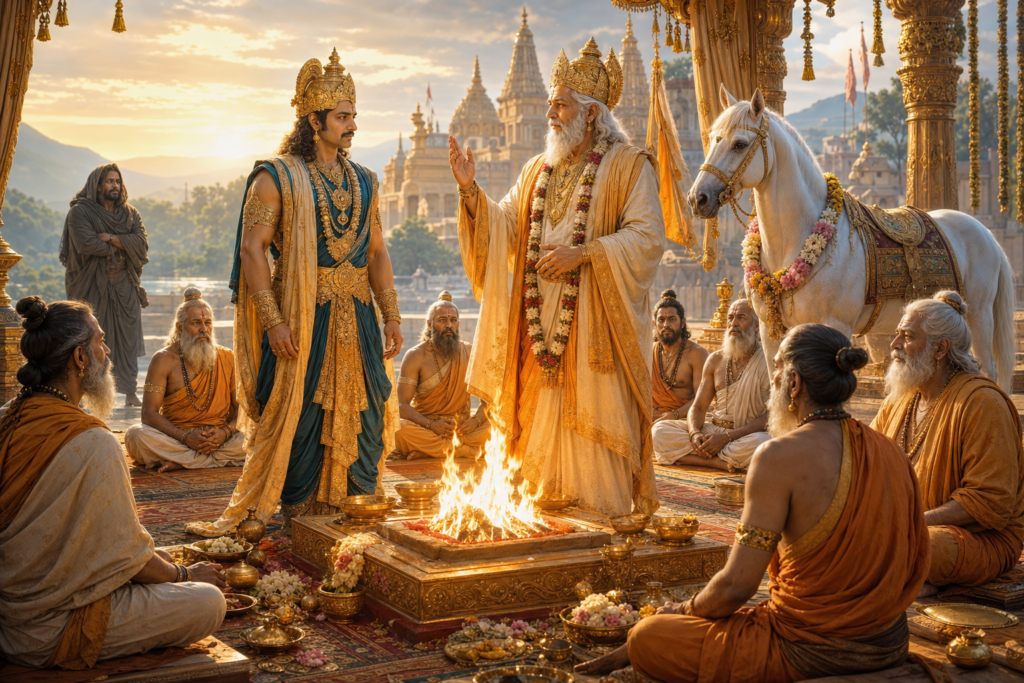
An evening with a senior Vaishnava teacher such as HH Candramauli Swami belongs to the living tradition of guru-shishya transmission. This transmission is not reducible to personality, ceremony, or institutional identity. In its strongest form, it is a disciplined method of learning in which spiritual insight is tested against shastra, lived conduct, humility, and service. The honorific HH, meaning His Holiness, signals reverence for renunciation and spiritual responsibility, but the deeper point is pedagogical: the teacher is respected because the teacher is expected to point beyond ego, toward Krishna consciousness, dharma, and the cultivation of devotion.
The evening setting itself carries importance in Dharmic life. Across Hindu traditions, the transition from day to night has long been treated as a time for recollection, prayer, mantra, and inner adjustment. The mind that has spent the day moving through work, conflict, ambition, social demands, and digital noise often becomes scattered. A devotional evening offers a deliberate counter-rhythm. It gathers attention, softens agitation, and turns ordinary time into reflective time. This is one reason satsanga remains relevant in modern urban life: it gives spiritual form to a very human need for steadiness.
In Gaudiya Vaishnava theology, the heart of such a gathering is bhakti, understood as loving devotional service to Sri Krishna. Bhakti is not treated as sentiment alone. It is a discipline of consciousness shaped through hearing, chanting, remembering, serving, worshiping, praying, and surrendering. The practices are emotional, but they are not vague. They train memory, attention, speech, habit, and moral intention. The repeated emphasis on hearing and chanting reflects a precise understanding of human psychology: what is repeatedly heard becomes what is repeatedly remembered, and what is repeatedly remembered gradually shapes character.
This makes the act of listening central. In many religious and philosophical cultures, speaking receives public attention, but in the bhakti tradition, listening is itself a sacred discipline. Sravana, or attentive hearing, requires humility. It asks the participant to suspend the restless urge to argue, perform, or immediately react. In a serious satsanga, listening becomes a form of inward purification. It allows scriptural themes from the Bhagavad Gita, Srimad Bhagavatham, and the teachings of Srila Prabhupada to enter practical life rather than remain as abstract doctrine.
Kirtana and japa also belong to this structure. The Hare Krishna tradition places special emphasis on the holy name as a practical means of spiritual awakening in the present age. Chanting is therefore not simply musical expression. It is a theology of sound, a practice of remembrance, and a communal discipline. When performed with sincerity, it transforms the voice from an instrument of complaint, distraction, or self-display into an instrument of devotion. This is why many participants experience kirtan not as entertainment but as relief, concentration, and moral reorientation.
The technical structure of bhakti also includes gradual development. Classical Vaishnava teaching often describes spiritual life through stages such as shraddha, sadhu-sanga, bhajana-kriya, anartha-nivritti, nistha, ruci, asakti, bhava, and prema. These terms describe movement from initial faith toward mature love of God. Their value is practical: they prevent spiritual life from being reduced to a sudden mood or an occasional emotional experience. They show that devotion matures through association, practice, purification, steadiness, taste, attachment, spiritual emotion, and ultimately divine love.
An evening with a saintly teacher often becomes meaningful because it places this long spiritual map within ordinary human experience. Many people arrive at such gatherings carrying fatigue, family responsibilities, professional pressure, grief, uncertainty, or quiet spiritual hunger. The academic language of theology can explain bhakti, but the lived experience of satsanga shows why it matters. Devotion becomes credible when it meets the human condition directly. It does not deny difficulty; it teaches how difficulty can be held within remembrance, service, humility, and trust.
The role of the guru in this setting must be understood carefully. Dharmic traditions do not honor the guru as a substitute for moral judgment or scriptural wisdom. The guru is honored as a guide who helps align the student with dharma. In the Vaishnava framework, authentic guidance should increase humility, compassion, discipline, and devotion. It should not encourage arrogance or sectarian contempt. A genuine spiritual evening therefore directs attention away from ego and toward seva, nama-smarana, ethical living, and the recognition of the divine presence in all beings.
This point is especially important for a blog committed to unity among Dharmic traditions. Hinduism, Buddhism, Jainism, and Sikhism differ in theology, metaphysics, ritual, and historical development, yet they share deep civilizational concerns: disciplined conduct, self-mastery, compassion, reverence for teachers, restraint of harmful impulses, and the transformation of consciousness. A Vaishnava satsanga can therefore be presented without diminishing other Dharmic paths. Its particular devotion to Krishna can stand alongside Buddhist mindfulness, Jain ahimsa, Sikh naam-simran and seva, and broader Hindu paths of jnana, karma, yoga, and bhakti.
The most constructive way to understand such an evening is through harmony without flattening difference. Unity does not require every tradition to say the same thing. It requires respect for sincere spiritual striving and recognition that Dharmic civilization has always contained multiple modes of realization. The Vaishnava emphasis on loving service contributes one powerful vocabulary to this shared heritage. It teaches that the heart becomes purified not by domination or pride, but by remembrance, surrender, kindness, and service to Bhagavan and His creation.
From a cultural perspective, gatherings around HH Candramauli Swami also reveal the continuing importance of community in Hindu spiritual life. Modern spirituality is often individualized and consumed privately through short videos, podcasts, and motivational fragments. Satsanga resists that fragmentation. It places people in a shared space where voices chant together, questions are heard, elders are respected, children observe devotional culture, and prasadam turns spiritual fellowship into embodied hospitality. The result is not only private inspiration but cultural continuity.
Prasadam, when present in such gatherings, deserves more than casual mention. In Vaishnava practice, prasadam is food offered to Krishna and then received as grace. This transforms eating from consumption into gratitude. It also teaches equality in a subtle but powerful way. People from different professions, ages, linguistic backgrounds, and social locations may sit together and receive the same sanctified food. In a world increasingly divided by status and identity, this ordinary act carries civilizational depth.
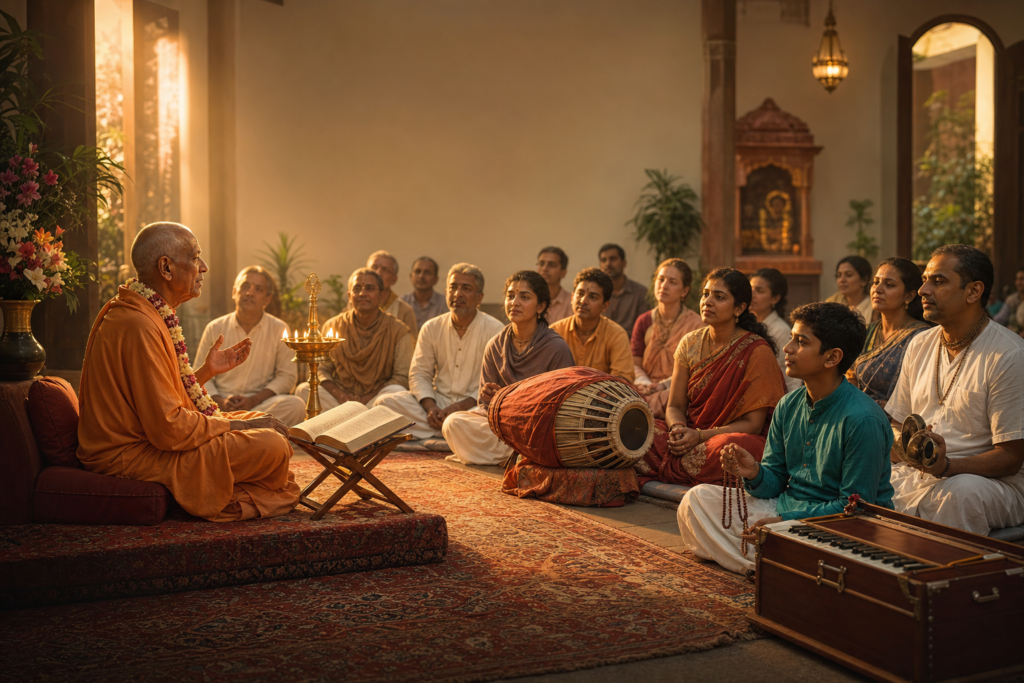
The emotional power of an evening satsanga often lies in its simplicity. A lamp, a harmonium, a mridanga, a scripture, a teacher, and a community of listeners may appear modest when compared with the scale of modern spectacle. Yet the inner effect can be lasting. The point is not sensory excess but purification of attention. The mind is invited to slow down. Speech is invited to become truthful and sacred. The body is invited to sit in discipline. The heart is invited to remember what is permanent beneath the anxieties of daily life.
In the contemporary context, this matters because many people suffer from spiritual dislocation without naming it as such. They may have information, mobility, entertainment, and professional ambition, yet still lack a stable center. Bhakti offers a different anthropology. It suggests that the human being is not satisfied merely by acquisition or self-expression. The self seeks relationship with the divine, meaningful service, and purified love. A devotional evening makes this claim visible through practice rather than argument alone.
The academic value of reflecting on such a program lies in seeing how theology becomes social practice. Concepts like dharma, bhakti, guru, seva, and nama are not isolated terms. They organize time, community, emotion, ethics, and memory. They shape how people gather, how they speak, how they eat, how they ask questions, how they interpret suffering, and how they imagine a meaningful life. A single evening can therefore serve as a small window into the larger architecture of Sanatana Dharma.
There is also a moral dimension. Authentic devotional culture should produce gentleness without weakness, conviction without hostility, and humility without passivity. The teachings associated with Krishna consciousness repeatedly challenge pride, envy, uncontrolled desire, and forgetfulness of the divine. In practical terms, this means spiritual practice must show up in conduct: honest speech, disciplined habits, respect for family and community, compassion toward other beings, and willingness to serve without constant demand for recognition.
For younger generations, an evening with a spiritual teacher can be especially significant. Many young Hindus and members of the broader Indian diaspora inherit festivals, symbols, and family customs, but do not always receive a clear philosophical grammar for them. A satsanga can connect inherited culture with intelligible meaning. It can show that chanting is not superstition, that guru-bhakti is not blind dependency, that temple life is not merely ethnic nostalgia, and that dharma can be lived thoughtfully in modern conditions.
For elders, such gatherings often carry another meaning. They preserve continuity. They allow memories of earlier devotional environments, family rituals, village temples, pilgrimage, and community singing to be renewed in a contemporary setting. This continuity is not a retreat into the past. It is a way of transmitting tested forms of wisdom into the present. When elders and youth share satsanga, tradition becomes less like a museum and more like a living conversation.
The date, June 25, 2026, situates the event in a moment when digital spiritual content is widely available, yet physical or communal gathering remains irreplaceable. Online access can expand reach, but embodied association carries a different force. The presence of a teacher, the shared sound of kirtan, and the discipline of sitting together create an environment that cannot be fully replicated by isolated viewing. This does not diminish digital media; it clarifies its role as a bridge rather than a substitute for lived practice.
The lasting benefit of such an evening is therefore not measured only by what was heard in one lecture. It is measured by what participants carry back into daily life. If remembrance becomes steadier, if speech becomes kinder, if chanting becomes more regular, if service becomes more natural, and if respect for other Dharmic paths becomes deeper, then the gathering has served its purpose. The true success of satsanga is not performance but transformation.
Evening With HH Candramauli Swami can thus be understood as part of a larger devotional ecology: guru, shastra, sadhu-sanga, kirtan, japa, prasadam, seva, and community. Its significance lies in how these elements work together to train the heart. In a restless age, this training is both ancient and urgently contemporary. It invites the mind to become clear, the heart to become soft, and the community to become a place where dharma is not merely discussed but practiced.
Inspired by this post on Dandavats.





Leave a Reply
You must be logged in to post a comment.