
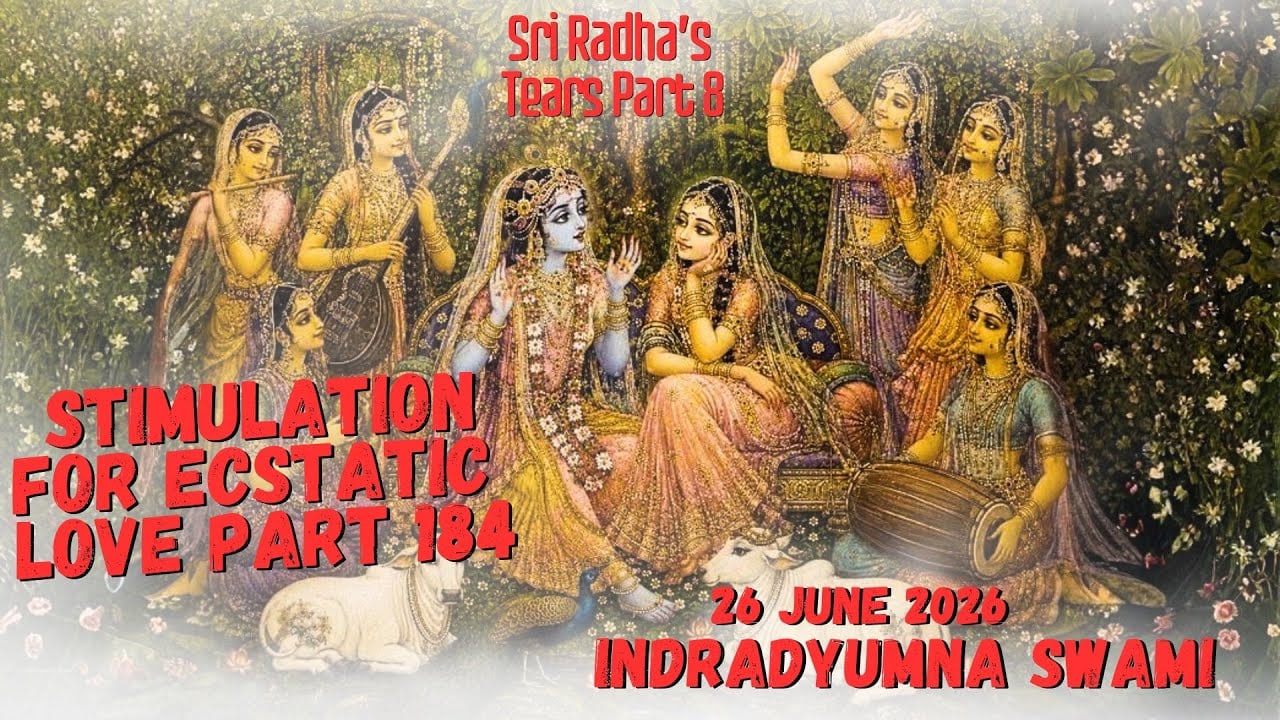
The theme of “Sri Radha’s Tears” belongs to one of the most delicate and sophisticated areas of Hindu devotional theology: the study of bhakti-rasa, the aesthetic and spiritual science of divine love. Within the Gaudiya Vaishnava tradition, Sri Radha is not treated merely as a poetic symbol of longing, nor only as a devotional figure associated with Lord Krishna. She is understood as the highest embodiment of mahābhāva, the fully ripened state of love in which devotion becomes so complete that the inner life, speech, senses, and even bodily expression are transformed by remembrance of the Divine.
The title “Stimulation for Ecstatic Love” points toward a technical category explained in Śrīla Rūpa Gosvāmī’s Bhakti-rasāmṛta-sindhu, later summarized in The Nectar of Devotion. In that framework, devotional emotion is not considered vague sentiment. It has causes, supports, intensifiers, expressions, and stages of maturation. The objects that awaken remembrance of Krishna, such as His flute, smile, footsteps, tulasī, Vṛndāvana, sacred festivals, and the company of devotees, are called stimuli for ecstatic love. These are not ordinary aesthetic triggers; they are devotional catalysts that bring the heart into living relationship with Sri Krishna.
Sri Radha’s tears, therefore, should be approached with care. In ordinary life, tears may arise from grief, exhaustion, fear, tenderness, joy, or relief. In devotional theology, however, the tears of Sri Radha are read through a different category: they are expressions of prema, pure love of God, intensified through separation and union. This distinction is essential because the emotional world of Radha-Krishna is not a projection of material romance. Gaudiya Vaishnava texts consistently distinguish divine love from worldly desire, emphasizing that the love of Vraja is selfless, God-centered, and spiritually complete.
A useful scholarly entry point is The Nectar of Devotion, especially its chapters on “Stimulation for Ecstatic Love” and “Symptoms of Ecstatic Love,” available through Bhaktivedanta VedaBase at vedabase.io/en/library/nod/26/ and vedabase.io/en/library/nod/27/. These chapters describe how Krishna’s qualities, activities, dress, flute, footprints, places of pastime, devotees, and sacred observances awaken devotional remembrance. The same text also discusses bodily expressions of ecstatic love, including crying, singing, dancing, rolling on the ground, heavy breathing, and other signs that indicate an extraordinary condition of the devotional heart.
This theology helps explain why tears occupy such a prominent place in narratives of Sri Radha. Her tears are not weakness; they are evidence of spiritual intensity. They disclose a form of consciousness in which the self is no longer organized around ego, acquisition, or control, but around loving service. In this sense, Radha’s tears become a theological language. They communicate what conceptual speech cannot fully hold: the soul’s total dependence on Krishna, the pain of separation from Him, and the sweetness of remembrance that makes even suffering spiritually luminous.
In Gaudiya Vaishnava thought, Sri Radha is inseparable from Krishna. The Śrī Caitanya-caritāmṛta explains that Radha and Krishna are one reality manifest in two forms for the purpose of tasting the mellows of divine love. It further identifies Sri Radha with the hlādinī-śakti, the pleasure-giving potency of Krishna, and describes her as the embodiment of mahābhāva. This is a technical claim with far-reaching significance: divine love is not treated as an accessory to God, but as intrinsic to the Divine Reality itself.
The relevant section of Śrī Caitanya-caritāmṛta, Ādi-līlā Chapter 4, states that the essence of the hlādinī potency is love of God, that the essence of love is bhāva, and that the ultimate development of bhāva is mahābhāva. Sri Radha is then identified as the embodiment of that highest devotional state. This source is available at vedabase.io/en/library/cc/adi/4/. Such passages give the subject of Radha’s tears a philosophical foundation rather than leaving it as devotional ornamentation.
The phrase “ecstatic love” can be misunderstood if read only through modern psychological categories. In bhakti literature, ecstasy does not mean emotional excess for its own sake. It refers to a devotional condition in which the heart is fully absorbed in Krishna and becomes responsive to His presence, absence, name, form, qualities, and līlā. The body may display symptoms, but the body is not the source of the experience. The source is purified consciousness awakened by devotion.
This is why the tradition gives careful attention to stimuli. Krishna’s flute, for example, is not merely a musical instrument. It functions as a summons. It interrupts ordinary perception and calls the consciousness toward divine intimacy. Krishna’s footprints in Vṛndāvana are not only marks in dust; they become sacred signs that awaken remembrance. Tulasī is not just a plant; she becomes a living participant in devotional worship. Ekādaśī and Janmāṣṭamī are not simply calendar observances; they create ritual time in which memory, discipline, and affection converge.
Sri Radha’s tears should be read within this same symbolic and theological world. They arise when the beloved is remembered with such force that separation becomes unbearable, yet that very separation deepens love. In Sanskrit devotional aesthetics, separation is not a failure of love. It can become a powerful intensifier of love. The absence of Krishna becomes a mode of presence because every sound, fragrance, memory, and place becomes charged with His significance. This paradox is central to the emotional architecture of Vraja bhakti.
The experience is relatable even for those approaching the subject academically. Human beings know that memory can make absence present. A song, a scent, a path, a season, or a familiar object can suddenly revive a relationship with remarkable force. Bhakti literature takes this ordinary structure of memory and elevates it into a sacred discipline. The devotee learns to let the world become a field of remembrance, not a distraction from the Divine. In Sri Radha, this capacity reaches its highest perfection.
For this reason, the tears of Sri Radha are also pedagogical. They teach that devotion is not emotional suppression. It is not cold abstraction, and it is not merely ritual correctness. It is the refinement of the whole person: intellect, memory, body, speech, longing, humility, and love. A mature devotional culture does not ask the heart to become numb. It trains the heart to become truthful, disciplined, compassionate, and oriented toward the Divine.
This point has broad relevance for dharmic traditions. Hinduism, Buddhism, Jainism, and Sikhism each preserve distinct metaphysical commitments and practices, yet all recognize that the untrained heart is restless and that spiritual discipline must transform perception, conduct, and attachment. Bhakti’s language of tears may differ from Buddhist mindfulness, Jain aparigraha, or Sikh remembrance through nām, but the shared civilizational insight is clear: spiritual life is not complete until the inner being is reshaped. The goal is not sectarian rivalry but deeper reverence for the many dharmic paths that refine human consciousness.
In the Vaishnava context, this refinement is centered on loving service to Krishna. The devotee does not seek tears as a performance. Authentic tears are not manufactured for public display, nor are they proof of superiority. The texts repeatedly warn, directly or indirectly, that external symptoms must be understood in relation to inner purity. A person may imitate emotion, but imitation does not produce prema. Genuine devotional emotion is marked by humility, steadiness, service, and freedom from self-centered motive.
Sri Radha’s tears are therefore the opposite of theatrical religiosity. They are the natural expression of a heart entirely possessed by Krishna-prema. Her longing does not diminish her dignity. It reveals her supreme spiritual stature. In worldly terms, dependence may be seen as weakness; in bhakti, loving dependence on Krishna is the soul’s highest freedom. Radha’s tears disclose a love so pure that the usual boundaries between joy and sorrow no longer function in ordinary ways.
The tradition also emphasizes that Krishna Himself is conquered by such love. The power of Sri Radha is not political, coercive, or institutional. It is the power of complete devotion. In Śrī Caitanya-caritāmṛta, Krishna desires to understand the sweetness of Radha’s love and the bliss she experiences in loving Him. This theological reversal is striking: the Supreme Lord becomes eager to taste the love of His greatest devotee. The devotee’s love is thus not passive; it becomes the very center of divine self-disclosure.
This is one reason Sri Chaitanya Mahaprabhu is so central to Gaudiya Vaishnava theology. He is understood as Krishna appearing with the mood and complexion of Sri Radha, distributing the path of nāma-saṅkīrtana and prema-bhakti. The chanting of the holy names is not presented merely as a ritual sound pattern. It is a practice meant to awaken the dormant relationship between the soul and Krishna. When approached with sincerity, humility, and discipline, the name becomes a stimulus for remembrance and transformation.
The emotional depth of Radha’s tears should not obscure the intellectual sophistication of the tradition. Bhakti-rasa theory classifies devotional experience with technical precision. It distinguishes stable emotion, stimulating causes, consequent expressions, transitory emotions, and involuntary ecstatic symptoms. This is a refined spiritual psychology, developed not to reduce devotion to mechanism but to protect its meaning. The tradition recognizes that sacred emotion has structure, grammar, and theological purpose.
The word rasa itself is important. It can mean taste, essence, relish, or aesthetic flavor. In devotional theology, rasa refers to the spiritually relishable relationship between Krishna and His devotees. Different relationships carry different devotional moods: reverence, service, friendship, parental affection, and intimate love. The love of Sri Radha is considered the summit of madhura-rasa, not because it resembles worldly passion, but because it reveals the fullest self-giving, intimacy, and absorption in Krishna.
A mature reading must therefore avoid two errors. The first error is sentimentalism, which treats Radha’s tears as merely emotional and neglects their theological discipline. The second error is reductionism, which treats them as mythology or psychology without entering the devotional categories that make them intelligible. Academic fairness requires studying a tradition through its own vocabulary before translating it into external categories. Terms such as bhāva, prema, mahābhāva, hlādinī-śakti, rasa, and līlā carry meanings that cannot be replaced by generic words like feeling or romance.
For practitioners, this subject also offers a practical meditation. The heart is constantly stimulated by something: ambition, fear, comparison, entertainment, resentment, memory, or longing. Bhakti asks a disciplined question: what should be allowed to stimulate consciousness? If Krishna’s name, devotees, sacred places, scriptures, festivals, and forms of worship become the chosen stimuli, then attention gradually moves from fragmentation toward devotion. Sri Radha represents the perfected state of that attention, where every stimulus becomes Krishna-centered.
This insight has particular relevance in the digital age. Modern attention is often scattered by speed, novelty, and emotional manipulation. The bhakti tradition proposes a different ecology of perception. It invites repeated remembrance, sacred sound, disciplined observance, association with devotees, and contemplative engagement with scripture. Such practices do not erase emotion; they purify and redirect it. In this context, Sri Radha’s tears become a profound challenge to superficial spirituality. They ask whether the heart has learned to love beyond convenience.
The role of Vṛndāvana is also central. In bhakti literature, Vṛndāvana is not merely geography. It is sacred space saturated with memory of Krishna’s pastimes. The forest, Yamunā, cows, flute, dust, footprints, and companions of Krishna all participate in an environment of divine remembrance. For Sri Radha and the gopīs, the landscape itself becomes alive with Krishna. This sacred geography demonstrates how place can shape consciousness. Pilgrimage, temple worship, and festival culture continue this principle by turning physical movement into spiritual recollection.
The tears of Sri Radha also illuminate the relationship between separation and service. In ordinary experience, separation can become self-absorption. In Radha’s love, separation intensifies service. Her longing is not possessive in a worldly sense; it is oriented toward Krishna’s happiness. This is why her love is treated as the highest form of devotion. It does not seek to consume the beloved. It seeks to serve, please, remember, and glorify the beloved without selfish calculation.
Such a vision can soften modern assumptions about strength. Contemporary culture often prizes self-protection, emotional control, and independence. Bhakti does not reject maturity or discipline, but it proposes that the highest strength is the courage to love the Divine completely. Sri Radha’s tears are therefore not a collapse of selfhood. They are the flowering of a self wholly purified by devotion. The individual is not erased; the individual becomes transparent to love.
This subject also calls for humility among readers and practitioners. The states described in Radha-Krishna theology are not casual emotional experiences. They belong to the highest realms of devotional realization. Traditional teachers often advise that such topics be approached through hearing, reverence, ethical living, chanting, service, and guidance, rather than through curiosity alone. The goal is not to imitate Sri Radha’s tears, but to honor what they reveal about pure devotion.
At the same time, the theme is not remote from everyday spiritual life. Every sincere act of remembrance, every offering made without pride, every moment of chanting, every attempt to serve without recognition, and every honest prayer participates in the same broad movement toward purified love. The summit may be beyond ordinary experience, but the path begins with simple practices. Bhakti is generous in this way: it gives profound metaphysics and accessible discipline within the same tradition.
The unity of dharmic traditions is strengthened when such subjects are presented with respect and precision. Sri Radha’s tears belong specifically to Vaishnava theology, yet their deeper lesson resonates widely: the human heart must be educated by truth, disciplined by practice, softened by compassion, and lifted beyond ego. Hindu bhakti, Buddhist mindfulness, Jain self-restraint, and Sikh nām-simran each offer distinct but serious paths for transforming the inner life. A culture that honors these paths can cultivate unity without flattening difference.
In conclusion, “Sri Radha’s Tears” is not a minor devotional image. It is a doorway into the profound science of bhakti-rasa. It reveals how remembrance becomes emotion, how emotion becomes devotion, how devotion becomes service, and how service culminates in love without selfishness. Through the lens of Sri Radha, tears are no longer merely signs of sorrow. They become sacred evidence of the soul’s highest possibility: complete absorption in Sri Krishna through pure, selfless, ecstatic love.
Inspired by this post on Dandavats.


Leave a Reply
You must be logged in to post a comment.